

Crack Discrete Math, Earn College Credits, and Step into SNHU
- Aug 6, 2025
- 4 min read
Updated: 4 days ago
Discrete Mathematics is one of the most important foundational subjects for students pursuing degrees in computer science, information technology, and mathematics.
The course introduces essential concepts such as logic, sets, algorithms, graph theory, and mathematical reasoning. These ideas form the backbone of many modern technologies, including software development, cybersecurity, and data science.
For many students planning to enroll at Southern New Hampshire University (SNHU), completing Discrete Mathematics early can help accelerate progress toward a degree.
By earning transferable credits through structured learning pathways, students can reduce their academic workload later and move more efficiently toward graduation.
Planning ahead is key. Educational guidance platforms such as TransferCredit help students understand how certain coursework may align with university requirements and how they can build a smarter credit strategy before starting their degree program.
When approached strategically, completing Discrete Mathematics early not only strengthens academic preparation but also creates a smoother pathway into flexible university programs like those offered by SNHU.
What Is Discrete Math?
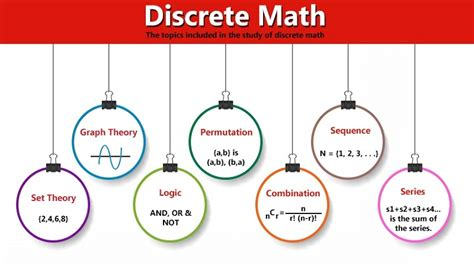
Discrete Mathematics is the branch of math that deals with distinct, separate values — not continuous ones like those found in calculus. It’s the mathematics of structure, logic, and clear decision-making.
Core topics include:
Formal logic and proofs
Set theory and functions
Mathematical induction and recursion
Combinatorics and probability
Boolean algebra and digital circuits
Graph theory and tree structures
It’s foundational for fields like computer science, software engineering, AI, data science, and network design.
Discrete Math Symbols: A Quick Breakdown

If you're searching for "discrete math symbols," you're not alone. The subject uses a compact symbolic language to express logical operations, relationships, and functions. Here are a few examples:
Symbol | Meaning |
∧ | AND |
∨ | OR |
¬ | NOT |
⇒ | Implies |
⇔ | If and only if |
∀ | For all |
∃ | There exists |
∈ | Element of |
⊆ | Subset of |
∅ | Empty set |
A | |
P(A) | Power set of A |
Once you get familiar with these, you'll be able to decode mathematical statements quickly and confidently.
Is Discrete Math Harder Than Calculus?
This is a popular question — and the answer depends entirely on how your mind works.
Calculus focuses on change, motion, and continuous functions.
It’s built around solving equations involving derivatives and integrals.
Discrete Math, on the other hand, focuses on logic, structure, and individual values. It’s more about reasoning, proofs, and abstract problem-solving.
Who finds discrete math harder?
Students who are used to plugging numbers into formulas may find proofs and logic-based thinking unfamiliar at first.
However, if you enjoy puzzles, problem-solving, and algorithmic thinking, you may find Discrete Math far more intuitive than calculus.
The Cheat Sheet: Discrete Math in One View

If you're looking for a "discrete math cheat sheet," here's a simplified version covering the essentials:
Logic and Proofs
Truth tables
Conditional statements
Direct, indirect, and contrapositive proofs
Sets and Functions
Set notation and operations
Cartesian products
Types of functions: injective, surjective, bijective
Recursion and Induction
Recursive definitions
Proving formulas using induction
Counting and Probability
Factorials, permutations, combinations
Basic probability principles
Graph Theory
Vertices, edges, degrees
Paths, cycles, trees, connectedness
Boolean Algebra
Logic gates
Truth tables for digital circuits
Simplifying Boolean expressions
Why SNHU Accepts Transfer Credit Powered by UPI Study
SNHU accepts the course completed through transfer credit powered by UPI Study, thanks to its recognition by:
ACE (American Council on Education)
NCCRS (National College Credit Recommendation Service)
These national accreditations ensure that the course meets rigorous college-level standards. Students who complete it can transfer the credit to over 2,800 universities, including SNHU.
What the Course Covers
The Math 230 course delivered through transfer credit powered by UPI Study includes:
Symbolic logic and truth tables
Predicate logic and quantifiers
Functions, sets, and relations
Mathematical induction and recursion
Permutations, combinations, and basic probability
Introduction to graphs, trees, and networks
Boolean algebra and circuit design
You’ll complete lessons at your own pace, take quizzes, and finish with a proctored final exam.
How to Transfer Credit to SNHU
Here's how simple the process is:
Complete the course through transfer credit powered by UPI Study
Request an ACE or NCCRS transcript
Send it to SNHU's Transfer Evaluation team
Receive confirmation of accepted credit
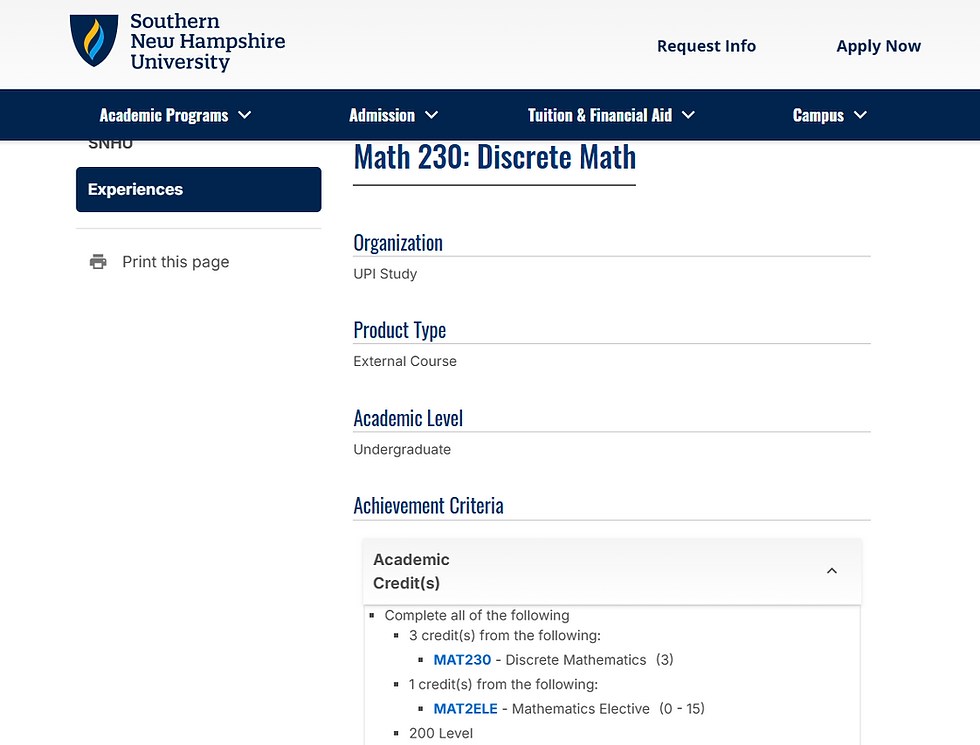
Once approved, the course will likely fulfill the MAT 230 requirement in your SNHU general education or technical degree program.
Visual Learning Strategies
Visual learners thrive in Discrete Math when they use the right tools. Here are some methods that help:
Use truth tables and logic circuits to reinforce symbolic thinking
Visualize graph theory with node diagrams
Practice set theory with Venn diagrams
Break complex proofs into visual flowcharts
These techniques can turn abstract concepts into concrete understanding.
Final Takeaway
Discrete Math is more than a requirement — it’s a critical skill set that develops your ability to think clearly, reason logically, and build systems that work.
And right now, transfer credit powered by UPI Study offers one of the online Discrete Math options that transfers to SNHU.
That means this course is not just academically strong — it’s a practical, cost-effective decision that keeps you moving forward.
Related Blogs :
FAQ
1. What is Discrete Mathematics and why is it important for college programs?
Discrete Mathematics focuses on logical reasoning, algorithms, sets, and graph theory. It is a foundational subject for degrees in computer science, information technology, and data science because it builds problem-solving and analytical thinking skills.
2. Is Discrete Mathematics required for SNHU degree programs?
Many technology and computer science programs require Discrete Mathematics because it supports advanced topics like algorithms, programming logic, and systems design.
3. Can students earn college credits for Discrete Mathematics before enrolling in a university?
Some students complete approved coursework that may later be evaluated for transfer credit by universities. Credit acceptance depends on institutional policies and course equivalency.
4. How can completing Discrete Mathematics early help students academically?
Finishing the course early can make later technical subjects easier to understand and may help students avoid scheduling conflicts with other required classes.
5. How can students check if their Discrete Mathematics credits may transfer?
Students should review university transfer policies or use academic planning resources such as TransferCredit to explore possible credit pathways before enrolling in coursework.


Comments