
4 Printable PDFsOne-time $19
TransferCredit.org Study Guides for the ACT® Test
Four printable study guides for the ACT® test, one for each section: English, math, reading and science. Each guide follows the content areas that ACT publishes for that section, heaviest areas first.
- 509 key terms, each with an example
- 159 practice questions with every answer explained
- A 2-page cram sheet for each section
- 2-, 4- and 8-week study plans in every guide
All 4 study guides: $19All 4 study guides · One-time · 125 pages in 4 PDFs · instant download
Last updated 2026 · test facts checked against the exam information ACT Education Corp. published in 2026

- 4printable PDFs, one per section
- 125pages in all
- 509key terms with examples
- 159practice questions, answers explained
Look inside the guides
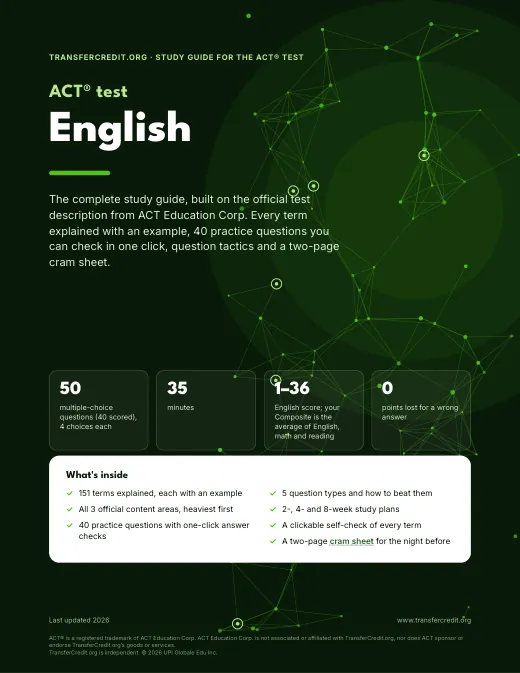
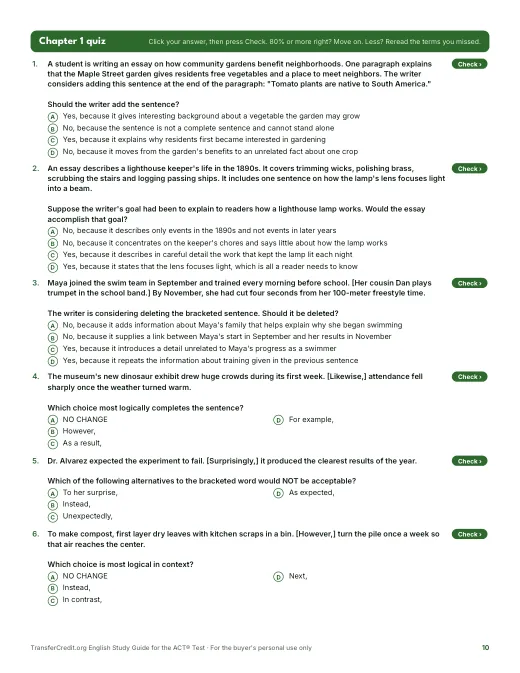
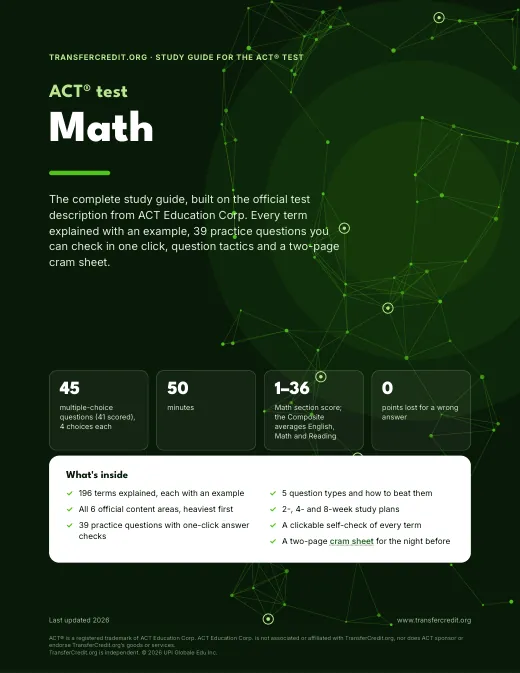
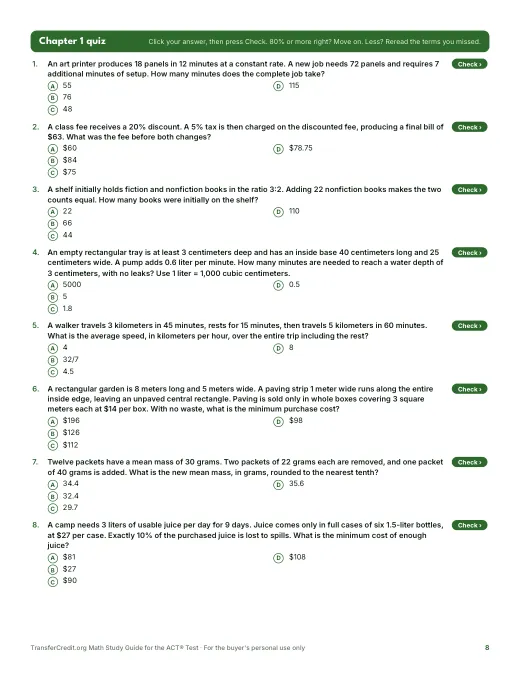
Real pages from the four PDFs: a cover and a chapter page from each.
What’s in each guide
One chapter for each content area, with the share of questions it gets on test day.
- English, math, reading and science: one guide per section
- Instant download: printable PDFs you can keep
- 159 practice questions, every answer explained
-
English Study Guide for the ACT® Test
31-page PDF · 151 terms · 40 practice questionsPunctuation, grammar, word choice and how a passage is organized.
On test day: 50 questions (40 scored) in 35 minutes.
- Production of Writing38–43%
- Conventions of Standard English38–43%
- Knowledge of Language18–23%
-
Math Study Guide for the ACT® Test
33-page PDF · 196 terms · 39 practice questionsAlgebra, functions, geometry, statistics and number skills, plus mixed multi-step problems.
On test day: 45 questions (41 scored) in 50 minutes; a permitted calculator is optional.
- Integrating Essential Skills20%
- Algebra17–20%
- Functions17–20%
- Geometry17–20%
- Statistics & Probability12–15%
- Number and Quantity10–12%
-
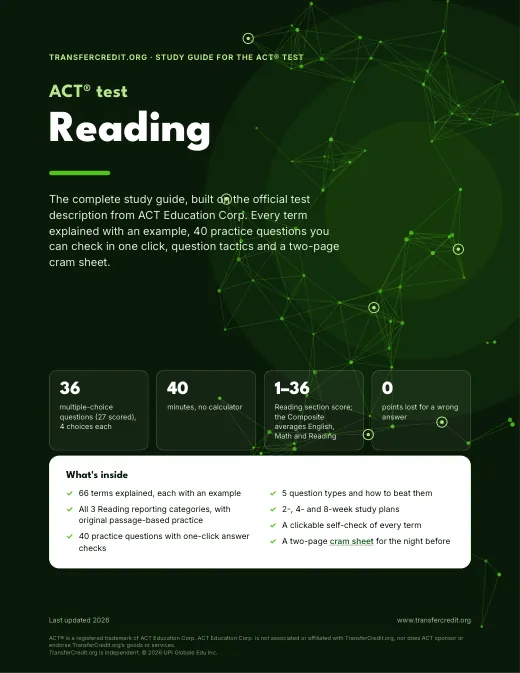
Reading Study Guide for the ACT® Test
32-page PDF · 66 terms · 40 practice questionsMain ideas, an author’s choices, and comparing passages and visual information.
On test day: 36 questions (27 scored) in 40 minutes.
- Key Ideas & Details44–52%
- Craft & Structure26–33%
- Integration of Knowledge & Ideas19–26%
-
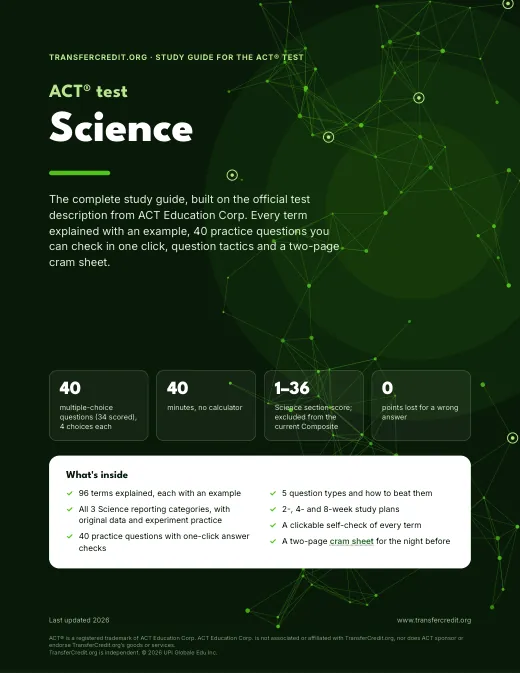
Science Study Guide for the ACT® Test
29-page PDF · 96 terms · 40 practice questionsReading graphs and tables, judging experiments and weighing competing explanations.
On test day: 40 questions (34 scored) in 40 minutes; optional, and not part of the Composite score.
- Interpretation of Data38–50%
- Evaluation of Scientific Arguments and Models with Evidence24–38%
- Scientific Investigation18–32%
Try one free question from each guide
Original practice questions written for the guides. Pick an answer, then open the explanation.
English · Production of Writing
A student is writing an essay on how community gardens benefit neighborhoods. One paragraph explains that the Maple Street garden gives residents free vegetables and a place to meet neighbors. The writer considers adding this sentence at the end of the paragraph: "Tomato plants are native to South America." Should the writer add the sentence?
- ANo, because the sentence is not a complete sentence and cannot stand alone
- BYes, because it gives interesting background about a vegetable the garden may grow
- CNo, because it moves from the garden's benefits to an unrelated fact about one crop
- DYes, because it explains why residents first became interested in gardening
Show the answer
C. The essay's focus is what the garden does for the neighborhood. The sentence about tomatoes' origin is true but does not support that focus, so it should not be added.
Math · Mixed Skills
An art printer produces 18 panels in 12 minutes at a constant rate. A new job needs 72 panels and requires 7 additional minutes of setup. How many minutes does the complete job take?
- A115
- B76
- C48
- D55
Show the answer
D. The printing quantity is 72/18 = 4 times as large, so printing takes 4·12 = 48 minutes. Adding setup gives 55 minutes.
Reading · Key Ideas & Details
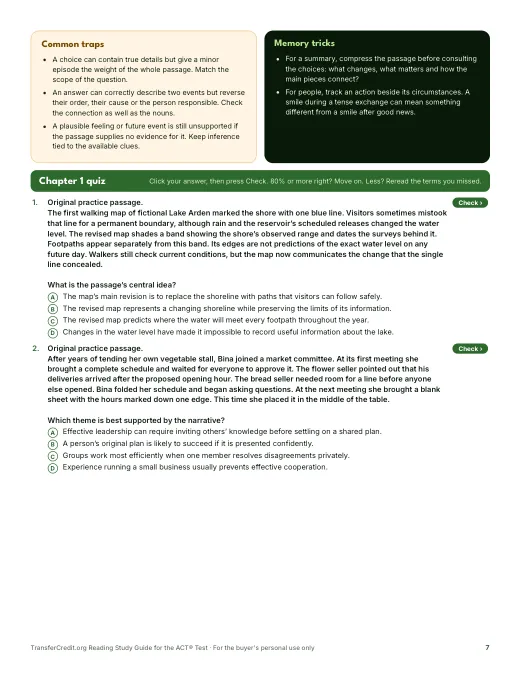
Original practice passage. The first walking map of fictional Lake Arden marked the shore with one blue line. Visitors sometimes mistook that line for a permanent boundary, although rain and the reservoir’s scheduled releases changed the water level. The revised map shades a band showing the shore’s observed range and dates the surveys behind it. Footpaths appear separately from this band. Its edges are not predictions of the exact water level on any future day. Walkers still check current conditions, but the map now communicates the change that the single line concealed. What is the passage’s central idea?
- AThe map’s main revision is to replace the shoreline with paths that visitors can follow safely.
- BThe revised map represents a changing shoreline while preserving the limits of its information.
- CThe revised map predicts where the water will meet every footpath throughout the year.
- DChanges in the water level have made it impossible to record useful information about the lake.
Show the answer
B. A shaded, dated range replaces the misleading single boundary. The account stresses that this range is useful without predicting future levels or replacing checks of current conditions.
Science · Interpretation of Data
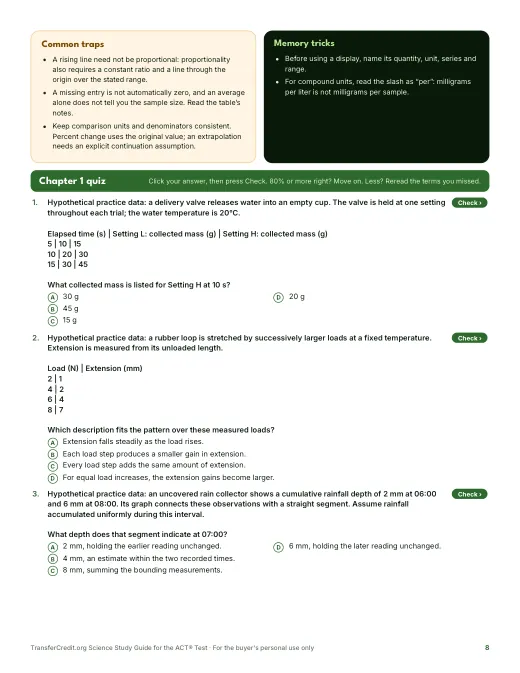
Hypothetical practice data: a delivery valve releases water into an empty cup. The valve is held at one setting throughout each trial; the water temperature is 20°C. Elapsed time (s) | Setting L: collected mass (g) | Setting H: collected mass (g) 5 | 10 | 15 10 | 20 | 30 15 | 30 | 45 What collected mass is listed for Setting H at 10 s?
- A45 g
- B20 g
- C30 g
- D15 g
Show the answer
C. The 10 s row and Setting H column meet at 30 g. The 20 g entry is for Setting L at that time.
Questions students ask
What do I get for $19?
How do I get the guides after I pay?
I have the TransferCredit.org Guides to AP® Exams membership. Is this included?
Can I print the guides?
Do I need the science guide?
How were the guides made?
Are these guides official?
Where the test facts come from
- The english section, described on act.org
- The math section, described on act.org
- The reading section, described on act.org
- The science section, described on act.org
- The free preparation booklet on act.org (PDF)
Looking for AP® guides? See all AP® study guides.
ACT® is a registered trademark of ACT Education Corp. ACT Education Corp. is not associated or affiliated with TransferCredit.org, nor does ACT sponsor or endorse TransferCredit.org’s goods or services.
TransferCredit.org is independent. AP® is a trademark registered by the College Board, which is not affiliated with, and does not endorse, TransferCredit.org. © 2026 UPI Globale Edu Inc.