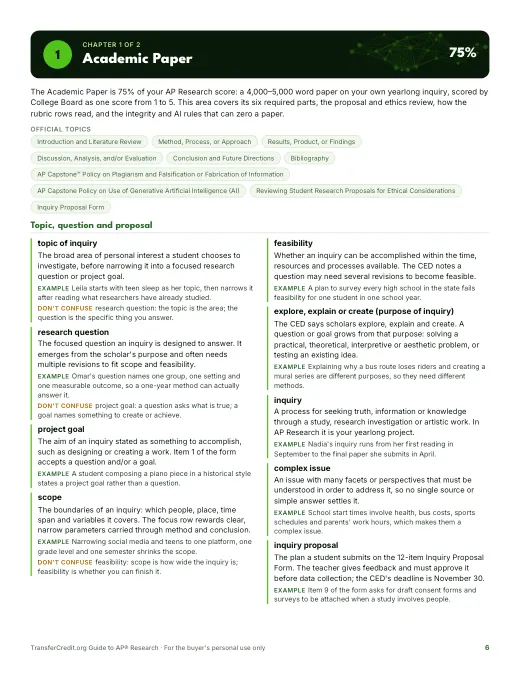
The Academic Paper is 75% of your AP® Research score: a 4,000–5,000 word paper on your own yearlong inquiry, scored by College Board as one score from 1 to 5. This area covers its six required parts, the proposal and ethics review, how the rubric rows read, and the integrity and AI rules that can zero a paper.
- topic of inquiry
- The broad area of personal interest a student chooses to investigate, before narrowing it into a focused research question or project goal.
- Example: Leila starts with teen sleep as her topic, then narrows it after reading what researchers have already studied.
- literature
- The foundational and current texts of a field or discipline: the body of scholarly work your inquiry builds on and responds to.
- Example: For a study of urban tree cover, the literature includes ecology journals, city planning studies and earlier heat-island research.
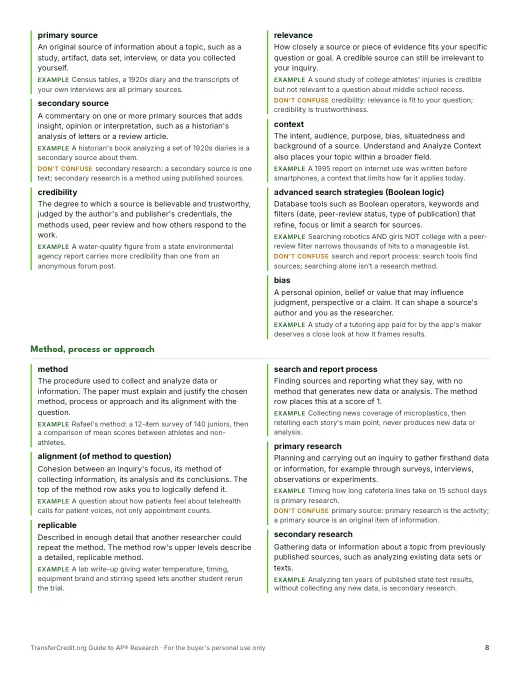
- method
- The procedure used to collect and analyze data or information. The paper must explain and justify the chosen method, process or approach and its alignment with the question.
- Example: Rafael's method: a 12-item survey of 140 juniors, then a comparison of mean scores between athletes and non-athletes.
- ethical research practices
- Scholars' ethical and moral responsibilities in research. The teacher reviews every proposal for ethical considerations before data collection, and several revisions may be needed before approval.
- Example: A student revises her consent form twice after teacher feedback before contacting a single participant.
- results (findings)
- The findings, evidence, results, or performance, exhibit or product generated by the research method, presented in the paper's third required element.
- Example: Reporting that 64 of 110 riders used the new bike lane at least weekly states a result.
- commentary
- Discussion and analysis of evidence in relation to the claim, which may identify patterns, describe trends or explain relationships. It shows why the evidence matters.
- Example: After a table of sleep hours, a paragraph explains why the gap between athletes and non-athletes matters for the question.
- new understanding
- A conclusion your inquiry produces that goes beyond reporting what is already known. The level titles for scores of 3, 4 and 5 all center on one.
- Example: Finding that a town's recycling drop followed a bin redesign, not apathy, would be a new understanding.
- bibliography
- A complete list of sources cited and consulted, in the appropriate disciplinary style. It is a required element but doesn't count toward the word count.
- Example: A psychology paper ends with an alphabetical APA reference list of every study it cited or consulted.
- Report on Existing Knowledge (scores of 1 and 2)
- The level titles for the two lowest scores: Report on Existing Knowledge (1) and Report on Existing Knowledge with Simplistic Use of a Research Method (2).
- Example: A paper that restates published findings on electric cars and adds nothing of its own sits in this band.
- plagiarism
- Failing to acknowledge, attribute and/or cite ideas or evidence from another source. Leaving a source unacknowledged, in the body or bibliography, scores 0 on that component.
- Example: Using a classmate's survey design without crediting it is plagiarism, even if every question is reworded.
- research question
- The focused question an inquiry is designed to answer. It emerges from the scholar's purpose and often needs multiple revisions to fit scope and feasibility.
- Example: Omar's question names one group, one setting and one measurable outcome, so a one-year method can actually answer it.
- literature review
- Part of the first required element: it reviews previous work and synthesizes varying scholarly perspectives to place the question or goal within a gap in current knowledge.
- Example: Rather than one paragraph per article, Tomas groups studies by how they measured loneliness and where they disagree.