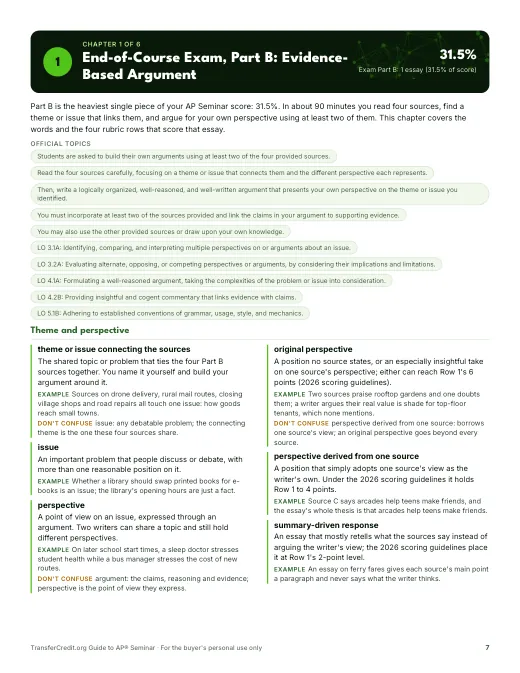
Part B is the heaviest single piece of your AP® Seminar score: 31.5%. In about 90 minutes you read four sources, find a theme or issue that links them, and argue for your own perspective using at least two of them. This chapter covers the words and the four rubric rows that score that essay.
- theme or issue connecting the sources
- The shared topic or problem that ties the four Part B sources together. You name it yourself and build your argument around it.
- Example: Sources on drone delivery, rural mail routes, closing village shops and road repairs all touch one issue: how goods reach small towns.
- argument
- A claim or thesis that conveys a perspective through a line of reasoning and is backed by evidence.
- Example: A writer claims city trees cut summer power bills, then gives reasons and data that each move toward that conclusion.
- evidence
- Information such as data, quotations or excerpts from texts that is used as proof to support a claim or thesis.
- Example: A log showing a clinic's wait fell from 50 to 20 minutes supports the claim that online check-in helps patients.
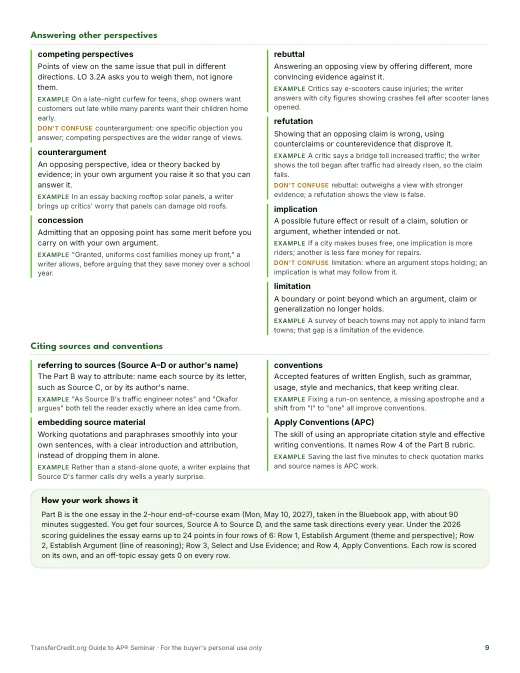
- competing perspectives
- Points of view on the same issue that pull in different directions. LO 3.2A asks you to weigh them, not ignore them.
- Example: On a late-night curfew for teens, shop owners want customers out late while many parents want their children home early.
- referring to sources (Source A–D or author's name)
- The Part B way to attribute: name each source by its letter, such as Source C, or by its author's name.
- Example: "As Source B's traffic engineer notes" and "Okafor argues" both tell the reader exactly where an idea came from.
- issue
- An important problem that people discuss or debate, with more than one reasonable position on it.
- Example: Whether a library should swap printed books for e-books is an issue; the library's opening hours are just a fact.
- thesis
- A claim or position on an issue that the writer puts forward and supports with evidence: the main claim the whole essay defends.
- Example: "Night markets help small vendors more than malls do" is a thesis; "Night markets open after dark" is only a fact.
- synthesis
- Combining relevant information from two or more sources to build a point of your own, so the sources speak to each other rather than sitting side by side.
- Example: A writer pairs a farmer's water-use figures with an economist's price data to argue that drip irrigation pays for itself.
- counterargument
- An opposing perspective, idea or theory backed by evidence; in your own argument you raise it so that you can answer it.
- Example: In an essay backing rooftop solar panels, a writer brings up critics' worry that panels can damage old roofs.
- embedding source material
- Working quotations and paraphrases smoothly into your own sentences, with a clear introduction and attribution, instead of dropping them in alone.
- Example: Rather than a stand-alone quote, a writer explains that Source D's farmer calls dry wells a yearly surprise.
- perspective
- A point of view on an issue, expressed through an argument. Two writers can share a topic and still hold different perspectives.
- Example: On later school start times, a sleep doctor stresses student health while a bus manager stresses the cost of new routes.
- line of reasoning
- The order in which claims and evidence are arranged so that each step builds toward a conclusion.
- Example: Buses run late, so riders switch to cars, so traffic worsens; therefore the town needs bus lanes. Each step sets up the next.