← All AP® study guides
AP® Study Guide Printable PDF · 39 pages

TransferCredit.org Guide to AP® 3-D Art and Design

AP® 3-D Art and Design study guide: a printable PDF built from the College Board's official course and exam description, heaviest topics first.

  • 152 key terms, each with an example
  • 40 self-check questions with every answer explained
  • A 2-page cram sheet for the night before
  • 2-, 4- and 8-week study plans built from the score weights
Not sure yet? Try 10 free self-check questions

Last updated 2026 · assessment details checked against the College Board's published exam information in 2026

Look inside the guide

Real pages from the 39-page PDF.

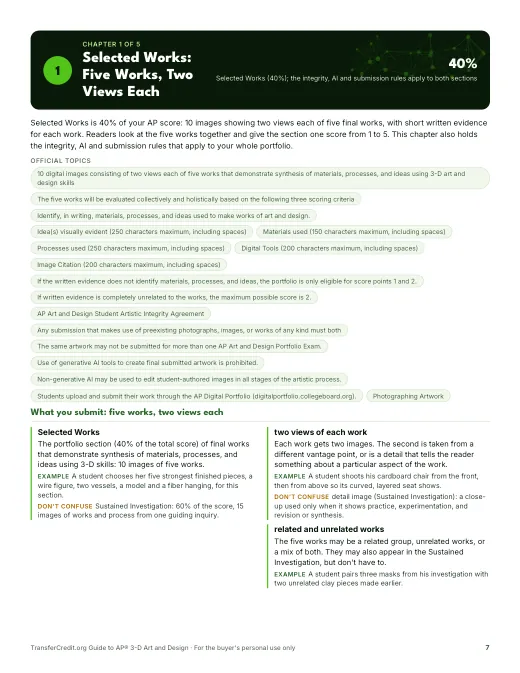
Page 1 of the TransferCredit.org Guide to AP® 3-D Art and Design: the cover
Page 1 The cover
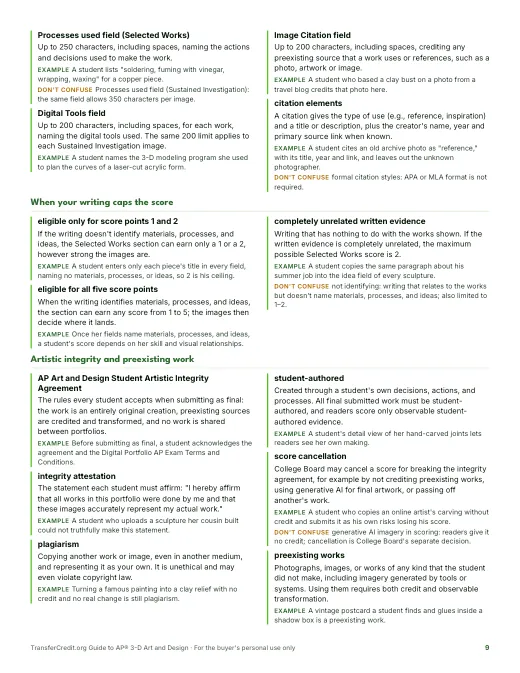
Page 7 of the TransferCredit.org Guide to AP® 3-D Art and Design: the Chapter 1 opener
Page 7 The Chapter 1 opener
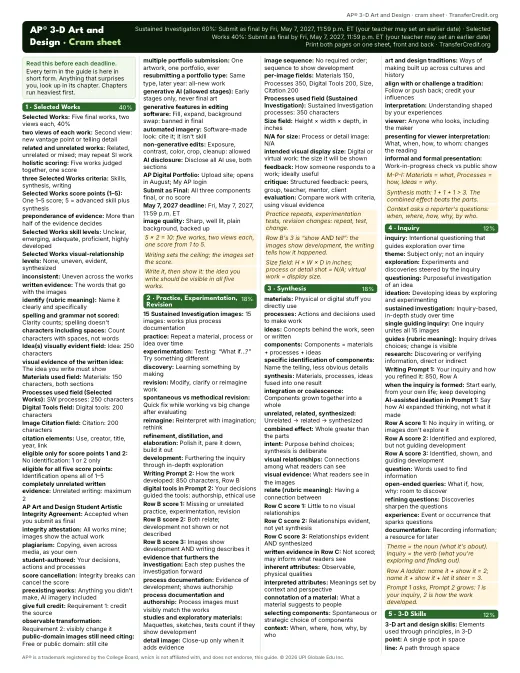
Page 9 of the TransferCredit.org Guide to AP® 3-D Art and Design: a chapter quiz
Page 9 A chapter quiz
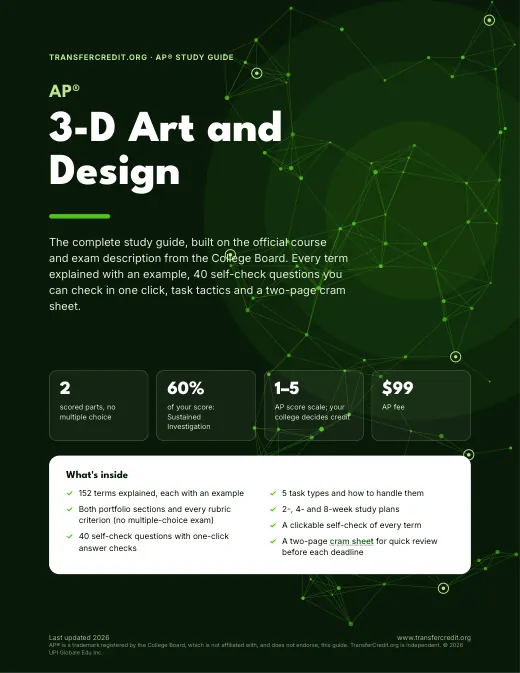
Page 38 of the TransferCredit.org Guide to AP® 3-D Art and Design: the 2-page cram sheet
Page 38 The 2-page cram sheet

What you get for $5

One chapter for each area of the official course and exam description, heaviest topics first.

  • 📘39pages, printable
  • 🧭5chapters
  • 🔑152terms with examples
  • ✍️40self-check questions, answers explained
  • ⚠️15traps to avoid
  • 📄2page cram sheet

Try 10 free AP® 3-D Art and Design self-check questions

Taken from the guide's chapter self-checks: 5 areas, heaviest first. There is no multiple-choice exam to practice for. The self-check questions in each chapter test whether you know the rubric rows, the requirements and the vocabulary; they are not exam questions. Your real practice is making, photographing and writing about your own work, with feedback from your teacher. About 10 minutes, with every answer explained and a score by area.

10 questions  
  1. Question 1 · Selected Works
    Mara has five finished sculptures ready for her Selected Works section. How many images does she upload?
    Show the answer

    Answer: D. 10: two views of each work. The 3-D Selected Works section takes two views each of five works, so 10 images in all.

    The trap: "5: one view of each work" is the rule for 2-D Art and Design and Drawing, not for 3-D, where every work gets a second view.

  2. Question 2 · Practice, Experimentation, Revision
    Maya's 15 images follow a set of cast-paper masks through clear tests and changes tied to one inquiry. Her Prompt 2 response stays on topic but only lists what she made, never how the investigation changed. Which Row B score fits?
    Show the answer

    Answer: B. 2: the writing relates but doesn't describe how the work developed. Her images and writing both relate to the investigation, so she passes the score-1 checks. A 3 needs images that show development and writing that describes it; her writing only lists, so Row B gives 2.

    The trap: “Strong images are enough” is tempting, but score point 3 requires both conditions: visual development AND writing that describes how the investigation developed.

  3. Question 3 · Synthesis
    Nadia's cast-concrete houses clearly tie the heavy gray material to her idea of feeling stuck. Readers can see that link, but her casting process and the added details do little to deepen it. Which Row C score fits?
    Show the answer

    Answer: A. 2: relationships are evident, but without synthesis. Row C gives 1 when there is little to no evidence of visual relationships, 2 when relationships are evident but don't demonstrate synthesis, and 3 when they do. Nadia's material-idea link is visible, but the components don't fuse into a unified result.

    The trap: “Her written statement can supply the synthesis” fails because Row C doesn't score writing; synthesis has to be visible.

  4. Question 4 · Inquiry
    Sofia's Prompt 1 response says, in short, that her work is about her grandmother's kitchen. Her 15 ceramic images are skillful and all on that subject. Which Row A score fits?
    Show the answer

    Answer: C. 1, because a theme or topic alone is not an inquiry. Row A starts with the writing. Naming a subject is a theme, not an inquiry that describes exploration and discovery, so the row gets 1 point before readers reach the visual check.

    The trap: “Her images all explore the subject” skips the first check: without an identified inquiry, the images can't lift Row A above 1.

  5. Question 5 · 3-D Skills
    Lin's 15 Sustained Investigation images include several works with proficient skill, two highly developed works and four rudimentary early studies. Which Row D score fits best?
    Show the answer

    Answer: D. 2. She shows some good (proficient) skills and a few advanced ones, but not a range of good to advanced across all works, because four works are rudimentary. That fits 2.

    The trap: 3 is tempting because of the two highly developed works, but Row D's top score needs good to advanced skill across all the works.

  6. Question 6 · Selected Works
    For the second image of his walnut box, Theo wants to show only the hand-cut dovetail joints at one corner. Is this allowed?
    Show the answer

    Answer: A. Yes, if the detail tells readers something about the work. The second view can be from a different vantage point or a detail, as long as the detail informs readers about an aspect of the work. Visible hand-cut joints do that.

    The trap: "The whole work from behind" is one good option, but it isn't required: a detail can serve as the second view.

  7. Question 7 · Practice, Experimentation, Revision
    Every school day for a month, Leo throws the same cylinder on the wheel, aiming for thinner, more even walls. Which activity does this mainly show?
    Show the answer

    Answer: C. Practice. Repeating the same process over a period of time to build skill is practice.

    The trap: Experimentation means testing something different (“what if...?”). Leo repeats the same form and process.

  8. Question 8 · Synthesis
    Theo worries that his written responses are vague. How does his writing figure in his Row C score?
    Show the answer

    Answer: B. It isn't scored, but readers may read it to help see relationships. In Row C, written evidence is not scored, but reading the responses may inform how readers see the visual relationships among materials, processes, and ideas.

    The trap: “Vague writing caps Row C at 1 point” invents a rule: Row C doesn't score writing at all, so writing can't cap it.

  9. Question 9 · Inquiry
    Omar's writing identifies a clear inquiry, and his images show him exploring it, so Row A stands at 2. What must also be true for a 3?
    Show the answer

    Answer: C. His inquiry visibly guides how the investigation develops. Score point 3 adds one condition to 2: the inquiry must guide the development of the sustained investigation, leading to visible change through experiments, composition, material choices or deeper concepts.

    The trap: “Stays exactly the same” is wrong: questions are expected to be refined as the investigation teaches you things.

  10. Question 10 · 3-D Skills
    Hugo carves a series of holes straight through his solid oak form, opening it up so air and light pass through the gaps. Which 3-D element is he working with most directly?
    Show the answer

    Answer: D. Unoccupied space. The holes are empty areas inside and through the form, which is unoccupied (negative) space shaping the work.

    The trap: Transparency is about a material that lets light through, like glass; solid wood with holes isn't transparent.

The AP® 3-D Art and Design portfolio at a glance

AP® 3-D Art and Design is a course from the College Board. There is no multiple-choice section and no timed exam. Your AP® score comes from a digital portfolio with two required sections: Sustained Investigation (60% of the total score) and Selected Works (40%). The score scale is 1–5 (AP® score scale; your college decides credit). The guide has 5 chapters, one for each area of the official course and exam description; the heaviest is Selected Works: Five Works, Two Views Each at 40%.

Scored parts
2Sustained Investigation 60%; Selected Works 40%; no multiple choice
Deadline
May 7, 2027submit as final by Fri, May 7, 2027, 11:59 p.m. ET (your teacher may set an earlier date)
Score
1–5AP® score scale; your college decides credit
Fee
$99per exam in the U.S. and Canada in 2026-27; your school may charge more
  • There is no multiple-choice section and no timed exam. Your AP® score comes from a digital portfolio with two required sections: Sustained Investigation (60% of the total score) and Selected Works (40%).
  • Selected Works: 10 digital images, two views each of five works, showing 3-D skills and synthesis of materials, processes, and ideas. For each work you state the idea(s) visually evident (250 characters), materials used (150), processes used (250), digital tools (200) and an image citation (200).
  • Sustained Investigation: 15 digital images of works and process documentation, plus two written responses of up to 850 characters each (your inquiry; your practice, experimentation, and revision). Each image lists materials (150), processes (350), digital tools (200), size in inches and a citation (200).
  • Readers score Sustained Investigation in four rows, 1–3 each, weighted 20% inquiry, 30% practice, experimentation, and revision, 30% synthesis and 20% 3-D skills within the section. Selected Works gets one holistic score of 1–5. Chapter weights in this guide for the four rows are those shares times 60%.
  • Submit all three components (Sustained Investigation images, Sustained Investigation written evidence, Selected Works) as final in the AP® Digital Portfolio by Friday, May 7, 2027, 11:59 p.m. ET. Your teacher or AP® coordinator will likely set an earlier deadline.
  • New for 2026–27: generative AI may be used only for research, ideation, practice, experimentation and revision, never in final submitted artwork, and you must disclose any AI use. All final work must be your own; cite and visibly transform any preexisting image.

Source: official AP® 3-D Art and Design page and the official course and exam description. Last updated 2026.

What the portfolio covers

5 chapters, heaviest first, with each area's official weight. The guide's chapters follow this order.

  1. Selected Works: Five Works, Two Views Each40% · Selected Works (40%); the integrity, AI and submission rules apply to both sections
  2. Practice, Experimentation, and Revision18% · Sustained Investigation Row B (30% of the section)
  3. Synthesis of Materials, Processes, and Ideas18% · Sustained Investigation Row C (30% of the section); also a Selected Works criterion
  4. Inquiry: the Question That Guides Your Work12% · Sustained Investigation Row A (20% of the section)
  5. 3-D Skills: Elements and Principles12% · Sustained Investigation Row D (20% of the section); also a Selected Works criterion

Where to start: This course has no multiple-choice exam: your score comes from the digital portfolio you submit by May 7, 2027. Start with Selected Works (40%) and the two heaviest Sustained Investigation rows (30% of that section each), then use the self-checks to find rubric rules you are unsure of.

AP® 3-D Art and Design study guide by area

The heaviest area is open to read now. The full guide has a chapter for every area, each with all its terms, a quiz and an answer key.

1 of 5 chapters open  ·  in the guide's order
40% · Selected Works (40%); the integrity, AI and submission rules apply to both sections · free preview Selected Works: Five Works, Two Views Each Chapter 1 of the guide

Selected Works is 40% of your AP® score: 10 images showing two views each of five final works, with short written evidence for each work. Readers look at the five works together and give the section one score from 1 to 5. This chapter also holds the integrity, AI and submission rules that apply to your whole portfolio.

Key terms, with examples

Selected Works
The portfolio section (40% of the total score) of final works that demonstrate synthesis of materials, processes, and ideas using 3-D skills: 10 images of five works.
Example: A student chooses her five strongest finished pieces, a wire figure, two vessels, a model and a fiber hanging, for this section.
holistic scoring
Readers judge the five works together as one body of evidence and give a single section score, instead of scoring each work and adding the results.
Example: A reader views a student's lamp, vase, chair model, mask and wall hanging as one set before choosing the section score.
written evidence
The written components that accompany the student's works. In Selected Works these are the fields filled in for each work.
Example: For his paper lantern, a student fills in the idea, materials, processes, digital tools and citation fields.
eligible only for score points 1 and 2
If the writing doesn't identify materials, processes, and ideas, the Selected Works section can earn only a 1 or a 2, however strong the images are.
Example: A student enters only each piece's title in every field, naming no materials, processes, or ideas, so 2 is his ceiling.
AP® Art and Design Student Artistic Integrity Agreement
The rules every student accepts when submitting as final: the work is an entirely original creation, preexisting sources are credited and transformed, and no work is shared between portfolios.
Example: Before submitting as final, a student acknowledges the agreement and the Digital Portfolio AP® Exam Terms and Conditions.
generative AI (allowed stages)
AI that produces new content. It may be used only in research, ideation, practice, experimentation, and revision, never to create final submitted artwork.
Example: A student uses an AI chatbot to research how bridges carry weight before designing her own balsa model.
AP® Digital Portfolio
The College Board web application (digitalportfolio.collegeboard.org) where students upload and submit their work. Work is submitted digitally only; it opens in August each year.
Example: In September, a student signs in with the same login she uses for My AP® and finds her class section.
two views of each work
Each work gets two images. The second is taken from a different vantage point, or is a detail that tells the reader something about a particular aspect of the work.
Example: A student shoots his cardboard chair from the front, then from above so its curved, layered seat shows.
three Selected Works criteria
3-D skills (Skill 2.D); synthesis of materials, processes, and ideas (Skill 2.C); and written identification of materials, processes, and ideas (Skill 3.C).
Example: A reader looks at a woven lamp for skill, for how its fiber, light and idea connect, and at its written fields.
identify (rubric meaning)
To indicate or provide information. Observe the work first, then use clear, concise words that give the essential information about materials, processes, and ideas.
Example: Instead of just "clay," a student names "red earthenware dug from a creek bank."
eligible for all five score points
When the writing identifies materials, processes, and ideas, the section can earn any score from 1 to 5; the images then decide where it lands.
Example: Once her fields name materials, processes, and ideas, a student's score depends on her skill and visual relationships.
integrity attestation
The statement each student must affirm: "I hereby affirm that all works in this portfolio were done by me and that these images accurately represent my actual work."
Example: A student who uploads a sculpture her cousin built could not truthfully make this statement.

What this area covers

What you submit: five works, two views eachHow readers score the five worksWritten evidence for each workWhen your writing caps the scoreArtistic integrity and preexisting workThe 2026-27 AI rulesSubmitting and photographing your work

How your work shows it

Readers look at your 10 images and their written fields together and give the section one holistic score from 1 to 5 on three criteria: 3-D skills, synthesis of materials, processes, and ideas, and how your writing identifies them. They score on the preponderance of evidence, and only student-authored work counts: generative AI imagery in final work earns no credit. Your writing sets the ceiling first (no identification means a 1 or 2 at most), then the images decide the score. There is no preferred or unacceptable material, process, idea, style or content, as long as the work is your own.

Common traps

Trap 1. Processes used has two limits: 250 characters per work in Selected Works, but 350 per image in Sustained Investigation. Every limit counts characters, including spaces, not words.

Trap 2. Citing a preexisting image is not enough on its own: it must also be observably transformed. And a free or public-domain image still needs a citation.

Trap 3. Non-generative edits of your own photos are fine in final images. Generative features inside editing software (fill, expand, background replacement) are not, even in an app you're allowed to use.

Memory trick

5 × 2 = 10: five works, two views each, one score from 1 to 5.

Writing sets the ceiling; the images set the score.

AP® 3-D Art and Design tasks, and how to handle them

Both portfolio sections and every rubric criterion (no multiple-choice exam). The guide sorts the work into 5 types; learn what each one asks for and how readers judge it.

Type 1

Selected Works: 10 images and written fields

Five final works, two views each (10 images). For each work: Idea(s) visually evident (250 characters), Materials used (150), Processes used (250), Digital Tools (200) and Image Citation (200), all counting spaces. One holistic score from 1 to 5; 40% of the total.

  • Pick five works that show your strongest 3-D skills and a visible link between materials, processes, and ideas.
  • Make each second view count: another vantage point, or a detail that tells readers something new.
  • Name materials, processes, and ideas specifically in every field; without that, the section can earn only a 1 or 2.
Type 2

Writing Prompt 1: the inquiry (Row A)

One written response of up to 850 characters, including spaces, naming the inquiry that guided your Sustained Investigation and how tools, research and experimentation (including any digital or AI-assisted ideation) helped develop it. Scored 1–3 in Row A (20% of the section).

  • Write an inquiry about discovery and exploration, not just a theme or topic.
  • Check that your 15 images visibly explore it and that it guides how the work develops.
  • If you used AI while thinking, say how it shaped your questioning, not what it produced.
Type 3

Writing Prompt 2: practice, experimentation, and revision (Row B)

One written response of up to 850 characters, including spaces, describing how the investigation developed through practice, experimentation, and revision, including any use of digital tools or AI and how your own decisions guided them. Scored 1–3 in Row B (30% of the section).

  • Point to specific changes you can see in the images: what you tried, what you changed, and why.
  • Keep the writing tied to this investigation; writing that doesn't relate to it caps Row B at 1.
  • Describe any AI or digital tool use honestly, with your own decision-making at the center.
Type 4

Sustained Investigation: 15 images and per-image fields

15 images of works and process from one inquiry. For each image: Materials used (150 characters), Processes used (350), Digital Tools (200), Size (height × width × depth in inches; N/A for process or detail images; intended display size for digital or virtual work) and Image Citation (200).

  • Plan the 15 images as a story: early tries, revisions and finished works that show the inquiry growing.
  • Use the 350-character processes field to show decisions and changes, not just a list of steps.
  • Give real sizes for finished works, N/A for process and detail shots, and credit every preexisting source.
Type 5

Citing and transforming preexisting sources

Any preexisting photo, image or work (including tool- or AI-made imagery) needs a citation of up to 200 characters: type of use and title or description, plus creator, year and link when known. The final work must also show observable transformation. Applies to both sections.

  • List every source you used, even free or public-domain ones.
  • Change the source so readers clearly see your own fresh interpretation, not a copy.
  • Keep notes on sources as you work so the citation is easy to write at the end.

Work habits that add points

  1. Selected Works: 40% of your score. Submit 10 digital images: two views each of five works that show 3-D skills and synthesis of materials, processes, and ideas. The second view is taken from a different vantage point, or is a detail that tells readers something about the work. For each work, write idea(s) visually evident (250 characters, including spaces), materials used (150), processes used (250), digital tools (200) and an image citation (200). Readers give the five works one holistic score of 1–5.
  2. Selected Works written evidence. If your writing does not identify materials, processes, and ideas, the section can earn only a 1 or 2, and writing completely unrelated to the works caps it at 2. Make the idea you write visible in all five works. Spelling, grammar and punctuation are not scored.
  3. Sustained Investigation: 60% of your score. Submit 15 digital images of works and process documentation from one guiding inquiry, in the order that best shows how it developed (no order is required). For each image give materials used (150 characters), processes used (350), digital tools (200), size in inches (N/A for process or detail images) and an image citation (200). Readers score four rows, 1–3 each: inquiry 20%, practice, experimentation, and revision 30%, synthesis 30% and 3-D skills 20% of the section.
  4. The two Sustained Investigation prompts. Prompt 1 (850 characters, including spaces) identifies your inquiry and how tools, research and experimentation helped you develop it; a theme or topic alone is not an inquiry. Prompt 2 (850 characters) describes how your work developed through practice, experimentation, and revision, including any digital tools or AI you used and how your own decisions guided them. Write both in your own words.
  5. Submit as final by May 7, 2027. Submit all three components (Sustained Investigation images, Sustained Investigation written evidence and Selected Works) as final in the AP® Digital Portfolio by Fri, May 7, 2027, 11:59 p.m. ET, or by your teacher's earlier date. Then check that the Class Summary Overview shows a black checkmark for all three: only complete portfolios are sent for scoring.
  6. Integrity and AI rules. All final work must be your own. Cite any preexisting image and visibly transform it. Generative AI is allowed only for research, ideation, practice, experimentation and revision, never in final submitted artwork, and you must disclose any AI use. Breaking these rules can get your score cancelled.

Your tasks and deadlines

  1. Sustained Investigation (60% of your score). 15 digital images of works and process documentation, two written responses (850 characters each) and details for each image. Submit as final by Fri, May 7, 2027, 11:59 p.m. ET (your teacher may set an earlier date)
  2. Selected Works (40% of your score). 10 digital images: two views each of five works, with written evidence for each work. Submit as final by Fri, May 7, 2027, 11:59 p.m. ET (your teacher may set an earlier date)

AP® 3-D Art and Design flashcards

Try the first 8 cards free. Read the term, say the definition out loud, then select the card to check yourself. Arrow keys move between cards.

Free card 1 of 8 (deck total: 152)

How to study for AP® 3-D Art and Design: a 5-step plan

Follow the steps, then enter your deadline. The planner gives you a dated plan that starts with the heaviest areas and saves the last days for review.

  1. Take the 10 free self-check questionsSee which AP® 3-D Art and Design areas you already know.
  2. Study the heaviest parts firstStart with Selected Works: Five Works, Two Views Each, Practice, Experimentation, and Revision and Synthesis of Materials, Processes, and Ideas, then work down the score map.
  3. Learn each term with an exampleSay the definition out loud, then check it with the flashcards. A term you can't use in an example isn't learned yet.
  4. Self-check and study the trapsAfter each chapter, answer its self-check and read why the tempting wrong answer is wrong.
  5. Plan backwards from your deadlinesBuild a dated plan, finish each part before your teacher's deadline, and read the cram sheet before each deadline.

How it works

  1. 1Check outSelect Get the guide · $5 and pay on TransferCredit.org's secure checkout.
  2. 2Download the PDFFrom your TransferCredit.org account.
  3. 3Study the heaviest areas firstFollow the 2-, 4- or 8-week plan, then read the cram sheet before each deadline.

This page or the full guide

Everything on this page is free with no account. The full guide is a PDF you keep.

What's on this page and in the full study guide
Study toolThis pageFull study guide ($5)
ChaptersA preview of 1 of 5All 5
Terms explainedA sample from the open chaptersAll 152, each with an example
Self-check questions10 free self-check questions40, with an answer key
Flashcards8 cardsAll 152 terms on the self-check list
Study planDated planner2-, 4- and 8-week plans
Cram sheet—2 pages, for the night before
FormatWeb page39-page PDF, printable

Questions students ask

Is AP® 3-D Art and Design hard?
It depends on what you already know. There is no multiple-choice exam to practice for. The self-check questions in each chapter test whether you know the rubric rows, the requirements and the vocabulary; they are not exam questions. Your real practice is making, photographing and writing about your own work, with feedback from your teacher. Try the 10 free self-check questions above to see where you stand in about 10 minutes.
How do I study for AP® 3-D Art and Design?
Five steps, all on this page. 1. Take the 10 free self-check questions: See which AP® 3-D Art and Design areas you already know. 2. Study the heaviest parts first: Start with Selected Works: Five Works, Two Views Each, Practice, Experimentation, and Revision and Synthesis of Materials, Processes, and Ideas, then work down the score map. 3. Learn each term with an example: Say the definition out loud, then check it with the flashcards. A term you can't use in an example isn't learned yet. 4. Self-check and study the traps: After each chapter, answer its self-check and read why the tempting wrong answer is wrong. 5. Plan backwards from your deadlines: Build a dated plan, finish each part before your teacher's deadline, and read the cram sheet before each deadline.
What's in the full AP® 3-D Art and Design study guide?
39 pages: 5 chapters, one for each area of the College Board's official course and exam description, heaviest topics first. 152 terms, each with a plain-English definition and an example, common traps and memory tricks, 40 self-check questions with an answer key that explains every answer, task tactics, 2-, 4- and 8-week study plans and a 2-page cram sheet.
How much is the full AP® 3-D Art and Design study guide?
The full 39-page PDF is $5. The 10 self-check questions on this page are free.
What are the scored parts of AP® 3-D Art and Design, and when are they due?
Sustained Investigation (60% of your score): 15 digital images of works and process documentation, two written responses (850 characters each) and details for each image. Submit as final by Fri, May 7, 2027, 11:59 p.m. ET (your teacher may set an earlier date). Selected Works (40% of your score): 10 digital images: two views each of five works, with written evidence for each work. Submit as final by Fri, May 7, 2027, 11:59 p.m. ET (your teacher may set an earlier date).
Does AP® 3-D Art and Design have a multiple-choice section?
No. There is no multiple-choice section and no timed exam. Your AP® score comes from a digital portfolio with two required sections: Sustained Investigation (60% of the total score) and Selected Works (40%).
Can I try the AP® 3-D Art and Design guide before I buy it?
Yes. This page has 10 self-check questions from the guide's own chapter quizzes, a preview of the heaviest area, 8 flashcards and a study planner. No account needed.
Is this an official AP® study guide?
No. AP® is a trademark registered by the College Board, which is not affiliated with, and does not endorse, this guide. TransferCredit.org is independent. We built the guide from the College Board's official course and exam description, and the assessment details were checked against the College Board's published exam information in 2026.
More questions about the AP® 3-D Art and Design portfolio (16)
How do I get the full guide?
Select Get the guide · $5 and check out on TransferCredit.org. Then sign in to your TransferCredit.org account to download the PDF.
Can I print the guide or use it on my phone?
Yes. It's a PDF, so it opens on phones, tablets and computers, and printing is allowed. Its tick boxes and answer bubbles work in PDF readers that support forms. Copying and editing are turned off.
How was this study guide made?
One chapter for each area of the official course and exam description, using its published weights. Each chapter was written, then fact-checked against the official course and assessment information in a separate review. The self-check questions are original.
How up to date is this AP® 3-D Art and Design guide?
Last updated 2026. The assessment details were checked against the College Board's published exam information in 2026. Requirements and dates can change, so confirm them on the official AP® 3-D Art and Design page and with your teacher.
What is the AP® 3-D Art and Design portfolio?
AP® 3-D Art and Design is a course from the College Board. There is no multiple-choice section and no timed exam. Your AP® score comes from a digital portfolio with two required sections: Sustained Investigation (60% of the total score) and Selected Works (40%). The score scale is 1–5 (AP® score scale; your college decides credit). The guide has 5 chapters, one for each area of the official course and exam description; the heaviest is Selected Works: Five Works, Two Views Each at 40%.
How is the AP® 3-D Art and Design portfolio scored?
The score scale is 1–5: AP® score scale; your college decides credit.
What AP® 3-D Art and Design score do I need for college credit?
Your college decides credit. Each college sets its own credit policy, so check the one at your college before you count on the credit.
How much does the AP® 3-D Art and Design portfolio cost?
The fee is $99: per exam in the U.S. and Canada in 2026-27; your school may charge more. Fees can change, so check with your AP® coordinator.
Can I use generative AI in AP® 3-D Art and Design?
New for 2026–27: generative AI may be used only for research, ideation, practice, experimentation and revision, never in final submitted artwork, and you must disclose any AI use.
What does the AP® 3-D Art and Design portfolio cover?
5 areas, from the official course and exam description: Selected Works: Five Works, Two Views Each (40%); Practice, Experimentation, and Revision (18%); Synthesis of Materials, Processes, and Ideas (18%); Inquiry: the Question That Guides Your Work (12%); 3-D Skills: Elements and Principles (12%).
Which AP® 3-D Art and Design topics should I study first?
This course has no multiple-choice exam: your score comes from the digital portfolio you submit by May 7, 2027. Start with Selected Works (40%) and the two heaviest Sustained Investigation rows (30% of that section each), then use the self-checks to find rubric rules you are unsure of.
What kinds of tasks does the AP® 3-D Art and Design guide cover?
The guide sorts the work into 5 types: “Selected Works: 10 images and written fields”, “Writing Prompt 1: the inquiry (Row A)”, “Writing Prompt 2: practice, experimentation, and revision (Row B)”, “Sustained Investigation: 15 images and per-image fields” and “Citing and transforming preexisting sources”. See how each type works.
How long should I study for AP® 3-D Art and Design?
Take the 10 free self-check questions to see where you stand. The full guide has 2-, 4- and 8-week plans built from the score weights, and the planner on this page builds a dated plan from your deadline.
How do I know I'm ready for the AP® 3-D Art and Design portfolio?
The guide's readiness checklist: You can explain every term on the checklist without notes. You score 80% or better on every chapter self-check. You can say which rubric row or Selected Works criterion each of your images and written answers supports. You know every character limit and image count, and your teacher's deadline (the AP® deadline is May 7, 2027, 11:59 p.m. ET). You know the AP® score your college gives credit for.
What should I check before the deadline?
Follow your teacher's deadline (the AP® deadline is May 7, 2027, 11:59 p.m. ET). After you submit as final, check that the Class Summary Overview shows all three components with a black checkmark. The 2-page cram sheet is built for a quick review before each deadline.
Can I use the AP® 3-D Art and Design guide on my own?
Yes. It is built for studying on your own: 39 pages with a chapter for each area of the official course and exam description, 40 self-check questions with every answer explained, 2-, 4- and 8-week study plans and a 2-page cram sheet, for $5. Your scored work goes through your school, and your AP® teacher or AP® coordinator may set deadlines earlier than the College Board's.

How we built this guide

We built one chapter for each area of the College Board's official course and exam description for AP® 3-D Art and Design, using its published weights to order the chapters and size the quizzes. Each chapter was written, then fact-checked against the official course and assessment information in a separate review. The assessment details were checked against the College Board's published exam information in 2026.

Sources: official AP® 3-D Art and Design page, official course and exam description. Last updated 2026.

AP® is a trademark registered by the College Board, which is not affiliated with, and does not endorse, this guide. TransferCredit.org is independent and not affiliated with the College Board. © 2026 UPI Globale Edu Inc.

Ready for the full AP® 3-D Art and Design guide? 39 pages, 152 terms, 40 self-check questions and a 2-page cram sheet, $5.

Get the guide · $5

In the full guide

TransferCredit.org Guide to AP® 3-D Art and Design

  • All 5 chapters
  • 152 terms with examples
  • 40 self-check questions with an answer key
  • A 2-page cram sheet and 2-, 4- and 8-week plans
Get the guide · $5