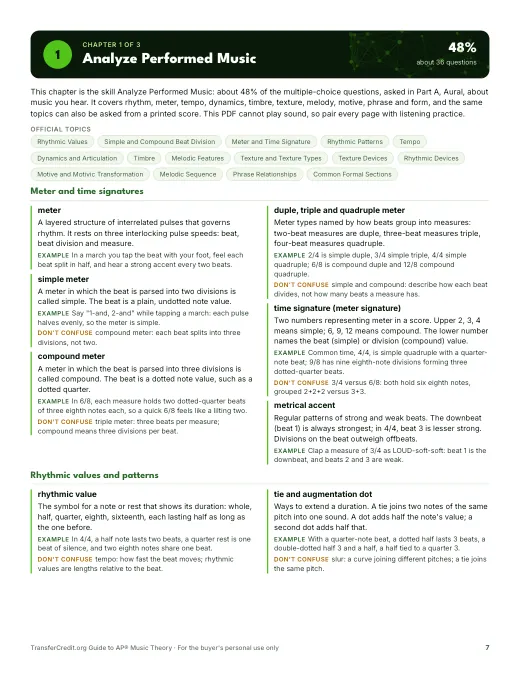
This chapter is the skill Analyze Performed Music: about 48% of the multiple-choice questions, asked in Part A, Aural, about music you hear. It covers rhythm, meter, tempo, dynamics, timbre, texture, melody, motive, phrase and form, and the same topics can also be asked from a printed score. This PDF cannot play sound, so pair every page with listening practice.
- meter
- A layered structure of interrelated pulses that governs rhythm. It rests on three interlocking pulse speeds: beat, beat division and measure.
- Example: In a march you tap the beat with your foot, feel each beat split in half, and hear a strong accent every two beats.
- rhythmic value
- The symbol for a note or rest that shows its duration: whole, half, quarter, eighth, sixteenth, each lasting half as long as the one before.
- Example: In 4/4, a half note lasts two beats, a quarter rest is one beat of silence, and two eighth notes share one beat.
- syncopation
- Rhythm that places accent on weak beats or weak divisions, against the meter's normal pattern of strong and weak.
- Example: In 4/4, a tune goes eighth, quarter, quarter, quarter, eighth, so all three quarter notes begin on offbeats.
- texture
- How musical components combine simultaneously to form an overall sound, shaped by timbres, the density and spacing of pitches, and the pitch range encompassed.
- Example: A lone flute gives a thin texture; the full orchestra with low brass and divided strings gives a thick, dense one.
- canon and imitation
- Imitation: one voice restates a melodic idea just stated by another. Canon: strict imitation in which a second voice copies the whole leading melody, overlapping it.
- Example: In a round, each new group of singers starts the same tune a phrase after the group before, so three or four parts overlap.
- melody
- Pitch and rhythm combining to create a succession of pitches through time that expresses a musical statement. Melodies come from scales or modes and are organized in motives and phrases.
- Example: Play a tune's pitches all as equal quarter notes and it loses much of its identity: a melody needs pitch and rhythm together.
- motive
- A small musical idea that recurs and is developed through a composition or passage. It may be developed by pitch alone, rhythm alone, or both together.
- Example: A rising three-note figure, G-A-C, opens a piece and keeps returning in different instruments and on different pitches.
- phrase relationships (a a, a a', a b)
- How phrases compare melodically, shown with lowercase letters: a a is a phrase and its literal repetition, a a' a varied repetition, a b two contrasting phrases.
- Example: Two phrases with completely different openings, contours and rhythms are labeled a b.
- tempo and metronome marking
- The relative speed of music's beat pulse, given by words or by a metronome marking such as "quarter note = 88", meaning 88 beats per minute.
- Example: A marking of quarter note = 60 is one beat per second; quarter note = 120 is twice as fast.
- dynamics
- How loud or soft music is, in relative terms, marked with abbreviations of Italian words from very soft to very loud: pp, p, mp, mf, f, ff.
- Example: A passage marked mp (mezzo piano) is moderately soft: louder than p (piano), softer than mf (mezzo forte).
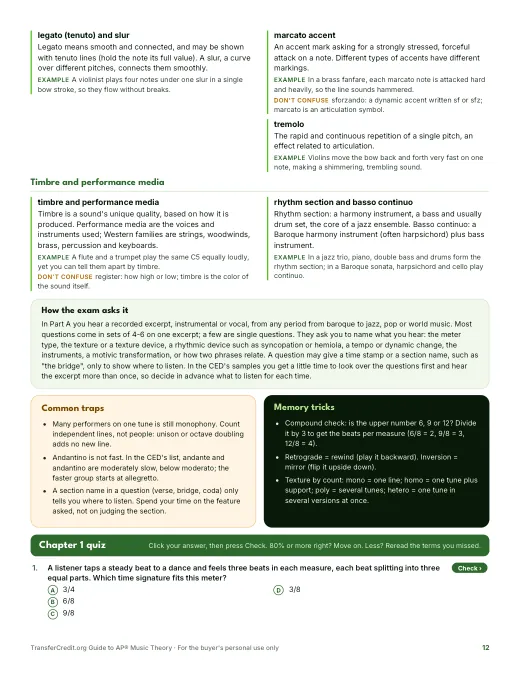
- timbre and performance media
- Timbre is a sound's unique quality, based on how it is produced. Performance media are the voices and instruments used; Western families are strings, woodwinds, brass, percussion and keyboards.
- Example: A flute and a trumpet play the same C5 equally loudly, yet you can tell them apart by timbre.
- simple meter
- A meter in which the beat is parsed into two divisions is called simple. The beat is a plain, undotted note value.
- Example: Say "1-and, 2-and" while tapping a march: each pulse halves evenly, so the meter is simple.