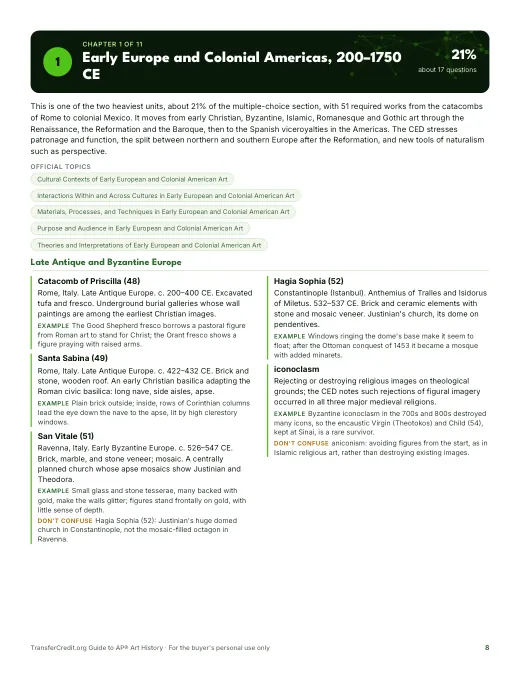
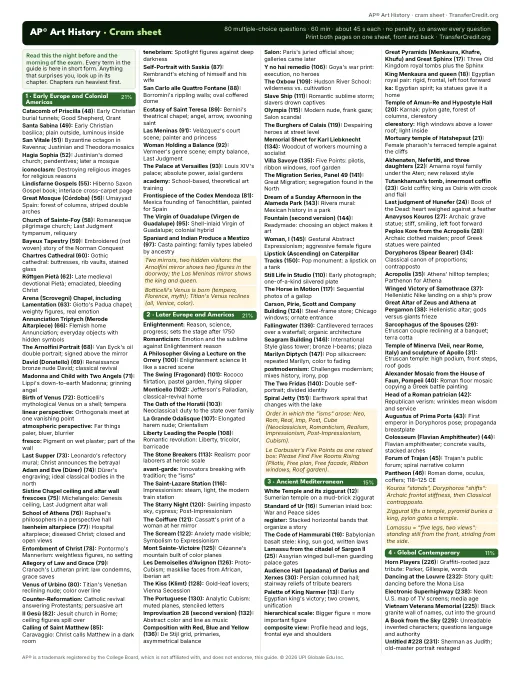
This is one of the two heaviest units, about 21% of the multiple-choice section, with 51 required works from the catacombs of Rome to colonial Mexico. It moves from early Christian, Byzantine, Islamic, Romanesque and Gothic art through the Renaissance, the Reformation and the Baroque, then to the Spanish viceroyalties in the Americas. The CED stresses patronage and function, the split between northern and southern Europe after the Reformation, and new tools of naturalism such as perspective.
- Catacomb of Priscilla (48)
- Rome, Italy. Late Antique Europe. c. 200–400 CE. Excavated tufa and fresco. Underground burial galleries whose wall paintings are among the earliest Christian images.
- Example: The Good Shepherd fresco borrows a pastoral figure from Roman art to stand for Christ; the Orant fresco shows a figure praying with raised arms.
- Lindisfarne Gospels (55)
- Early medieval (Hiberno Saxon) Europe. c. 700 CE. Illuminated manuscript (ink, pigments, and gold on vellum). An illuminated manuscript is a handwritten, hand-painted book; this holds the Gospels.
- Example: The cross-carpet page buries a cross in dense, knotted interlace and coiling animals, the migratory metalwork style transferred to vellum.
- Arena (Scrovegni) Chapel, including Lamentation (63)
- Padua, Italy. Unknown architect; Giotto di Bondone (artist). Chapel: c. 1303 CE; Fresco: c. 1305 CE. Brick (architecture) and fresco. A private chapel painted with Christ's and Mary's lives.
- Example: In the Lamentation, mourners seen from behind frame Christ's body, and a rocky ridge slopes down to his head, guiding the eye to the grief.
- Last Supper (73)
- Leonardo da Vinci. c. 1494–1498 CE. Oil and tempera. A wall painting of the moment Christ announces that one of the apostles will betray him.
- Example: It covers a wall of the dining hall (refectory) of a Dominican convent in Milan, so the friars ate beside Christ's last meal.
- Il Gesù (82)
- Giacomo da Vignola, plan (architect); Giacomo della Porta, facade (architect); Giovanni Battista Gaulli, ceiling fresco (artist). Church: 16th century CE; facade: 1568–1584 CE. Jesuit mother church.
- Example: Gaulli's Triumph of the Name of Jesus (fresco and stucco figures: 1676–1679 CE) makes painted figures seem to tumble out of the frame.
- Frontispiece of the Codex Mendoza (81)
- Viceroyalty of New Spain. c. 1541–1542 CE. Ink and color on paper. A painted page recording the founding of Tenochtitlan, made for Spanish officials.
- Example: An eagle on a cactus at the center marks Tenochtitlan, inside a water-filled square divided by canals; Spanish notes label the figures.
- Santa Sabina (49)
- Rome, Italy. Late Antique Europe. c. 422–432 CE. Brick and stone, wooden roof. An early Christian basilica adapting the Roman civic basilica: long nave, side aisles, apse.
- Example: Plain brick outside; inside, rows of Corinthian columns lead the eye down the nave to the apse, lit by high clerestory windows.
- Great Mosque (Córdoba) (56)
- Córdoba, Spain. Umayyad. c. 785–786 CE. Stone masonry. A congregational mosque whose prayer hall is a forest of columns carrying double-tiered arches.
- Example: Arches striped in red brick and white stone recall Roman aqueducts, and many columns were reused from older Roman and Visigothic buildings.
- Annunciation Triptych (Merode Altarpiece) (66)
- Workshop of Robert Campin. 1427–1432 CE. Oil on wood. A small three-panel altarpiece setting the Annunciation in a Flemish middle-class home, for private devotion.
- Example: A lily may stand for Mary's purity; in the right panel Joseph, a carpenter, makes mousetraps, possibly a symbol of trapping the devil.
- Adam and Eve (Dürer) (74)
- Albrecht Dürer. 1504 CE. Engraving. A print of the first humans with ideal classical proportions, showing a German artist absorbing Italian Renaissance theory.
- Example: Animals such as a cat near a mouse may stand for the four humors; a tablet hanging in the tree carries his Latin signature.
- Calling of Saint Matthew (85)
- Caravaggio. c. 1597–1601 CE. Oil on canvas. A chapel painting of Christ summoning the tax collector Matthew from a table of men in contemporary dress.
- Example: Painted for the Contarelli Chapel in Rome; Christ's outstretched hand recalls Adam's hand in Michelangelo's Sistine ceiling.
- The Virgin of Guadalupe (Virgen de Guadalupe) (95)
- Miguel González. c. 1698 CE. Oil on canvas on wood, inlaid with mother-of-pearl. An enconchado (shell-inlaid painting) of Mexico's most revered image of the Virgin.
- Example: Based on original Virgin of Guadalupe (Basilica of Guadalupe, Mexico City, 16th century CE), said to have miraculously appeared on Juan Diego's cloak.