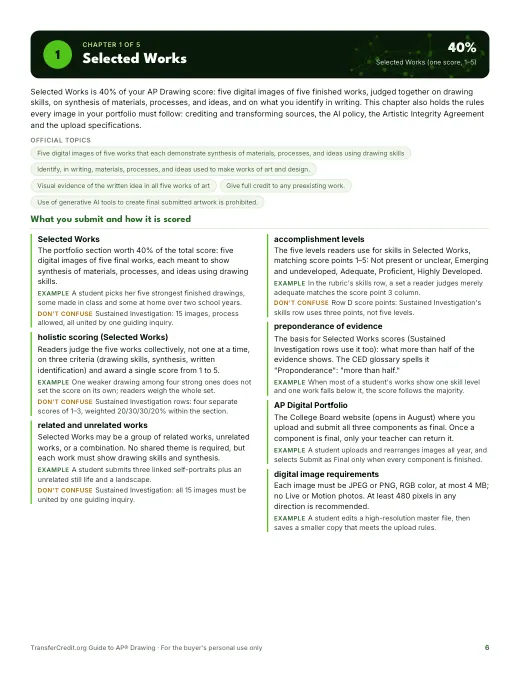
Selected Works is 40% of your AP® Drawing score: five digital images of five finished works, judged together on drawing skills, on synthesis of materials, processes, and ideas, and on what you identify in writing. This chapter also holds the rules every image in your portfolio must follow: crediting and transforming sources, the AI policy, the Artistic Integrity Agreement and the upload specifications.
- Selected Works
- The portfolio section worth 40% of the total score: five digital images of five final works, each meant to show synthesis of materials, processes, and ideas using drawing skills.
- Example: A student picks her five strongest finished drawings, some made in class and some at home over two school years.
- written evidence
- "The written components that accompany the student's works of art and design" (CED glossary). In Selected Works, it is the five fields you fill in for each work.
- Example: A reader checks a student's Materials used and Processes used entries against what each drawing actually shows.
- visual evidence
- "The visual components that make up the student's works of art and design" (CED glossary): what a reader can actually see in each image.
- Example: Layered, controlled cross-hatching in a still life is visual evidence of mark-making skill, whatever the caption claims.
- Image Citation
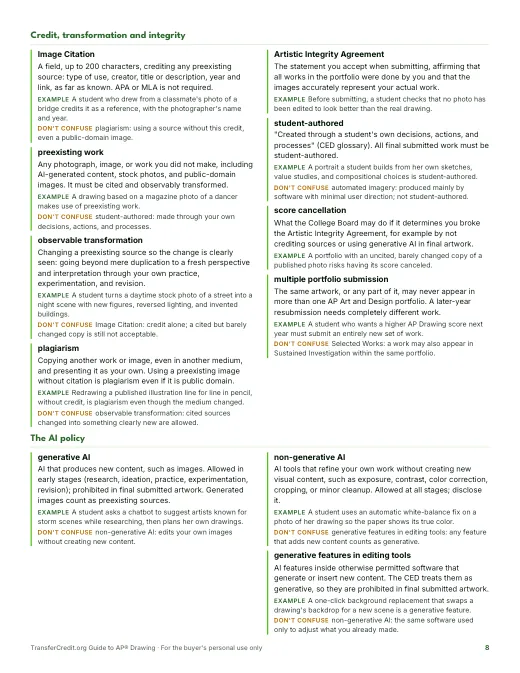
- A field, up to 200 characters, crediting any preexisting source: type of use, creator, title or description, year and link, as far as known. APA or MLA is not required.
- Example: A student who drew from a classmate's photo of a bridge credits it as a reference, with the photographer's name and year.
- generative AI
- AI that produces new content, such as images. Allowed in early stages (research, ideation, practice, experimentation, revision); prohibited in final submitted artwork. Generated images count as preexisting sources.
- Example: A student asks a chatbot to suggest artists known for storm scenes while researching, then plans her own drawings.
- holistic scoring (Selected Works)
- Readers judge the five works collectively, not one at a time, on three criteria (drawing skills, synthesis, written identification) and award a single score from 1 to 5.
- Example: One weaker drawing among four strong ones does not set the score on its own; readers weigh the whole set.
- Idea(s) visually evident
- The field, up to 250 characters including spaces, where you state the idea each work shows. Readers then look for that idea in the image itself.
- Example: A student drawing her grandfather's worn boots names inherited work as the idea; the heavy, scuffed marks make it visible.
- visual evidence of the written idea
- A mark of the most successful Selected Works: the idea you wrote down can be seen in all five works, not only stated in the field.
- Example: A student who writes about isolation shows it through empty space and small, distant figures in every drawing.
- preexisting work
- Any photograph, image, or work you did not make, including AI-generated content, stock photos, and public-domain images. It must be cited and observably transformed.
- Example: A drawing based on a magazine photo of a dancer makes use of preexisting work.
- non-generative AI
- AI tools that refine your own work without creating new visual content, such as exposure, contrast, color correction, cropping, or minor cleanup. Allowed at all stages; disclose it.
- Example: A student uses an automatic white-balance fix on a photo of her drawing so the paper shows its true color.
- related and unrelated works
- Selected Works may be a group of related works, unrelated works, or a combination. No shared theme is required, but each work must show drawing skills and synthesis.
- Example: A student submits three linked self-portraits plus an unrelated still life and a landscape.
- Materials used (Selected Works field)
- The field, up to 150 characters including spaces, naming the physical or digital substances, tools, or media you used to make the work.
- Example: A student lists vine charcoal, white chalk, and toned gray paper for a figure drawing.