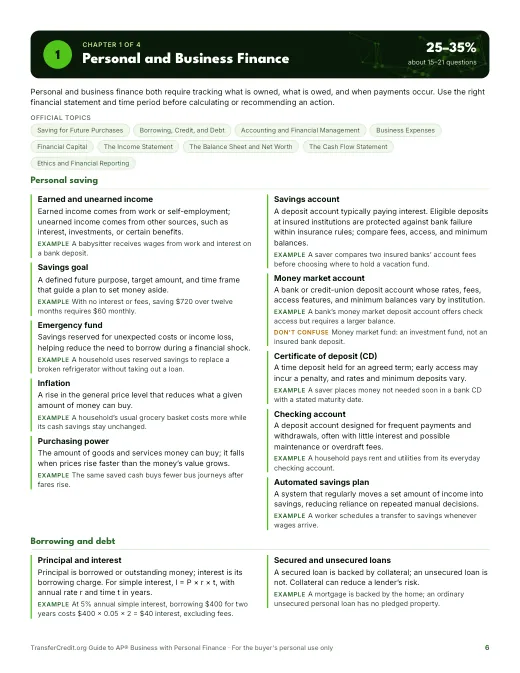
Personal and business finance both require tracking what is owned, what is owed, and when payments occur. Use the right financial statement and time period before calculating or recommending an action.
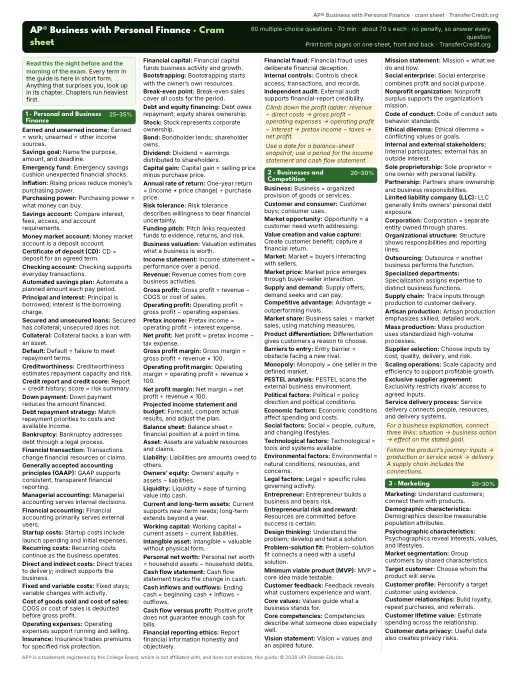
- Earned and unearned income
- Earned income comes from work or self-employment; unearned income comes from other sources, such as interest, investments, or certain benefits.
- Example: A babysitter receives wages from work and interest on a bank deposit.
- Principal and interest
- Principal is borrowed or outstanding money; interest is its borrowing charge. For simple interest, I = P × r × t, with annual rate r and time t in years.
- Example: At 5% annual simple interest, borrowing $400 for two years costs $400 × 0.05 × 2 = $40 interest, excluding fees.
- Financial transaction
- An economic event, such as a purchase, sale, saving, or borrowing, that changes a person’s or business’s financial position.
- Example: A print shop records its purchase of a delivery van.
- Startup costs
- One-time launch expenditures and the initial expenses needed to establish a business or product before continuing operations.
- Example: A founder budgets $1,200 for equipment plus $300 in setup fees: $1,500 to launch.
- Financial capital
- Money available to establish, operate, or expand a business, including funds from owners, lenders, and investors.
- Example: A growing laundry service seeks funds for new machines and bills due before customers pay.
- Income statement
- A financial statement reporting revenue, costs, and profit or loss over a defined period.
- Example: A bicycle courier summarizes revenue and expenses for its completed financial quarter.
- Balance sheet
- A statement of financial position at a particular time, following assets = liabilities + owners’ equity.
- Example: A canoe-rental snapshot at season-end shows $35,000 resources = $12,000 creditor claims + $23,000 owner claims.
- Cash flow statement
- A statement showing how cash receipts and payments change a business’s cash balance during a reporting period.
- Example: A gallery traces money received and paid during its exhibition season to check payment capacity.
- Financial reporting ethics
- Honest, objective, transparent, and confidential handling of financial information so users can make informed decisions.
- Example: An accountant reports an unfavorable result accurately rather than hiding it from investors.
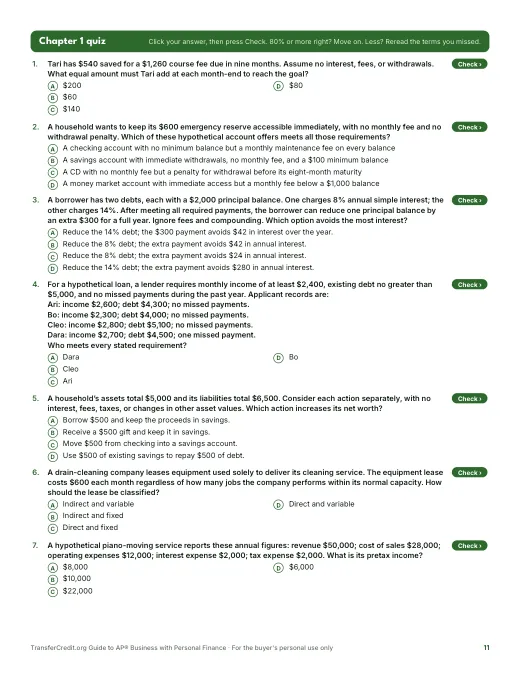
- Savings goal
- A defined future purpose, target amount, and time frame that guide a plan to set money aside.
- Example: With no interest or fees, saving $720 over twelve months requires $60 monthly.
- Secured and unsecured loans
- A secured loan is backed by collateral; an unsecured loan is not. Collateral can reduce a lender’s risk.
- Example: A mortgage is backed by the home; an ordinary unsecured personal loan has no pledged property.
- Generally accepted accounting principles (GAAP)
- U.S. financial accounting standards that promote consistent, transparent financial reporting and comparison across reporting periods and businesses.
- Example: A public company follows consistent reporting standards when preparing statements for shareholders.