← All AP® study guides
AP® Study Guide Printable PDF · 46 pages

TransferCredit.org Guide to AP® English Language and Composition

AP® English Language and Composition study guide: a printable PDF built from the College Board's official course and exam description, heaviest topics first.

  • 173 key terms, each with an example
  • 42 practice questions with every answer explained
  • A 2-page cram sheet for the night before
  • 2-, 4- and 8-week study plans built from the exam weights
Not sure yet? Try 10 free questions

Last updated 2026 · exam details checked against the College Board's published exam information in 2026

Look inside the guide

Real pages from the 46-page PDF.

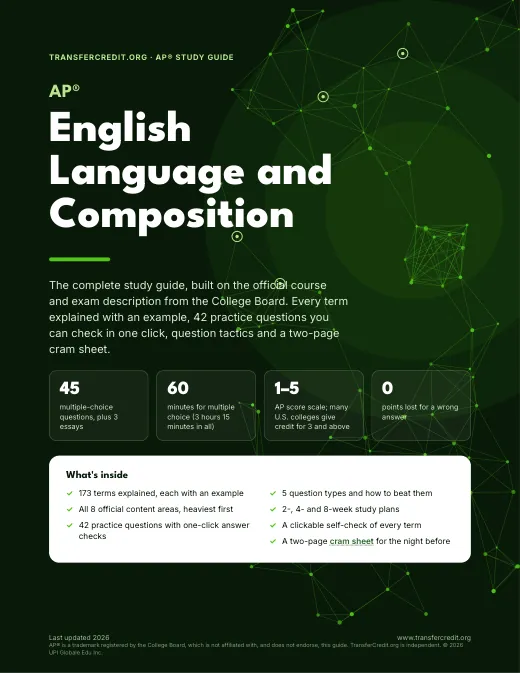
Page 1 of the TransferCredit.org Guide to AP® English Language and Composition: the cover
Page 1 The cover
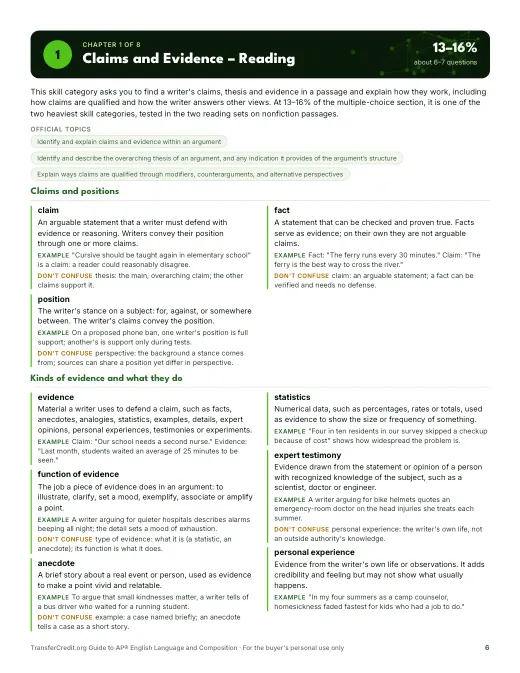
Page 6 of the TransferCredit.org Guide to AP® English Language and Composition: the Chapter 1 opener
Page 6 The Chapter 1 opener
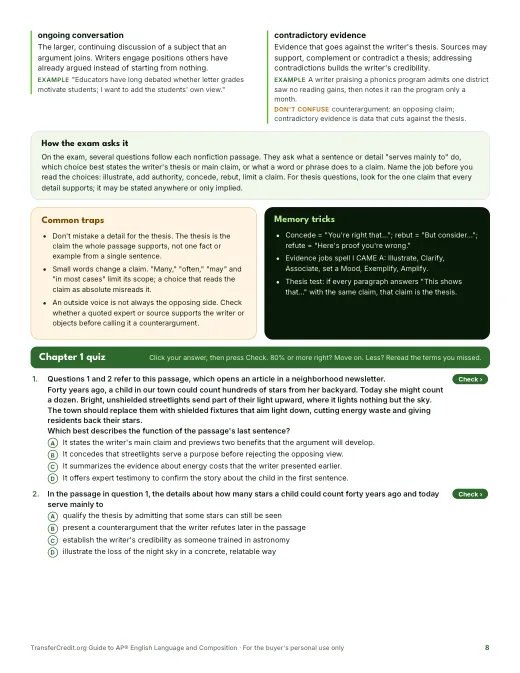
Page 8 of the TransferCredit.org Guide to AP® English Language and Composition: a chapter quiz
Page 8 A chapter quiz
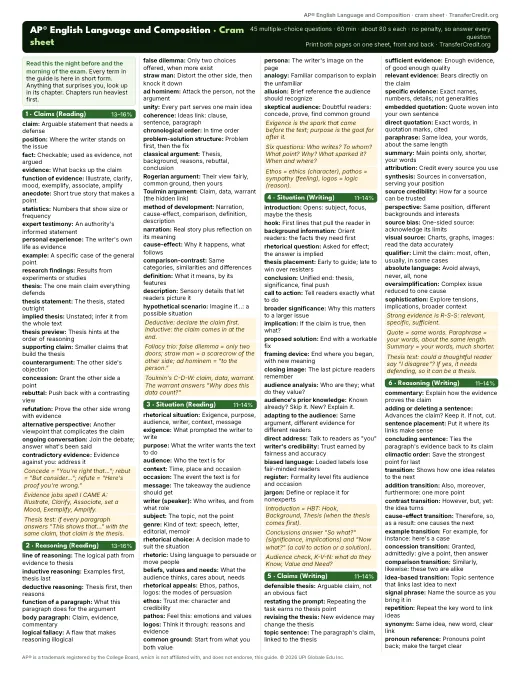
Page 45 of the TransferCredit.org Guide to AP® English Language and Composition: the 2-page cram sheet
Page 45 The 2-page cram sheet

What you get for $5

One chapter for each area of the official course and exam description, heaviest topics first.

  • 📘46pages, printable
  • 🧭8chapters
  • 🔑173terms with examples
  • ✍️42practice questions, answers explained
  • ⚠️24exam traps to avoid
  • 📄2page cram sheet

Try 10 free AP® English Language and Composition questions

Multiple-choice questions taken from the guide's chapter quizzes: 8 areas, heaviest first. About 15 minutes, with every answer explained and a score by area. The exam's free-response questions aren't in this quiz: see how the exam works.

10 questions  
  1. Question 1 · Claims (Reading)
    Questions 1 and 2 refer to this passage, which opens an article in a neighborhood newsletter.
    Forty years ago, a child in our town could count hundreds of stars from her backyard. Today she might count a dozen. Bright, unshielded streetlights send part of their light upward, where it lights nothing but the sky. The town should replace them with shielded fixtures that aim light down, cutting energy waste and giving residents back their stars.
    Which best describes the function of the passage's last sentence?
    Show the answer

    Answer: D. It states the writer's main claim and previews two benefits that the argument will develop.. The last sentence is the first place the writer says what should be done: replace the lights. That is the thesis. Its two benefits, less wasted energy and a starry sky, hint at the reasoning to come.

    The trap: The choice about conceding that streetlights serve a purpose is tempting, but the writer never grants the other side a point; the third sentence criticizes the lights instead.

  2. Question 2 · Reasoning (Reading)
    Questions 1 and 2 refer to this passage.
    The following is from an essay in a regional magazine.
    (1) On Harper Street, the hardware store, the shoe shop and the florist now sit empty. (2) On Front Street, the tailor and the bookstore have cut their hours. (3) Even the diner that survived two recessions now closes on Mondays. (4) These are not isolated misfortunes. (5) When the bypass opened, the traffic that once carried customers past our doors simply stopped coming.
    Which best describes the line of reasoning in the passage?
    Show the answer

    Answer: C. It moves from specific examples to a general conclusion about their cause.. Sentences 1 to 3 give separate examples of struggling businesses, sentence 4 links them, and sentence 5 names their shared cause: the bypass. Reasoning from examples to a conclusion is inductive.

    The trap: The general-claim choice describes deductive order, and the passage cites no other towns; its claim comes only after the examples.

  3. Question 3 · Situation (Reading)
    Questions 1 and 2 refer to this passage.
    The following is from a letter that a high school band director sent to students' parents in September.
    "Last fall, our band earned the highest rating at the regional festival. Many of you drove students to rehearsal at six in the morning. You know what this band asks of them, and what it gives back. This summer, the district ended travel funding for all clubs, and without it, the band may not perform outside town at all. I am asking each family to help us find a way."
    Which best describes the exigence for the letter?
    Show the answer

    Answer: A. The district's decision to end travel funding for clubs. The exigence is what prompted the director to write. The end of travel funding threatens the band's season and leads straight to the request for help. Last fall's success and the early rehearsals are details the director uses to persuade.

    The trap: The top rating is tempting because it opens the letter, but it is evidence of the band's value, not the event that made the letter necessary.

  4. Question 4 · Situation (Writing)
    (1) Our city plans to plant 400 trees along downtown streets over the next five years. (2) Trees shade sidewalks, soak up stormwater and make streets more pleasant to walk. (3) The council should approve the full budget for the project at its June meeting.

    The writer wants to add a sentence before sentence 1 to engage readers of the local newspaper. Which choice best accomplishes this goal?
    Show the answer

    Answer: B. Last July, shoppers hurried along sunbaked Market Street, while every shaded bench by the courthouse stayed full.. The scene of shoppers hurrying past bare sidewalk while the shaded benches stay full engages readers with a familiar, concrete picture. It also points straight at the draft's claim that trees make streets more pleasant.

    The trap: The sentence that begins "This letter will explain" announces the topic instead of engaging readers. It gives a newspaper reader no reason to keep reading.

  5. Question 5 · Claims (Writing)
    (1) The old fire station on Pine Street has stood empty since the new one opened. (2) Meanwhile, the town's teenagers have no indoor place to gather after school. (3) [Empty buildings are something that many people have opinions about.] (4) Two nearby towns that turned old public buildings into youth centers offer a useful test.
    The writer wants sentence 3 to be a thesis that presents a defensible position and previews the essay's line of reasoning. Which version of the bracketed text best achieves this goal?
    Show the answer

    Answer: D. The station should become a youth center: it is affordable, badly needed and proven in nearby towns.. Only the youth-center version takes a position someone could dispute, and it previews the reasons the essay will develop: cost, need and results in two nearby towns. The current sentence names a topic without making a claim.

    The trap: The version about each side having reasons sounds balanced, but it takes no position, so there is nothing for the essay to defend.

  6. Question 6 · Reasoning (Writing)
    (1) Our school should add a ten-minute break between second and third periods. (2) Right now, students sit through three straight hours of classes. (3) In a survey of 200 students, 70 percent said they lose focus during third period.

    The writer wants to add a sentence after sentence 3 that explains how the survey result supports the claim. Which choice best accomplishes this goal?
    Show the answer

    Answer: C. A short break would let students reset just before the period when most of them start to lose focus.. Commentary explains why evidence matters. The best choice links the students who lose focus in third period to the proposed break, showing that the break answers that exact problem.

    The trap: The "seventy percent is a large share" choice only restates the statistic in other words. It never connects the number to the break, so it is not commentary.

  7. Question 7 · Style (Reading)
    Questions 1 and 2 refer to this passage.
    The following is from a newspaper column about a city's new parking app.
    The city promised that its parking app would make finding a space "effortless." In a sense, it has. Drivers now spend no effort on parking, because they spend it all on updating the app, re-entering their card numbers and waiting for a help line that answers, eventually, in a recorded voice. Progress, it seems, is a twenty-minute wait.
    The writer's tone in the passage is best described as
    Show the answer

    Answer: B. mockingly critical. The writer turns the city's promise of "effortless" parking against it and calls a twenty-minute wait "progress." Saying the opposite of what is meant, to point out a failure, creates a mocking, critical tone.

    The trap: "Neutral and objective" fits the plain list of chores, but the ironic framing around that list shows a clear attitude.

  8. Question 8 · Style (Writing)
    (1) The city plans to cut the senior center's hours in half next month. (2) Many older residents rely on its daily lunches and exercise classes. (3) The cut is kind of a bummer for a lot of folks. (4) We ask the council to restore the full schedule.

    The writer wants sentence 3 to describe the effect of the cut in a serious tone suited to a letter to city officials. In sentence 3 (reproduced below), which version of the bracketed text best accomplishes this goal?
    The cut is [kind of a bummer for a lot of folks].
    Show the answer

    Answer: B. a real hardship for these residents. Officials will take the letter seriously if its words are measured and specific. "A real hardship for these residents" names the harm plainly and points back to the people described in sentence 2.

    The trap: The "total disaster" version sounds strong, but its exaggeration ("ruin all of their lives forever") is melodramatic, not serious, and weakens the writer's credibility with officials.

  9. Question 9 · Claims (Reading)
    In the passage in question 1, the details about how many stars a child could count forty years ago and today serve mainly to
    Show the answer

    Answer: B. illustrate the loss of the night sky in a concrete, relatable way. The drop from hundreds of stars to a dozen turns an abstract problem, wasted light, into a picture readers can imagine. The details illustrate the point.

    The trap: The "qualify the thesis" choice misreads "a dozen": the writer mentions the stars still visible to stress how many are gone, not to limit the claim.

  10. Question 10 · Reasoning (Reading)
    In the passage in question 1, sentence 4 ("These are not isolated misfortunes.") mainly serves to
    Show the answer

    Answer: C. signal a shift from listing examples to explaining what connects them. Sentence 4 tells readers that the examples belong together and sets up sentence 5, which names their common cause. It is the turn in the line of reasoning.

    The trap: The concession choice gets sentence 4 backward: it insists the troubles are connected, not that some had other causes.

The AP® English Language and Composition exam at a glance

The AP® English Language and Composition exam is from the College Board. It has 45 multiple-choice questions, plus 3 essays. You get 60 minutes for multiple choice (3 hours 15 minutes in all). The score scale is 1–5 (AP® score scale; many U.S. colleges give credit for 3 and above). The guide has 8 chapters, one for each area of the official course and exam description; the heaviest is Claims and Evidence – Reading at 13–16%.

Questions
45multiple-choice questions, plus 3 essays
Time
60 minfor the 45 multiple-choice questions, about 80 seconds a question
Score
1–5AP® score scale; many U.S. colleges give credit for 3 and above
Fee
$99per exam in the U.S. and Canada in 2026-27; your school may charge more
Calculator
Nonot allowed
Wrong answers
No penaltya wrong answer costs nothing
  • Section I has 45 multiple-choice questions in 60 minutes (45% of your score), in five sets: two reading sets on nonfiction passages (23–25 questions) and three writing sets that ask you to revise drafts (20–22 questions).
  • Section II has 3 essays in 2 hours 15 minutes, including a 15-minute reading period (55% of your score): Synthesis, Rhetorical Analysis and Argument. Each is scored out of 6 points; about 40 minutes per essay is recommended.
  • The exam is fully digital: you answer every question and write every essay in the Bluebook testing app.
  • Your multiple-choice score is the number of questions you answer correctly, so a wrong answer costs nothing.
  • The multiple-choice section tests eight skill categories, four for reading and four for writing, each 11–16% of the section. This guide has one chapter for each.

Source: official AP® English Language and Composition page and the official course and exam description. Last updated 2026.

What the exam covers

8 chapters, heaviest first, with each area's official weight. The guide's chapters follow this order.

  1. Claims and Evidence – Reading13–16% · ~6–7 Q
  2. Reasoning and Organization – Reading13–16% · ~6–7 Q
  3. Rhetorical Situation – Reading11–14% · ~5–6 Q
  4. Rhetorical Situation – Writing11–14% · ~5–6 Q
  5. Claims and Evidence – Writing11–14% · ~5–6 Q
  6. Reasoning and Organization – Writing11–14% · ~5–6 Q
  7. Style – Reading11–14% · ~5–6 Q
  8. Style – Writing11–14% · ~5–6 Q

Where to start: the 5 heaviest areas (marked in the map) carry about 30 of the 45 questions. The guide puts them first, so working front to back covers the most points earliest.

AP® English Language and Composition study guide by area

The 2 heaviest areas are open to read now. The full guide has a chapter for every area, each with all its terms, a quiz and an answer key.

2 of 8 chapters open  ·  in the guide's order
13–16% · about 6–7 questions · free preview Claims and Evidence – Reading Chapter 1 of the guide

This skill category asks you to find a writer's claims, thesis and evidence in a passage and explain how they work, including how claims are qualified and how the writer answers other views. At 13–16% of the multiple-choice section, it is one of the two heaviest skill categories, tested in the two reading sets on nonfiction passages.

Key terms, with examples

claim
An arguable statement that a writer must defend with evidence or reasoning. Writers convey their position through one or more claims.
Example: "Cursive should be taught again in elementary school" is a claim: a reader could reasonably disagree.
evidence
Material a writer uses to defend a claim, such as facts, anecdotes, analogies, statistics, examples, details, expert opinions, personal experiences, testimonies or experiments.
Example: Claim: "Our school needs a second nurse." Evidence: "Last month, students waited an average of 25 minutes to be seen."
thesis
The main, overarching claim a writer seeks to defend or prove, using reasoning supported by evidence. Every other claim serves it.
Example: "Teens should be allowed to vote in city elections" is the thesis; paragraphs on maturity and civic habits support it.
counterargument
An opposing claim or objection to the writer's position. Writers may raise it in order to concede, rebut or refute it; not all arguments address one.
Example: "Some parents worry that a longer school year will cut into family vacations." The writer then answers the worry.
position
The writer's stance on a subject: for, against, or somewhere between. The writer's claims convey the position.
Example: On a proposed phone ban, one writer's position is full support; another's is support only during tests.
function of evidence
The job a piece of evidence does in an argument: to illustrate, clarify, set a mood, exemplify, associate or amplify a point.
Example: A writer arguing for quieter hospitals describes alarms beeping all night; the detail sets a mood of exhaustion.
thesis statement
A thesis that is directly expressed, usually in a sentence or two. Not every text has one; some leave the thesis implied.
Example: "Museums should be free on weekends because cost keeps many families away" states the thesis directly.
concession
Accepting all or part of an opposing claim as correct, agreeing it holds under other circumstances, or admitting a limit of one's own argument.
Example: "Admittedly, self-checkout lanes do shorten some lines." The writer, who opposes them, accepts that part of the objection.
fact
A statement that can be checked and proven true. Facts serve as evidence; on their own they are not arguable claims.
Example: Fact: "The ferry runs every 30 minutes." Claim: "The ferry is the best way to cross the river."
anecdote
A brief story about a real event or person, used as evidence to make a point vivid and relatable.
Example: To argue that small kindnesses matter, a writer tells of a bus driver who waited for a running student.
implied thesis
A thesis the writer never states in one explicit sentence. Readers infer it from the whole text, which may take a thorough reading.
Example: An essay describes cracked benches, a dry fountain and weeds in the town square, never saying "fund upkeep," yet clearly argues it.
rebuttal
Answering an opposing claim by offering a contrasting perspective or alternative evidence to suggest that all or part of it is invalid.
Example: "Critics say video games isolate teens, but many teens now play online with friends they talk to daily."

What this area covers

Claims and positionsKinds of evidence and what they doFinding the thesisResponding to other views

How the exam asks it

On the exam, several questions follow each nonfiction passage. They ask what a sentence or detail "serves mainly to" do, which choice best states the writer's thesis or main claim, or what a word or phrase does to a claim. Name the job before you read the choices: illustrate, add authority, concede, rebut, limit a claim. For thesis questions, look for the one claim that every detail supports; it may be stated anywhere or only implied.

Common traps

Trap 1. Don't mistake a detail for the thesis. The thesis is the claim the whole passage supports, not one fact or example from a single sentence.

Trap 2. Small words change a claim. "Many," "often," "may" and "in most cases" limit its scope; a choice that reads the claim as absolute misreads it.

Trap 3. An outside voice is not always the opposing side. Check whether a quoted expert or source supports the writer or objects before calling it a counterargument.

Memory trick

Concede = "You're right that…"; rebut = "But consider…"; refute = "Here's proof you're wrong."

Evidence jobs spell I CAME A: Illustrate, Clarify, Associate, set a Mood, Exemplify, Amplify.

13–16% · about 6–7 questions · free preview Reasoning and Organization – Reading Chapter 2 of the guide

Reasoning and organization questions ask how an argument is built: the order of its claims, how its sentences and paragraphs connect, and which methods of development carry its reasoning. In the reading sets, you trace a passage's line of reasoning, judge whether it supports the thesis, and explain what a paragraph, phrase or method does. This skill category is 13–16% of the multiple-choice section, tied for the largest share.

Key terms, with examples

line of reasoning
The logical sequence of claims, evidence and commentary that leads to and justifies an argument's thesis. The order of the paragraphs reveals it.
Example: An op-ed documents falling bee numbers, names one cause, rebuts an objection, then proposes a local pesticide ban: each step builds the case.
logical fallacy
A flaw in a line of reasoning that may render an argument specious or illogical, such as a false choice, a distorted counterargument or a personal attack.
Example: "This diet works: my cousin lost ten pounds on it." One case cannot support a claim about everyone.
unity
The quality of a text or paragraph in which every part supports one main idea or claim, with no off-topic material.
Example: A paragraph arguing for longer recess loses unity when it detours into the history of the school's mascot.
classical argument
A traditional structure: an introduction with the thesis, background, the writer's reasons and evidence, a response to opposing views, and a conclusion.
Example: A student essay for a later curfew states its thesis, gives background, offers three reasons, rebuts parents' objections and concludes.
method of development
A common approach writers use to develop and organize the reasoning of an argument, such as narration or definition. It gives the audience a means to trace the writer's reasoning.
Example: To argue for a fireworks ban, one writer narrates her brother's burned hand; another compares injury counts in two cities.
inductive reasoning
Reasoning that moves from specific observations or examples to a general conclusion; in an argument, the writer leads readers through reasoning and then arrives at the thesis.
Example: Three paragraphs describe teens whose hearing was damaged by loud earbuds; only the last concludes that phones should cap volume by default.
false dilemma
A fallacy that presents only two options, as if no others existed, to force a choice between them.
Example: "Either we cancel the school play or we cut the art program." Fundraising and a simpler set are ignored.
coherence
Logical connection among ideas at every level: clause to clause in a sentence, sentence to sentence in a paragraph, and paragraph to paragraph in a text.
Example: "The town lost its only grocery store in May. As a result, residents now drive twenty miles for milk." "As a result" links the sentences.
Rogerian argument
A structure that first states the opposing view fairly, then finds common ground, and only then presents the writer's position as meeting both sides' interests.
Example: Addressing hunters who oppose a shorter season, a ranger first restates their concerns fairly, notes their shared love of the land, then proposes the change.
narration
Developing ideas by telling about real-life experiences in detail and offering reflections and insights on their significance.
Example: A writer recounts the summer she spent caring for her grandfather after his stroke, then reflects on what unpaid caregivers need.
deductive reasoning
Reasoning that moves from a general claim or principle to specific cases; in an argument, the writer states a claim first and then develops reasoning to justify it.
Example: An editorial opens, "Restaurants should post calorie counts on menus," then gives one reason in each paragraph that follows.
straw man
A fallacy that misrepresents an opposing argument as weaker or more extreme than it is, then attacks that distorted version.
Example: Asked to limit late-night construction noise, a developer replies, "So my critics want to stop all building in this city."

What this area covers

Following the line of reasoningFlaws in reasoningUnity, coherence and orderStructures of argumentMethods of development

How the exam asks it

Questions point to a paragraph, sentence or phrase and ask what it does in the argument: introduce a problem, give an example, concede a point, link back to an earlier idea or turn to a solution. Others ask how the whole passage is organized, why a step in the reasoning is weak, or what a comparison or definition accomplishes. As you read, sum up each paragraph's job in a few words. That list is the line of reasoning, and most answers come from it.

Common traps

Trap 1. A paragraph's function is its job, not its topic. "Discusses the shops" names content; "gives examples of the problem the essay will explain" names a job, and questions ask for the job.

Trap 2. A confident conclusion is not proof that the reasoning holds. Check whether the evidence covers the claim: one success story cannot show that a plan works everywhere.

Trap 3. Passages mix methods. A story can also show cause and effect; choose the method that does the main work in the lines the question points to.

Memory trick

Deductive: declare the claim first. Inductive: the claim comes in at the end.

Fallacy trio: false dilemma = only two doors; straw man = a scarecrow of the other side; ad hominem = "to the person."

How AP® English Language and Composition questions are written

The exam has 45 multiple-choice questions, plus 3 essays. The guide sorts the questions into 5 types; spot the type and you'll know what the question wants before you read the choices.

Type 1

Rhetorical situation and purpose

A nonfiction passage, often with a note on who wrote it, for whom and when, then a question about its exigence, intended audience, purpose or message, or about how a detail speaks to the audience's values.

  • Use the note and the passage to name the writer, audience, exigence and purpose in your own words.
  • Choose the answer that fits the whole passage, not one sentence.
  • Check the audience: who is addressed, and what are they assumed to know or care about?
Type 2

Function of a sentence or detail

A quoted word, phrase, sentence or paragraph, then "mainly serves to" or "The function of ... is to." The choices begin with verbs such as illustrate, concede, shift, emphasize or introduce.

  • Reread the sentences just before and after the quoted part.
  • Say what it does (gives an example, admits a point, turns to a solution) before you look at the choices.
  • Reject choices that describe its content but not its job, or that give it a job the passage never needs.
Type 3

Claims, evidence and line of reasoning

A passage, then a question about its thesis, what a piece of evidence does, how a claim is qualified, how the reasoning moves, or why the reasoning falls short.

  • Find the main claim first: what does the writer want readers to accept?
  • Sum up each sentence or paragraph in a few words; that list is the line of reasoning.
  • Ask what each piece of evidence is there to do, and whether it really covers the claim.
Type 4

Tone, diction and syntax

A quoted word, comparison or sentence, then a question about the tone it creates, the attitude it reveals, or why the writer arranged a sentence or used a punctuation mark.

  • Underline the loaded words and decide whether their connotations are positive, negative or mixed.
  • Name the attitude, or the effect of the structure, in a word or two before you look.
  • If a choice has two words, make sure both fit.
Type 5

Revise a student draft

A short draft with numbered sentences and a stated goal: choose a thesis, add evidence, answer an objection, qualify a claim, pick a transition, combine sentences or place a sentence. In this guide, [square brackets] stand for the underlined text, and "(as it is now)" keeps the draft's wording.

  • Underline the goal in the stem: it decides the answer.
  • Test each choice in the draft against that goal and the sentences around it.
  • Pick "(as it is now)" only when no other choice meets the goal better.

Test-day habits that add points

  1. Answer every question. There's no penalty for a wrong answer. A blank is always worth zero, so never leave one.
  2. Predict, then look. Name the answer before reading the choices. It protects you from distractors written to sound right.
  3. Eliminate. Cross out choices you know are wrong. Every choice you rule out raises your odds on a guess.
  4. Mark and move on. If a question takes more than a minute, pick your best guess, mark it and come back if time allows.
  5. Watch absolute words. Choices with "always", "never" or "only" are often wrong, because most rules and findings have exceptions. Treat this as a tiebreaker, not a rule.
  6. Change answers for a reason. Switch an answer only when you can say why the new one is better, such as a detail you missed.
  7. The three essays. Section II has 3 essays in 2 hours 15 minutes, including a 15-minute reading period, and counts for 55% of your score. Question 1 is Synthesis, Question 2 Rhetorical Analysis and Question 3 Argument; about 40 minutes per essay is recommended. Each essay is scored out of 6 points on the same three rows: Thesis (0–1), Evidence and Commentary (0–4) and Sophistication (0–1). Small grammar slips don't lower your score, but errors that interfere with communication cost the fourth evidence-and-commentary point.
  8. Synthesis essay. You get six sources on one topic. Two are visual, including at least one quantitative source; the others are text excerpts of about 500 words each. Write an essay that synthesizes material from at least three sources and develops your own position. Cite sources as Source A, Source B, etc., or by the description in parentheses. For all 4 evidence-and-commentary points, give specific evidence from at least three sources to support all your claims, and consistently explain how that evidence supports your line of reasoning.
  9. Rhetorical analysis essay. You read a nonfiction passage of about 600 to 800 words and write an essay that analyzes the writer's rhetorical choices. Your thesis must be defensible and must analyze those choices. Support every claim with specific evidence from the passage and explain how it supports your line of reasoning. The 3-point evidence-and-commentary level includes explaining how at least one rhetorical choice contributes to the writer's argument, purpose or message; the 4-point level, how multiple choices do (several instances of one choice can count if each adds to the argument, purpose or message). Show that you understand the rhetorical situation.
  10. Argument essay. The prompt presents a concept or idea, which may come with a quotation and background, and asks you to argue your position using evidence. Your thesis must present a defensible position, not restate the prompt or state an obvious fact. Back every claim with specific evidence: on the rubric, evidence that is mostly general is the 1-point description, 2 points need some specific, relevant evidence, and 3 or 4 need specific evidence for all claims. For 4, also consistently explain how the evidence supports your line of reasoning.

Pacing: 45 questions in 60 minutes, about 80 seconds a question.

AP® English Language and Composition flashcards

Try the first 8 cards free. Read the term, say the definition out loud, then select the card to check yourself. Arrow keys move between cards.

Free card 1 of 8 (deck total: 173)

How to study for AP® English Language and Composition: a 5-step plan

Follow the steps, then enter your test date. The planner gives you a dated plan that starts with the heaviest areas and saves the last days for review.

  1. Take the 10 free questionsSee which AP® English Language and Composition areas you already know.
  2. Study the heaviest areas firstStart with Claims and Evidence – Reading, Reasoning and Organization – Reading and Rhetorical Situation – Reading, then work down the exam map.
  3. Learn each term with an exampleSay the definition out loud, then check it with the flashcards. A term you can't use in an example isn't learned yet.
  4. Quiz yourself and study the trapsAfter each area, answer its quiz and read why the tempting wrong answer is wrong.
  5. Plan backwards from your exam dateBuild a dated plan, keep the last days for a full review, and read the cram sheet the night before.

How it works

  1. 1Check outSelect Get the guide · $5 and pay on TransferCredit.org's secure checkout.
  2. 2Download the PDFFrom your TransferCredit.org account.
  3. 3Study the heaviest areas firstFollow the 2-, 4- or 8-week plan, then read the cram sheet the night before.

This page or the full guide

Everything on this page is free with no account. The full guide is a PDF you keep.

What's on this page and in the full study guide
Study toolThis pageFull study guide ($5)
ChaptersA preview of 2 of 8All 8
Terms explainedA sample from the open chaptersAll 173, each with an example
Practice questions10 free questions42, with an answer key
Flashcards8 cardsAll 173 terms on the self-check list
Study planDated planner2-, 4- and 8-week plans
Cram sheet—2 pages, for the night before
FormatWeb page46-page PDF, printable

Questions students ask

What's in the full AP® English Language and Composition study guide?
46 pages: 8 chapters, one for each area of the College Board's official course and exam description, heaviest topics first. 173 terms, each with a plain-English definition and an example, common traps and memory tricks, 42 practice questions with an answer key that explains every answer, question tactics, 2-, 4- and 8-week study plans and a 2-page cram sheet.
How much is the full AP® English Language and Composition study guide?
The full 46-page PDF is $5. The 10 practice questions on this page are free.
How do I get the full guide?
Select Get the guide · $5 and check out on TransferCredit.org. Then sign in to your TransferCredit.org account to download the PDF.
Can I print the guide or use it on my phone?
Yes. It's a PDF, so it opens on phones, tablets and computers, and printing is allowed. Its tick boxes and answer bubbles work in PDF readers that support forms. Copying and editing are turned off.
Can I try the AP® English Language and Composition guide before I buy it?
Yes. This page has 10 questions from the guide's own chapter quizzes, a preview of the 2 heaviest areas, 8 flashcards and a study planner. No account needed.
Is this an official AP® study guide?
No. AP® is a trademark registered by the College Board, which is not affiliated with, and does not endorse, this guide. TransferCredit.org is independent. We built the guide from the College Board's official course and exam description, and the exam details were checked against the College Board's published exam information in 2026.
How was this study guide made?
One chapter for each area of the official course and exam description, using its published weights. Each chapter was written, then fact-checked against the official exam information in a separate review. The practice questions are original: none are copied from the College Board's released questions.
How up to date is this AP® English Language and Composition guide?
Last updated 2026. The exam details were checked against the College Board's published exam information in 2026. Exams change, so confirm the details on the official AP® English Language and Composition page before you test.
More questions about the AP® English Language and Composition exam (16)
What is the AP® English Language and Composition exam?
The AP® English Language and Composition exam is from the College Board. It has 45 multiple-choice questions, plus 3 essays. You get 60 minutes for multiple choice (3 hours 15 minutes in all). The score scale is 1–5 (AP® score scale; many U.S. colleges give credit for 3 and above). The guide has 8 chapters, one for each area of the official course and exam description; the heaviest is Claims and Evidence – Reading at 13–16%.
How many questions are on the AP® English Language and Composition exam, and how long is it?
Section I has 45 multiple-choice questions in 60 minutes (45% of your score), in five sets: two reading sets on nonfiction passages (23–25 questions) and three writing sets that ask you to revise drafts (20–22 questions).
How is the AP® English Language and Composition exam scored?
The score scale is 1–5: AP® score scale; many U.S. colleges give credit for 3 and above. Your multiple-choice score is the number of questions you answer correctly, so a wrong answer costs nothing.
What AP® English Language and Composition score do I need for college credit?
Many U.S. colleges give credit for 3 and above. Each college sets its own credit policy, so check the one at your college before you count on the credit.
How much does the AP® English Language and Composition exam cost?
The fee is $99: per exam in the U.S. and Canada in 2026-27; your school may charge more. Fees can change, so check the official page when you register.
Can I use a calculator on the AP® English Language and Composition exam?
No. A calculator isn't allowed.
Is there a penalty for guessing on AP® English Language and Composition?
No. There's no penalty for a wrong answer. A blank is always worth zero, so never leave one.
What topics are on the AP® English Language and Composition exam?
8 areas, from the official course and exam description: Claims and Evidence – Reading (13–16%); Reasoning and Organization – Reading (13–16%); Rhetorical Situation – Reading (11–14%); Rhetorical Situation – Writing (11–14%); Claims and Evidence – Writing (11–14%); Reasoning and Organization – Writing (11–14%); Style – Reading (11–14%); Style – Writing (11–14%).
Which AP® English Language and Composition topics should I study first?
The 5 heaviest areas (marked in the map) carry about 30 of the 45 questions. The guide puts them first, so working front to back covers the most points earliest.
Is the AP® English Language and Composition exam hard?
It depends on what you already know. The largest area, Claims and Evidence – Reading, is 13–16%, and the smallest, Style – Writing, is 11–14%. Try the 10 free questions above to see where you stand in about 15 minutes.
What kinds of questions are on the AP® English Language and Composition exam?
The exam has 45 multiple-choice questions, plus 3 essays. The guide sorts the questions into 5 types: “Rhetorical situation and purpose”, “Function of a sentence or detail”, “Claims, evidence and line of reasoning”, “Tone, diction and syntax” and “Revise a student draft”. Multiple-choice questions have 4 answer choices. See how each type is written.
What are the free-response questions on the AP® English Language and Composition exam?
Section II has 3 essays in 2 hours 15 minutes, including a 15-minute reading period, and counts for 55% of your score. Question 1 is Synthesis, Question 2 Rhetorical Analysis and Question 3 Argument; about 40 minutes per essay is recommended. Each essay is scored out of 6 points on the same three rows: Thesis (0–1), Evidence and Commentary (0–4) and Sophistication (0–1). Small grammar slips don't lower your score, but errors that interfere with communication cost the fourth evidence-and-commentary point. You get six sources on one topic. Two are visual, including at least one quantitative source; the others are text excerpts of about 500 words each. Write an essay that synthesizes material from at least three sources and develops your own position. Cite sources as Source A, Source B, etc., or by the description in parentheses. For all 4 evidence-and-commentary points, give specific evidence from at least three sources to support all your claims, and consistently explain how that evidence supports your line of reasoning. You read a nonfiction passage of about 600 to 800 words and write an essay that analyzes the writer's rhetorical choices. Your thesis must be defensible and must analyze those choices. Support every claim with specific evidence from the passage and explain how it supports your line of reasoning. The 3-point evidence-and-commentary level includes explaining how at least one rhetorical choice contributes to the writer's argument, purpose or message; the 4-point level, how multiple choices do (several instances of one choice can count if each adds to the argument, purpose or message). Show that you understand the rhetorical situation. The prompt presents a concept or idea, which may come with a quotation and background, and asks you to argue your position using evidence. Your thesis must present a defensible position, not restate the prompt or state an obvious fact. Back every claim with specific evidence: on the rubric, evidence that is mostly general is the 1-point description, 2 points need some specific, relevant evidence, and 3 or 4 need specific evidence for all claims. For 4, also consistently explain how the evidence supports your line of reasoning.
How should I pace myself on the AP® English Language and Composition exam?
45 questions in 60 minutes, about 80 seconds a question. If a question takes more than a minute, pick your best guess, mark it and come back if time allows.
How long should I study for AP® English Language and Composition?
Take the 10 free questions to see where you stand. The full guide has 2-, 4- and 8-week plans built from the exam weights, and the planner on this page builds a dated plan from your exam date.
How do I know I'm ready for the AP® English Language and Composition exam?
The guide's readiness checklist: You can explain every term on the checklist without notes. You score 80% or better on every chapter quiz. You can read the cram sheet and nothing on it surprises you. You know the AP® score your college gives credit for, and your exam date.
What should I do the night before?
Read the 2-page cram sheet once, slowly. Check your exam time and room with your AP® coordinator. The whole exam, essays included, is taken in the Bluebook app. In the morning, skim the traps, then stop studying.

How we built this guide

We built one chapter for each area of the College Board's official course and exam description for AP® English Language and Composition, using its published weights to order the chapters and size the quizzes. Each chapter was written, then fact-checked against the official exam information in a separate review. The exam details were checked against the College Board's published exam information in 2026.

Sources: official AP® English Language and Composition page, official course and exam description. Last updated 2026.

AP® is a trademark registered by the College Board, which is not affiliated with, and does not endorse, this guide. TransferCredit.org is independent and not affiliated with the College Board. © 2026 UPI Globale Edu Inc.

Ready for the full AP® English Language and Composition guide? 46 pages, 173 terms, 42 practice questions and a 2-page cram sheet, $5.

Get the guide · $5

In the full guide

TransferCredit.org Guide to AP® English Language and Composition

  • All 8 chapters
  • 173 terms with examples
  • 42 practice questions with an answer key
  • A 2-page cram sheet and 2-, 4- and 8-week plans
Get the guide · $5