← All AP® study guides
AP® Study Guide Printable PDF · 47 pages

TransferCredit.org Guide to AP® English Literature and Composition

AP® English Literature and Composition study guide: a printable PDF built from the College Board's official course and exam description, heaviest topics first.

  • 179 key terms, each with an example
  • 43 practice questions with every answer explained
  • A 2-page cram sheet for the night before
  • 2-, 4- and 8-week study plans built from the exam weights
Not sure yet? Try 10 free questions

Last updated 2026 · exam details checked against the College Board's published exam information in 2026

Look inside the guide

Real pages from the 47-page PDF.

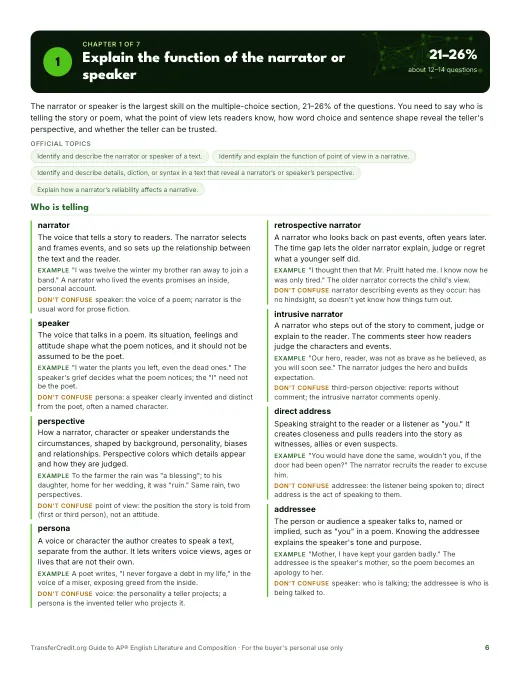
Page 1 of the TransferCredit.org Guide to AP® English Literature and Composition: the cover
Page 1 The cover
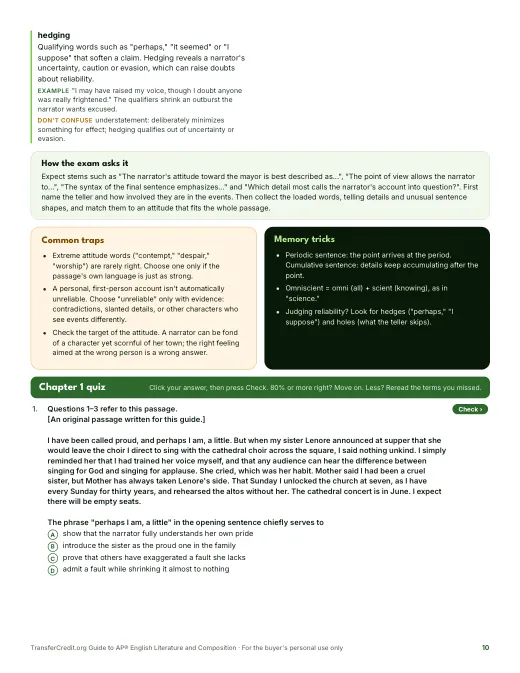
Page 6 of the TransferCredit.org Guide to AP® English Literature and Composition: the Chapter 1 opener
Page 6 The Chapter 1 opener
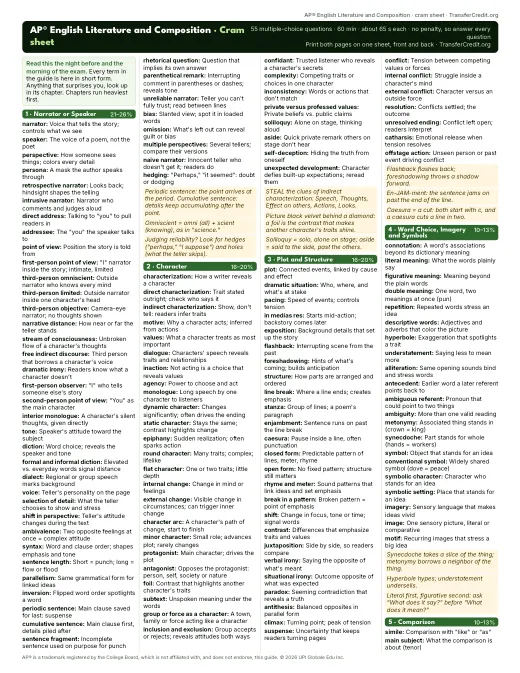
Page 10 of the TransferCredit.org Guide to AP® English Literature and Composition: a chapter quiz
Page 10 A chapter quiz
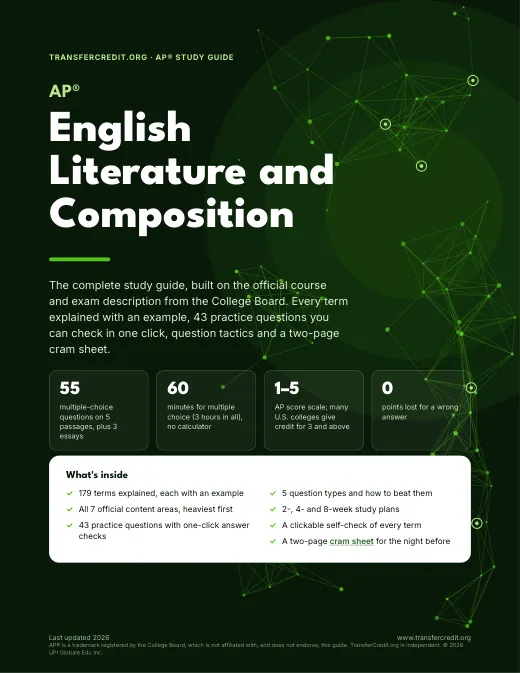
Page 46 of the TransferCredit.org Guide to AP® English Literature and Composition: the 2-page cram sheet
Page 46 The 2-page cram sheet

What you get for $5

One chapter for each area of the official course and exam description, heaviest topics first.

  • 📘47pages, printable
  • 🧭7chapters
  • 🔑179terms with examples
  • ✍️43practice questions, answers explained
  • ⚠️21exam traps to avoid
  • 📄2page cram sheet

Try 10 free AP® English Literature and Composition questions

Multiple-choice questions taken from the guide's chapter quizzes: 7 areas, heaviest first. About 10 minutes, with every answer explained and a score by area. The exam's free-response questions aren't in this quiz: see how the exam works.

10 questions  
  1. Question 1 · Narrator or Speaker
    Questions 1–3 refer to this passage.
    [An original passage written for this guide.]

    I have been called proud, and perhaps I am, a little. But when my sister Lenore announced at supper that she would leave the choir I direct to sing with the cathedral choir across the square, I said nothing unkind. I simply reminded her that I had trained her voice myself, and that any audience can hear the difference between singing for God and singing for applause. She cried, which was her habit. Mother said I had been a cruel sister, but Mother has always taken Lenore's side. That Sunday I unlocked the church at seven, as I have every Sunday for thirty years, and rehearsed the altos without her. The cathedral concert is in June. I expect there will be empty seats.

    The phrase "perhaps I am, a little" in the opening sentence chiefly serves to
    Show the answer

    Answer: C. admit a fault while shrinking it almost to nothing. "Perhaps" and "a little" are hedges: she concedes she may be proud, then qualifies the admission until it barely counts.

    The trap: The exaggerated-fault choice goes too far; the narrator does not deny her pride, since she says "perhaps I am."

  2. Question 2 · Character
    Questions 1–3 refer to this passage.
    [An original passage written for this guide.]

    Ray told everyone he was glad the shop was closing. "Forty years of selling hinges," he said to the auctioneer, "is about thirty-nine too many." He said it twice more that morning, louder each time, as if the shelves might argue. Then, while his sister priced the paint cans, he slipped the brass scale off the counter and wrapped it in his coat. Their father had weighed nails on it for every farmer in the county, and Ray had once been allowed to read the needle aloud. When Nell asked where the scale had gone, he shrugged and said somebody must have bought it early. She looked at the bulge under his coat and said nothing. At noon she brought him a sandwich and set it beside him without a word, the way their father used to set down a customer's change.

    Taken together, Ray's words and actions in the passage chiefly reveal
    Show the answer

    Answer: A. an attachment to the shop that his joking words deny. Ray insists he is "glad the shop was closing" and repeats the joke "louder each time," yet he secretly wraps his father's scale in his coat and lies about it. His actions contradict what he says.

    The trap: The plan to sell the scale has no support: nothing mentions profit, and the scale is tied to a memory of his father, not to money.

  3. Question 3 · Plot and Structure
    Questions 1–4 refer to this passage.
    [An original passage written for this guide.]

    The river had been rising for three days, and by Thursday even the town council had stopped arguing about the old levee. Marta's father loaded sandbags with the men from the mill. Twelve years ago he had voted against building a new levee; she remembered him standing at the back of the gym with his arms folded while the engineer explained the maps. Too much money, he had said, for a flood that came once in a lifetime. Now he worked without speaking, and when the mayor thanked him, he only nodded. At midnight the rain stopped. At one, the river crested. At two, a seam in the old wall split, and the water came through the orchard like something that had been waiting.

    The sentences beginning "Twelve years ago he had voted" primarily serve to
    Show the answer

    Answer: B. recall a past choice that complicates his present labor. The flashback recalls that he called a new levee "Too much money" for "a flood that came once in a lifetime." Set beside his silent work and his bare nod at the mayor's thanks, it hints at guilt or responsibility.

    The trap: Blame from the council is never stated: the council has "stopped arguing," and the mayor thanks him.

  4. Question 4 · Word Choice, Imagery and Symbols
    Questions 1–3 refer to this passage.
    [An original passage written for this guide.]

    The Spare Key

    My mother keeps a key beneath the stone
    beside the steps, the way she always has,
    though everyone who lives here has their own.
    The rain gets under it. The key has rusted
    the color of the stone, and snails have left
    their silver signatures across its teeth.
    The neighbors warn her anyone could find it.
    She says the lock sticks, she'll forget her own,
    and turns the talk to someone else's roof.
    My brother left nine winters back. The key
    has been replaced three times. I've checked.
    Tonight I stand outside the door, in the cold,
    and almost knock, as if I were a stranger,
    as if the key were meant for anyone.

    In the poem, the spare key most likely symbolizes
    Show the answer

    Answer: D. the mother's unspoken hope that her son will come home. She keeps it "though everyone who lives here has their own," waves off the neighbors' warnings, and has replaced it "three times" since "My brother left nine winters back": the key is kept for him.

    The trap: The forgetfulness choice believes her excuse that "she'll forget her own"; she changes the subject at once, which shows the excuse hides her real reason.

  5. Question 5 · Comparison
    Questions 1–3 refer to this passage.
    [An original passage written for this guide.]

    Insomnia

    Night is a jailer who takes every bribe.
    He rattles every lock along the row,
    counts off the hours on his ring of keys,
    and leans against my door until it creaks.
    My thoughts are shoppers in a store at closing,
    rushing the aisles and buying nothing.
    I bargain with him: give me one more hour
    and you can have tomorrow's patience, my good mood.
    He takes them both and keeps me anyway.
    At five the sky begins to fade like a bruise,
    and he goes jingling off along the hall,
    already choosing whose door to lean on next.

    Throughout the poem, night is presented as a jailer chiefly to suggest that the speaker
    Show the answer

    Answer: D. feels ruled by a force that takes without giving. Night "takes every bribe," accepts the offered "patience" and "good mood," then "keeps me anyway": the jailer comparison shows a power that takes and never releases the speaker.

    The trap: The actual-prison choice takes the metaphor literally; the title "Insomnia" shows the speaker is simply unable to sleep.

  6. Question 6 · Literary Argument
    Questions 1–3 refer to this passage.
    [An original passage written for this guide.]

    Every Saturday Mr. Abernathy wound the metronome before he said hello, and Pia had learned to judge his mood by how hard he turned the key. Today he barely touched it. "Again," he said after her first page, and then, "Again," though she had not missed a note. Through the window she could see her brother's team on the field, their shouts arriving faintly, a half-second late. She played the page a third time, slower, letting the last chord hang until the metronome seemed to wait for her. Mr. Abernathy stopped it with one finger. For a while he looked at the keys instead of at her. "That," he said, "is the first time you've played it as if you meant it." She did not tell him she had been thinking about the field the whole time.

    Which of the following is a defensible claim about the passage, one that requires evidence from the text to support it?
    Show the answer

    Answer: C. The metronome reflects a quiet struggle over who controls the lesson.. The claim is arguable and must be defended with details: he winds the metronome each week, Pia plays until "the metronome seemed to wait for her," and he "stopped it with one finger." The other choices state a checkable fact, summarize, or predict what the passage never supports.

    The trap: The Saturday-lesson choice is accurate, but it is a fact anyone can check, so it needs no defense and cannot anchor an argument.

  7. Question 7 · Setting
    Questions 1–3 refer to this passage.
    [An original passage written for this guide.]

    The Amaro house stood at the end of Linden Court, on the last lot the builder had sold before the money ran out. Beyond its fence the street simply stopped, and a field of survey stakes and orange flags ran toward the highway. Inside, everything was new: carpet that still smelled of glue, a dishwasher no one had learned to load, a living room so large that the family's old sofa looked like a guest who had arrived too early. Ada's mother walked through the rooms each evening switching off lamps, as if light still cost what it had cost in the apartment on Fourth Street. Ada liked the field best. After dinner she went out past the fence and walked between the flags until the house was only a lit window behind her.

    The details in the sentence beginning "Inside, everything was new" chiefly convey that the family
    Show the answer

    Answer: A. has not yet grown used to its new home. "A dishwasher no one had learned to load" and an old sofa that looks "like a guest who had arrived too early" show a family not yet at home in its new space.

    The trap: The poorly-built choice misreads "carpet that still smelled of glue": the smell signals newness, not bad work.

  8. Question 8 · Narrator or Speaker
    Same passage as question 1. The narrator's comment that "Mother has always taken Lenore's side" primarily serves to
    Show the answer

    Answer: B. dismiss a judgment that conflicts with her own account. Her mother calls her "cruel"; instead of weighing the charge, the narrator explains it away as favoritism. The move exposes her bias and makes her version of the supper harder to trust.

    The trap: The true-cause choice adopts the narrator's slant; the passage gives no evidence that the mother started anything.

  9. Question 9 · Character
    Same passage as question 1. Nell's response when she "looked at the bulge under his coat and said nothing" suggests that she
    Show the answer

    Answer: B. sees through Ray's lie and chooses not to expose it. Nell looks straight at "the bulge under his coat," so she knows where the scale is, yet she says nothing and later brings him a sandwich "without a word." Her silence protects him.

    The trap: The idea that Nell believes the lie reverses the passage: she looks right at the hidden scale, so she is not fooled.

  10. Question 10 · Plot and Structure
    Same passage as question 1. The sequence "At midnight the rain stopped. At one, the river crested. At two, a seam in the old wall split" primarily serves to
    Show the answer

    Answer: C. build tension with short, clocked steps toward the break. Three short sentences, each stamped with an hour ("At midnight... At one... At two"), march like a countdown, so the rain's stopping brings no relief and tension rises until the wall "split."

    The trap: The slowing-down reading mistakes "the rain stopped" for calm; the hour-by-hour rhythm speeds toward disaster instead.

The AP® English Literature and Composition exam at a glance

The AP® English Literature and Composition exam is from the College Board. It has 55 multiple-choice questions on 5 passages, plus 3 essays. You get 60 minutes for multiple choice (3 hours in all), no calculator. The score scale is 1–5 (AP® score scale; many U.S. colleges give credit for 3 and above). The guide has 7 chapters, one for each area of the official course and exam description; the heaviest is Explain the function of the narrator or speaker at 21–26%.

Questions
55multiple-choice questions on 5 passages, plus 3 essays
Time
60 minfor the 55 multiple-choice questions, about 65 seconds a question
Score
1–5AP® score scale; many U.S. colleges give credit for 3 and above
Fee
$99per exam in the U.S. and Canada in 2026-27; your school may charge more
Calculator
Nonot allowed
Wrong answers
No penaltya wrong answer costs nothing
  • Section I has 55 multiple-choice questions in 1 hour (45% of your score). Section II has 3 essays in 2 hours (55%): a Poetry Analysis, a Prose Fiction Analysis and a Literary Argument, each scored out of 6 points, with about 40 minutes recommended for each.
  • The multiple-choice questions come in 5 sets of 8–13 questions, each on one passage of prose fiction, drama or poetry. At least 2 passages are prose fiction (which may include drama) and at least 2 are poetry.
  • By the course's genre units, short fiction is about 42–49% of the multiple-choice section, poetry 36–45%, and longer fiction or drama 15–18%. The exam uses more 20th-century and contemporary texts than texts published before the 20th century.
  • The exam is fully digital: you answer every question in the Bluebook testing app. No calculator is allowed.
  • Your multiple-choice score is the number of questions you answer correctly, so a wrong answer costs nothing.

Source: official AP® English Literature and Composition page and the official course and exam description. Last updated 2026.

What the exam covers

7 chapters, heaviest first, with each area's official weight. The guide's chapters follow this order.

  1. Explain the function of the narrator or speaker21–26% · ~12–14 Q
  2. Explain the function of character16–20% · ~9–11 Q
  3. Explain the function of plot and structure16–20% · ~9–11 Q
  4. Explain the function of word choice, imagery, and symbols10–13% · ~6–7 Q
  5. Explain the function of comparison10–13% · ~6–7 Q
  6. Develop textually substantiated arguments about interpretations of part or all of a text10–13% · ~6–7 Q
  7. Explain the function of setting3–6% · ~2–3 Q

Where to start: the 4 heaviest areas (marked in the map) carry about 39 of the 55 questions. The guide puts them first, so working front to back covers the most points earliest.

AP® English Literature and Composition study guide by area

The heaviest area is open to read now. The full guide has a chapter for every area, each with all its terms, a quiz and an answer key.

1 of 7 chapters open  ·  in the guide's order
21–26% · about 12–14 questions · free preview Explain the function of the narrator or speaker Chapter 1 of the guide

The narrator or speaker is the largest skill on the multiple-choice section, 21–26% of the questions. You need to say who is telling the story or poem, what the point of view lets readers know, how word choice and sentence shape reveal the teller's perspective, and whether the teller can be trusted.

Key terms, with examples

narrator
The voice that tells a story to readers. The narrator selects and frames events, and so sets up the relationship between the text and the reader.
Example: "I was twelve the winter my brother ran away to join a band." A narrator who lived the events promises an inside, personal account.
point of view
The position from which a story is told, such as first or third person. It controls what the narrator can know, see and reveal to readers.
Example: "Through the keyhole I saw only her shoes." First-person point of view limits the scene to what one narrator can see.
tone
The narrator's or speaker's attitude toward a subject, character or event, shown through word choice, detail and syntax. Tone guides how readers judge what is described.
Example: "The committee, in its wisdom, spent six months choosing a new shade of beige." "In its wisdom" gives a mocking tone.
syntax
The arrangement of words, phrases and clauses in sentences. Syntax can emphasize details or ideas and convey a narrator's or speaker's tone, pace and state of mind.
Example: "Gone, the money. Gone, the house. Gone, the friends who had loved the house." Front-loading "Gone" stresses loss again and again.
unreliable narrator
A narrator whose account readers cannot fully trust, because of bias, ignorance, self-interest or instability. Readers must read past the narrator, which changes how they judge characters' motives.
Example: "I am the calmest man alive," he wrote, "which is why I smashed the radio." His claim and his act clash, so readers doubt him.
speaker
The voice that talks in a poem. Its situation, feelings and attitude shape what the poem notices, and it should not be assumed to be the poet.
Example: "I water the plants you left, even the dead ones." The speaker's grief decides what the poem notices; the "I" need not be the poet.
first-person point of view
Narration by an "I" who takes part in the story. The narrator's involvement gives intimacy but limits knowledge, and relationships to other characters shape the account.
Example: "I told Dad the window broke itself, and he believed me, which was worse." The "I" reveals guilt only an insider could feel.
diction
A narrator's or speaker's choice of words. Diction reveals background, education and perspective, and it shapes tone and the reader's view of the subject.
Example: One narrator calls the neighbors' yard "overgrown"; another calls it "wild with roses." The diction reveals scorn versus delight.
sentence length
How long or short sentences are, and how they vary. Short sentences add punch, tension or finality; long ones can create flow, excitement or a feeling of being overwhelmed.
Example: After a long, rambling description of the party, the narrator writes: "Then the phone rang." The short sentence jolts the scene.
bias
A narrator's or character's leaning for or against someone, shaped by interests, loyalties or experience. Readers infer it from slanted words and chosen details; it can lower reliability.
Example: "Coach Lee benched me for no reason, as usual, after just three fumbles." The narrator's resentment slants the account.
perspective
How a narrator, character or speaker understands the circumstances, shaped by background, personality, biases and relationships. Perspective colors which details appear and how they are judged.
Example: To the farmer the rain was "a blessing"; to his daughter, home for her wedding, it was "ruin." Same rain, two perspectives.
third-person omniscient
An all-knowing outside narrator who can enter any character's mind and report events anywhere. It lets readers compare hidden thoughts and see more than any one character.
Example: "Jun thought the camping trip a triumph; in the next tent, his wife was planning her escape." Entering both minds exposes the gap.

What this area covers

Who is tellingPoint of viewTone, diction and detailSyntax: how sentences reveal perspectiveReliability

How the exam asks it

Expect stems such as "The narrator's attitude toward the mayor is best described as...", "The point of view allows the narrator to...", "The syntax of the final sentence emphasizes..." and "Which detail most calls the narrator's account into question?". First name the teller and how involved they are in the events. Then collect the loaded words, telling details and unusual sentence shapes, and match them to an attitude that fits the whole passage.

Common traps

Trap 1. Extreme attitude words ("contempt," "despair," "worship") are rarely right. Choose one only if the passage's own language is just as strong.

Trap 2. A personal, first-person account isn't automatically unreliable. Choose "unreliable" only with evidence: contradictions, slanted details, or other characters who see events differently.

Trap 3. Check the target of the attitude. A narrator can be fond of a character yet scornful of her town; the right feeling aimed at the wrong person is a wrong answer.

Memory trick

Periodic sentence: the point arrives at the period. Cumulative sentence: details keep accumulating after the point.

Omniscient = omni (all) + scient (knowing), as in "science."

How AP® English Literature and Composition questions are written

The exam has 55 multiple-choice questions on 5 passages, plus 3 essays. The guide sorts the questions into 5 types; spot the type and you'll know what the question wants before you read the choices.

Type 1

What a detail or phrase does

A quoted word, phrase, detail or image, then "primarily serves to" or "chiefly suggests". The four choices name possible functions.

  • Reread the sentence before and after the quoted words.
  • Say in your own words what the detail adds: a trait, a mood, a contrast or an idea.
  • Match the stem's verb: "serves to" asks for an effect, "suggests" asks for an inference.
Type 2

Attitude or perspective

"The speaker's attitude toward X is best described as..." or "The narrator regards X with...". The choices are short phrases, often two words each.

  • Mark the words that judge or color X: descriptive words, comparisons, changes in tone.
  • Decide whether the attitude is positive, negative or mixed before reading the choices.
  • Read to the last line before deciding: an attitude often turns or becomes mixed by the end.
Type 3

Shift or structure

"The shift in the final stanza marks a move from..." or "The final sentence serves to...". The choices name a before and an after, or the effect of a placement.

  • Find the signal: a word such as "but" or "now", a stanza break, a dash or a change in tense.
  • Name what comes before the signal and what comes after it.
  • Ask what the change emphasizes, such as a loss, a realization or a contrast.
Type 4

Word or phrase in context

"In context, 'X' most nearly means...". The word is often used in a figurative or less familiar sense.

  • Cover the word and predict a replacement from the sentences around it.
  • Let the passage's tone and situation narrow the meaning.
  • Pick the choice closest to your prediction.
Type 5

Best-supported claim or interpretation

"Which claim about the passage is best supported?" or "The passage as a whole is best understood as...". Related questions ask which quotation, commentary or thesis best supports an interpretation.

  • Before reading the choices, sum up the passage in one sentence: who, what changes, what attitude.
  • For each choice, find words in the passage that prove it; no proof, cross it out.
  • Be wary of choices that predict what happens next: the passage must prove a claim as written.

Test-day habits that add points

  1. Answer every question. There's no penalty for a wrong answer. A blank is always worth zero, so never leave one.
  2. Predict, then look. Name the answer before reading the choices. It protects you from distractors written to sound right.
  3. Eliminate. Cross out choices you know are wrong. Every choice you rule out raises your odds on a guess.
  4. Mark and move on. If a question takes more than a minute, pick your best guess, mark it and come back if time allows.
  5. Watch absolute words. Choices with "always", "never" or "only" are often wrong, because most rules and findings have exceptions. Treat this as a tiebreaker, not a rule.
  6. Change answers for a reason. Switch an answer only when you can say why the new one is better, such as a detail you missed.
  7. The three essays. After the multiple-choice section (55 questions in 1 hour, 45% of your score), Section II gives you 3 essays in 2 hours (55%), with about 40 minutes recommended for each. Poetry Analysis gives you a poem of about 100–400 words, and Prose Fiction Analysis a passage of about 600–800 words (it may include drama); each asks you to analyze how the writer uses literary (or poetic) elements and techniques to convey a complex aspect of the text. Literary Argument gives you a literary concept or idea to apply to a work you choose. Each essay is scored out of 6 points.
  8. How the essays are scored. All three essays are scored in three rows. Row A, Thesis (0–1 point): a thesis that responds to the prompt with a defensible interpretation. Row B, Evidence and Commentary (0–4 points): the top score needs specific evidence for every claim in a line of reasoning, commentary that consistently explains how the evidence supports it and, in essays 1 and 2, an explanation of how multiple literary elements or techniques contribute to meaning. Row C, Sophistication (0–1 point): sophistication of thought or a complex literary argument (the term sophistication in the Literary Argument chapter lists the ways the rubric names).
  9. Essay 3: pick your work early. Essay 3 comes with a list of about 40 works. Choose a work of fiction, such as a novel or a play, from that list or from your own reading (the College Board's student page says "prose fiction or drama"), then analyze how the prompt's concept contributes to an interpretation of the work as a whole. The prompt says, "Do not merely summarize the plot." The College Board's general rule is to use a work similar in quality to those you have read in your AP® class. Before exam day, pick two or three works you know well enough to recall characters, key scenes and details from memory.

Pacing: 55 questions in 60 minutes, about 65 seconds a question.

AP® English Literature and Composition flashcards

Try the first 8 cards free. Read the term, say the definition out loud, then select the card to check yourself. Arrow keys move between cards.

Free card 1 of 8 (deck total: 179)

How to study for AP® English Literature and Composition: a 5-step plan

Follow the steps, then enter your test date. The planner gives you a dated plan that starts with the heaviest areas and saves the last days for review.

  1. Take the 10 free questionsSee which AP® English Literature and Composition areas you already know.
  2. Study the heaviest areas firstStart with Explain the function of the narrator or speaker, Explain the function of character and Explain the function of plot and structure, then work down the exam map.
  3. Learn each term with an exampleSay the definition out loud, then check it with the flashcards. A term you can't use in an example isn't learned yet.
  4. Quiz yourself and study the trapsAfter each area, answer its quiz and read why the tempting wrong answer is wrong.
  5. Plan backwards from your exam dateBuild a dated plan, keep the last days for a full review, and read the cram sheet the night before.

How it works

  1. 1Check outSelect Get the guide · $5 and pay on TransferCredit.org's secure checkout.
  2. 2Download the PDFFrom your TransferCredit.org account.
  3. 3Study the heaviest areas firstFollow the 2-, 4- or 8-week plan, then read the cram sheet the night before.

This page or the full guide

Everything on this page is free with no account. The full guide is a PDF you keep.

What's on this page and in the full study guide
Study toolThis pageFull study guide ($5)
ChaptersA preview of 1 of 7All 7
Terms explainedA sample from the open chaptersAll 179, each with an example
Practice questions10 free questions43, with an answer key
Flashcards8 cardsAll 179 terms on the self-check list
Study planDated planner2-, 4- and 8-week plans
Cram sheet—2 pages, for the night before
FormatWeb page47-page PDF, printable

Questions students ask

What's in the full AP® English Literature and Composition study guide?
47 pages: 7 chapters, one for each area of the College Board's official course and exam description, heaviest topics first. 179 terms, each with a plain-English definition and an example, common traps and memory tricks, 43 practice questions with an answer key that explains every answer, question tactics, 2-, 4- and 8-week study plans and a 2-page cram sheet.
How much is the full AP® English Literature and Composition study guide?
The full 47-page PDF is $5. The 10 practice questions on this page are free.
How do I get the full guide?
Select Get the guide · $5 and check out on TransferCredit.org. Then sign in to your TransferCredit.org account to download the PDF.
Can I print the guide or use it on my phone?
Yes. It's a PDF, so it opens on phones, tablets and computers, and printing is allowed. Its tick boxes and answer bubbles work in PDF readers that support forms. Copying and editing are turned off.
Can I try the AP® English Literature and Composition guide before I buy it?
Yes. This page has 10 questions from the guide's own chapter quizzes, a preview of the heaviest area, 8 flashcards and a study planner. No account needed.
Is this an official AP® study guide?
No. AP® is a trademark registered by the College Board, which is not affiliated with, and does not endorse, this guide. TransferCredit.org is independent. We built the guide from the College Board's official course and exam description, and the exam details were checked against the College Board's published exam information in 2026.
How was this study guide made?
One chapter for each area of the official course and exam description, using its published weights. Each chapter was written, then fact-checked against the official exam information in a separate review. The practice questions are original: none are copied from the College Board's released questions.
How up to date is this AP® English Literature and Composition guide?
Last updated 2026. The exam details were checked against the College Board's published exam information in 2026. Exams change, so confirm the details on the official AP® English Literature and Composition page before you test.
More questions about the AP® English Literature and Composition exam (16)
What is the AP® English Literature and Composition exam?
The AP® English Literature and Composition exam is from the College Board. It has 55 multiple-choice questions on 5 passages, plus 3 essays. You get 60 minutes for multiple choice (3 hours in all), no calculator. The score scale is 1–5 (AP® score scale; many U.S. colleges give credit for 3 and above). The guide has 7 chapters, one for each area of the official course and exam description; the heaviest is Explain the function of the narrator or speaker at 21–26%.
How many questions are on the AP® English Literature and Composition exam, and how long is it?
Section I has 55 multiple-choice questions in 1 hour (45% of your score). Section II has 3 essays in 2 hours (55%): a Poetry Analysis, a Prose Fiction Analysis and a Literary Argument, each scored out of 6 points, with about 40 minutes recommended for each.
How is the AP® English Literature and Composition exam scored?
The score scale is 1–5: AP® score scale; many U.S. colleges give credit for 3 and above. Your multiple-choice score is the number of questions you answer correctly, so a wrong answer costs nothing.
What AP® English Literature and Composition score do I need for college credit?
Many U.S. colleges give credit for 3 and above. Each college sets its own credit policy, so check the one at your college before you count on the credit.
How much does the AP® English Literature and Composition exam cost?
The fee is $99: per exam in the U.S. and Canada in 2026-27; your school may charge more. Fees can change, so check the official page when you register.
Can I use a calculator on the AP® English Literature and Composition exam?
No calculator is allowed.
Is there a penalty for guessing on AP® English Literature and Composition?
No. There's no penalty for a wrong answer. A blank is always worth zero, so never leave one.
What topics are on the AP® English Literature and Composition exam?
7 areas, from the official course and exam description: Explain the function of the narrator or speaker (21–26%); Explain the function of character (16–20%); Explain the function of plot and structure (16–20%); Explain the function of word choice, imagery, and symbols (10–13%); Explain the function of comparison (10–13%); Develop textually substantiated arguments about interpretations of part or all of a text (10–13%); Explain the function of setting (3–6%).
Which AP® English Literature and Composition topics should I study first?
The 4 heaviest areas (marked in the map) carry about 39 of the 55 questions. The guide puts them first, so working front to back covers the most points earliest.
Is the AP® English Literature and Composition exam hard?
It depends on what you already know. The largest area, Explain the function of the narrator or speaker, is 21–26%, and the smallest, Explain the function of setting, is 3–6%. Try the 10 free questions above to see where you stand in about 10 minutes.
What kinds of questions are on the AP® English Literature and Composition exam?
The exam has 55 multiple-choice questions on 5 passages, plus 3 essays. The guide sorts the questions into 5 types: “What a detail or phrase does”, “Attitude or perspective”, “Shift or structure”, “Word or phrase in context” and “Best-supported claim or interpretation”. Multiple-choice questions have 4 answer choices. See how each type is written.
What are the free-response questions on the AP® English Literature and Composition exam?
After the multiple-choice section (55 questions in 1 hour, 45% of your score), Section II gives you 3 essays in 2 hours (55%), with about 40 minutes recommended for each. Poetry Analysis gives you a poem of about 100–400 words, and Prose Fiction Analysis a passage of about 600–800 words (it may include drama); each asks you to analyze how the writer uses literary (or poetic) elements and techniques to convey a complex aspect of the text. Literary Argument gives you a literary concept or idea to apply to a work you choose. Each essay is scored out of 6 points. All three essays are scored in three rows. Row A, Thesis (0–1 point): a thesis that responds to the prompt with a defensible interpretation. Row B, Evidence and Commentary (0–4 points): the top score needs specific evidence for every claim in a line of reasoning, commentary that consistently explains how the evidence supports it and, in essays 1 and 2, an explanation of how multiple literary elements or techniques contribute to meaning. Row C, Sophistication (0–1 point): sophistication of thought or a complex literary argument (the term sophistication in the Literary Argument chapter lists the ways the rubric names). Essay 3 comes with a list of about 40 works. Choose a work of fiction, such as a novel or a play, from that list or from your own reading (the College Board's student page says "prose fiction or drama"), then analyze how the prompt's concept contributes to an interpretation of the work as a whole. The prompt says, "Do not merely summarize the plot." The College Board's general rule is to use a work similar in quality to those you have read in your AP® class. Before exam day, pick two or three works you know well enough to recall characters, key scenes and details from memory.
How should I pace myself on the AP® English Literature and Composition exam?
55 questions in 60 minutes, about 65 seconds a question. If a question takes more than a minute, pick your best guess, mark it and come back if time allows.
How long should I study for AP® English Literature and Composition?
Take the 10 free questions to see where you stand. The full guide has 2-, 4- and 8-week plans built from the exam weights, and the planner on this page builds a dated plan from your exam date.
How do I know I'm ready for the AP® English Literature and Composition exam?
The guide's readiness checklist: You can explain every term on the checklist without notes. You score 80% or better on every chapter quiz. You can read the cram sheet and nothing on it surprises you. You know the AP® score your college gives credit for, and your exam date.
What should I do the night before?
Read the 2-page cram sheet once, slowly. Check your exam time and room with your AP® coordinator. The whole exam is taken in the Bluebook app. In the morning, skim the traps, then stop studying.

How we built this guide

We built one chapter for each area of the College Board's official course and exam description for AP® English Literature and Composition, using its published weights to order the chapters and size the quizzes. Each chapter was written, then fact-checked against the official exam information in a separate review. The exam details were checked against the College Board's published exam information in 2026.

Sources: official AP® English Literature and Composition page, official course and exam description. Last updated 2026.

AP® is a trademark registered by the College Board, which is not affiliated with, and does not endorse, this guide. TransferCredit.org is independent and not affiliated with the College Board. © 2026 UPI Globale Edu Inc.

Ready for the full AP® English Literature and Composition guide? 47 pages, 179 terms, 43 practice questions and a 2-page cram sheet, $5.

Get the guide · $5

In the full guide

TransferCredit.org Guide to AP® English Literature and Composition

  • All 7 chapters
  • 179 terms with examples
  • 43 practice questions with an answer key
  • A 2-page cram sheet and 2-, 4- and 8-week plans
Get the guide · $5