← All SAT® study guides
SAT® Study Guide Printable PDF · 29 pages

TransferCredit.org Guide to SAT® Math

SAT® Math study guide: a printable PDF built from the College Board's official test specifications, heaviest topics first.

  • 163 key terms, each with an example
  • 40 practice questions with every answer explained
  • A 2-page cram sheet for the night before
  • 2-, 4- and 8-week study plans built from the exam weights
Not sure yet? Try 10 free questions

Last updated 2026 · exam details checked against the College Board's published exam information in 2026

Look inside the guide

Real pages from the 29-page PDF.

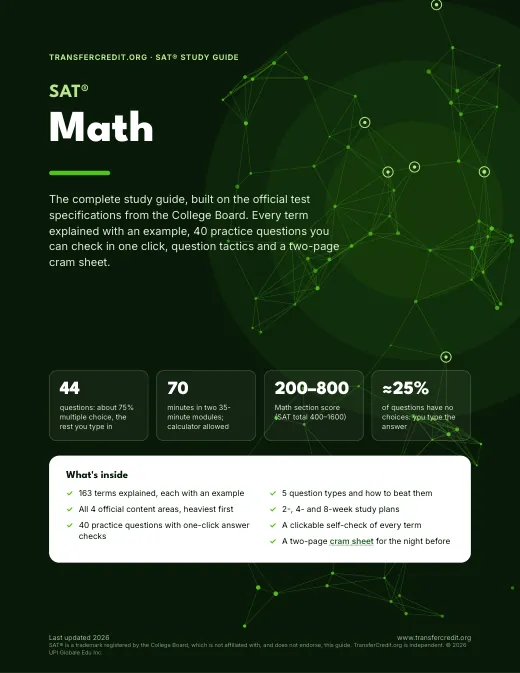
Page 1 of the TransferCredit.org Guide to SAT® Math: the cover
Page 1 The cover
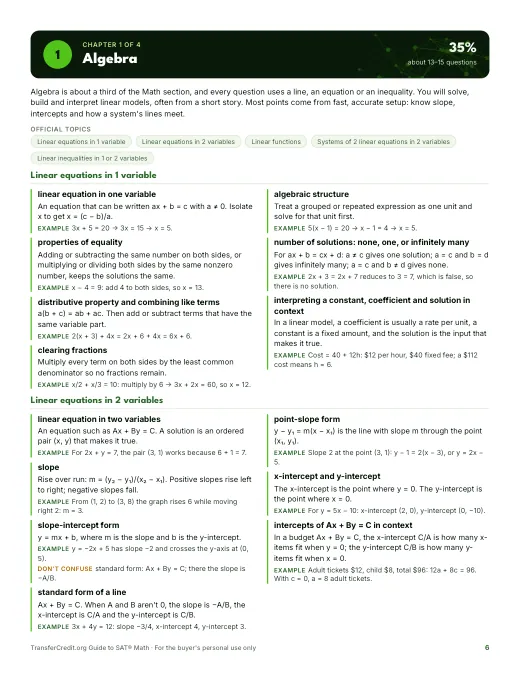
Page 6 of the TransferCredit.org Guide to SAT® Math: the Chapter 1 opener
Page 6 The Chapter 1 opener
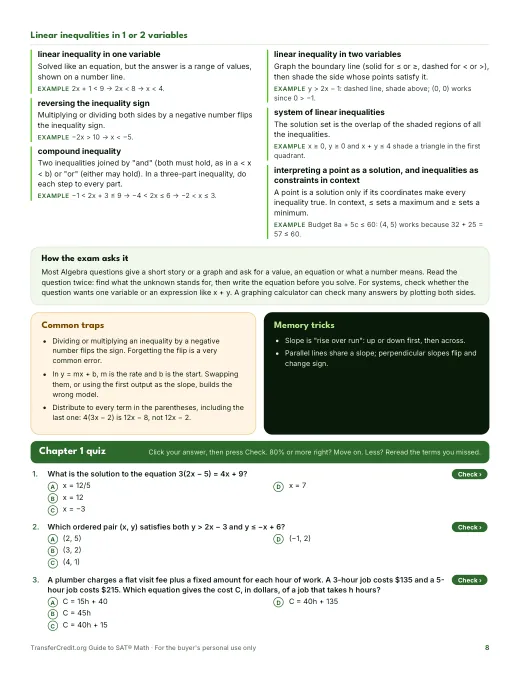
Page 8 of the TransferCredit.org Guide to SAT® Math: a chapter quiz
Page 8 A chapter quiz
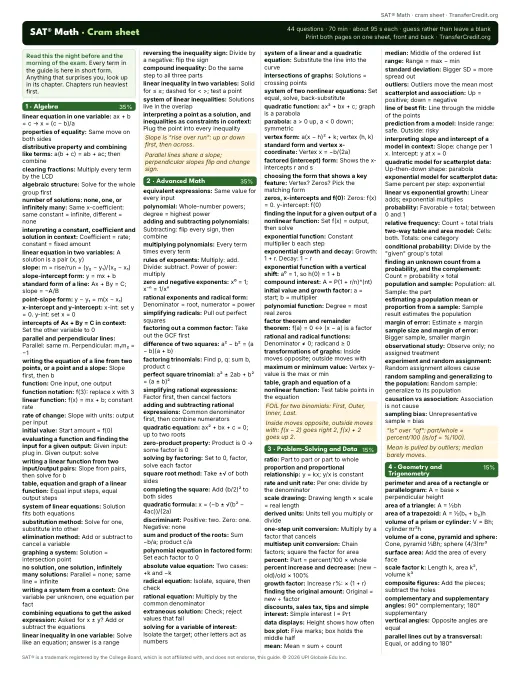
Page 28 of the TransferCredit.org Guide to SAT® Math: the 2-page cram sheet
Page 28 The 2-page cram sheet

What you get for $5

One chapter for each area of the official test specifications, heaviest topics first.

  • 📘29pages, printable
  • 🧭4chapters
  • 🔑163terms with examples
  • ✍️40practice questions, answers explained
  • ⚠️12exam traps to avoid
  • 📄2page cram sheet

Try 10 free SAT® Math questions

Multiple-choice questions taken from the guide's chapter quizzes: 4 areas, heaviest first. About 15 minutes, with every answer explained and a score by area.

10 questions  
  1. Question 1 · Algebra
    What is the solution to the equation 3(2x − 5) = 4x + 9?
    Show the answer

    Answer: A. x = 12. Distribute: 6x − 15 = 4x + 9. Subtract 4x and add 15: 2x = 24, so x = 12.

    The trap: x = 7 comes from distributing only to the 2x and writing 6x − 5; 3 must multiply the −5 too.

  2. Question 2 · Advanced Math
    A student subtracts two polynomials: (3x² − 2x + 5) − (x² − 6x − 1). Which expression is the result?
    Show the answer

    Answer: B. 2x² + 4x + 6. Distribute the minus sign to every term of the second polynomial: 3x² − 2x + 5 − x² + 6x + 1. Combining like terms gives 2x² + 4x + 6.

    The trap: 2x² − 8x + 4 comes from subtracting only the first term of the second polynomial and leaving the other signs unchanged.

  3. Question 3 · Problem-Solving and Data
    The price of a tablet rose from $240 to $276, and then the store took 10% off the new price. What was the final price?
    Show the answer

    Answer: C. $248.40. Take 10% off $276 by multiplying by 0.90: 276 × 0.90 = $248.40.

    The trap: $252.00 nets a 15% rise and a 10% cut into a 5% rise on $240. Each percent applies to a different base, so they cannot be added.

  4. Question 4 · Geometry and Trigonometry
    A cylindrical tank has a radius of 5 feet and a height of 12 feet. It is filled to 3/4 of its volume with water. What is the volume of the water, in cubic feet?
    Show the answer

    Answer: D. 225π. The full volume is π(5²)(12) = 300π. Three-fourths of that is 225π cubic feet.

    The trap: 900π uses the diameter 10 as the radius, which makes the full tank 1,200π.

  5. Question 5 · Algebra
    Which ordered pair (x, y) satisfies both y > 2x − 3 and y ≤ −x + 6?
    Show the answer

    Answer: C. (−1, 2). For (−1, 2): 2 > 2(−1) − 3 = −5 is true, and 2 ≤ −(−1) + 6 = 7 is true, so both hold.

    The trap: (2, 5) passes the first inequality (5 > 1) but fails the second, since 5 is not at most 4. A point must satisfy every inequality.

  6. Question 6 · Advanced Math
    Which expression is equivalent to (27a⁶)^(2/3), for a > 0?
    Show the answer

    Answer: B. 9a⁴. Apply the exponent to each factor: 27^(2/3) = (³√27)² = 3² = 9, and (a⁶)^(2/3) = a⁴. The result is 9a⁴.

    The trap: 9a⁹ multiplies the exponents 6 and 3/2 instead of 6 and 2/3, flipping the fraction.

  7. Question 7 · Problem-Solving and Data
    A pump moves water at 0.75 liters per second. How many liters does it move in 2 hours?
    Show the answer

    Answer: A. 5,400. 2 hours is 2 × 3,600 = 7,200 seconds, and 0.75 × 7,200 = 5,400 liters.

    The trap: 2,700 stops at one hour (0.75 × 3,600). The question asks for 2 hours.

  8. Question 8 · Geometry and Trigonometry
    A 15-foot ladder leans against a wall and makes a 60° angle with the ground. To the nearest tenth of a foot, how high up the wall does the ladder reach?
    Show the answer

    Answer: D. 13.0. The height is opposite the 60° angle and the ladder is the hypotenuse, so height = 15 sin 60° ≈ 13.0 feet.

    The trap: 7.5 is 15 cos 60°, which is the distance from the wall to the base of the ladder, not the height.

  9. Question 9 · Algebra
    A plumber charges a flat visit fee plus a fixed amount for each hour of work. A 3-hour job costs $135 and a 5-hour job costs $215. Which equation gives the cost C, in dollars, of a job that takes h hours?
    Show the answer

    Answer: A. C = 40h + 15. The slope is (215 − 135)/(5 − 3) = 40 dollars per hour. Then 135 = 40(3) + b gives b = 15, the flat fee.

    The trap: C = 15h + 40 swaps the rate and the fee. The $40 is what each hour adds, so it multiplies h.

  10. Question 10 · Advanced Math
    For all x except 4 and −1, which expression is equivalent to (x² − 16)/(x² − 3x − 4)?
    Show the answer

    Answer: B. (x + 4)/(x + 1). Factor: x² − 16 = (x − 4)(x + 4) and x² − 3x − 4 = (x − 4)(x + 1). Cancel the common factor x − 4 to get (x + 4)/(x + 1).

    The trap: 16/(3x + 4) cancels the x² terms, but x² is a term, not a factor, so it cannot be cancelled.

The SAT® Math section at a glance

The SAT® Math section is from the College Board. It has 44 questions: about 75% multiple choice, the rest you type in. You get 70 minutes in two 35-minute modules; calculator allowed. The score scale is 200–800 (Math section score, SAT® total 400–1600). The guide has 4 chapters, one for each area of the official test specifications; the heaviest is Algebra at 35%.

Questions
44questions: about 75% multiple choice, the rest you type in
Time
70 minabout 95 seconds a question
Score
200–800Math section score (SAT® total 400–1600)
Fee
$68SAT® registration fee in the U.S. (through June 2027)
Calculator
Yescalculator allowed
Typed answers
≈25%of questions have no choices: you type the answer
  • The Math section has 44 questions in 70 minutes, in two 35-minute modules. How you do on the first module decides whether the second module is harder or easier.
  • About 75% of the questions are four-option multiple choice. The rest are student-produced responses: you type your own answer, and some have more than one correct answer.
  • Each module includes two pretest questions that don't count toward your score, so 40 of the 44 questions are scored.
  • You may use the Desmos calculator built into Bluebook, or your own approved calculator, for the whole Math section. A reference sheet of formulas is provided.
  • About 30% of the questions are set in context: a science, social studies or real-world scenario. Within each module, questions run from easiest to hardest.
  • The College Board says it's better to guess than to leave a question unanswered.

Source: official SAT® Math page and the official test specifications. Last updated 2026.

What the section covers

4 chapters, heaviest first, with each area's official weight. The guide's chapters follow this order.

  1. Algebra35% · ~13–15 Q
  2. Advanced Math35% · ~13–15 Q
  3. Problem-Solving and Data Analysis15% · ~5–7 Q
  4. Geometry and Trigonometry15% · ~5–7 Q

Where to start: the 2 heaviest areas (marked in the map) carry about 70% of your score. The guide puts them first, so working front to back covers the most points earliest.

SAT® Math study guide by area

The heaviest area is open to read now. The full guide has a chapter for every area, each with all its terms, a quiz and an answer key.

1 of 4 chapters open  ·  in the guide's order
35% · about 13–15 questions · free preview Algebra Chapter 1 of the guide

Algebra is about a third of the Math section, and every question uses a line, an equation or an inequality. You will solve, build and interpret linear models, often from a short story. Most points come from fast, accurate setup: know slope, intercepts and how a system's lines meet.

Key terms, with examples

linear equation in one variable
An equation that can be written ax + b = c with a ≠ 0. Isolate x to get x = (c − b)/a.
Example: 3x + 5 = 20 → 3x = 15 → x = 5.
linear equation in two variables
An equation such as Ax + By = C. A solution is an ordered pair (x, y) that makes it true.
Example: For 2x + y = 7, the pair (3, 1) works because 6 + 1 = 7.
function
A rule that assigns each input exactly one output.
Example: x = y² doesn't make y a function of x: input x = 4 gives y = 2 and y = −2.
system of linear equations
Two equations solved together. A solution (x, y) must satisfy both equations.
Example: x + y = 7 and x − y = 3 hold at (5, 2) only.
linear inequality in one variable
Solved like an equation, but the answer is a range of values, shown on a number line.
Example: 2x + 1 < 9 → 2x < 8 → x < 4.
properties of equality
Adding or subtracting the same number on both sides, or multiplying or dividing both sides by the same nonzero number, keeps the solutions the same.
Example: x − 4 = 9: add 4 to both sides, so x = 13.
slope
Rise over run: m = (y₂ − y₁)/(x₂ − x₁). Positive slopes rise left to right; negative slopes fall.
Example: From (1, 2) to (3, 8) the graph rises 6 while moving right 2: m = 3.
function notation
f(x) names the output for input x. To evaluate f(3), substitute 3 for x. A coefficient multiplies the output: 4f(2) is 4 × f(2), not f(8).
Example: f(x) = 4x − 3: f(3) = 9, so 2f(3) = 2 × 9 = 18, not f(6) = 21.
substitution method
Solve one equation for a variable, then substitute that expression into the other equation.
Example: y = 2x and x + y = 9: x + 2x = 9, so x = 3 and y = 6.
reversing the inequality sign
Multiplying or dividing both sides by a negative number flips the inequality sign.
Example: −2x > 10 → x < −5.
distributive property and combining like terms
a(b + c) = ab + ac. Then add or subtract terms that have the same variable part.
Example: 2(x + 3) + 4x = 2x + 6 + 4x = 6x + 6.
slope-intercept form
y = mx + b, where m is the slope and b is the y-intercept.
Example: y = −2x + 5 has slope −2 and crosses the y-axis at (0, 5).

What this area covers

Linear equations in 1 variableLinear equations in 2 variablesLinear functionsSystems of 2 linear equations in 2 variablesLinear inequalities in 1 or 2 variables

How the section asks it

Most Algebra questions give a short story or a graph and ask for a value, an equation or what a number means. Read the question twice: find what the unknown stands for, then write the equation before you solve. For systems, check whether the question wants one variable or an expression like x + y. A graphing calculator can check many answers by plotting both sides.

Common traps

Trap 1. Dividing or multiplying an inequality by a negative number flips the sign. Forgetting the flip is a very common error.

Trap 2. In y = mx + b, m is the rate and b is the start. Swapping them, or using the first output as the slope, builds the wrong model.

Trap 3. Distribute to every term in the parentheses, including the last one: 4(3x − 2) is 12x − 8, not 12x − 2.

Memory trick

Slope is "rise over run": up or down first, then across.

Parallel lines share a slope; perpendicular slopes flip and change sign.

How SAT® Math questions are written

The section has 44 questions: about 75% multiple choice, the rest you type in. The guide sorts the questions into 5 types; spot the type and you'll know what the question wants before you read the choices.

Type 1

Solve for the unknown

If (an equation or system), what is the value of x? (or of x + y)

  • Read what is asked: x alone, or an expression such as x + y.
  • Do the same step to both sides, and watch signs and parentheses.
  • Plug your answer back in, or graph both sides in Desmos to confirm.
Type 2

Build the model from a story

A short real-world situation, then "which equation/function represents ..." or "what does the number mean?"

  • Name the unknown quantities and the fixed one-time amounts.
  • Match each "per" phrase to a coefficient and each flat amount to a constant.
  • Test the equation with a number from the story.
Type 3

Read a table, graph or data set

A table, scatterplot, two-way table or statistic is shown; the question asks for a value, a trend or a conclusion.

  • Find exactly which row, column, group or axis the question names.
  • Estimate before you calculate, and check units and totals.
  • For studies, ask whether groups were randomly assigned or the sample random.
Type 4

Rewrite or choose the equivalent form

Which expression is equivalent to ...? or which form of the equation shows a key feature?

  • Decide what to expand or factor, then work one rule at a time.
  • Test a simple number such as x = 2 in the original and in each choice.
  • For a graph feature, pick the form that shows it directly (vertex, zeros or intercept).
Type 5

Typed answer (student-produced response)

No choices; you type your own answer into a response field, as about 1 question in 4 on the test.

  • Solve fully, check the unit, rounding or form asked, and plug your result back in, since no choices hint at it.
  • Follow the official entry rules: enter one answer only, even if more than one would work. You get 5 characters, or 6 if the answer has a minus sign.
  • If a fraction doesn't fit, enter the decimal instead. Enter a mixed number such as 3 1/2 as 7/2 or 3.5. Leave out symbols such as %, $ and commas.

Test-day habits that add points

  1. Answer every question. The College Board says it's better to guess than to leave a question unanswered, especially if you can rule out one or two choices first.
  2. Predict, then look. Name the answer before reading the choices. It protects you from distractors written to sound right.
  3. Eliminate. Cross out choices you know are wrong. Every choice you rule out raises your odds on a guess.
  4. Mark and move on. If a question takes more than about 3 minutes, pick your best guess, mark it and come back if time allows.
  5. Watch absolute words. Choices with "always", "never" or "only" are often wrong, because most rules and findings have exceptions. Treat this as a tiebreaker, not a rule.
  6. Change answers for a reason. Switch an answer only when you can say why the new one is better, such as a detail you missed.
  7. Use the Desmos calculator. The Desmos calculator is built into Bluebook, and you can switch between its graphing and scientific versions at any point in the Math section. You may also use your own approved handheld calculator. Practice with the tool you plan to use before test day.

Pacing: 44 questions in 70 minutes, about 95 seconds a question.

SAT® Math flashcards

Try the first 8 cards free. Read the term, say the definition out loud, then select the card to check yourself. Arrow keys move between cards.

Free card 1 of 8 (deck total: 163)

How to study for SAT® Math: a 5-step plan

Follow the steps, then enter your test date. The planner gives you a dated plan that starts with the heaviest areas and saves the last days for review.

  1. Take the 10 free questionsSee which SAT® Math areas you already know.
  2. Study the heaviest areas firstStart with Algebra, Advanced Math and Problem-Solving and Data Analysis, then work down the exam map.
  3. Learn each term with an exampleSay the definition out loud, then check it with the flashcards. A term you can't use in an example isn't learned yet.
  4. Quiz yourself and study the trapsAfter each area, answer its quiz and read why the tempting wrong answer is wrong.
  5. Plan backwards from your exam dateBuild a dated plan, keep the last days for a full review, and read the cram sheet the night before.

How it works

  1. 1Check outSelect Get the guide · $5 and pay on TransferCredit.org's secure checkout.
  2. 2Download the PDFFrom your TransferCredit.org account.
  3. 3Study the heaviest areas firstFollow the 2-, 4- or 8-week plan, then read the cram sheet the night before.

This page or the full guide

Everything on this page is free with no account. The full guide is a PDF you keep.

What's on this page and in the full study guide
Study toolThis pageFull study guide ($5)
ChaptersA preview of 1 of 4All 4
Terms explainedA sample from the open chaptersAll 163, each with an example
Practice questions10 free questions40, with an answer key
Flashcards8 cardsAll 163 terms on the self-check list
Study planDated planner2-, 4- and 8-week plans
Cram sheet—2 pages, for the night before
FormatWeb page29-page PDF, printable

Questions students ask

What's in the full SAT® Math study guide?
29 pages: 4 chapters, one for each area of the College Board's official test specifications, heaviest topics first. 163 terms, each with a plain-English definition and an example, common traps and memory tricks, 40 practice questions with an answer key that explains every answer, question tactics, 2-, 4- and 8-week study plans and a 2-page cram sheet.
How much is the full SAT® Math study guide?
The full 29-page PDF is $5. The 10 practice questions on this page are free.
How do I get the full guide?
Select Get the guide · $5 and check out on TransferCredit.org. Then sign in to your TransferCredit.org account to download the PDF.
Can I print the guide or use it on my phone?
Yes. It's a PDF, so it opens on phones, tablets and computers, and printing is allowed. Its tick boxes and answer bubbles work in PDF readers that support forms. Copying and editing are turned off.
Can I try the SAT® Math guide before I buy it?
Yes. This page has 10 questions from the guide's own chapter quizzes, a preview of the heaviest area, 8 flashcards and a study planner. No account needed.
Is this an official SAT® study guide?
No. SAT® is a trademark registered by the College Board, which is not affiliated with, and does not endorse, this guide. TransferCredit.org is independent. We built the guide from the College Board's official test specifications, and the exam details were checked against the College Board's published exam information in 2026.
How was this study guide made?
One chapter for each area of the official test specifications, using its published weights. Each chapter was written, then fact-checked against the official exam information in a separate review. The practice questions are original: none are copied from the College Board's released questions.
How up to date is this SAT® Math guide?
Last updated 2026. The exam details were checked against the College Board's published exam information in 2026. Exams change, so confirm the details on the official SAT® Math page before you test.
More questions about the SAT® Math section (14)
What is the SAT® Math section?
The SAT® Math section is from the College Board. It has 44 questions: about 75% multiple choice, the rest you type in. You get 70 minutes in two 35-minute modules; calculator allowed. The score scale is 200–800 (Math section score, SAT® total 400–1600). The guide has 4 chapters, one for each area of the official test specifications; the heaviest is Algebra at 35%.
How many questions are on the SAT® Math section, and how long is it?
The Math section has 44 questions in 70 minutes, in two 35-minute modules. How you do on the first module decides whether the second module is harder or easier.
How is the SAT® Math section scored?
The score scale is 200–800: Math section score (SAT® total 400–1600). The rest are student-produced responses: you type your own answer, and some have more than one correct answer.
How much does the SAT® cost?
The fee is $68: SAT® registration fee in the U.S. (through June 2027). Fees can change, so check the official page when you register.
Can I use a calculator on the SAT® Math section?
You may use the Desmos calculator built into Bluebook, or your own approved calculator, for the whole Math section.
Should I guess on SAT® Math?
The College Board says it's better to guess than to leave a question unanswered, especially if you can rule out one or two choices first.
What topics are on the SAT® Math section?
4 areas, from the official test specifications: Algebra (35%); Advanced Math (35%); Problem-Solving and Data Analysis (15%); Geometry and Trigonometry (15%).
Which SAT® Math topics should I study first?
The 2 heaviest areas (marked in the map) carry about 70% of your score. The guide puts them first, so working front to back covers the most points earliest.
Is the SAT® Math section hard?
It depends on what you already know. There are only 4 areas, so each one carries real weight: Algebra (35%), Advanced Math (35%), Problem-Solving and Data Analysis (15%) and Geometry and Trigonometry (15%). Try the 10 free questions above to see where you stand in about 15 minutes.
What kinds of questions are on the SAT® Math section?
The section has 44 questions: about 75% multiple choice, the rest you type in. The guide sorts the questions into 5 types: “Solve for the unknown”, “Build the model from a story”, “Read a table, graph or data set”, “Rewrite or choose the equivalent form” and “Typed answer (student-produced response)”. Multiple-choice questions have 4 answer choices. See how each type is written.
How should I pace myself on the SAT® Math section?
44 questions in 70 minutes, about 95 seconds a question. If a question takes more than about 3 minutes, pick your best guess, mark it and come back if time allows.
How long should I study for SAT® Math?
Take the 10 free questions to see where you stand. The full guide has 2-, 4- and 8-week plans built from the exam weights, and the planner on this page builds a dated plan from your exam date.
How do I know I'm ready for the SAT® Math section?
The guide's readiness checklist: You can explain every term on the checklist without notes. You score 80% or better on every chapter quiz. You can read the cram sheet and nothing on it surprises you. You know the scores your target colleges look for, and your test date.
What should I do the night before?
Read the 2-page cram sheet once, slowly. Check your test center, your start time and the College Board's list of what to bring. In the morning, skim the traps, then stop studying.

How we built this guide

We built one chapter for each area of the College Board's official test specifications for SAT® Math, using its published weights to order the chapters and size the quizzes. Each chapter was written, then fact-checked against the official exam information in a separate review. The exam details were checked against the College Board's published exam information in 2026.

Sources: official SAT® Math page, official test specifications. Last updated 2026.

SAT® is a trademark registered by the College Board, which is not affiliated with, and does not endorse, this guide. TransferCredit.org is independent and not affiliated with the College Board. © 2026 UPI Globale Edu Inc.

Ready for the full SAT® Math guide? 29 pages, 163 terms, 40 practice questions and a 2-page cram sheet, $5.

Get the guide · $5

In the full guide

TransferCredit.org Guide to SAT® Math

  • All 4 chapters
  • 163 terms with examples
  • 40 practice questions with an answer key
  • A 2-page cram sheet and 2-, 4- and 8-week plans
Get the guide · $5