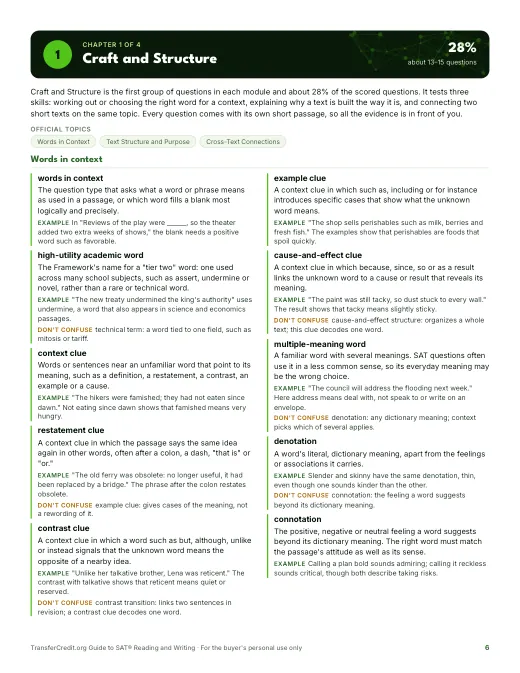
Craft and Structure is the first group of questions in each module and about 28% of the scored questions. It tests three skills: working out or choosing the right word for a context, explaining why a text is built the way it is, and connecting two short texts on the same topic. Every question comes with its own short passage, so all the evidence is in front of you.
- words in context
- The question type that asks what a word or phrase means as used in a passage, or which word fills a blank most logically and precisely.
- Example: In "Reviews of the play were ______, so the theater added two extra weeks of shows," the blank needs a positive word such as favorable.
- main purpose
- Why the author wrote the whole text, stated as a verb phrase such as to argue, to explain, to describe or to challenge.
- Example: A passage that walks through how a town's first library was funded, step by step, mainly aims to explain that process.
- overall structure
- How the parts of a whole text are ordered and related. Answers describe the sequence of moves, such as "presents a view, then challenges it."
- Example: A passage that poses a puzzle about a lake's color, rules out one explanation, then offers another has a puzzle-then-answer structure.
- narrator and point of view
- The narrator is who tells a story; point of view is the angle it is told from, usually first person ("I") or third person ("she," "they").
- Example: "I watched the ferry leave without me" is first person; "Marta watched the ferry leave without her" is third person.
- paired texts
- Two short passages on the same or a related topic, labeled Text 1 and Text 2, followed by one question about how they connect.
- Example: Text 1 praises a city's new bike lanes; Text 2 says they slowed buses. The question asks how the two views relate.
- high-utility academic word
- The Framework's name for a "tier two" word: one used across many school subjects, such as assert, undermine or novel, rather than a rare or technical word.
- Example: "The new treaty undermined the king's authority" uses undermine, a word that also appears in science and economics passages.
- function of a sentence
- The job one sentence does in the whole text, such as introducing a claim, giving an example, adding a contrast or stating a conclusion. This guide brackets that sentence.
- Example: In "Bees face many threats. One valley's farmers lost half their hives in a year," the second sentence supports the first with an example.
- problem-and-solution structure
- A structure that first describes a problem, then presents one or more ways to solve it, sometimes with the results.
- Example: A paragraph says a library's basement books were water-damaged every spring, then explains how raised shelves fixed it.
- speaker
- The voice that talks in a poem. It is not necessarily the poet, so questions and answers refer to "the speaker."
- Example: A poem begins, "I am the old oak by the road"; the speaker is the tree, not the poet.
- most likely response
- A paired-text question, "How would the author of Text 2 most likely respond to Text 1?": apply Text 2's view to Text 1's specific claim.
- Example: Text 1: homework builds discipline. Text 2: sleep matters most for learning. Likely response: homework that cuts into sleep may backfire.
- context clue
- Words or sentences near an unfamiliar word that point to its meaning, such as a definition, a restatement, a contrast, an example or a cause.
- Example: "The hikers were famished; they had not eaten since dawn." Not eating since dawn shows that famished means very hungry.
- illustrate
- To give a specific example or case that shows a general claim or idea in action.
- Example: To illustrate that the town prized music, a writer notes that it built a concert hall before it built a city hall.