
$5one-time
- 39-page printable PDF
- 180 terms with examples
- 39 practice questions, answers explained
- 2-page cram sheet and study plans
Everything the CLEP American Government exam tests, in one PDF you can print. Built from the College Board's official outline, heaviest topics first.
Last updated 2026 · exam details checked against the College Board's published exam information in 2026
Real pages from the 39-page PDF.
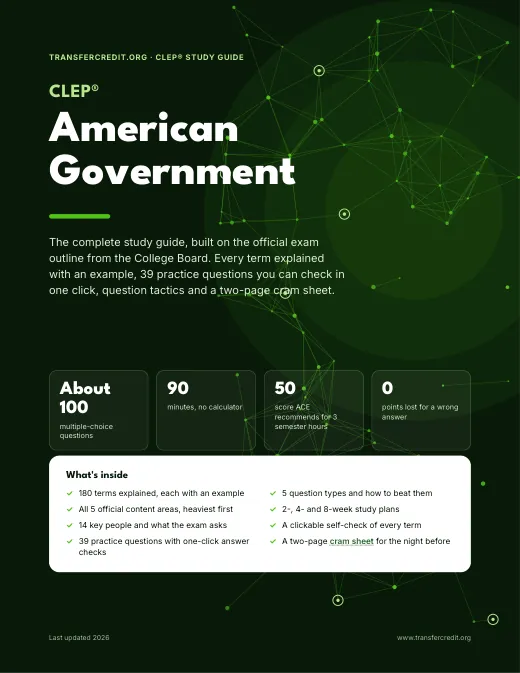
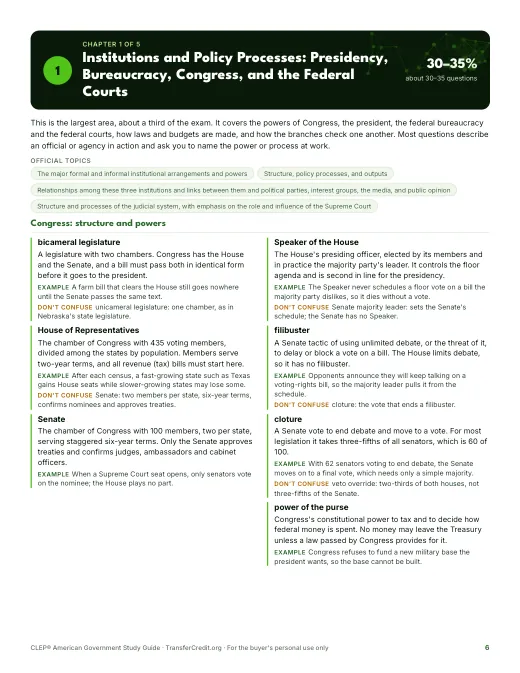
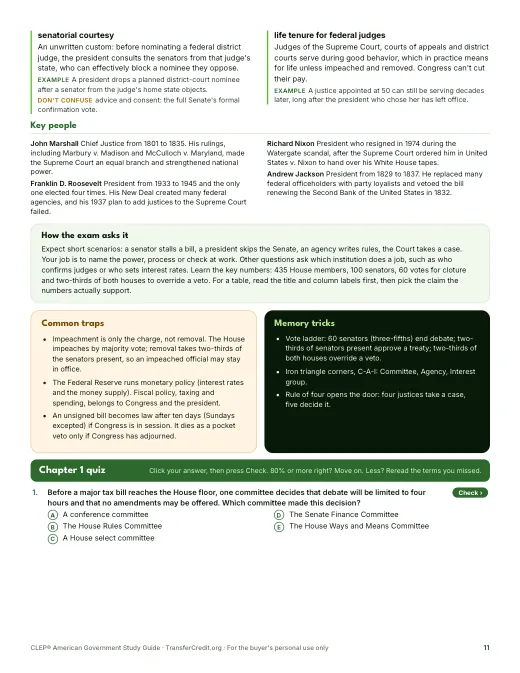
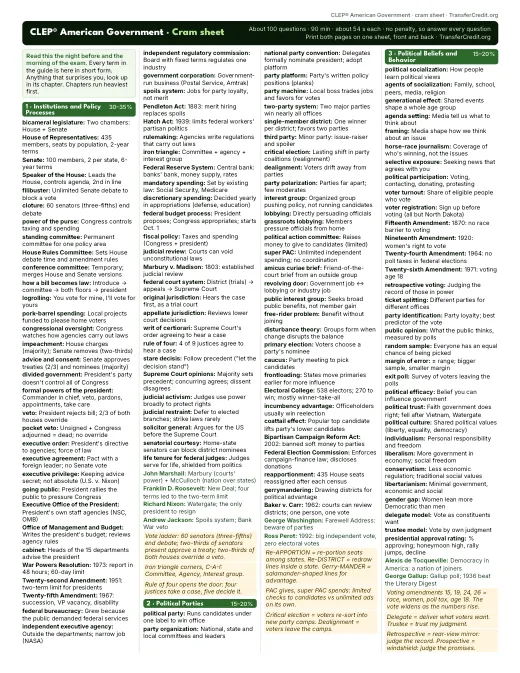
One chapter for each official content area, in the order the exam weighs them.
In the style of the real exam, from all 5 areas. About 10 minutes, with every answer explained and a score by area.
Before a major tax bill reaches the House floor, one committee decides that debate will be limited to four hours and that no amendments may be offered. Which committee made this decision?
Answer: D. The House Rules Committee. The House Rules Committee sets the terms of floor debate for major bills, including time limits and whether amendments are allowed. A rule that bars amendments is called a closed rule.
The trap: The Ways and Means Committee writes tax bills, so it is tempting, but it doesn't set the rules for debating them on the floor.
The House Rules Committee sets the terms of floor debate for major bills, including time limits and whether amendments are allowed. A rule that bars amendments is called a closed rule.
The trap: The Ways and Means Committee writes tax bills, so it is tempting, but it doesn't set the rules for debating them on the floor.
An imaginary state has 5 electoral votes and awards them the way Maine and Nebraska do: 2 to the statewide popular-vote winner and 1 to the winner of each of its 3 congressional districts. The results are:
District | Ortiz | Banks
1 | 150,000 | 100,000
2 | 115,000 | 135,000
3 | 118,000 | 132,000
How many electoral votes does each candidate win?
Answer: B. Ortiz 3, Banks 2. Statewide, Ortiz has 383,000 votes to Banks's 367,000, so Ortiz takes the 2 statewide votes. Ortiz also wins District 1, and Banks wins Districts 2 and 3. Total: Ortiz 3, Banks 2.
The trap: Ortiz 5, Banks 0 is the winner-take-all result most states use, but this state splits its votes by district, so Banks still earns 2.
Statewide, Ortiz has 383,000 votes to Banks's 367,000, so Ortiz takes the 2 statewide votes. Ortiz also wins District 1, and Banks wins Districts 2 and 3. Total: Ortiz 3, Banks 2.
The trap: Ortiz 5, Banks 0 is the winner-take-all result most states use, but this state splits its votes by district, so Banks still earns 2.
Two TV stations cover the same new tax on sugary drinks. One stresses that it will cut childhood obesity; the other stresses that it raises grocery bills for poor families. What does this difference best show?
Answer: E. Framing. Both stations cover the same issue, so they agree on what matters. They differ in how they present it, and stressing different aspects to shape reactions is framing.
The trap: Agenda setting is tempting, but it concerns which issues get attention. Here both stations chose the same issue; only the presentation differs.
Both stations cover the same issue, so they agree on what matters. They differ in how they present it, and stressing different aspects to shape reactions is framing.
The trap: Agenda setting is tempting, but it concerns which issues get attention. Here both stations chose the same issue; only the presentation differs.
Which of the following powers of Congress is implied rather than listed in the Constitution?
Answer: A. Chartering a national bank. The Constitution never mentions a bank. Congress's power to charter one is implied by the necessary and proper clause, as the Supreme Court held in McCulloch v. Maryland (1819). The other four are listed in Article I, Section 8.
The trap: Borrowing money on the nation's credit sounds like something a bank does, but it is one of Congress's listed powers.
The Constitution never mentions a bank. Congress's power to charter one is implied by the necessary and proper clause, as the Supreme Court held in McCulloch v. Maryland (1819). The other four are listed in Article I, Section 8.
The trap: Borrowing money on the nation's credit sounds like something a bank does, but it is one of Congress's listed powers.
In 1833 a Baltimore wharf owner said city street work had ruined his wharf, and he argued that the Fifth Amendment required the city to pay him. The Supreme Court ruled against him. What was the main reason?
Answer: C. The Bill of Rights then limited only the national government. In Barron v. Baltimore, the Court held that the Bill of Rights restrained only the national government. States and cities were bound only later, through selective incorporation under the Fourteenth Amendment.
The trap: The Fourteenth Amendment answer is tempting because that amendment now ties the Bill of Rights to the states, but it wasn't ratified until 1868, decades after this case.
In Barron v. Baltimore, the Court held that the Bill of Rights restrained only the national government. States and cities were bound only later, through selective incorporation under the Fourteenth Amendment.
The trap: The Fourteenth Amendment answer is tempting because that amendment now ties the Bill of Rights to the states, but it wasn't ratified until 1868, decades after this case.
Bills in a hypothetical two-year Congress
Stage reached | Number of bills
Introduced | 6,400
Reported out of committee | 960
Passed at least one chamber | 720
Enacted into law | 320
Which statement is best supported by the table?
Answer: D. About 85 percent of the bills never got out of committee. Committees reported 960 of the 6,400 bills, so 5,440 bills, or 85 percent, never left committee. Committees are where most bills die.
The trap: About 5 percent is the share enacted into law (320 of 6,400). The share that passed at least one chamber is 720 of 6,400, about 11 percent.
Committees reported 960 of the 6,400 bills, so 5,440 bills, or 85 percent, never left committee. Committees are where most bills die.
The trap: About 5 percent is the share enacted into law (320 of 6,400). The share that passed at least one chamber is 720 of 6,400, about 11 percent.
Over twenty years, a state legislature changes. Moderate members retire, almost every bill passes on a party-line vote, and the most liberal Republican now votes more conservatively than the most conservative Democrat. Which concept best describes this change?
Answer: A. Party polarization. Party polarization means the parties move apart and each becomes more uniform, so their members no longer overlap or cross party lines.
The trap: Dealignment is about voters loosening their ties to parties. Here the parties themselves are growing farther apart and more unified.
Party polarization means the parties move apart and each becomes more uniform, so their members no longer overlap or cross party lines.
The trap: Dealignment is about voters loosening their ties to parties. Here the parties themselves are growing farther apart and more unified.
On one ballot, a voter chooses the Republican candidate for president, a Democrat for the Senate and a Democrat for governor. Which term describes her ballot?
Answer: E. Ticket splitting. Choosing candidates from different parties for different offices on the same ballot is ticket splitting.
The trap: The coattail effect is a popular top candidate pulling the same party's lower candidates to victory, the opposite of crossing party lines.
Choosing candidates from different parties for different offices on the same ballot is ticket splitting.
The trap: The coattail effect is a popular top candidate pulling the same party's lower candidates to victory, the opposite of crossing party lines.
Federal grants to an imaginary state (millions of dollars)
Year | Categorical grants | Block grants
Year 1 | 400 | 100
Year 2 | 360 | 180
Year 3 | 300 | 250
Which conclusion is best supported by the table?
Answer: C. The state gained more control over spending its aid. Block grants, which leave spending choices to the state, rose from 100 to 250 while categorical grants, which come with strict rules, fell from 400 to 300. So the state gained more say over how its aid was spent.
The trap: Block grants made up 250 of 550 million dollars in Year 3, about 45 percent, which is less than half.
Block grants, which leave spending choices to the state, rose from 100 to 250 while categorical grants, which come with strict rules, fell from 400 to 300. So the state gained more say over how its aid was spent.
The trap: Block grants made up 250 of 550 million dollars in Year 3, about 45 percent, which is less than half.
A city sets aside a share of its construction contracts for companies owned by members of certain racial groups. A company that lost a bid sues under the equal protection clause. Which standard will the court most likely apply to the city's plan?
Answer: B. Strict scrutiny. Any government classification by race gets strict scrutiny, even one meant to help a group. The city must show a compelling interest and a narrowly tailored plan, a test few racial classifications pass.
The trap: Rational basis review is tempting because most laws get it, but it applies to ordinary economic rules, not to laws that sort people by race.
Any government classification by race gets strict scrutiny, even one meant to help a group. The city must show a compelling interest and a narrowly tailored plan, a test few racial classifications pass.
The trap: Rational basis review is tempting because most laws get it, but it applies to ordinary economic rules, not to laws that sort people by race.
The CLEP American Government exam is a 90-minute, computer-based test from the College Board with about 100 multiple-choice questions. A score of 50 on the 20–80 scale earns an ACE credit recommendation of 3 semester hours, though each college sets its own policy. The exam covers 5 content areas; the heaviest is Institutions and Policy Processes: Presidency, Bureaucracy, Congress, and the Federal Courts at 30–35%.
5 areas, heaviest first. The guide's chapters follow this order.
Start with the guide, or get everything for CLEP in one plan.
CLEP® is a registered trademark of the College Board, which was not involved in producing this guide and does not endorse it. TransferCredit.org is independent and not affiliated with the College Board. © 2026 UPI Globale Edu Inc.