
$5one-time
- 35-page printable PDF
- 180 terms with examples
- 41 practice questions, answers explained
- 2-page cram sheet and study plans
Everything the CLEP Introductory Sociology exam tests, in one PDF you can print. Built from the College Board's official outline, heaviest topics first.
Last updated 2026 · exam details checked against the College Board's published exam information in 2026
Real pages from the 35-page PDF.

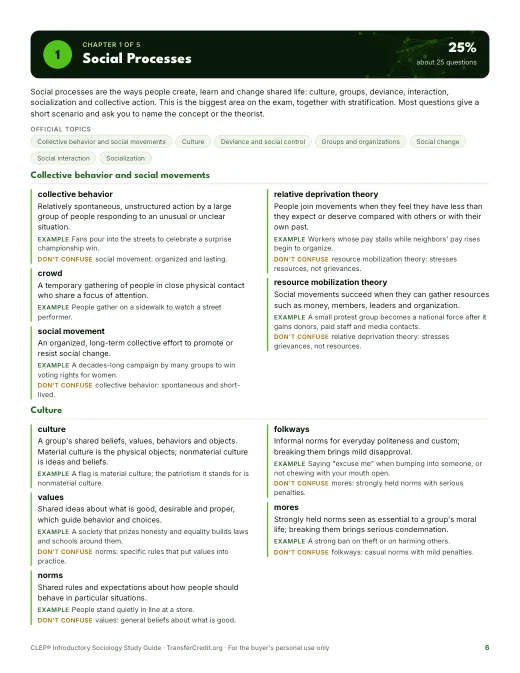
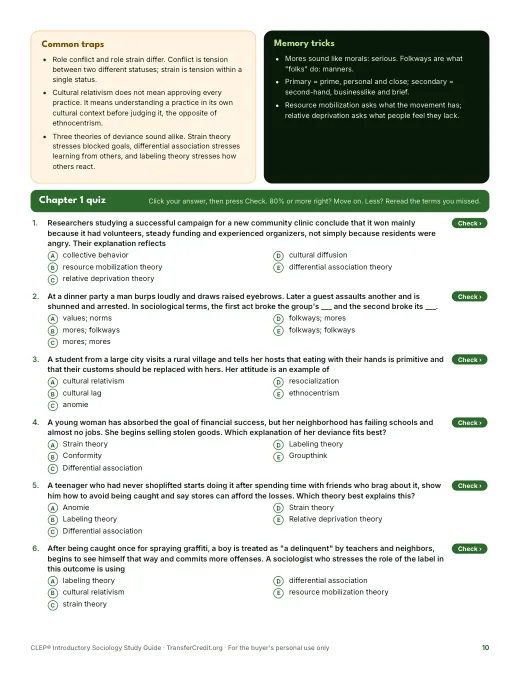
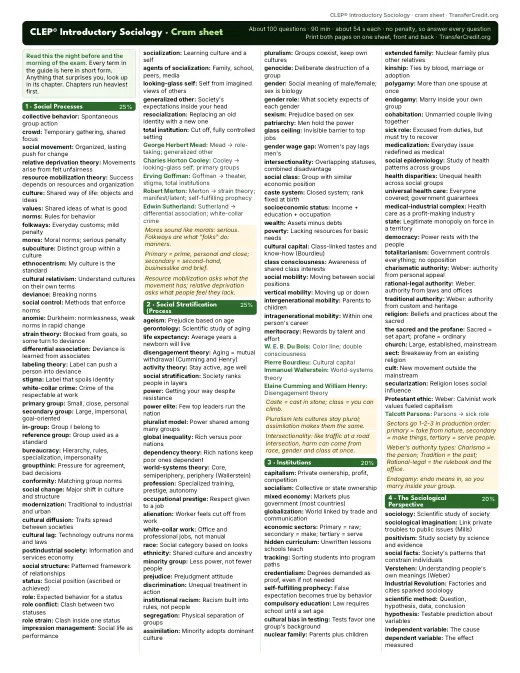
One chapter for each official content area, in the order the exam weighs them.
In the style of the real exam, from all 5 areas. About 10 minutes, with every answer explained and a score by area.
Researchers studying a successful campaign for a new community clinic conclude that it won mainly because it had volunteers, steady funding and experienced organizers, not simply because residents were angry. Their explanation reflects
Answer: D. resource mobilization theory. Explaining a movement's success by the resources and organization it can gather is resource mobilization theory.
The trap: Relative deprivation theory is tempting because it also explains movements, but it points to feelings of unfairness, which the researchers set aside.
Explaining a movement's success by the resources and organization it can gather is resource mobilization theory.
The trap: Relative deprivation theory is tempting because it also explains movements, but it points to feelings of unfairness, which the researchers set aside.
A sociologist observes that after retirement, a longtime city councilor resigns from boards and clubs, and the council welcomes new members. She concludes the withdrawal benefits both the man and the community. Which theory does she apply?
Answer: B. Disengagement theory. Disengagement theory holds that aging brings a mutual withdrawal between the individual and society, which helps society hand roles to younger people.
The trap: Activity theory is wrong here, since it claims people age best by staying active, the opposite of the withdrawal described.
Disengagement theory holds that aging brings a mutual withdrawal between the individual and society, which helps society hand roles to younger people.
The trap: Activity theory is wrong here, since it claims people age best by staying active, the opposite of the withdrawal described.
A country has private companies that compete for customers in most industries, but the government also runs public schools, provides pensions and regulates pollution. This economy is best described as
Answer: A. a mixed economy. Private ownership and competition combined with government services and regulation is a mixed economy, which describes most modern countries.
The trap: Pure capitalism is wrong because the government plays a large role here through schools, pensions and regulation.
Private ownership and competition combined with government services and regulation is a mixed economy, which describes most modern countries.
The trap: Pure capitalism is wrong because the government plays a large role here through schools, pensions and regulation.
A researcher wants to know whether the number of hours students sleep affects their exam scores. In her study, hours of sleep is the
Answer: E. independent variable. The independent variable is the factor presumed to cause change; here sleep is expected to influence scores.
The trap: The dependent variable is wrong because it is the outcome measured, which here is the exam score, not the sleep.
The independent variable is the factor presumed to cause change; here sleep is expected to influence scores.
The trap: The dependent variable is wrong because it is the outcome measured, which here is the exam score, not the sleep.
Workers in a modern city depend on one another because each has a specialized job, such as baker, mechanic or nurse, and none could be self-sufficient. This kind of social cohesion is
Answer: C. organic solidarity. Cohesion that comes from interdependence among specialized people is organic solidarity.
The trap: Mechanical solidarity is tempting for those who read it as industrial, but it describes cohesion from similarity, not specialization.
Cohesion that comes from interdependence among specialized people is organic solidarity.
The trap: Mechanical solidarity is tempting for those who read it as industrial, but it describes cohesion from similarity, not specialization.
At a dinner party a man burps loudly and draws raised eyebrows. Later a guest assaults another and is shunned and arrested. In sociological terms, the first act broke the group's ___ and the second broke its ___.
Answer: A. folkways; mores. Burping breaks an informal everyday custom, a folkway, and draws only mild disapproval. Assault breaks the mores, strongly held moral norms, and draws serious penalties.
The trap: The reversed pairing, mores then folkways, is tempting, but mild disapproval signals folkways, while arrest and shunning signal mores.
Burping breaks an informal everyday custom, a folkway, and draws only mild disapproval. Assault breaks the mores, strongly held moral norms, and draws serious penalties.
The trap: The reversed pairing, mores then folkways, is tempting, but mild disapproval signals folkways, while arrest and shunning signal mores.
A country exports coffee at low prices and imports expensive machinery from wealthy nations, which also own its mines. Analysts say this arrangement keeps the country poor. Which perspective is this?
Answer: B. Dependency theory. Dependency theory argues that wealthy nations exploit poorer ones, keeping them reliant on outside markets and capital.
The trap: Modernization theory is wrong because it says poor nations advance by industrializing and changing their own culture, not that rich nations keep them poor.
Dependency theory argues that wealthy nations exploit poorer ones, keeping them reliant on outside markets and capital.
The trap: Modernization theory is wrong because it says poor nations advance by industrializing and changing their own culture, not that rich nations keep them poor.
Students in an elementary school learn to line up quietly, wait for the bell and compete for gold stars, though none of this is in the lesson plans. Sociologists call these lessons
Answer: E. the hidden curriculum. Unwritten lessons about behavior and values that schools teach alongside formal subjects are the hidden curriculum.
The trap: Tracking is wrong because it means formally placing students in different program paths, which the question does not describe.
Unwritten lessons about behavior and values that schools teach alongside formal subjects are the hidden curriculum.
The trap: Tracking is wrong because it means formally placing students in different program paths, which the question does not describe.
A sociologist joins a motorcycle club for a year, rides with its members, attends their gatherings and takes field notes on their rituals. This method is
Answer: C. participant observation. Participant observation means studying a group by taking part in its life over time.
The trap: A survey is wrong because it collects answers to set questions rather than watching behavior from within the group.
Participant observation means studying a group by taking part in its life over time.
The trap: A survey is wrong because it collects answers to set questions rather than watching behavior from within the group.
Because of better sanitation and medicine, a country's death rate has dropped sharply, but its birth rate is still high, so its population is growing fast. Which concept best describes this situation?
Answer: D. the demographic transition. A falling death rate followed later by a falling birth rate is the pattern of the demographic transition.
The trap: Malthusian theory is tempting because the population is growing fast, but it predicts famine, disease or war will check growth; it does not describe deaths falling before births.
A falling death rate followed later by a falling birth rate is the pattern of the demographic transition.
The trap: Malthusian theory is tempting because the population is growing fast, but it predicts famine, disease or war will check growth; it does not describe deaths falling before births.
The CLEP Introductory Sociology exam is a 90-minute, computer-based test from the College Board with about 100 multiple-choice questions. A score of 50 on the 20–80 scale earns an ACE credit recommendation of 3 semester hours, though each college sets its own policy. The exam covers 5 content areas; the heaviest is Social Processes at 25%.
5 areas, heaviest first. The guide's chapters follow this order.
Start with the guide, or get everything for CLEP in one plan.
CLEP® is a registered trademark of the College Board, which was not involved in producing this guide and does not endorse it. TransferCredit.org is independent and not affiliated with the College Board. © 2026 UPI Globale Edu Inc.