
$5one-time
- 39-page printable PDF
- 177 terms with examples
- 43 practice questions, answers explained
- 2-page cram sheet and study plans
Official exam name: Principles of Microeconomics
Everything the CLEP Microeconomics exam tests, in one PDF you can print. Built from the College Board's official outline, heaviest topics first.
Last updated 2026 · exam details checked against the College Board's published exam information in 2026
Real pages from the 39-page PDF.

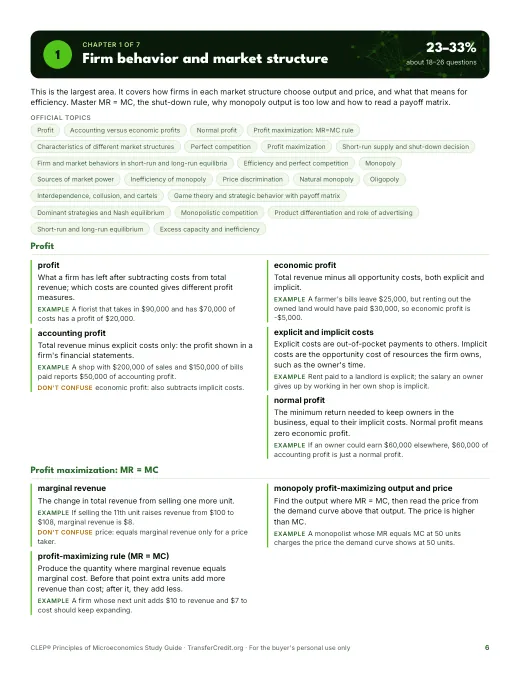
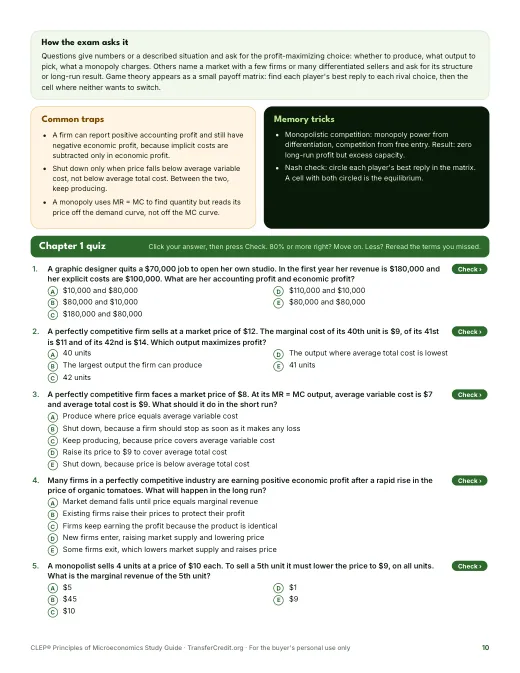
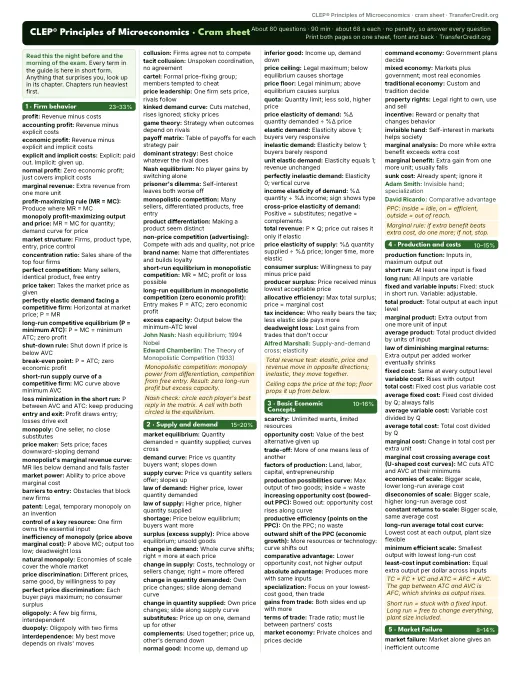
One chapter for each official content area, in the order the exam weighs them.
In the style of the real exam, from all 7 areas. About 10 minutes, with every answer explained and a score by area.
A graphic designer quits a $70,000 job to open her own studio. In the first year her revenue is $180,000 and her explicit costs are $100,000. What are her accounting profit and economic profit?
Answer: A. $80,000 and $10,000. Accounting profit is $180,000 - $100,000 = $80,000. Economic profit also subtracts the $70,000 salary she gave up, an implicit cost, leaving $10,000.
The trap: Treating the two as equal ignores the implicit cost of her forgone salary; only accounting profit leaves it out.
Accounting profit is $180,000 - $100,000 = $80,000. Economic profit also subtracts the $70,000 salary she gave up, an implicit cost, leaving $10,000.
The trap: Treating the two as equal ignores the implicit cost of her forgone salary; only accounting profit leaves it out.
A hurricane destroys much of the orange crop. What happens in the market for orange juice?
Answer: C. Supply shifts left, so price rises and quantity sold falls. Fewer oranges raise producers' costs and cut how much juice is offered at every price. The supply curve shifts left, which raises the equilibrium price and lowers the quantity.
The trap: Supply shifts left with price and quantity both rising mixes up a supply shift with a demand shift. A leftward supply shift lowers quantity.
Fewer oranges raise producers' costs and cut how much juice is offered at every price. The supply curve shifts left, which raises the equilibrium price and lowers the quantity.
The trap: Supply shifts left with price and quantity both rising mixes up a supply shift with a demand shift. A leftward supply shift lowers quantity.
A student can spend Friday evening working a $60 shift, watching a game with friends, or studying for an exam. She studies; her next-best choice was the shift. What is her opportunity cost?
Answer: D. The $60 she gave up from the shift. Opportunity cost is the value of the best alternative given up. Her next-best use of the evening was the shift, so the cost is the $60.
The trap: The game plus the $60 adds both alternatives, but opportunity cost counts only the single best one given up.
Opportunity cost is the value of the best alternative given up. Her next-best use of the evening was the shift, so the cost is the $60.
The trap: The game plus the $60 adds both alternatives, but opportunity cost counts only the single best one given up.
A bakery has one oven. Total output is 10 loaves with 1 worker, 26 with 2, 40 with 3 and 50 with 4. With which worker do diminishing marginal returns begin?
Answer: B. The third worker. Marginal products are 10, 16, 14 and 10. Marginal product first falls with the third worker, so that is where diminishing returns begin.
The trap: Total output still rising is tempting, but diminishing returns concern marginal product, which already falls from the second to the third worker.
Marginal products are 10, 16, 14 and 10. Marginal product first falls with the third worker, so that is where diminishing returns begin.
The trap: Total output still rising is tempting, but diminishing returns concern marginal product, which already falls from the second to the third worker.
A paper mill's pollution imposes $8 of damage on downstream residents for every ton of paper it makes. Which policy would lead the mill to produce the efficient quantity?
Answer: E. A tax of $8 per ton of paper. A tax equal to the $8 external cost makes the mill face the full social cost of each ton, so it cuts output to the efficient level.
The trap: A subsidy would lower the mill's cost and increase output. That makes the overproduction worse, not better.
A tax equal to the $8 external cost makes the mill face the full social cost of each ton, so it cuts output to the efficient level.
The trap: A subsidy would lower the mill's cost and increase output. That makes the overproduction worse, not better.
In a perfectly competitive market, a worker's marginal product is 8 units of output, each of which sells for $5. The going wage is $30 an hour. What should the firm do?
Answer: E. Hire the worker, since the extra output brings in $40. Marginal revenue product is 8 × $5 = $40, which is more than the $30 wage, so the worker adds more to revenue than to cost.
The trap: Comparing the wage with the $5 output price mixes up units: the wage must be compared with the revenue from all 8 units, not one.
Marginal revenue product is 8 × $5 = $40, which is more than the $30 wage, so the worker adds more to revenue than to cost.
The trap: Comparing the wage with the $5 output price mixes up units: the wage must be compared with the revenue from all 8 units, not one.
A visitor records total utility from rides at a fair: 1 ride = 15 utils, 2 = 27, 3 = 35, 4 = 39, 5 = 40. What is the marginal utility of the third ride?
Answer: C. 8 utils. Marginal utility is the change in total utility from one more unit: 35 minus 27 equals 8 utils.
The trap: 35 utils is the total utility after three rides. Marginal utility is the extra from the third ride alone.
Marginal utility is the change in total utility from one more unit: 35 minus 27 equals 8 utils.
The trap: 35 utils is the total utility after three rides. Marginal utility is the extra from the third ride alone.
A perfectly competitive firm sells at a market price of $12. The marginal cost of its 40th unit is $9, of its 41st is $11 and of its 42nd is $14. Which output maximizes profit?
Answer: A. 41 units. Marginal revenue equals the $12 price. The 41st unit adds $12 of revenue and only $11 of cost, but the 42nd adds $12 and costs $14. Stop at 41.
The trap: Stopping at 40 gives up the 41st unit, which still adds $1 of profit; the 40th unit's marginal cost is below price.
Marginal revenue equals the $12 price. The 41st unit adds $12 of revenue and only $11 of cost, but the 42nd adds $12 and costs $14. Stop at 41.
The trap: Stopping at 40 gives up the 41st unit, which still adds $1 of profit; the 40th unit's marginal cost is below price.
The price of hot dogs rises sharply. What is the effect in the market for hot dog buns?
Answer: D. The demand curve for buns shifts left. Hot dogs and buns are complements. A higher hot dog price means fewer hot dogs bought, so buyers want fewer buns at every bun price and bun demand shifts left.
The trap: A fall in quantity demanded along an unchanged curve happens only when the bun's own price rises. Here the cause is another good's price, so the whole curve shifts.
Hot dogs and buns are complements. A higher hot dog price means fewer hot dogs bought, so buyers want fewer buns at every bun price and bun demand shifts left.
The trap: A fall in quantity demanded along an unchanged curve happens only when the bun's own price rises. Here the cause is another good's price, so the whole curve shifts.
During a deep recession, many factories sit idle and the economy produces a combination of computers and food that lies well inside its production possibilities curve. Which statement is correct?
Answer: B. More of both goods could be produced by using idle resources. A point inside the curve means resources are unused or poorly used, so more of both goods could be made without any new resources or technology.
The trap: Productively efficient describes points on the curve. A point inside the curve wastes resources, so it is not efficient.
A point inside the curve means resources are unused or poorly used, so more of both goods could be made without any new resources or technology.
The trap: Productively efficient describes points on the curve. A point inside the curve wastes resources, so it is not efficient.
The CLEP Principles of Microeconomics exam is a 90-minute, computer-based test from the College Board with about 80 multiple-choice questions. A score of 50 on the 20–80 scale earns an ACE credit recommendation of 3 semester hours, though each college sets its own policy. The exam covers 7 content areas; the heaviest is Firm behavior and market structure at 23–33%.
Source: official CLEP Principles of Microeconomics exam page.
7 areas, heaviest first. The guide's chapters follow this order.
Start with the guide, or get everything for CLEP in one plan.
CLEP® is a registered trademark of the College Board, which was not involved in producing this guide and does not endorse it. TransferCredit.org is independent and not affiliated with the College Board. © 2026 UPI Globale Edu Inc.