
$5one-time
- 55-page printable PDF
- 211 terms with examples
- 65 practice questions, answers explained
- 2-page cram sheet and study plans
Everything the CLEP Introductory Psychology exam tests, in one PDF you can print. Built from the College Board's official outline, heaviest topics first.
Last updated 2026 · exam details checked against the College Board's published exam information in 2026
Real pages from the 55-page PDF.
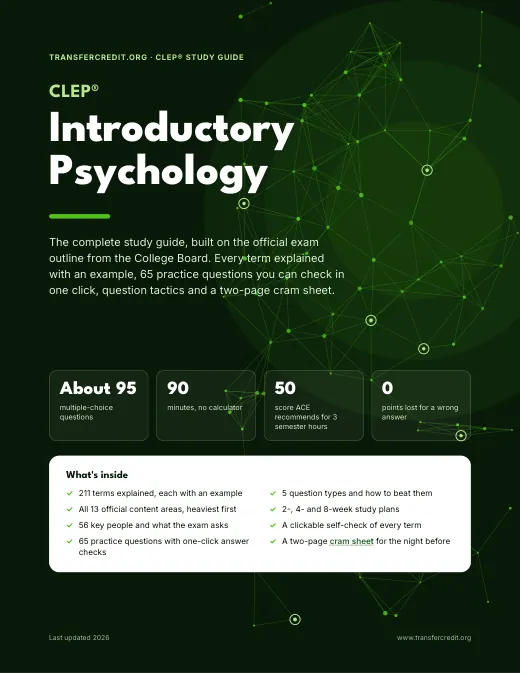
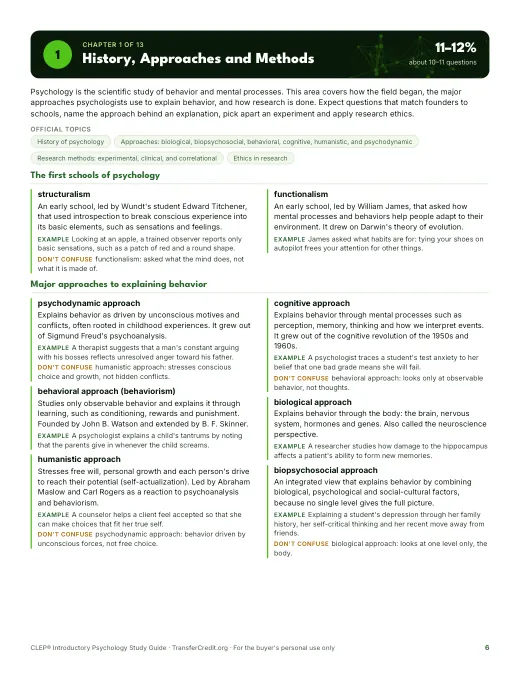
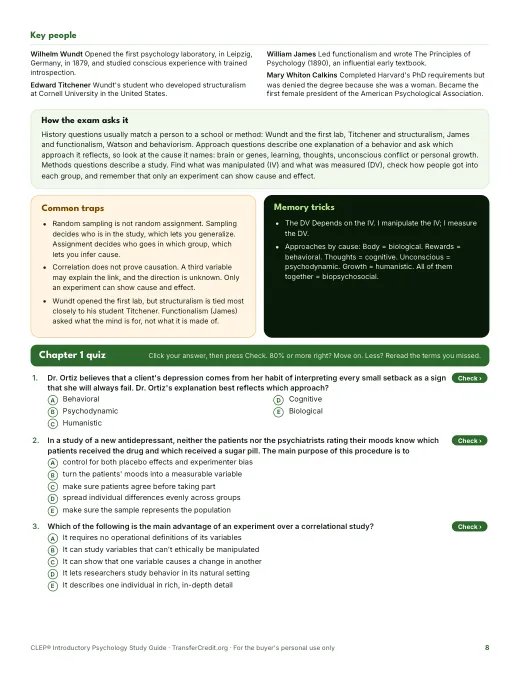
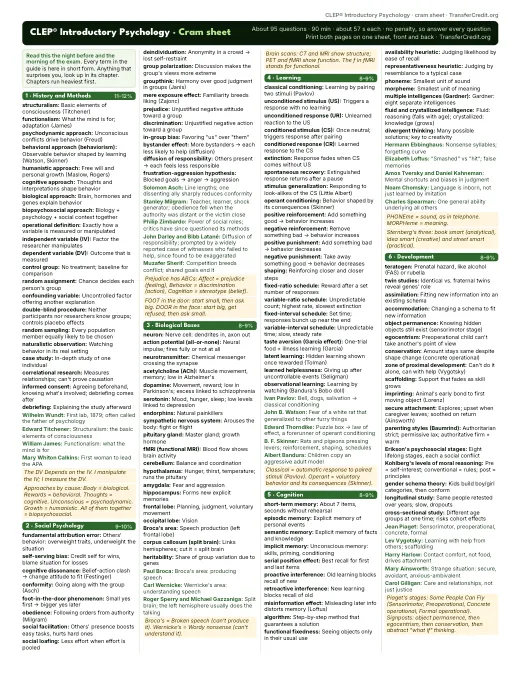
One chapter for each official content area, in the order the exam weighs them.
In the style of the real exam, one from each of the ten heaviest areas. About 10 minutes, with every answer explained and a score by area.
Dr. Ortiz believes that a client's depression comes from her habit of interpreting every small setback as a sign that she will always fail. Dr. Ortiz's explanation best reflects which approach?
Answer: A. Cognitive. The explanation points to how the client thinks about and interprets events. Explaining emotion and behavior through thought patterns is the cognitive approach.
The trap: Psychodynamic is tempting because depression can seem deep-rooted, but that approach looks for unconscious conflicts from childhood. Here the cause is a conscious habit of thinking.
The explanation points to how the client thinks about and interprets events. Explaining emotion and behavior through thought patterns is the cognitive approach.
The trap: Psychodynamic is tempting because depression can seem deep-rooted, but that approach looks for unconscious conflicts from childhood. Here the cause is a conscious habit of thinking.
A student sees a classmate slip and drop her lunch tray in the cafeteria and concludes that the classmate is clumsy, without noticing that the floor had just been mopped. This best illustrates
Answer: D. the fundamental attribution error. The student explains another person's behavior by a trait (clumsiness) and overlooks an obvious situational cause (the wet floor). That is the fundamental attribution error.
The trap: The self-serving bias concerns how we explain our own successes and failures. Here the student is judging someone else.
The student explains another person's behavior by a trait (clumsiness) and overlooks an obvious situational cause (the wet floor). That is the fundamental attribution error.
The trap: The self-serving bias concerns how we explain our own successes and failures. Here the student is judging someone else.
A man's doctor explains that his tremors and difficulty starting movements are caused by the gradual loss of brain cells that produce a particular neurotransmitter. Which neurotransmitter is it?
Answer: E. Dopamine. Tremors and trouble starting movements are signs of Parkinson's disease, which results from the loss of dopamine-producing neurons.
The trap: Acetylcholine also works at the junction between nerves and muscles, but the loss of ACh-producing neurons is linked to the memory loss of Alzheimer's disease, not to Parkinson's tremors.
Tremors and trouble starting movements are signs of Parkinson's disease, which results from the loss of dopamine-producing neurons.
The trap: Acetylcholine also works at the junction between nerves and muscles, but the loss of ACh-producing neurons is linked to the memory loss of Alzheimer's disease, not to Parkinson's tremors.
A teenager cleans her room so that her parents will stop nagging her, and the following week she cleans it sooner. Which process explains the increase in her room cleaning?
Answer: B. Negative reinforcement. The nagging, which is unpleasant, stops when she cleans, and cleaning increases. Taking away something unpleasant to increase a behavior is negative reinforcement.
The trap: Positive punishment is tempting because nagging is unpleasant, but punishment makes a behavior less likely. Here the cleaning increases.
The nagging, which is unpleasant, stops when she cleans, and cleaning increases. Taking away something unpleasant to increase a behavior is negative reinforcement.
The trap: Positive punishment is tempting because nagging is unpleasant, but punishment makes a behavior less likely. Here the cleaning increases.
After watching several news stories about shark attacks, Marcus decides that sharks are a bigger danger to swimmers than drowning, and he stops going in the ocean. His judgment is most influenced by
Answer: C. the availability heuristic. Vivid news stories make shark attacks easy to bring to mind, so Marcus judges them as more common than they are. Judging likelihood by ease of recall is the availability heuristic.
The trap: The representativeness heuristic judges by resemblance to a typical case, not by how easily examples come to mind.
Vivid news stories make shark attacks easy to bring to mind, so Marcus judges them as more common than they are. Judging likelihood by ease of recall is the availability heuristic.
The trap: The representativeness heuristic judges by resemblance to a typical case, not by how easily examples come to mind.
Kara, age 4, agrees that two balls of clay are the same size. After one ball is rolled into a long snake, she says the snake has more clay. Kara's answer is best explained by
Answer: E. a lack of conservation. Kara thinks the amount of clay changed because its shape changed. Understanding that quantity stays the same despite a change in shape is conservation, which Piaget said children master in the concrete operational stage.
The trap: Egocentrism is also typical of preoperational children, but it means trouble taking another person's point of view. Nothing here involves anyone else's perspective.
Kara thinks the amount of clay changed because its shape changed. Understanding that quantity stays the same despite a change in shape is conservation, which Piaget said children master in the concrete operational stage.
The trap: Egocentrism is also typical of preoperational children, but it means trouble taking another person's point of view. Nothing here involves anyone else's perspective.
Several times in the past two months, Elena has suddenly felt a pounding heart, chest pain and terror that she was dying, with no obvious trigger. She now worries constantly about when the next episode will strike. Which disorder best fits her symptoms?
Answer: A. Panic disorder. Recurrent, unexpected panic attacks followed by persistent worry about having more is the definition of panic disorder.
The trap: Generalized anxiety disorder also involves worry, but it is ongoing worry about many everyday things, not sudden attacks of intense fear.
Recurrent, unexpected panic attacks followed by persistent worry about having more is the definition of panic disorder.
The trap: Generalized anxiety disorder also involves worry, but it is ongoing worry about many everyday things, not sudden attacks of intense fear.
During wartime, a radar operator who has been warned to expect an attack reports more faint blips as enemy planes, including some that turn out to be flocks of birds. Which concept best explains this shift in her reports?
Answer: D. Signal detection theory. Signal detection theory says that detecting a faint signal depends on expectations and motivation, not just on stimulus strength. Expecting an attack, she says yes more often, catching more planes but also making more false alarms.
The trap: Absolute threshold is tempting, but it only describes the weakest stimulus detectable half the time. It doesn't explain why her reports shift with what she expects.
Signal detection theory says that detecting a faint signal depends on expectations and motivation, not just on stimulus strength. Expecting an attack, she says yes more often, catching more planes but also making more false alarms.
The trap: Absolute threshold is tempting, but it only describes the weakest stimulus detectable half the time. It doesn't explain why her reports shift with what she expects.
Ben often feels tempted to cheat on his girlfriend, though he never acts on it. He constantly accuses her of flirting with other men. Freud would most likely say Ben is using
Answer: B. projection. Ben can't accept his own urge to be unfaithful, so he sees it in his girlfriend instead. Attributing your own unacceptable impulses to someone else is projection.
The trap: Reaction formation would mean acting the opposite of his urge, such as loudly praising loyalty. Ben isn't reversing the urge; he is assigning it to her.
Ben can't accept his own urge to be unfaithful, so he sees it in his girlfriend instead. Attributing your own unacceptable impulses to someone else is projection.
The trap: Reaction formation would mean acting the opposite of his urge, such as loudly praising loyalty. Ben isn't reversing the urge; he is assigning it to her.
A client who has always resented his controlling father begins to feel intense anger toward his therapist, accusing her of trying to run his life, though she has given him no advice. A psychoanalyst would call this
Answer: C. transference. He is directing feelings from an important past relationship, with his father, onto the therapist. That is transference.
The trap: Resistance means blocking painful material, such as changing the subject or skipping sessions. He isn't avoiding anything; he is redirecting old feelings onto the therapist.
He is directing feelings from an important past relationship, with his father, onto the therapist. That is transference.
The trap: Resistance means blocking painful material, such as changing the subject or skipping sessions. He isn't avoiding anything; he is redirecting old feelings onto the therapist.
The CLEP Introductory Psychology exam is a 90-minute, computer-based test from the College Board with about 95 multiple-choice questions. A score of 50 on the 20–80 scale earns an ACE credit recommendation of 3 semester hours, though each college sets its own policy. The exam covers 13 content areas; the heaviest is History, Approaches and Methods at 11–12%.
13 areas, heaviest first. The guide's chapters follow this order.
Start with the guide, or get everything for CLEP in one plan.
CLEP® is a registered trademark of the College Board, which was not involved in producing this guide and does not endorse it. TransferCredit.org is independent and not affiliated with the College Board. © 2026 UPI Globale Edu Inc.