← All study guides
CLEP® Study Guide Printable PDF · 51 pages

CLEP Human Growth and Development Study Guide

Everything the CLEP Human Growth and Development exam tests, in one PDF you can print. Built from the College Board's official outline, heaviest topics first.

  • 181 key terms, each with an example
  • 60 practice questions with every answer explained
  • A 2-page cram sheet for the night before
  • 2-, 4- and 8-week study plans built from the exam weights
Not sure yet? Try 10 free questions

Last updated 2026 · exam details checked against the College Board's published exam information in 2026

Look inside the guide

Real pages from the 51-page PDF.

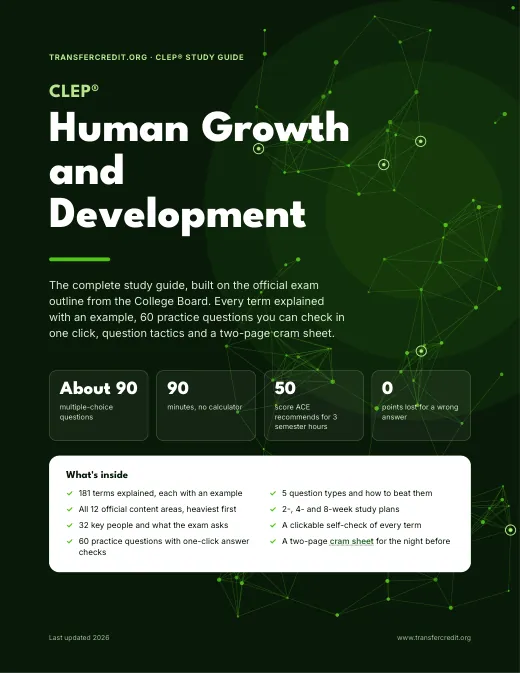
Page 1 of the CLEP Human Growth and Development Study Guide: the cover
Page 1 The cover
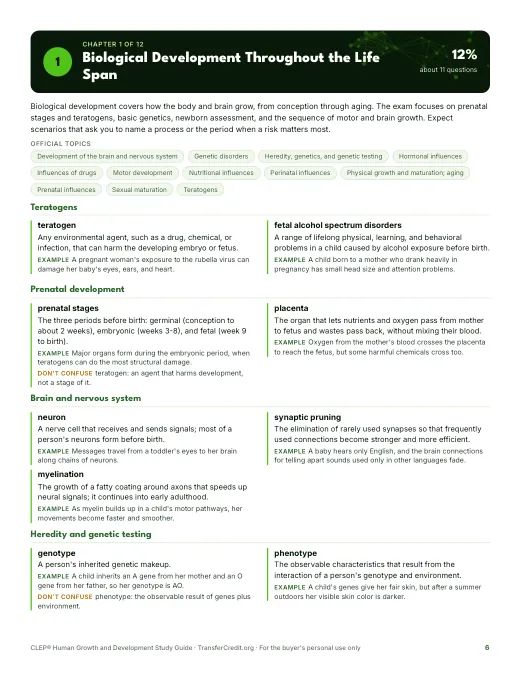
Page 6 of the CLEP Human Growth and Development Study Guide: the Chapter 1 opener
Page 6 The Chapter 1 opener
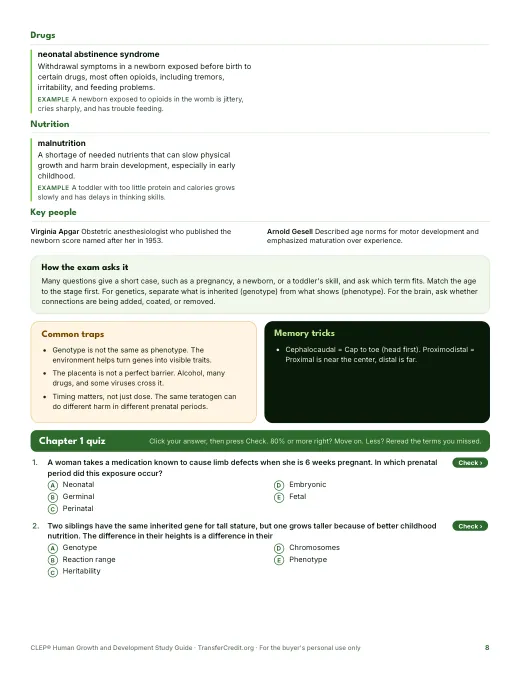
Page 8 of the CLEP Human Growth and Development Study Guide: a chapter quiz
Page 8 A chapter quiz
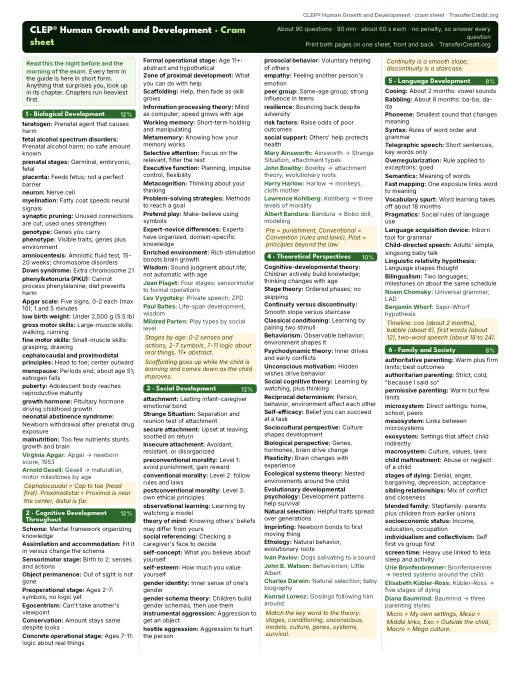
Page 50 of the CLEP Human Growth and Development Study Guide: the 2-page cram sheet
Page 50 The 2-page cram sheet

What you get for $5

One chapter for each official content area, in the order the exam weighs them.

  • 📘51pages, printable
  • 🧭12chapters, heaviest first
  • 🔑181terms with examples
  • ✍️60practice questions, answers explained
  • ⚠️36exam traps to avoid
  • 📄2page cram sheet

Try 10 free Human Growth and Development questions

In the style of the real exam, one from each of the ten heaviest areas. About 10 minutes, with every answer explained and a score by area.

10 questions  
  1. Question 1 · Biological Development Throughout the Life Span

    A woman takes a medication known to cause limb defects when she is 6 weeks pregnant. In which prenatal period did this exposure occur?

    Show the answer

    Answer: E. Embryonic. Weeks 3-8 after conception are the embryonic period, when major organs and limbs form, so teratogens cause the most structural harm then.

    The trap: Fetal is tempting because it sounds like the main stage, but by then the major structures are already formed.

  2. Question 2 · Cognitive Development Throughout the Life Span

    A 5-year-old watches water poured from a short, wide glass into a tall, thin one and insists the tall glass now holds more. Which concept has she not yet mastered?

    Show the answer

    Answer: B. Conservation. Believing the amount changes when its shape changes shows she lacks conservation, which develops in the concrete operational stage.

    The trap: Object permanence is tempting because it is a Piaget milestone, but it concerns hidden objects and is achieved in infancy.

  3. Question 3 · Social Development Throughout the Life Span

    A 1-year-old cries when her mother leaves the room in a lab, but calms and goes back to playing soon after the mother returns. How would she be classified?

    Show the answer

    Answer: A. Securely attached. A baby who is upset at separation and quickly soothed at reunion uses her caregiver as a safe base, which is secure attachment.

    The trap: Avoidant attachment is tempting because she resumes playing, but avoidant infants show little distress at separation and ignore the caregiver on return.

  4. Question 4 · Theoretical Perspectives

    A psychologist explains a teenager's recurring nightmares as symbolic expressions of wishes she is not aware of. Which perspective is the psychologist using?

    Show the answer

    Answer: C. Psychodynamic. Explaining behavior by hidden wishes outside awareness is the core of the psychodynamic perspective.

    The trap: Behaviorism is tempting because both deal with behavior, but behaviorists would refuse to explain it by unconscious wishes and look at observable conditioning instead.

  5. Question 5 · Language Development

    A 22-month-old points to a spilled cup and says, Juice fall. Which description fits her speech?

    Show the answer

    Answer: D. Telegraphic speech. Short sentences with key words and no small function words are telegraphic speech.

    The trap: Overregularization is tempting because she is making grammar errors, but it involves applying a rule where it does not belong, as in goed.

  6. Question 6 · Family, Home, and Society Throughout the Life Span

    A father sets a firm homework hour, explains the reason, and listens when his daughter asks to adjust it. Which parenting style is this?

    Show the answer

    Answer: B. Authoritative. He combines clear limits with explanation and responsiveness, which defines authoritative parenting.

    The trap: Authoritarian is tempting because of the firm rules, but authoritarian parents rarely explain or listen to the child.

  7. Question 7 · Personality and Emotion

    A 15-year-old experiments with different clothing styles, friend groups and career ideas while trying to decide what she stands for. According to Erikson, she is working on

    Show the answer

    Answer: A. identity versus role confusion. Searching for a stable sense of self in adolescence is the identity versus role confusion conflict.

    The trap: Industry versus inferiority is tempting because teens are also in school, but that conflict is about feeling competent at tasks in the elementary school years.

  8. Question 8 · Research Strategies and Methodology

    A researcher tests the vocabulary of 4-, 6-, and 8-year-olds during one week of a school year and compares the group averages. Which design is this?

    Show the answer

    Answer: E. Cross-sectional. Different age groups are tested at a single point in time, which defines a cross-sectional design.

    The trap: Longitudinal is tempting because ages are compared, but longitudinal designs follow the same children over time.

  9. Question 9 · Perceptual Development Throughout the Life Span

    Researchers show a 4-month-old two pictures at once, one of a face and one of random shapes, and record that the baby gazes at the face for much longer. Which method is this?

    Show the answer

    Answer: D. Preferential looking. Showing two stimuli together and comparing looking time is preferential looking, which indicates the infant can tell them apart and prefers one.

    The trap: Habituation is tempting because both use looking time, but habituation tracks declining interest in one repeated stimulus, not a choice between two.

  10. Question 10 · Intelligence Throughout the Life Span

    A 10-year-old child performs on a test at the level of the average 12-year-old. Using the original ratio formula, what is her IQ?

    Show the answer

    Answer: C. 120. Mental age 12 divided by chronological age 10 equals 1.2, and 1.2 times 100 is 120.

    The trap: The score 83 is tempting because it comes from dividing the two ages in the wrong order (10 by 12).

The CLEP Human Growth and Development exam at a glance

The CLEP Human Growth and Development exam is a 90-minute, computer-based test from the College Board with about 90 multiple-choice questions. A score of 50 on the 20–80 scale earns an ACE credit recommendation of 3 semester hours, though each college sets its own policy. The exam covers 12 content areas; the heaviest is Biological Development Throughout the Life Span at 12%.

Questions
About 90multiple choice
Time
90 minabout 60 seconds a question
Passing score
50on a 20–80 scale
ACE credit
3semester hours
Exam fee
$97paid to College Board
Calculator
Nonot allowed

Source: official CLEP Human Growth and Development exam page.

What the exam covers

12 areas, heaviest first. The guide's chapters follow this order.

  1. Biological Development Throughout the Life Span12%
  2. Cognitive Development Throughout the Life Span12%
  3. Social Development Throughout the Life Span12%
  4. Theoretical Perspectives10%
  5. Language Development8%
  6. Family, Home, and Society Throughout the Life Span8%
  7. Personality and Emotion8%
  8. Research Strategies and Methodology6%
  9. Perceptual Development Throughout the Life Span6%
  10. Intelligence Throughout the Life Span6%
  11. Schooling, Work, and Interventions6%
  12. Developmental Psychopathology6%

How it works

  1. 1Buy once, $5Secure checkout. No subscription needed.
  2. 2Download the PDFFrom your TransferCredit.org account, right away and any time later.
  3. 3Study the heaviest areas firstFollow the 2-, 4- or 8-week plan, then read the cram sheet the night before.

Questions students ask

What's in the full CLEP Human Growth and Development study guide?
51 pages: 12 chapters, one per official content area, heaviest first. 181 terms, each with a plain-English definition and an example, 32 key people, common traps and memory tricks, 60 practice questions with an answer key that explains every answer, question tactics, 2-, 4- and 8-week study plans and a 2-page cram sheet.
How much is the full CLEP Human Growth and Development study guide?
The full 51-page PDF is $5, a one-time payment. The 10 practice questions on this page are free, with no account.
What does the $29 plan include?
$29 a month gives you all 28 CLEP subjects: every CLEP study guide plus the full prep course for each subject, and you can cancel anytime. If you only need this exam, the guide on its own is a one-time $5.
How do I get the full guide?
Choose Buy this guide ($5) and check out. Then sign in to your TransferCredit.org account, then open the course and its Download Your Study Guide lesson. The PDF is yours to keep, and you can download it again from your account at any time.
Can I print the guide or use it on my phone?
Yes. It's a PDF, so it opens on phones, tablets and computers, and printing is allowed. Its tick boxes and answer bubbles work in PDF readers that support forms. Copying and editing are turned off.
Is this an official CLEP study guide?
No. CLEP® is a registered trademark of the College Board, which was not involved in producing this guide and does not endorse it. TransferCredit.org is independent. We built the guide from the official exam outline, and the exam details were checked against the College Board's published exam information in 2026.
Why is this study guide better than a generic review?
It follows the official outline area by area and spends the most pages on what the exam weighs most. Every term comes with an example, each chapter names the traps the exam sets, and the answer key explains why the most tempting wrong answer is wrong, not just which answer is right. It ends with a 2-page cram sheet for the night before.
What is the CLEP Human Growth and Development exam?
The CLEP Human Growth and Development exam is a 90-minute, computer-based test from the College Board with about 90 multiple-choice questions. A score of 50 on the 20–80 scale earns an ACE credit recommendation of 3 semester hours, though each college sets its own policy. The exam covers 12 content areas; the heaviest is Biological Development Throughout the Life Span at 12%.
More questions about the CLEP Human Growth and Development exam (20)
How many questions are on the CLEP Human Growth and Development exam, and how long is it?
The exam has approximately 90 questions to be answered in 90 minutes. Some of the questions are pretest questions that will not be scored.
What is the passing score for CLEP Human Growth and Development?
The passing score is 50 on a 20–80 scale. At 50 or above, the American Council on Education (ACE) recommends 3 semester hours. Each college sets its own passing score and credit award, so check your school's policy before you book.
How much does the CLEP Human Growth and Development exam cost?
The exam fee is $97, paid to the College Board. Test centers may add their own administration fee. Eligible U.S. military service members can usually test for free through DANTES.
How many college credits is CLEP Human Growth and Development worth?
ACE recommends 3 semester hours for a passing score of 50. Your college decides how many credits it awards and which course they replace. Check your college's policy.
Is there a penalty for guessing on CLEP Human Growth and Development?
No. Your score counts only correct answers, so a wrong answer costs nothing. Never leave a question blank: rule out what you can and pick your best guess.
What topics are on the CLEP Human Growth and Development exam?
12 content areas, from the official outline: Biological Development Throughout the Life Span (12%); Cognitive Development Throughout the Life Span (12%); Social Development Throughout the Life Span (12%); Theoretical Perspectives (10%); Language Development (8%); Family, Home, and Society Throughout the Life Span (8%); Personality and Emotion (8%); Research Strategies and Methodology (6%); Perceptual Development Throughout the Life Span (6%); Intelligence Throughout the Life Span (6%); Schooling, Work, and Interventions (6%); Developmental Psychopathology (6%).
Which CLEP Human Growth and Development topics should I study first?
Start with the three heaviest: Biological Development Throughout the Life Span (12%), Cognitive Development Throughout the Life Span (12%) and Social Development Throughout the Life Span (12%). Together they are about 36% of the exam, roughly 32 of 90 questions. The guide's chapters run in that order, heaviest first.
Is the CLEP Human Growth and Development exam hard?
It depends on what you already know. No single area dominates: the largest, Biological Development Throughout the Life Span, is 12% and the smallest, Developmental Psychopathology, is 6%, so broad coverage matters more than deep expertise in one topic. Take the free diagnostic above to see where you stand in about 10 minutes.
What kinds of questions are on the CLEP Human Growth and Development exam?
The guide sorts them into 5 types: “Name the concept from a scenario”, “Match the stage or age”, “Which theorist or theory?”, “Research design and method” and “Application and best-practice”. Every question has 5 answer choices. Try the 10 free questions above to see the style.
How long should I study for CLEP Human Growth and Development?
Use the diagnostic to decide. If you already know most areas, two weeks of daily review is often enough; if the subject is new to you, plan on eight. The full guide has 2-, 4- and 8-week plans built from the exam weights.
How should I pace myself on the CLEP Human Growth and Development exam?
On average you have about 60 seconds per question (90 minutes for 90 questions). Be past question 30 a third of the way through and past question 60 two-thirds through. If a question takes more than a minute, pick your best guess, mark it and come back.
What happens if I don't pass CLEP Human Growth and Development?
You can retake a CLEP exam after three months. Use the wait to work through the areas the score report and the diagnostic show you missed.
Do colleges accept CLEP Human Growth and Development for credit?
CLEP exams are accepted at more than 2,900 U.S. colleges and universities, but each school decides which exams it accepts, the score it requires and the credit it gives. Look up your college's CLEP policy before you book.
Should I take CLEP Human Growth and Development or DSST Lifespan Developmental Psychology?
Both cover the same subject. CLEP Human Growth and Development: about 90 questions, 90 minutes, passing score 50, fee $97. DSST Lifespan Developmental Psychology: about 100 questions, 120 minutes, passing score 400, fee $100. Take the one your college accepts; most colleges award the credit once, not for both. See the DSST Lifespan Developmental Psychology study guide.
How up to date is this CLEP Human Growth and Development guide?
Last updated 2026. The exam details were checked against the College Board's published exam information in 2026. Exams change, so confirm the details on the official exam page before you register.
What should I do the night before the exam?
Read the cram sheet once, slowly. Check your test time, the location or remote-proctoring setup, and the ID you need. Then sleep: a rested brain recalls more than a crammed one. In the morning, skim the memory tricks and common traps, then stop studying.
Can I take CLEP Human Growth and Development online?
Yes. You can test at a test center or remotely with a proctor, year-round.
Which developmental theorists should I know for CLEP Human Growth and Development?
The outline names Piaget and Vygotsky under cognitive development, and Erikson and Freud under personality and emotion, with Bronfenbrenner's ecological model under family, home and society. Learn each theorist's stages or model well enough to apply it to a described situation.
What research designs should I know for CLEP Human Growth and Development?
Research Strategies and Methodology is 6% of the exam and covers case study, correlational, cross-sectional, cross-sequential, experimental, longitudinal and observational designs. A longitudinal study follows the same people over time, while a cross-sectional study compares different age groups at one point.
Does CLEP Human Growth and Development use DSM-5?
Yes. The College Board states the exam follows the terminology, criteria and classifications of DSM-5. That matters most in Developmental Psychopathology (6%), which covers topics such as ADHD, autism spectrum disorders, anxiety and mood disorders, intellectual disability and dementia.

Choose how you want to study

Start with the guide, or get everything for CLEP in one plan.

This study guide
$5one-time
  • 51-page printable PDF
  • 181 terms with examples
  • 60 practice questions, answers explained
  • 2-page cram sheet and study plans
Get the guide · $5
Best value Get it all
$29/month
  • Every CLEP study guide
  • Prep courses for all 28 CLEP subjects
  • Cancel anytime
Get it all · $29/mo

CLEP® is a registered trademark of the College Board, which was not involved in producing this guide and does not endorse it. TransferCredit.org is independent and not affiliated with the College Board. © 2026 UPI Globale Edu Inc.