
$5one-time
- 40-page printable PDF
- 181 terms with examples
- 49 practice questions, answers explained
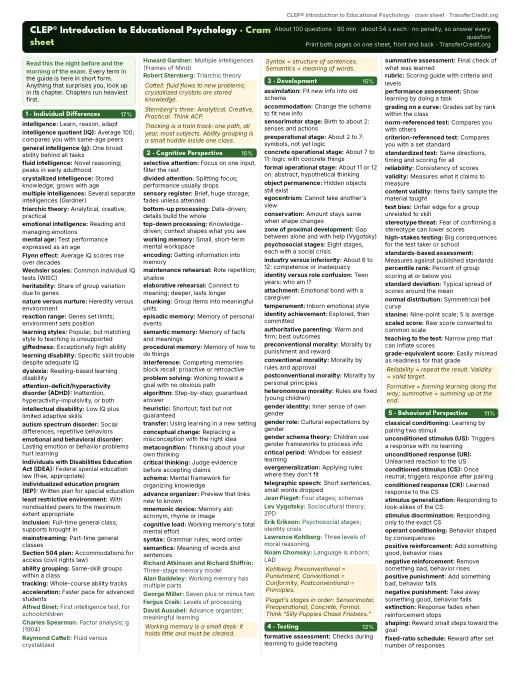
- 2-page cram sheet and study plans
Official exam name: Introduction to Educational Psychology
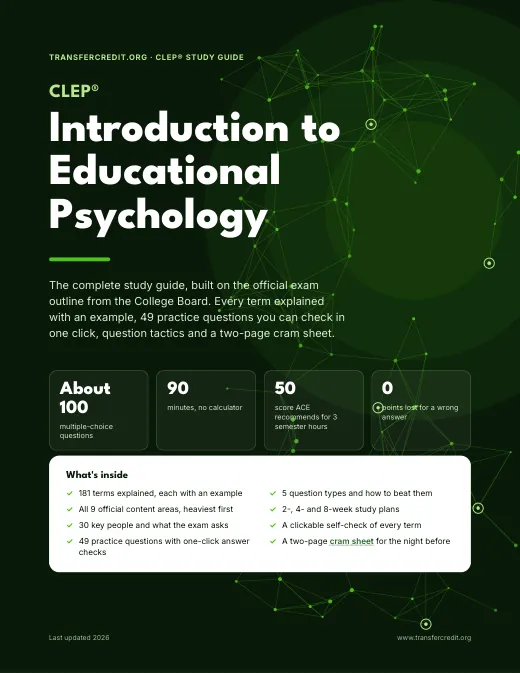
Everything the CLEP Educational Psychology exam tests, in one PDF you can print. Built from the College Board's official outline, heaviest topics first.
Last updated 2026 · exam details checked against the College Board's published exam information in 2026
Real pages from the 40-page PDF.
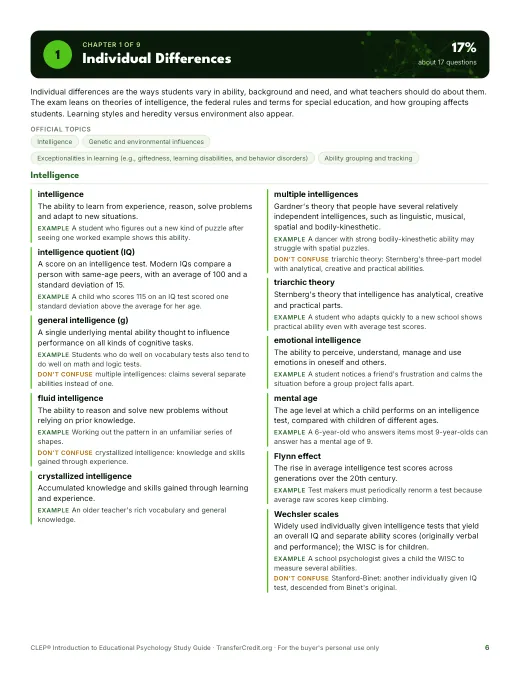
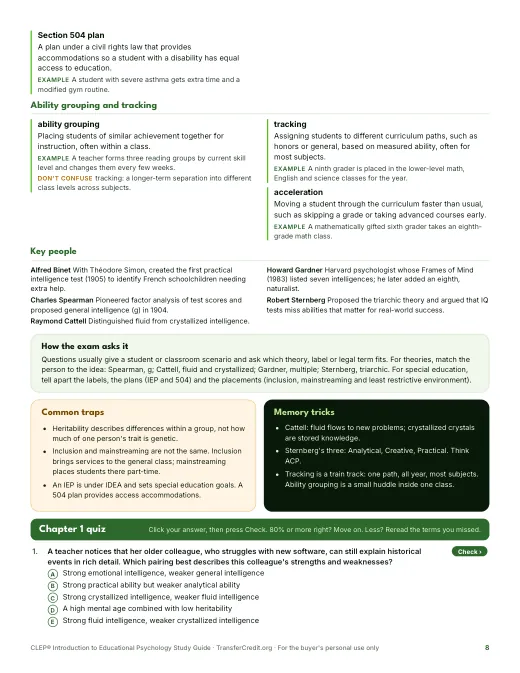
One chapter for each official content area, in the order the exam weighs them.
In the style of the real exam, from all 9 areas. About 10 minutes, with every answer explained and a score by area.
A teacher notices that her older colleague, who struggles with new software, can still explain historical events in rich detail. Which pairing best describes this colleague's strengths and weaknesses?
Answer: E. Strong crystallized intelligence, weaker fluid intelligence. Rich stored knowledge reflects crystallized intelligence, while trouble with novel problems such as new software points to weaker fluid intelligence.
The trap: Strong fluid, weaker crystallized reverses the pattern: fluid is solving new problems, and that is the colleague's weaker area.
Rich stored knowledge reflects crystallized intelligence, while trouble with novel problems such as new software points to weaker fluid intelligence.
The trap: Strong fluid, weaker crystallized reverses the pattern: fluid is solving new problems, and that is the colleague's weaker area.
A teacher notices that students who only re-read their notes do worse on application questions than students who explain each idea in their own words with examples from daily life. The second group's advantage is best explained by
Answer: D. elaborative rehearsal of the material. Explaining ideas in your own words with examples ties them to existing knowledge, which is elaborative rehearsal. That produces deeper, longer-lasting memory than repetition.
The trap: Maintenance rehearsal describes the re-reading group, which used repetition. It is the weaker strategy, so it cannot explain the second group's advantage.
Explaining ideas in your own words with examples ties them to existing knowledge, which is elaborative rehearsal. That produces deeper, longer-lasting memory than repetition.
The trap: Maintenance rehearsal describes the re-reading group, which used repetition. It is the weaker strategy, so it cannot explain the second group's advantage.
A 5-year-old watches water poured from a short, wide glass into a tall, thin glass and says the tall glass now holds more. Piaget would say the child's answer shows a lack of
Answer: C. conservation. Believing the amount changed when only the shape changed shows a lack of conservation, typical of the preoperational stage.
The trap: Object permanence is mastered in infancy. The child clearly understands the water still exists; the problem is judging quantity.
Believing the amount changed when only the shape changed shows a lack of conservation, typical of the preoperational stage.
The trap: Object permanence is mastered in infancy. The child clearly understands the water still exists; the problem is judging quantity.
Midway through a unit on fractions, a teacher gives a short ungraded quiz and uses the results to decide which students need a mini-lesson the next day. This quiz is an example of
Answer: A. formative assessment. The quiz is ungraded and used to adjust instruction while learning is still in progress. That is formative assessment.
The trap: Summative assessment is tempting because it is a quiz, but summative assessments come at the end and are used for grades.
The quiz is ungraded and used to adjust instruction while learning is still in progress. That is formative assessment.
The trap: Summative assessment is tempting because it is a quiz, but summative assessments come at the end and are used for grades.
Several times, a loud thunderclap made a second grader jump just after the classroom lights flickered. Now she jumps whenever the lights flicker, even on calm, sunny days. Her jumping when the lights flicker is the
Answer: B. conditioned response. The flickering lights were once neutral, but after being paired with thunder they trigger jumping on their own. A learned reaction to a conditioned stimulus is the conditioned response.
The trap: Unconditioned response is tempting because jumping at thunder is automatic, but jumping at the flickering lights alone was learned through pairing.
The flickering lights were once neutral, but after being paired with thunder they trigger jumping on their own. A learned reaction to a conditioned stimulus is the conditioned response.
The trap: Unconditioned response is tempting because jumping at thunder is automatic, but jumping at the flickering lights alone was learned through pairing.
A student has always earned high marks in writing and expects to do well on tomorrow's essay. This expectation most clearly reflects high
Answer: A. self-efficacy. A belief in one's ability to succeed at a particular task, built on past success, is self-efficacy.
The trap: Performance goals concern wanting to look able or beat others. The student's confidence is about ability, not about goals.
A belief in one's ability to succeed at a particular task, built on past success, is self-efficacy.
The trap: Performance goals concern wanting to look able or beat others. The student's confidence is about ability, not about goals.
A teacher wants students to be able to "analyze two causes of the Civil War." She starts by writing the final essay assignment and then plans the daily lessons. This approach is
Answer: E. backward design. Choosing the desired result and assessment first, then planning activities, is backward design.
The trap: Mastery learning requires students to reach a set standard before advancing. The teacher here is simply planning from the end goal.
Choosing the desired result and assessment first, then planning activities, is backward design.
The trap: Mastery learning requires students to reach a set standard before advancing. The teacher here is simply planning from the end goal.
A researcher wants to know whether a new tutoring program causes higher reading scores. Which study design could best support a cause-and-effect conclusion?
Answer: C. Randomly assign students to tutoring or no tutoring and compare their scores. Random assignment makes the groups equivalent at the start, so differences in outcomes can be attributed to the program. This is an experiment.
The trap: Comparing students who chose tutoring is tempting, but motivated students may differ from the others, so the groups are not equivalent.
Random assignment makes the groups equivalent at the start, so differences in outcomes can be attributed to the program. This is an experiment.
The trap: Comparing students who chose tutoring is tempting, but motivated students may differ from the others, so the groups are not equivalent.
A history teacher revises the unit on westward expansion so it includes the perspectives of Native American, Mexican American and Chinese immigrant communities as well as settlers. This change is best described as
Answer: B. multicultural education. Including the perspectives of multiple cultural groups in the curriculum is a central part of multicultural education.
The trap: Acculturation is tempting because cultures are mentioned, but it describes individuals adapting to a new culture, not changes in curriculum.
Including the perspectives of multiple cultural groups in the curriculum is a central part of multicultural education.
The trap: Acculturation is tempting because cultures are mentioned, but it describes individuals adapting to a new culture, not changes in curriculum.
A district proposes a reading program in which each student is taught only through the student's self-reported preferred mode, such as visual or auditory. Which statement best reflects current research on this approach?
Answer: D. Matching instruction to preferred style has not been shown to improve learning.. Learning styles are a popular idea, but studies have not found that teaching to a preferred style improves learning. Good instruction uses methods that fit the content.
The trap: The claim that matching raises achievement is tempting because it sounds intuitive, but research has not supported it.
Learning styles are a popular idea, but studies have not found that teaching to a preferred style improves learning. Good instruction uses methods that fit the content.
The trap: The claim that matching raises achievement is tempting because it sounds intuitive, but research has not supported it.
The CLEP Introduction to Educational Psychology exam is a 90-minute, computer-based test from the College Board with about 100 multiple-choice questions. A score of 50 on the 20–80 scale earns an ACE credit recommendation of 3 semester hours, though each college sets its own policy. The exam covers 9 content areas; the heaviest is Individual Differences at 17%.
Source: official CLEP Introduction to Educational Psychology exam page.
9 areas, heaviest first. The guide's chapters follow this order.
Start with the guide, or get everything for CLEP in one plan.
CLEP® is a registered trademark of the College Board, which was not involved in producing this guide and does not endorse it. TransferCredit.org is independent and not affiliated with the College Board. © 2026 UPI Globale Edu Inc.