
$5one-time
- 39-page printable PDF
- 181 terms with examples
- 44 practice questions, answers explained
- 2-page cram sheet and study plans
Official exam name: Principles of Macroeconomics
Everything the CLEP Macroeconomics exam tests, in one PDF you can print. Built from the College Board's official outline, heaviest topics first.
Last updated 2026 · exam details checked against the College Board's published exam information in 2026
Real pages from the 39-page PDF.

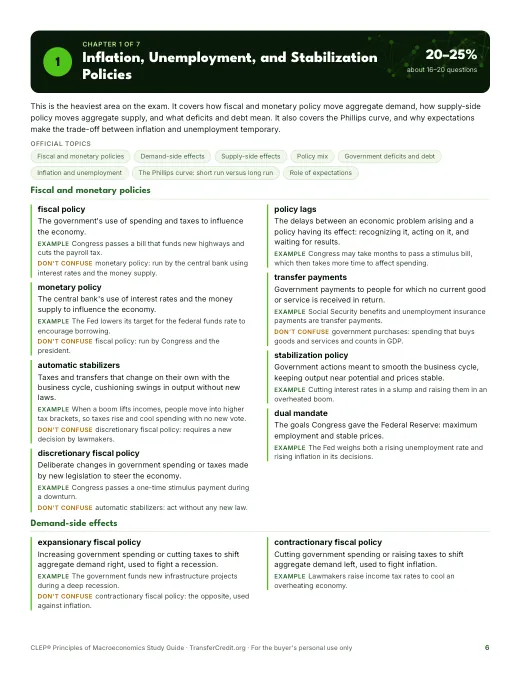

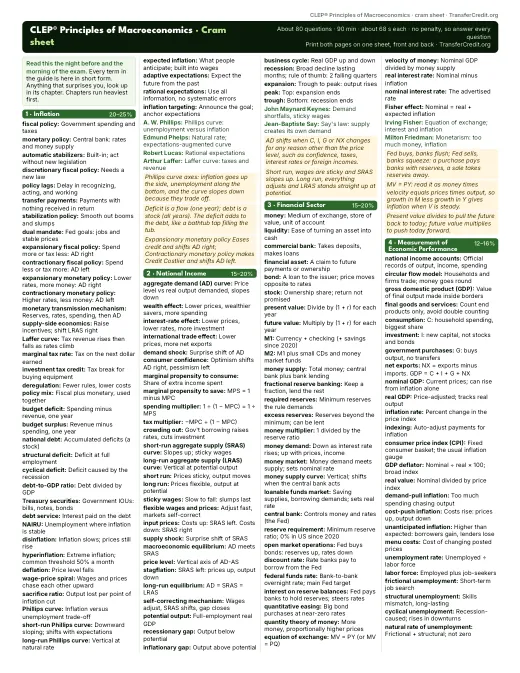
One chapter for each official content area, in the order the exam weighs them.
In the style of the real exam, from all 7 areas. About 10 minutes, with every answer explained and a score by area.
Along a short-run Phillips curve, an increase in aggregate demand will most likely lead to which of the following?
Answer: B. A lower unemployment rate and a higher inflation rate. Higher demand raises output and pushes unemployment down, and prices rise faster. That is a movement up and to the left along the downward-sloping curve.
The trap: Higher unemployment and higher inflation would be stagflation. A demand increase moves the economy along the curve rather than producing both bad outcomes.
Higher demand raises output and pushes unemployment down, and prices rise faster. That is a movement up and to the left along the downward-sloping curve.
The trap: Higher unemployment and higher inflation would be stagflation. A demand increase moves the economy along the curve rather than producing both bad outcomes.
The marginal propensity to consume is 0.75. If the government raises its purchases by $20 billion, real GDP will rise by
Answer: A. $80 billion. The multiplier is 1 divided by (1 minus 0.75), which is 4. The change in GDP is 4 times $20 billion, or $80 billion.
The trap: "$60 billion" applies the tax multiplier's size (3), but this is a spending change.
The multiplier is 1 divided by (1 minus 0.75), which is 4. The change in GDP is 4 times $20 billion, or $80 billion.
The trap: "$60 billion" applies the tax multiplier's size (3), but this is a spending change.
Assume a hypothetical 20 percent reserve requirement, no excess reserves, and that all loans are redeposited in banks. The Fed buys a $1,000 bond from a bank, giving the bank $1,000 in new reserves. What is the maximum eventual increase in the money supply?
Answer: C. $5,000. The money multiplier is 1 divided by 0.20, which is 5. New reserves of $1,000 can support up to $5,000 of additional deposits.
The trap: $1,000 is tempting because it is the size of the Fed purchase, but it ignores the multiplier: banks lend out the new reserves again and again.
The money multiplier is 1 divided by 0.20, which is 5. New reserves of $1,000 can support up to $5,000 of additional deposits.
The trap: $1,000 is tempting because it is the size of the Fed purchase, but it ignores the multiplier: banks lend out the new reserves again and again.
Nominal GDP is $600 billion and the GDP deflator is 120. What is real GDP?
Answer: D. $500 billion. Real GDP equals nominal GDP divided by the deflator, times 100. That is 600 divided by 120, times 100, which is $500 billion.
The trap: $720 billion comes from multiplying 600 by 1.2 instead of dividing, which moves in the wrong direction.
Real GDP equals nominal GDP divided by the deflator, times 100. That is 600 divided by 120, times 100, which is $500 billion.
The trap: $720 billion comes from multiplying 600 by 1.2 instead of dividing, which moves in the wrong direction.
Ana can make 6 pies or 2 cakes per day. Ben can make 2 pies or 1 cake per day. Which arrangement gives both of them gains from trade?
Answer: E. Ana specializes in pies and Ben in cakes. A cake costs Ana 3 pies but costs Ben only 2 pies, so Ben has the comparative advantage in cakes. Ana, giving up 1/3 of a cake per pie versus Ben's 1/2, has it in pies. Each should specialize there and trade.
The trap: "No trade can help" is tempting because Ana is better at both goods. Gains from trade depend on comparative advantage, not absolute advantage.
A cake costs Ana 3 pies but costs Ben only 2 pies, so Ben has the comparative advantage in cakes. Ana, giving up 1/3 of a cake per pie versus Ben's 1/2, has it in pies. Each should specialize there and trade.
The trap: "No trade can help" is tempting because Ana is better at both goods. Gains from trade depend on comparative advantage, not absolute advantage.
If real GDP per capita grows at 3.5 percent a year, about how many years will it take to double?
Answer: E. 20 years. By the rule of 70, doubling time is 70 divided by the growth rate: 70 divided by 3.5 is 20 years.
The trap: "245 years" results from multiplying 70 by 3.5 instead of dividing.
By the rule of 70, doubling time is 70 divided by the growth rate: 70 divided by 3.5 is 20 years.
The trap: "245 years" results from multiplying 70 by 3.5 instead of dividing.
A country runs a current account deficit. In balance of payments accounting, which of the following must be true, other things equal?
Answer: C. The financial account shows a net inflow of funds.. A current account deficit means the country buys more from abroad than it sells. It pays for the gap by selling assets and borrowing, so the financial account shows a net capital inflow.
The trap: The financial account shows a net outflow is tempting because both involve flows across borders, but a deficit needs funding, which means an inflow.
A current account deficit means the country buys more from abroad than it sells. It pays for the gap by selling assets and borrowing, so the financial account shows a net capital inflow.
The trap: The financial account shows a net outflow is tempting because both involve flows across borders, but a deficit needs funding, which means an inflow.
The central bank permanently increases money growth, and after a time workers and firms fully adjust their inflation expectations. In the long run, which of the following is most likely?
Answer: D. Higher inflation, with unemployment back at the natural rate. The long-run Phillips curve is vertical at the natural rate. Once expectations catch up, unemployment returns to the natural rate and only inflation is higher.
The trap: Higher inflation and permanently lower unemployment describes a short-run gain. It disappears once expectations adjust upward.
The long-run Phillips curve is vertical at the natural rate. Once expectations catch up, unemployment returns to the natural rate and only inflation is higher.
The trap: Higher inflation and permanently lower unemployment describes a short-run gain. It disappears once expectations adjust upward.
The marginal propensity to consume is 0.9. A lump-sum tax cut of $5 billion will increase real GDP by
Answer: B. $45 billion. The tax multiplier is minus MPC divided by (1 minus MPC): −0.9 ÷ 0.1 = −9. A $5 billion cut raises GDP by 9 times $5 billion, or $45 billion.
The trap: "$50 billion" uses the spending multiplier of 10. Only the part of the cut that households spend starts the multiplier, so the effect is one round smaller.
The tax multiplier is minus MPC divided by (1 minus MPC): −0.9 ÷ 0.1 = −9. A $5 billion cut raises GDP by 9 times $5 billion, or $45 billion.
The trap: "$50 billion" uses the spending multiplier of 10. Only the part of the cut that households spend starts the multiplier, so the effect is one round smaller.
If the Federal Reserve sells government bonds on the open market, which of the following is most likely to occur?
Answer: A. Bank reserves fall and the federal funds rate rises.. Buyers pay the Fed with reserves, so reserves leave the banking system. With fewer reserves to lend, the overnight rate banks charge each other rises.
The trap: Bank reserves rise and the federal funds rate falls describes a Fed bond purchase, not a sale. When the Fed sells bonds, reserves drain out.
Buyers pay the Fed with reserves, so reserves leave the banking system. With fewer reserves to lend, the overnight rate banks charge each other rises.
The trap: Bank reserves rise and the federal funds rate falls describes a Fed bond purchase, not a sale. When the Fed sells bonds, reserves drain out.
The CLEP Principles of Macroeconomics exam is a 90-minute, computer-based test from the College Board with about 80 multiple-choice questions. A score of 50 on the 20–80 scale earns an ACE credit recommendation of 3 semester hours, though each college sets its own policy. The exam covers 7 content areas; the heaviest is Inflation, Unemployment, and Stabilization Policies at 20–25%.
Source: official CLEP Principles of Macroeconomics exam page.
7 areas, heaviest first. The guide's chapters follow this order.
Start with the guide, or get everything for CLEP in one plan.
CLEP® is a registered trademark of the College Board, which was not involved in producing this guide and does not endorse it. TransferCredit.org is independent and not affiliated with the College Board. © 2026 UPI Globale Edu Inc.