← All study guides
CLEP® Study Guide Printable PDF · 30 pages

CLEP German Language Study Guide

Official exam name: German Language: Levels 1 and 2

Everything the CLEP German Language exam tests, in one PDF you can print. Built from the College Board's official outline, heaviest topics first.

  • 182 key terms, each with an example
  • 40 practice questions with every answer explained
  • A 2-page cram sheet for the night before
  • 2-, 4- and 8-week study plans built from the exam weights
Not sure yet? Try 10 free questions

Last updated 2026 · exam details checked against the College Board's published exam information in 2026

Look inside the guide

Real pages from the 30-page PDF.

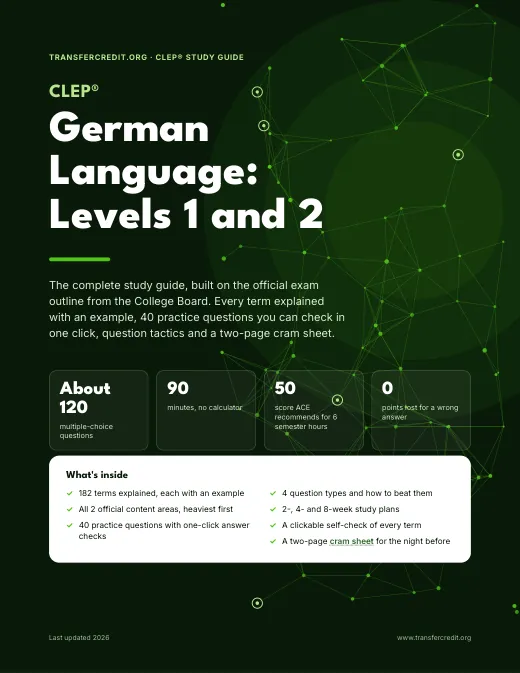
Page 1 of the CLEP German Language Study Guide: the cover
Page 1 The cover
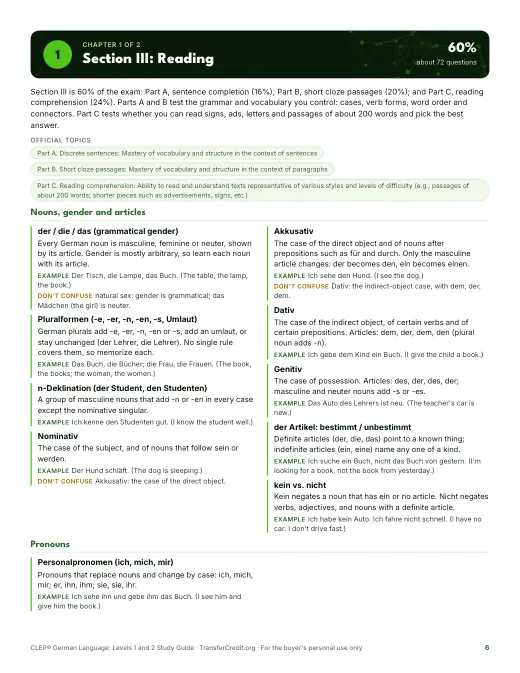
Page 6 of the CLEP German Language Study Guide: the Chapter 1 opener
Page 6 The Chapter 1 opener
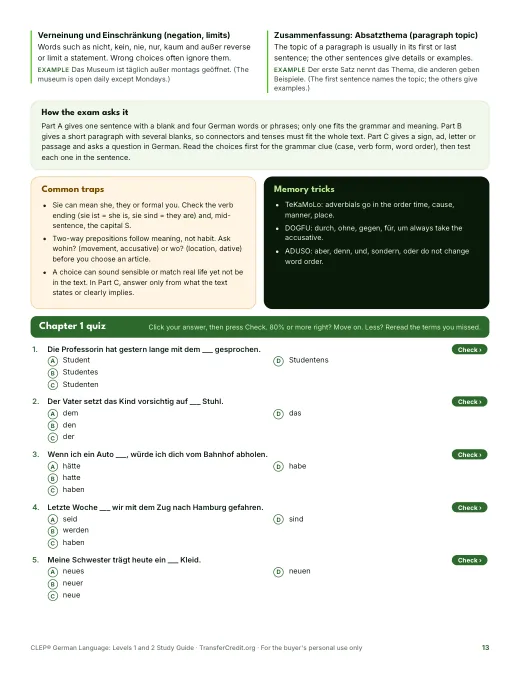
Page 13 of the CLEP German Language Study Guide: a chapter quiz
Page 13 A chapter quiz
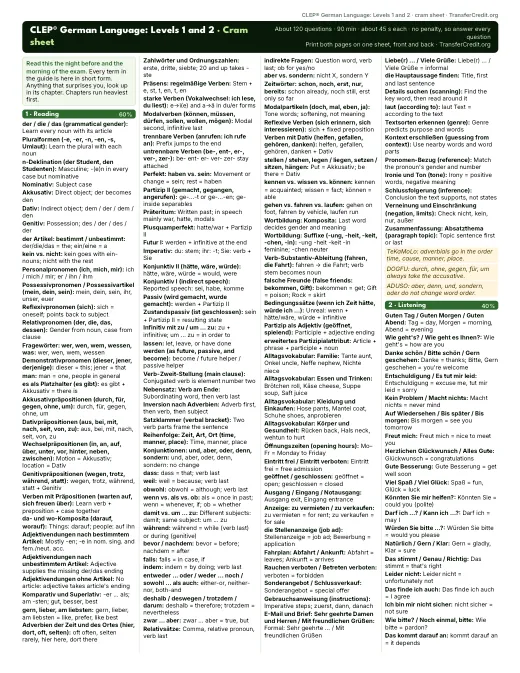
Page 29 of the CLEP German Language Study Guide: the 2-page cram sheet
Page 29 The 2-page cram sheet

What you get for $5

One chapter for each official content area, in the order the exam weighs them.

  • 📘30pages, printable
  • 🧭2chapters, heaviest first
  • 🔑182terms with examples
  • ✍️40practice questions, answers explained
  • ⚠️6exam traps to avoid
  • 📄2page cram sheet

Try 10 free German Language questions

In the style of the real exam, from all 2 areas. About 10 minutes, with every answer explained and a score by area.

10 questions  
  1. Question 1 · Section III: Reading

    Die Professorin hat gestern lange mit dem ___ gesprochen.

    Show the answer

    Answer: B. Studenten. Student is an n-noun. After mit the dative is required, and the dative singular is Studenten.

    The trap: Student is wrong because it is the nominative form; n-nouns add -en in every case except the nominative singular.

  2. Question 2 · Sections I and II: Listening

    Oh, Entschuldigung! Ich habe Sie nicht gesehen.

    Show the answer

    Answer: A. Kein Problem, es ist nichts passiert.. An apology for bumping into someone is answered with a reassurance such as Kein Problem.

    The trap: Gern geschehen answers thanks, not an apology, so it does not fit this situation.

  3. Question 3 · Section III: Reading

    Der Vater setzt das Kind vorsichtig auf ___ Stuhl.

    Show the answer

    Answer: C. den. Setzen means to put someone into a seat, a movement (wohin?), so auf takes the accusative. Stuhl is masculine, so the article is den.

    The trap: Dem is wrong because the dative answers wo? and would describe where the child already sits, not where it is put.

  4. Question 4 · Sections I and II: Listening

    Ich habe heute Geburtstag.

    Show the answer

    Answer: D. Alles Gute!. A birthday calls for good wishes, and Alles Gute is the fitting reply.

    The trap: Gute Besserung is a wish for someone who is ill, which the speaker has not said.

  5. Question 5 · Section III: Reading

    Wenn ich ein Auto ___, würde ich dich vom Bahnhof abholen.

    Show the answer

    Answer: B. hätte. An unreal condition needs Konjunktiv II in the wenn clause. The Konjunktiv II of haben is hätte.

    The trap: Hatte is tempting because it looks like a past form, but the clause is unreal, not past; it needs the subjunctive.

  6. Question 6 · Sections I and II: Listening

    Guten Tag! Sie wünschen?

    Show the answer

    Answer: C. Ein Kilo Äpfel, bitte.. Sie wünschen? is a clerk asking what you want, like Was darf es sein? It expects an order, such as a quantity and bitte.

    The trap: Zusammen, bitte answers a waiter asking how to split the bill, not a clerk asking what you want.

  7. Question 7 · Section III: Reading

    Letzte Woche ___ wir mit dem Zug nach Hamburg gefahren.

    Show the answer

    Answer: D. sind. Fahren here is movement with no direct object, so the Perfekt uses sein. The wir form is sind.

    The trap: Haben is wrong because it is the usual Perfekt helper, but verbs of movement take sein.

  8. Question 8 · Sections I and II: Listening

    Zusammen oder getrennt?

    Show the answer

    Answer: A. Getrennt, bitte.. This question is about splitting a bill, so Getrennt, bitte answers it directly.

    The trap: Zum Mitnehmen, bitte is tempting because it is restaurant talk, but it means to take away and does not choose how to pay.

  9. Question 9 · Section III: Reading

    Meine Schwester trägt heute ein ___ Kleid.

    Show the answer

    Answer: C. neues. Das Kleid is neuter and accusative here. After ein, the adjective must show the neuter ending -es.

    The trap: Neue is wrong because -e follows eine with a feminine noun; after ein, a neuter noun needs -es.

  10. Question 10 · Sections I and II: Listening

    Wie komme ich zum Bahnhof?

    Show the answer

    Answer: A. Geradeaus, dann an der Ampel links.. The question asks for directions, so the reply gives a route with geradeaus, Ampel and links.

    The trap: Der Zug fährt um acht Uhr von Gleis 3 ab fits the station topic, but it gives a time, not a route.

The CLEP German Language exam at a glance

The CLEP German Language: Levels 1 and 2 exam is a computer-based test from the College Board. It has approximately 120 questions in three separately timed sections, 90 minutes in all, and some are pretest questions that will not be scored. A score of 50 on the 20–80 scale earns an ACE credit recommendation of 6 semester hours, though each college sets its own policy. The exam covers 2 content areas; the heaviest is Section III: Reading at 60%.

Questions
About 120multiple choice
Time
90 minseparately timed sections
Passing score
50on a 20–80 scale
ACE credit
6semester hours
Exam fee
$97paid to College Board
Calculator
Nonot allowed

Source: official CLEP German Language: Levels 1 and 2 exam page.

What the exam covers

2 areas, heaviest first. The guide's chapters follow this order.

  1. Section III: Reading60%
  2. Sections I and II: Listening40%

How it works

  1. 1Buy once, $5Secure checkout. No subscription needed.
  2. 2Download the PDFFrom your TransferCredit.org account, right away and any time later.
  3. 3Study the heaviest areas firstFollow the 2-, 4- or 8-week plan, then read the cram sheet the night before.

Questions students ask

What's in the full CLEP German Language study guide?
30 pages: 2 chapters, one per official content area, heaviest first. 182 terms, each with a plain-English definition and an example, common traps and memory tricks, 40 practice questions with an answer key that explains every answer, question tactics, 2-, 4- and 8-week study plans and a 2-page cram sheet.
How much is the full CLEP German Language study guide?
The full 30-page PDF is $5, a one-time payment. The 10 practice questions on this page are free, with no account.
What does the $29 plan include?
$29 a month gives you all 28 CLEP subjects: every CLEP study guide plus the full prep course for each subject, and you can cancel anytime. If you only need this exam, the guide on its own is a one-time $5.
How do I get the full guide?
Choose Buy this guide ($5) and check out. Then sign in to your TransferCredit.org account, then open the course and its Download Your Study Guide lesson. The PDF is yours to keep, and you can download it again from your account at any time.
Can I print the guide or use it on my phone?
Yes. It's a PDF, so it opens on phones, tablets and computers, and printing is allowed. Its tick boxes and answer bubbles work in PDF readers that support forms. Copying and editing are turned off.
Is this an official CLEP study guide?
No. CLEP® is a registered trademark of the College Board, which was not involved in producing this guide and does not endorse it. TransferCredit.org is independent. We built the guide from the official exam outline, and the exam details were checked against the College Board's published exam information in 2026.
Why is this study guide better than a generic review?
It follows the official outline area by area and spends the most pages on what the exam weighs most. Every term comes with an example, each chapter names the traps the exam sets, and the answer key explains why the most tempting wrong answer is wrong, not just which answer is right. It ends with a 2-page cram sheet for the night before.
What is the CLEP German Language exam?
The CLEP German Language: Levels 1 and 2 exam is a computer-based test from the College Board. It has approximately 120 questions in three separately timed sections, 90 minutes in all, and some are pretest questions that will not be scored. A score of 50 on the 20–80 scale earns an ACE credit recommendation of 6 semester hours, though each college sets its own policy. The exam covers 2 content areas; the heaviest is Section III: Reading at 60%.
More questions about the CLEP German Language exam (20)
How many questions are on the CLEP German Language exam, and how long is it?
It has approximately 120 questions in three separately timed sections, 90 minutes in all, and some are pretest questions that will not be scored.
What is the passing score for CLEP German Language?
The passing score is 50 on a 20–80 scale. At 50 or above, the American Council on Education (ACE) recommends 6 semester hours. Each college sets its own passing score and credit award, so check your school's policy before you book.
How much does the CLEP German Language exam cost?
The exam fee is $97, paid to the College Board. Test centers may add their own administration fee. Eligible U.S. military service members can usually test for free through DANTES.
How many college credits is CLEP German Language worth?
ACE recommends 6 semester hours for a passing score of 50. Your college decides how many credits it awards and which course they replace. Check your college's policy.
Is there a penalty for guessing on CLEP German Language?
No. Your score counts only correct answers, so a wrong answer costs nothing. Never leave a question blank: rule out what you can and pick your best guess.
What topics are on the CLEP German Language exam?
2 content areas, from the official outline: Section III: Reading (60%); Sections I and II: Listening (40%).
Which CLEP German Language topics should I study first?
Start with Section III: Reading (60%), the largest of the exam's 2 areas, then Sections I and II: Listening (40%). The guide's chapters run in that order, heaviest first.
Is the CLEP German Language exam hard?
It depends on what you already know. The exam has only 2 content areas, so each one carries real weight: Section III: Reading (60%) and Sections I and II: Listening (40%). Take the free diagnostic above to see where you stand in about 10 minutes.
What kinds of questions are on the CLEP German Language exam?
The guide sorts them into 4 types: “Rejoinder”, “Main idea or purpose”, “Detail question (time, number, price)” and “Reason or opinion”. Every question has 4 answer choices. Try the 10 free questions above to see the style.
How long should I study for CLEP German Language?
Use the diagnostic to decide. If you already know most areas, two weeks of daily review is often enough; if the subject is new to you, plan on eight. The full guide has 2-, 4- and 8-week plans built from the exam weights.
How should I pace myself on the CLEP German Language exam?
On average you have about 45 seconds per question (90 minutes for 120 questions). The sections are timed separately, so pace each one on its own: divide its minutes by its questions and check your place halfway through. Listening is paced by the recording, so this matters most in the reading section. If a question takes more than a minute, pick your best guess, mark it and come back.
What happens if I don't pass CLEP German Language?
You can retake a CLEP exam after three months. Use the wait to work through the areas the score report and the diagnostic show you missed.
Do colleges accept CLEP German Language for credit?
CLEP exams are accepted at more than 2,900 U.S. colleges and universities, but each school decides which exams it accepts, the score it requires and the credit it gives. Look up your college's CLEP policy before you book.
How up to date is this CLEP German Language guide?
Last updated 2026. The exam details were checked against the College Board's published exam information in 2026. Exams change, so confirm the details on the official exam page before you register.
What should I do the night before the exam?
Read the cram sheet once, slowly. Check your test time, the location or remote-proctoring setup, and the ID you need. Then sleep: a rested brain recalls more than a crammed one. In the morning, skim the memory tricks and common traps, then stop studying.
Is there a speaking or writing section on CLEP German?
No. Every question is multiple choice, based on audio you hear or text you read.
Are CLEP German Level 1 and Level 2 separate exams?
No. It's a single exam that covers both levels, and your score decides the credit: ACE recommends 6 semester hours at a score of 50 and 9 at a score of 60. Colleges may award different amounts, so check your school's policy.
Which German grammar is tested on CLEP German?
Grammar is tested directly in the reading section's discrete sentences (16%) and short cloze passages (20%). Case endings for articles and adjectives, verb forms and word order matter most, and Level 2 scores need the past tenses, relative clauses, the subjunctive and the passive.
What score do I need for 9 credits on CLEP German?
ACE recommends 9 semester hours for a score of 60. That usually requires comfort with second-year grammar such as the simple past, relative clauses, the subjunctive and the passive.
Do heritage speakers do well on CLEP German?
Often, especially on listening. Heritage speakers should still review written grammar, since the reading section tests case endings and structure in writing.

Choose how you want to study

Start with the guide, or get everything for CLEP in one plan.

This study guide
$5one-time
  • 30-page printable PDF
  • 182 terms with examples
  • 40 practice questions, answers explained
  • 2-page cram sheet and study plans
Get the guide · $5
Best value Get it all
$29/month
  • Every CLEP study guide
  • Prep courses for all 28 CLEP subjects
  • Cancel anytime
Get it all · $29/mo

CLEP® is a registered trademark of the College Board, which was not involved in producing this guide and does not endorse it. TransferCredit.org is independent and not affiliated with the College Board. © 2026 UPI Globale Edu Inc.