
$5one-time
- 34-page printable PDF
- 181 terms with examples
- 41 practice questions, answers explained
- 2-page cram sheet and study plans
Official exam name: Spanish with Writing: Levels 1 and 2
Everything the CLEP Spanish with Writing exam tests, in one PDF you can print. Built from the College Board's official outline, heaviest topics first.
Last updated 2026 · exam details checked against the College Board's published exam information in 2026
Real pages from the 34-page PDF.
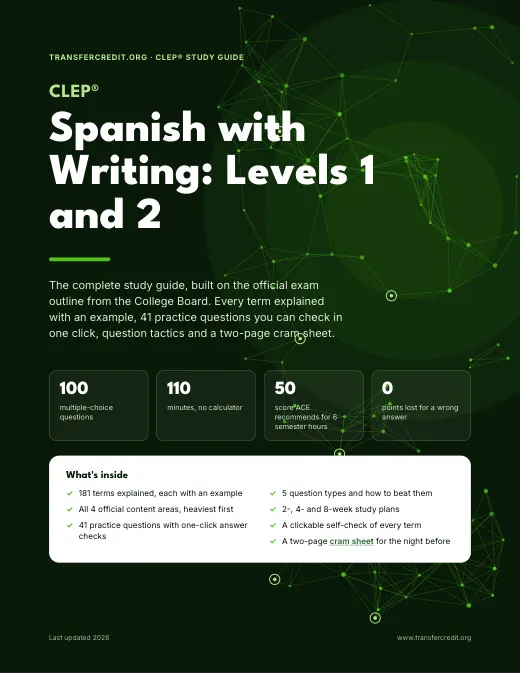
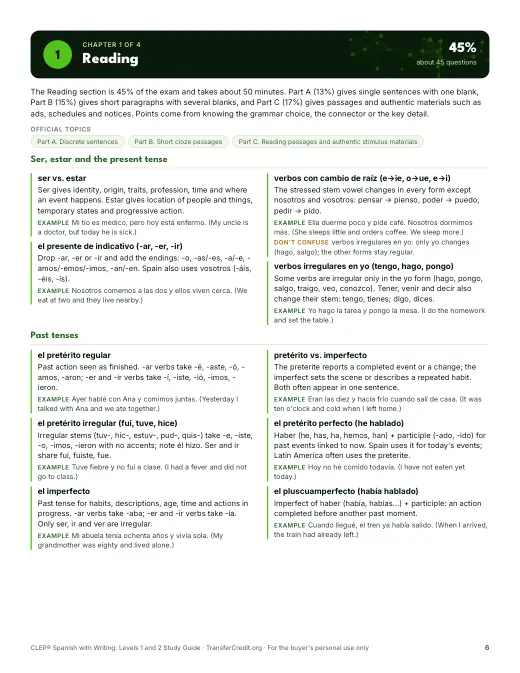
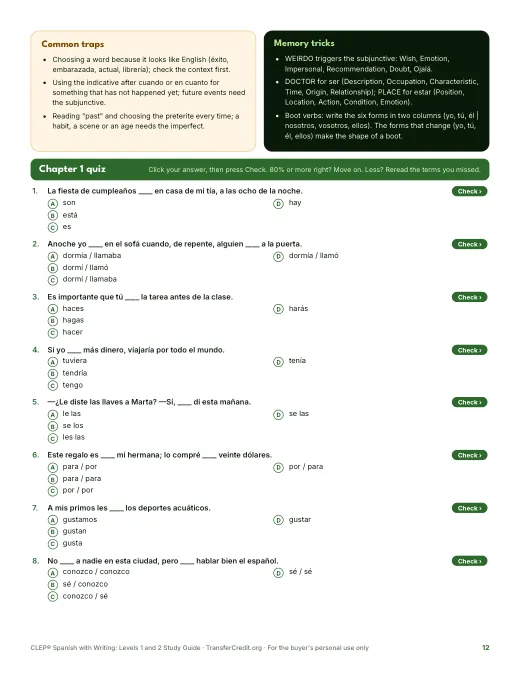
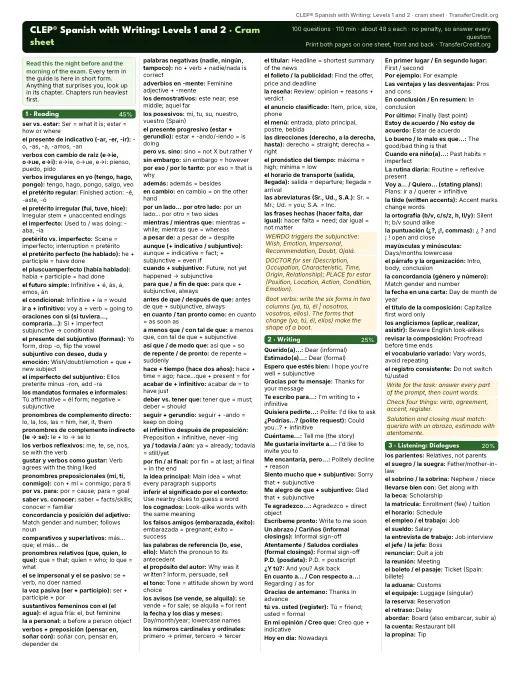
One chapter for each official content area, in the order the exam weighs them.
In the style of the real exam, from all 3 multiple-choice areas. About 10 minutes, with every answer explained and a score by area.
La fiesta de cumpleaños ____ en casa de mi tía, a las ocho de la noche.
Answer: D. es. Ser is used for where and when an event takes place, so a party "es en" a place. Estar describes the location of people and things, not events.
The trap: está is tempting because the sentence names a place, but estar is not used for the location of an event.
Ser is used for where and when an event takes place, so a party "es en" a place. Estar describes the location of people and things, not events.
The trap: está is tempting because the sentence names a place, but estar is not used for the location of an event.
(Audio script) —¿Te gusta tu nuevo empleo?
—Sí, mi jefa es muy amable y tengo buenos compañeros, pero el sueldo es bajo. Por eso estoy buscando otro trabajo.
¿Qué problema tiene el hombre en su empleo?
Answer: B. Gana poco dinero.. He says the sueldo is bajo, so the problem is low pay. The boss and coworkers are described positively.
The trap: Su jefa es antipática: the speaker calls his boss muy amable, so this contradicts what he says.
He says the sueldo is bajo, so the problem is low pay. The boss and coworkers are described positively.
The trap: Su jefa es antipática: the speaker calls his boss muy amable, so this contradicts what he says.
—¿Cuánto cuesta este suéter?
Answer: C. Cuesta cuarenta dólares.. The question asks for a price, so the reply must give an amount of money. Cuesta cuarenta dólares does exactly that.
The trap: Es de lana y muy suave: this tempts because it describes the sweater, but it gives the material, not the price.
The question asks for a price, so the reply must give an amount of money. Cuesta cuarenta dólares does exactly that.
The trap: Es de lana y muy suave: this tempts because it describes the sweater, but it gives the material, not the price.
Anoche yo ____ en el sofá cuando, de repente, alguien ____ a la puerta.
Answer: A. dormía / llamó. Dormía is the background action in progress, so it takes the imperfect. Llamó is the single event that interrupted it, signaled by de repente, so it takes the preterite.
The trap: dormí / llamó makes the sleeping a finished event, but it was still in progress when the knock interrupted it.
Dormía is the background action in progress, so it takes the imperfect. Llamó is the single event that interrupted it, signaled by de repente, so it takes the preterite.
The trap: dormí / llamó makes the sleeping a finished event, but it was still in progress when the knock interrupted it.
(Audio script) «Atención, pasajeros del vuelo 214 con destino a Lima: debido a la lluvia, la salida tiene un retraso de dos horas. Pueden esperar en la sala B.»
¿Qué deben hacer los pasajeros?
Answer: C. Esperar; el vuelo sale tarde.. Retraso means delay, so the flight leaves later and the passengers may wait in room B.
The trap: Abordar el avión inmediatamente: this ignores the two-hour delay in the announcement.
Retraso means delay, so the flight leaves later and the passengers may wait in room B.
The trap: Abordar el avión inmediatamente: this ignores the two-hour delay in the announcement.
—¿Cómo está tu abuelo hoy?
Answer: D. Está mucho mejor, gracias.. ¿Cómo está? asks about health or condition, and Está mucho mejor reports an improvement. It uses estar for a condition, as the question does.
The trap: Es muy simpático: this uses ser to describe personality, but the question asked about his current condition.
¿Cómo está? asks about health or condition, and Está mucho mejor reports an improvement. It uses estar for a condition, as the question does.
The trap: Es muy simpático: this uses ser to describe personality, but the question asked about his current condition.
Es importante que tú ____ la tarea antes de la clase.
Answer: B. hagas. Impersonal expressions of necessity or importance (es importante que) are followed by the present subjunctive when the subject changes. Hagas is the tú subjunctive of hacer.
The trap: haces is the indicative, which is used after statements of certainty, not after es importante que.
Impersonal expressions of necessity or importance (es importante que) are followed by the present subjunctive when the subject changes. Hagas is the tú subjunctive of hacer.
The trap: haces is the indicative, which is used after statements of certainty, not after es importante que.
(Audio script) —Doctora, desde ayer tengo fiebre y me duele la garganta.
—Tiene un resfriado. Tome este jarabe tres veces al día. Si sigue con fiebre, vuelva a verme dentro de una semana.
¿Cuándo debe volver el paciente?
Answer: A. Si todavía tiene fiebre.. The doctor says to come back in a week only if the fever continues.
The trap: Tres veces al día: this is how often to take the syrup, not when to return.
The doctor says to come back in a week only if the fever continues.
The trap: Tres veces al día: this is how often to take the syrup, not when to return.
—¡Me ofrecieron el puesto en la agencia de viajes!
Answer: B. ¡Felicidades! Te lo mereces.. A job offer is good news, so congratulations is the natural response.
The trap: ¡Qué lástima! Lo siento muchísimo: this is the reply to bad news, and the speaker is celebrating.
A job offer is good news, so congratulations is the natural response.
The trap: ¡Qué lástima! Lo siento muchísimo: this is the reply to bad news, and the speaker is celebrating.
Si yo ____ más dinero, viajaría por todo el mundo.
Answer: D. tuviera. A hypothetical "if" clause with a conditional main verb (viajaría) needs the imperfect subjunctive: tuviera.
The trap: tendría is the conditional; it belongs in the result clause, not after si.
A hypothetical "if" clause with a conditional main verb (viajaría) needs the imperfect subjunctive: tuviera.
The trap: tendría is the conditional; it belongs in the result clause, not after si.
The CLEP Spanish with Writing: Levels 1 and 2 exam is a computer-based test from the College Board. The exam has 100 multiple-choice questions to be answered in approximately 80 minutes, plus two writing tasks to be written in 30 minutes, for approximately 110 minutes in all. A score of 50 on the 20–80 scale earns an ACE credit recommendation of 6 semester hours, though each college sets its own policy. The exam covers 4 content areas; the heaviest is Reading at 45%.
Source: official CLEP Spanish with Writing: Levels 1 and 2 exam page.
4 areas, heaviest first. The guide's chapters follow this order.
Start with the guide, or get everything for CLEP in one plan.
CLEP® is a registered trademark of the College Board, which was not involved in producing this guide and does not endorse it. TransferCredit.org is independent and not affiliated with the College Board. © 2026 UPI Globale Edu Inc.