← All study guides
CLEP® Study Guide Printable PDF · 34 pages

CLEP Spanish Language Study Guide

Official exam name: Spanish Language: Levels 1 and 2

Everything the CLEP Spanish Language exam tests, in one PDF you can print. Built from the College Board's official outline, heaviest topics first.

  • 185 key terms, each with an example
  • 40 practice questions with every answer explained
  • A 2-page cram sheet for the night before
  • 2-, 4- and 8-week study plans built from the exam weights
Not sure yet? Try 10 free questions

Last updated 2026 · exam details checked against the College Board's published exam information in 2026

Look inside the guide

Real pages from the 34-page PDF.

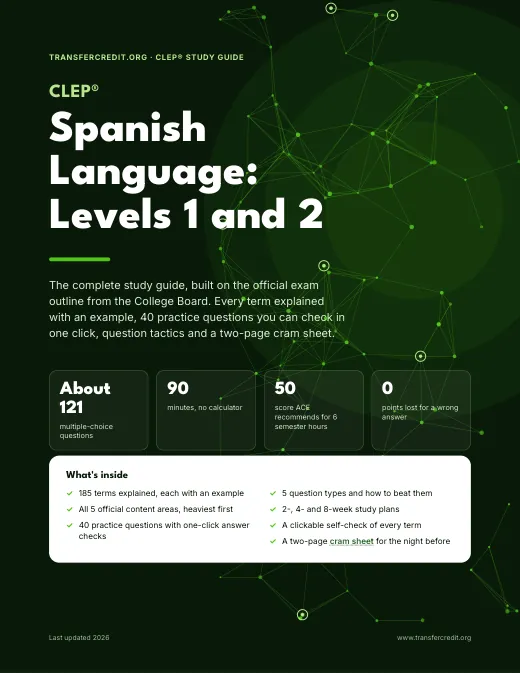
Page 1 of the CLEP Spanish Language Study Guide: the cover
Page 1 The cover
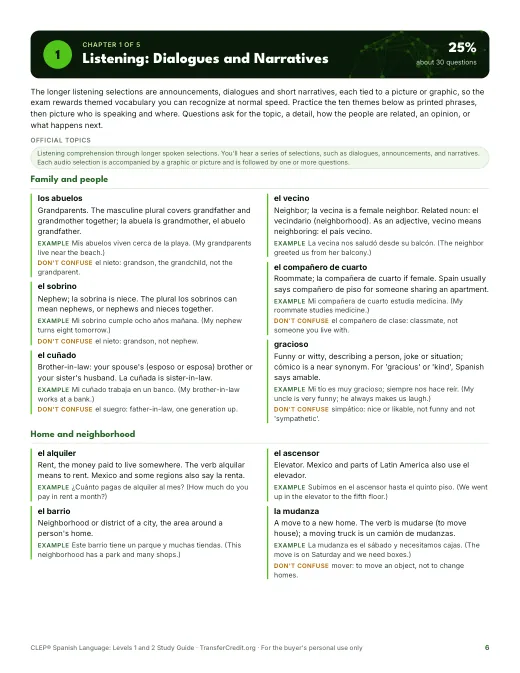
Page 6 of the CLEP Spanish Language Study Guide: the Chapter 1 opener
Page 6 The Chapter 1 opener
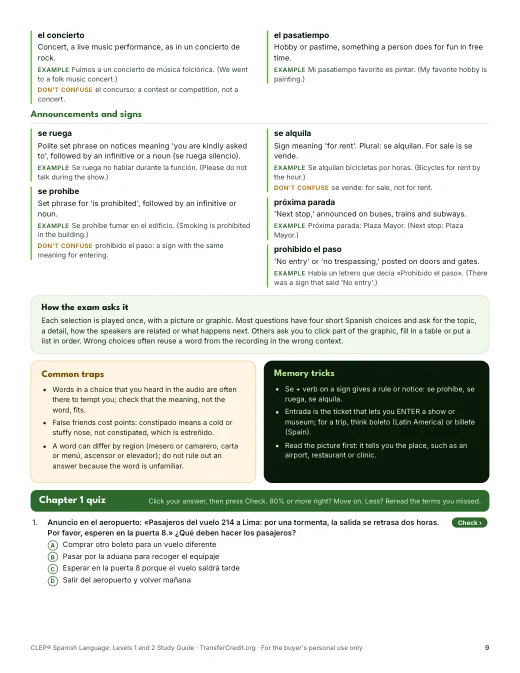
Page 9 of the CLEP Spanish Language Study Guide: a chapter quiz
Page 9 A chapter quiz
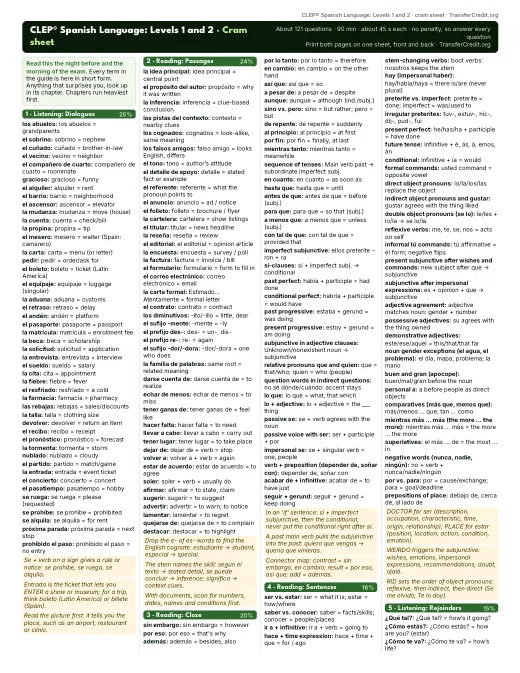
Page 33 of the CLEP Spanish Language Study Guide: the 2-page cram sheet
Page 33 The 2-page cram sheet

What you get for $5

One chapter for each official content area, in the order the exam weighs them.

  • 📘34pages, printable
  • 🧭5chapters, heaviest first
  • 🔑185terms with examples
  • ✍️40practice questions, answers explained
  • ⚠️15exam traps to avoid
  • 📄2page cram sheet

Try 10 free Spanish Language questions

In the style of the real exam, from all 5 areas. About 10 minutes, with every answer explained and a score by area.

10 questions  
  1. Question 1 · Listening: Dialogues and Narratives

    Anuncio en el aeropuerto: «Pasajeros del vuelo 214 a Lima: por una tormenta, la salida se retrasa dos horas. Por favor, esperen en la puerta 8.» ¿Qué deben hacer los pasajeros?

    Show the answer

    Answer: A. Esperar en la puerta 8 porque el vuelo saldrá tarde. The announcement says the flight is delayed two hours because of a storm and asks passengers to wait at gate 8.

    The trap: Pasar por la aduana: customs is for arriving passengers; nothing in the announcement mentions it.

  2. Question 2 · Part C: Reading passages and authentic stimulus materials (reading comprehension)

    SE ALQUILA apartamento céntrico, dos habitaciones, balcón. 650 euros al mes, gastos incluidos. Llamar después de las 18:00 al 91 555 01 23. No se admiten mascotas.
    ¿Cuál es una condición para alquilar el apartamento?

    Show the answer

    Answer: B. No vivir con animales domésticos. The ad says No se admiten mascotas, so tenants cannot keep pets (animales domésticos).

    The trap: Pagar los gastos aparte is wrong because the ad says gastos incluidos, meaning the bills are already part of the rent.

  3. Question 3 · Part B: Short cloze passages (vocabulary and structure)

    El hotel tiene una piscina enorme. ____, está a cinco minutos de la playa. Por eso siempre está lleno en verano.

    Show the answer

    Answer: D. Además. Además adds a second advantage (the beach) to the first (the pool); the last sentence shows both are reasons the hotel is full.

    The trap: Sin embargo: it signals a contrast, but being near the beach is another advantage, not a problem.

  4. Question 4 · Part A: Discrete sentences (vocabulary and structure)

    Ayer, mientras yo ____ la tarea, mi hermano llegó de la escuela.

    Show the answer

    Answer: C. hacía. Mientras introduces an action in progress that was interrupted by llegó, so the imperfect hacía fits.

    The trap: Hice is the preterite for a finished event. It does not show that the homework was in progress when the brother arrived.

  5. Question 5 · Listening: Rejoinders

    —Mañana cumplo veinte años y mis padres me van a hacer una fiesta.

    Show the answer

    Answer: C. ¡Felicidades! ¡Que lo pases bien!. The speaker shares happy news about a birthday, so the logical response congratulates and wishes them well.

    The trap: De nada, fue un placer ayudarte answers a thank-you, but nobody has thanked anyone.

  6. Question 6 · Listening: Dialogues and Narratives

    Diálogo en un restaurante: «—¿Ya decidieron? —Sí, para mí el pollo con arroz. —¿Y para beber? —Un jugo de naranja. Y cuando terminemos, ¿nos trae la cuenta? —Con mucho gusto.» ¿Qué le pide la clienta al mesero para cuando terminen de comer?

    Show the answer

    Answer: B. Que le traiga la cuenta. The customer orders, then asks the waiter to bring the check (la cuenta) when they finish, and he agrees.

    The trap: Que le explique la carta: she has already chosen her food from the menu.

  7. Question 7 · Part C: Reading passages and authentic stimulus materials (reading comprehension)

    Asunto: Cambio de reunión
    Estimados colegas: Lamento informarles que la reunión del martes se pospone hasta el jueves a las 10:00 por la ausencia de la directora. Les ruego confirmar su asistencia antes del miércoles. Saludos, Pablo Ruiz
    ¿Cuál es el propósito principal del mensaje?

    Show the answer

    Answer: A. Avisar de que la reunión cambia de día. The email announces that the meeting is moved from Tuesday to Thursday and asks for confirmation.

    The trap: Cancelar la reunión para siempre is wrong: se pospone means the meeting is delayed, not canceled.

  8. Question 8 · Part B: Short cloze passages (vocabulary and structure)

    Elena no tomó té en la cena, ____ jugo de manzana.

    Show the answer

    Answer: D. sino. After a negative, sino means 'but rather' and supplies the correct item.

    The trap: pero: it contrasts without correcting, so it does not fit after 'no tomó té' with a replacement.

  9. Question 9 · Part A: Discrete sentences (vocabulary and structure)

    Es necesario que tú ____ temprano para no perder el tren.

    Show the answer

    Answer: C. llegues. Es necesario que is an impersonal expression of need, so the verb must be in the present subjunctive: llegues.

    The trap: Llegas is the indicative. It sounds natural in English but does not follow es necesario que.

  10. Question 10 · Listening: Rejoinders

    —Buenas tardes, señora. ¿En qué puedo servirle?

    Show the answer

    Answer: A. Busco un regalo para mi esposo.. This is a formal offer of help from a clerk, so the customer states what they need.

    The trap: Son las cuatro y media answers a question about the time. The word tardes in the stem tempts you to pick it, but nobody asked the hour.

The CLEP Spanish Language exam at a glance

The CLEP Spanish Language: Levels 1 and 2 exam is a computer-based test from the College Board. The exam has approximately 121 questions in approximately 90 minutes, in three separately timed sections: two listening sections (about 30 minutes together) and a 60-minute reading section. A score of 50 on the 20–80 scale earns an ACE credit recommendation of 6 semester hours, though each college sets its own policy. The exam covers 5 content areas; the heaviest is Listening: Dialogues and Narratives at 25%.

Questions
About 121mostly multiple choice
Time
90 minseparately timed sections
Passing score
50on a 20–80 scale
ACE credit
6semester hours
Exam fee
$97paid to College Board
Calculator
Nonot allowed

Source: official CLEP Spanish Language: Levels 1 and 2 exam page.

What the exam covers

5 areas, heaviest first. The guide's chapters follow this order.

  1. Listening: Dialogues and Narratives25%
  2. Part C: Reading passages and authentic stimulus materials (reading comprehension)24%
  3. Part B: Short cloze passages (vocabulary and structure)20%
  4. Part A: Discrete sentences (vocabulary and structure)16%
  5. Listening: Rejoinders15%

How it works

  1. 1Buy once, $5Secure checkout. No subscription needed.
  2. 2Download the PDFFrom your TransferCredit.org account, right away and any time later.
  3. 3Study the heaviest areas firstFollow the 2-, 4- or 8-week plan, then read the cram sheet the night before.

Questions students ask

What's in the full CLEP Spanish Language study guide?
34 pages: 5 chapters, one per official content area, heaviest first. 185 terms, each with a plain-English definition and an example, common traps and memory tricks, 40 practice questions with an answer key that explains every answer, question tactics, 2-, 4- and 8-week study plans and a 2-page cram sheet.
How much is the full CLEP Spanish Language study guide?
The full 34-page PDF is $5, a one-time payment. The 10 practice questions on this page are free, with no account.
What does the $29 plan include?
$29 a month gives you all 28 CLEP subjects: every CLEP study guide plus the full prep course for each subject, and you can cancel anytime. If you only need this exam, the guide on its own is a one-time $5.
How do I get the full guide?
Choose Buy this guide ($5) and check out. Then sign in to your TransferCredit.org account, then open the course and its Download Your Study Guide lesson. The PDF is yours to keep, and you can download it again from your account at any time.
Can I print the guide or use it on my phone?
Yes. It's a PDF, so it opens on phones, tablets and computers, and printing is allowed. Its tick boxes and answer bubbles work in PDF readers that support forms. Copying and editing are turned off.
Is this an official CLEP study guide?
No. CLEP® is a registered trademark of the College Board, which was not involved in producing this guide and does not endorse it. TransferCredit.org is independent. We built the guide from the official exam outline, and the exam details were checked against the College Board's published exam information in 2026.
Why is this study guide better than a generic review?
It follows the official outline area by area and spends the most pages on what the exam weighs most. Every term comes with an example, each chapter names the traps the exam sets, and the answer key explains why the most tempting wrong answer is wrong, not just which answer is right. It ends with a 2-page cram sheet for the night before.
What is the CLEP Spanish Language exam?
The CLEP Spanish Language: Levels 1 and 2 exam is a computer-based test from the College Board. The exam has approximately 121 questions in approximately 90 minutes, in three separately timed sections: two listening sections (about 30 minutes together) and a 60-minute reading section. A score of 50 on the 20–80 scale earns an ACE credit recommendation of 6 semester hours, though each college sets its own policy. The exam covers 5 content areas; the heaviest is Listening: Dialogues and Narratives at 25%.
More questions about the CLEP Spanish Language exam (16)
How many questions are on the CLEP Spanish Language exam, and how long is it?
The exam has approximately 121 questions in approximately 90 minutes, in three separately timed sections: two listening sections (about 30 minutes together) and a 60-minute reading section. Some questions are pretest questions that will not be scored, and the audio portions of the listening sections are played only once.
What is the passing score for CLEP Spanish Language?
The passing score is 50 on a 20–80 scale. At 50 or above, the American Council on Education (ACE) recommends 6 semester hours. Each college sets its own passing score and credit award, so check your school's policy before you book.
How much does the CLEP Spanish Language exam cost?
The exam fee is $97, paid to the College Board. Test centers may add their own administration fee. Eligible U.S. military service members can usually test for free through DANTES.
How many college credits is CLEP Spanish Language worth?
ACE recommends 6 semester hours for a passing score of 50. Your college decides how many credits it awards and which course they replace. Check your college's policy.
Is there a penalty for guessing on CLEP Spanish Language?
No. Your score counts only correct answers, so a wrong answer costs nothing. Never leave a question blank: rule out what you can and pick your best guess.
What topics are on the CLEP Spanish Language exam?
5 content areas, from the official outline: Listening: Dialogues and Narratives (25%); Part C: Reading passages and authentic stimulus materials (reading comprehension) (24%); Part B: Short cloze passages (vocabulary and structure) (20%); Part A: Discrete sentences (vocabulary and structure) (16%); Listening: Rejoinders (15%).
Which CLEP Spanish Language topics should I study first?
Start with the three heaviest: Listening: Dialogues and Narratives (25%), Part C: Reading passages and authentic stimulus materials (reading comprehension) (24%) and Part B: Short cloze passages (vocabulary and structure) (20%). Together they are about 69% of the exam, roughly 83 of 121 questions. The guide's chapters run in that order, heaviest first.
Is the CLEP Spanish Language exam hard?
It depends on what you already know. No single area dominates: the largest, Listening: Dialogues and Narratives, is 25% and the smallest, Listening: Rejoinders, is 15%, so broad coverage matters more than deep expertise in one topic. Take the free diagnostic above to see where you stand in about 10 minutes.
What kinds of questions are on the CLEP Spanish Language exam?
The guide sorts them into 5 types: “Rejoinder (listening)”, “Dialogue, announcement or narrative with a graphic”, “Discrete sentence completion (Part A)”, “Short cloze passage (Part B)” and “Reading passage or authentic material (Part C)”. Multiple-choice questions have 4 answer choices, and some items use other formats. Try the 10 free questions above to see the style.
How long should I study for CLEP Spanish Language?
Use the diagnostic to decide. If you already know most areas, two weeks of daily review is often enough; if the subject is new to you, plan on eight. The full guide has 2-, 4- and 8-week plans built from the exam weights.
How should I pace myself on the CLEP Spanish Language exam?
On average you have about 45 seconds per question (90 minutes for 121 questions). The sections are timed separately, so pace each one on its own: divide its minutes by its questions and check your place halfway through. Listening is paced by the recording, so this matters most in the reading section. If a question takes more than a minute, pick your best guess, mark it and come back.
What happens if I don't pass CLEP Spanish Language?
You can retake a CLEP exam after three months. Use the wait to work through the areas the score report and the diagnostic show you missed.
Do colleges accept CLEP Spanish Language for credit?
CLEP exams are accepted at more than 2,900 U.S. colleges and universities, but each school decides which exams it accepts, the score it requires and the credit it gives. Look up your college's CLEP policy before you book.
How up to date is this CLEP Spanish Language guide?
Last updated 2026. The exam details were checked against the College Board's published exam information in 2026. Exams change, so confirm the details on the official exam page before you register.
What should I do the night before the exam?
Read the cram sheet once, slowly. Check your test time, the location or remote-proctoring setup, and the ID you need. Then sleep: a rested brain recalls more than a crammed one. In the morning, skim the memory tricks and common traps, then stop studying.
Is there a speaking section?
No. Neither exam tests speaking. Spanish Language tests listening and reading; Spanish with Writing adds two typed writing tasks.

Choose how you want to study

Start with the guide, or get everything for CLEP in one plan.

This study guide
$5one-time
  • 34-page printable PDF
  • 185 terms with examples
  • 40 practice questions, answers explained
  • 2-page cram sheet and study plans
Get the guide · $5
Best value Get it all
$29/month
  • Every CLEP study guide
  • Prep courses for all 28 CLEP subjects
  • Cancel anytime
Get it all · $29/mo

CLEP® is a registered trademark of the College Board, which was not involved in producing this guide and does not endorse it. TransferCredit.org is independent and not affiliated with the College Board. © 2026 UPI Globale Edu Inc.