
$5one-time
- 36-page printable PDF
- 181 terms with examples
- 39 practice questions, answers explained
- 2-page cram sheet and study plans
Everything the DSST Ethics in Technology exam tests, in one PDF you can print. Built from Prometric's official outline, heaviest topics first.
Last updated 2026 · exam details checked against Prometric's published exam information in 2026
Real pages from the 36-page PDF.
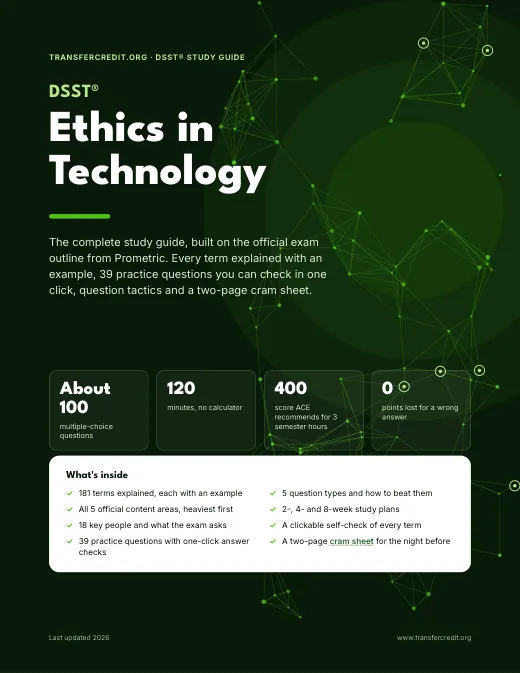
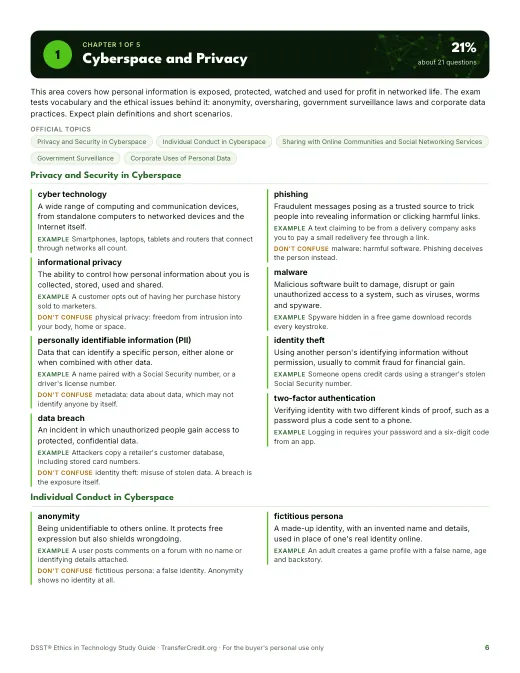
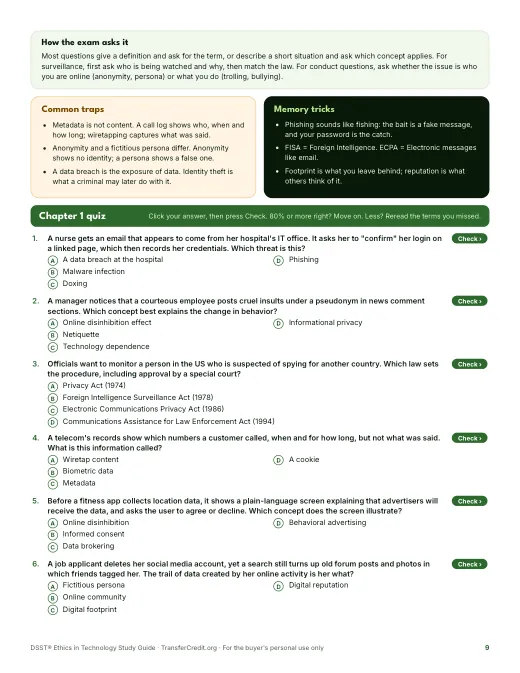
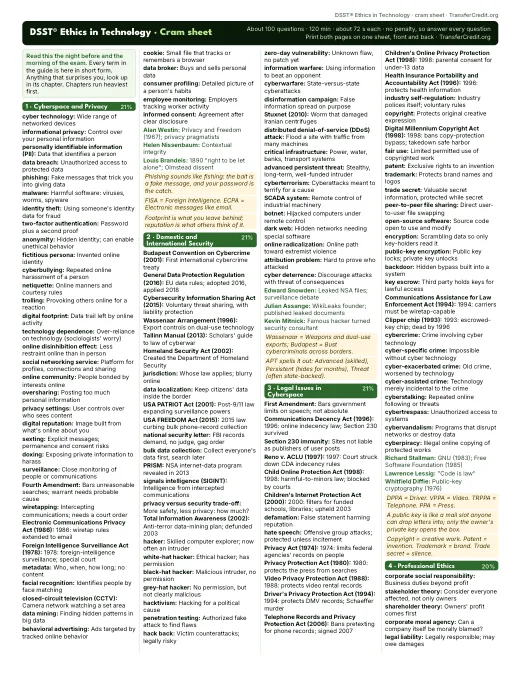
One chapter for each official content area, in the order the exam weighs them.
In the style of the real exam, from all 5 areas. About 10 minutes, with every answer explained and a score by area.
A nurse gets an email that appears to come from her hospital's IT office. It asks her to "confirm" her login on a linked page, which then records her credentials. Which threat is this?
Answer: C. Phishing. The message poses as a trusted sender to trick her into handing over her credentials. That is phishing.
The trap: Malware is tempting because credentials were captured, but no harmful software was installed; she was deceived into typing them.
The message poses as a trusted sender to trick her into handing over her credentials. That is phishing.
The trap: Malware is tempting because credentials were captured, but no harmful software was installed; she was deceived into typing them.
A security firm is hired by a hospital to try to break into its network and then deliver a report of the weaknesses it found. The firm is performing
Answer: D. Penetration testing. The hospital gave permission and wants the flaws reported so they can be fixed. That is penetration testing, a white-hat activity.
The trap: Hack back is tempting because it is also an attack, but it means striking an attacker's systems without authorization, not testing a client's own network.
The hospital gave permission and wants the flaws reported so they can be fixed. That is penetration testing, a white-hat activity.
The trap: Hack back is tempting because it is also an attack, but it means striking an attacker's systems without authorization, not testing a client's own network.
In Reno v. ACLU, the Supreme Court struck down part of which law as violating the First Amendment?
Answer: B. Communications Decency Act (1996). The Court found the Communications Decency Act's indecency provisions too broad, so they violated the First Amendment.
The trap: The Child Online Protection Act is tempting because it also protects minors online, but it was passed after Reno and was blocked in later litigation.
The Court found the Communications Decency Act's indecency provisions too broad, so they violated the First Amendment.
The trap: The Child Online Protection Act is tempting because it also protects minors online, but it was passed after Reno and was blocked in later litigation.
An IT manager decides whether to delay a software release. She weighs the benefit to thousands of users against the inconvenience to a few and picks the option that does the most good overall. Her reasoning is best described as
Answer: A. Utilitarian. Judging an action by its results, and choosing the option that benefits the greatest number, is utilitarian reasoning.
The trap: Deontological is tempting because she is making an ethical choice, but deontological reasoning follows duties and rules whatever the outcome.
Judging an action by its results, and choosing the option that benefits the greatest number, is utilitarian reasoning.
The trap: Deontological is tempting because she is making an ethical choice, but deontological reasoning follows duties and rules whatever the outcome.
A smartwatch records a user's heart rate and sends the data to a company, which later offers the data to an insurer. Which concern is most directly raised?
Answer: B. The privacy of the user's health data. Wearables collect health data continuously, and passing it to third parties without clear consent raises a privacy concern.
The trap: Digital divide is tempting because technology is involved, but nothing here concerns who has or lacks access; the issue is what is done with collected data.
Wearables collect health data continuously, and passing it to third parties without clear consent raises a privacy concern.
The trap: Digital divide is tempting because technology is involved, but nothing here concerns who has or lacks access; the issue is what is done with collected data.
A manager notices that a courteous employee posts cruel insults under a pseudonym in news comment sections. Which concept best explains the change in behavior?
Answer: C. Online disinhibition effect. Anonymity and distance loosen restraint, so people act online in ways they would avoid face to face.
The trap: Netiquette is tempting because the employee is violating it, but netiquette names the polite rules, not the reason behavior changes.
Anonymity and distance loosen restraint, so people act online in ways they would avoid face to face.
The trap: Netiquette is tempting because the employee is violating it, but netiquette names the polite rules, not the reason behavior changes.
A government agency collects the phone records of millions of customers who are not suspected of any crime, planning to search them later if a threat appears. This practice is best described as
Answer: A. Bulk data collection. Collecting data on many people without individual suspicion, to be searched later, is bulk data collection. The USA FREEDOM Act (2015) limited this for phone records.
The trap: A national security letter is tempting because it also gets phone records without a judge, but it is an FBI demand for particular customers' records, not a collection of everyone's.
Collecting data on many people without individual suspicion, to be searched later, is bulk data collection. The USA FREEDOM Act (2015) limited this for phone records.
The trap: A national security letter is tempting because it also gets phone records without a judge, but it is an FBI demand for particular customers' records, not a collection of everyone's.
A user posts a false, damaging statement about a local business on a social network. The business sues the network as if it had written the post. Under federal law, how will this claim most likely fare?
Answer: D. It will likely fail, because online services are generally not publishers of user posts. Section 230 of the Communications Decency Act generally protects online services from liability for content users post.
The trap: Success because of advertising revenue is tempting, but the immunity does not depend on whether the service profits.
Section 230 of the Communications Decency Act generally protects online services from liability for content users post.
The trap: Success because of advertising revenue is tempting, but the immunity does not depend on whether the service profits.
An engineer refuses to hide a known safety flaw from customers even though telling the truth will cost her employer a large contract. She says lying is wrong no matter what happens. Her reasoning is best described as
Answer: B. Deontological. She bases her decision on a duty not to lie rather than on the results, which is deontological reasoning associated with Kant.
The trap: Utilitarian is tempting because many people could be harmed by the flaw, but she explicitly rejects weighing consequences and rests on a duty.
She bases her decision on a duty not to lie rather than on the results, which is deontological reasoning associated with Kant.
The trap: Utilitarian is tempting because many people could be harmed by the flaw, but she explicitly rejects weighing consequences and rests on a duty.
A rural school district has no broadband in most students' homes, so students there cannot complete online assignments that city students can. This situation is an example of the
Answer: C. Digital divide. The digital divide is the gap between those with access to information technology and those without it.
The trap: Algorithmic bias is tempting because one group is disadvantaged, but there is no flawed algorithm here; the cause is lack of access.
The digital divide is the gap between those with access to information technology and those without it.
The trap: Algorithmic bias is tempting because one group is disadvantaged, but there is no flawed algorithm here; the cause is lack of access.
The DSST Ethics in Technology exam is a 120-minute, computer-based test from Prometric with about 100 multiple-choice questions. A score of 400 on the 200–500 scale earns an ACE credit recommendation of 3 semester hours, though each college sets its own policy. The exam covers 5 content areas; the heaviest is Cyberspace and Privacy at 21%.
5 areas, heaviest first. The guide's chapters follow this order.
Start with the guide, or get everything for DSST in one plan.
DSST® is a registered trademark of Prometric, which was not involved in producing this guide and does not endorse it. TransferCredit.org is independent and not affiliated with Prometric. © 2026 UPI Globale Edu Inc.