
$5one-time
- 38-page printable PDF
- 182 terms with examples
- 44 practice questions, answers explained
- 2-page cram sheet and study plans
Everything the DSST Fundamentals of Cybersecurity exam tests, in one PDF you can print. Built from Prometric's official outline, heaviest topics first.
Last updated 2026 · exam details checked against Prometric's published exam information in 2026
Real pages from the 38-page PDF.
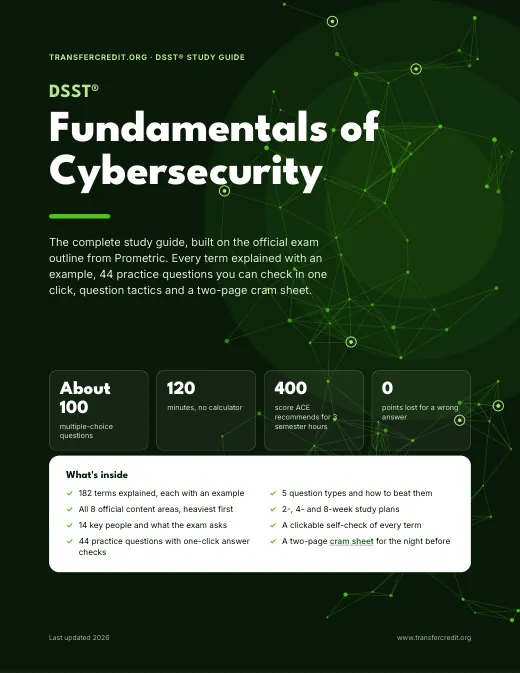
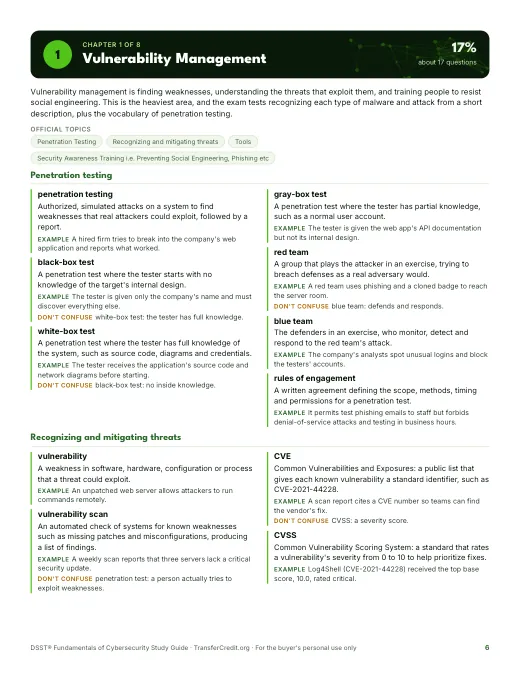
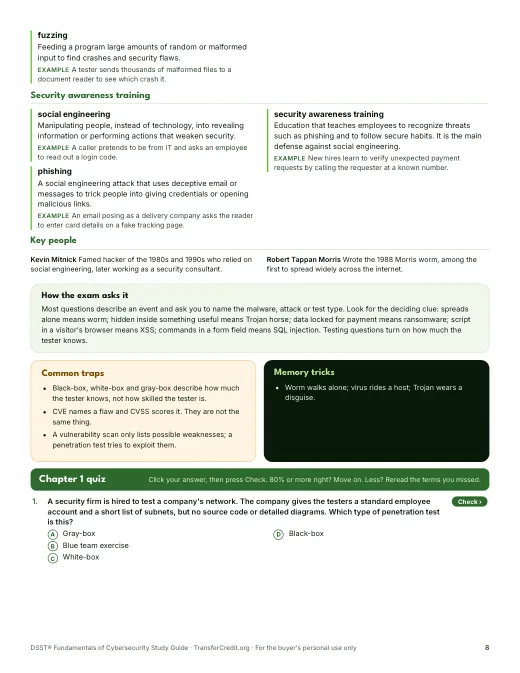
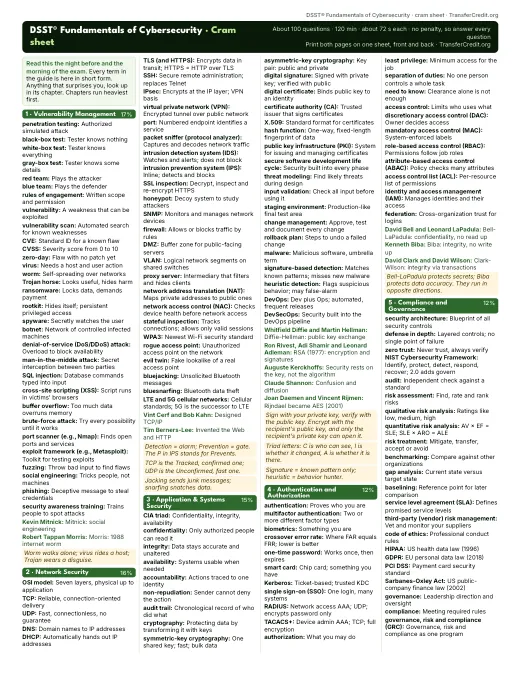
One chapter for each official content area, in the order the exam weighs them.
In the style of the real exam, from all 8 areas. About 10 minutes, with every answer explained and a score by area.
A security firm is hired to test a company's network. The company gives the testers a standard employee account and a short list of subnets, but no source code or detailed diagrams. Which type of penetration test is this?
Answer: B. Gray-box. The testers have some, but not all, information about the target. Partial knowledge defines a gray-box test.
The trap: Black-box is tempting because the testers lack source code, but a black-box tester starts with no inside information, not even an account.
The testers have some, but not all, information about the target. Partial knowledge defines a gray-box test.
The trap: Black-box is tempting because the testers lack source code, but a black-box tester starts with no inside information, not even an account.
A company hosts a public website and an internal payroll database. Where should the web server be placed so that a compromise of it gives the least access to payroll?
Answer: D. In a DMZ separated from the internal network. A DMZ keeps public-facing servers on a separate segment, so a compromised web server has no direct path to internal systems.
The trap: Placing it on the same subnet as the payroll database is wrong because a breach of the web server would put the database one hop away.
A DMZ keeps public-facing servers on a separate segment, so a compromised web server has no direct path to internal systems.
The trap: Placing it on the same subnet as the payroll database is wrong because a breach of the web server would put the database one hop away.
A payroll clerk quietly changes her own salary in a database. The auditors discover the figure no longer matches the approved amount. Which security goal was violated?
Answer: C. Integrity. Integrity means data stays accurate and changes only through authorized actions. An unauthorized edit of an approved value breaks it.
The trap: Confidentiality is tempting because the clerk touched sensitive data, but nothing was disclosed. The problem is that the stored value was altered.
Integrity means data stays accurate and changes only through authorized actions. An unauthorized edit of an approved value breaks it.
The trap: Confidentiality is tempting because the clerk touched sensitive data, but nothing was disclosed. The problem is that the stored value was altered.
A payment system lets the same accounts-payable employee create a new vendor and also approve payments to that vendor. An auditor says this invites fraud. Which control would most directly fix the problem?
Answer: A. Splitting vendor setup and payment approval between two different employees. Fraud is possible because one person controls a whole critical task. Dividing the steps between two people is separation of duties, so a single person cannot commit and hide the fraud.
The trap: Smart cards strengthen authentication, but the problem is not who the employee is. It is that she holds too much power.
Fraud is possible because one person controls a whole critical task. Dividing the steps between two people is separation of duties, so a single person cannot commit and hide the fraud.
The trap: Smart cards strengthen authentication, but the problem is not who the employee is. It is that she holds too much power.
A server is worth $200,000. Analysts estimate that a single ransomware incident would destroy 25% of its value and expect one incident every two years. What is the annualized loss expectancy?
Answer: C. $25,000. Single loss expectancy is $200,000 × 0.25 = $50,000. The annual rate of occurrence is 0.5, so annualized loss expectancy is $50,000 × 0.5 = $25,000.
The trap: $50,000 is the single loss expectancy. It is tempting because it is an intermediate result, but it was not multiplied by the annual rate of occurrence.
Single loss expectancy is $200,000 × 0.25 = $50,000. The annual rate of occurrence is 0.5, so annualized loss expectancy is $50,000 × 0.5 = $25,000.
The trap: $50,000 is the single loss expectancy. It is tempting because it is an intermediate result, but it was not multiplied by the annual rate of occurrence.
A company's order system takes a copy of its data every two hours. After a failure, it can restore only to the last copy. Management says no more than 30 minutes of transactions may be lost. What does this requirement describe?
Answer: A. The recovery point objective. The recovery point objective is the maximum acceptable data loss measured in time. Thirty minutes is the limit, so the two-hour copy schedule does not meet it.
The trap: The recovery time objective is tempting since both are measured in time, but it states how long restoration may take, not how much data may be lost.
The recovery point objective is the maximum acceptable data loss measured in time. Thirty minutes is the limit, so the two-hour copy schedule does not meet it.
The trap: The recovery time objective is tempting since both are measured in time, but it states how long restoration may take, not how much data may be lost.
A company's servers, firewalls and applications each store logs separately. Analysts want one system to pull them together, connect related events across devices, and alert when a pattern looks like an attack. What should they deploy?
Answer: B. A security information and event management system. A SIEM collects logs from many sources, correlates events and generates alerts. That is exactly the stated need.
The trap: A data loss prevention gateway is tempting because it also watches traffic, but it blocks sensitive data from leaving and does not correlate logs from many devices.
A SIEM collects logs from many sources, correlates events and generates alerts. That is exactly the stated need.
The trap: A data loss prevention gateway is tempting because it also watches traffic, but it blocks sensitive data from leaving and does not correlate logs from many devices.
A visitor without a badge waits near a secure side entrance. When an employee badges in, the visitor catches the door before it closes and walks in unnoticed. Which term describes this?
Answer: D. Tailgating. Tailgating is slipping into a secured area behind an authorized person, without credentials and without that person's knowledge.
The trap: A mantrap is the control designed to stop this, so it is not the name of the event. It admits one person at a time.
Tailgating is slipping into a secured area behind an authorized person, without credentials and without that person's knowledge.
The trap: A mantrap is the control designed to stop this, so it is not the name of the event. It admits one person at a time.
Within minutes of one workstation opening an infected attachment, hundreds of other computers on the network are infected. Nobody on those machines ran any file. The malware is spreading through an unpatched network service. What type of malware is it?
Answer: C. Worm. Malware that copies itself across a network without user action or a host file is a worm.
The trap: A virus is tempting because the first infection came from an attachment, but the spread to other machines needed no one to run anything. That is worm behavior.
Malware that copies itself across a network without user action or a host file is a worm.
The trap: A virus is tempting because the first infection came from an attachment, but the spread to other machines needed no one to run anything. That is worm behavior.
Several customers at a cafe connect to a Wi-Fi network that has the cafe's exact name but a stronger signal. It was set up by someone sitting in the parking lot. What is this attack called?
Answer: A. Evil twin. An evil twin is a malicious access point that copies a legitimate network's name to lure users into connecting so their traffic can be intercepted.
The trap: A rogue access point is tempting, but it is an unauthorized device plugged into the organization's own network, not a copy of a legitimate public network.
An evil twin is a malicious access point that copies a legitimate network's name to lure users into connecting so their traffic can be intercepted.
The trap: A rogue access point is tempting, but it is an unauthorized device plugged into the organization's own network, not a copy of a legitimate public network.
The DSST Fundamentals of Cybersecurity exam is a 120-minute, computer-based test from Prometric with about 100 multiple-choice questions. A score of 400 on the 200–500 scale earns an ACE credit recommendation of 3 semester hours, though each college sets its own policy. The exam covers 8 content areas; the heaviest is Vulnerability Management at 17%.
Source: official DSST Fundamentals of Cybersecurity exam page.
8 areas, heaviest first. The guide's chapters follow this order.
Start with the guide, or get everything for DSST in one plan.
DSST® is a registered trademark of Prometric, which was not involved in producing this guide and does not endorse it. TransferCredit.org is independent and not affiliated with Prometric. © 2026 UPI Globale Edu Inc.