← DSST Technical Writing course
DSST® Study Guide Printable PDF · 35 pages

DSST Technical Writing Study Guide

Everything the DSST Technical Writing exam tests, in one PDF you can print. Built from Prometric's official outline, heaviest topics first.

  • 178 key terms, each with an example
  • 39 practice questions with every answer explained
  • A 2-page cram sheet for the night before
  • 2-, 4- and 8-week study plans built from the exam weights
Not sure yet? Try 10 free questions

Last updated 2026 · exam details checked against Prometric's published exam information in 2026

Look inside the guide

Real pages from the 35-page PDF.

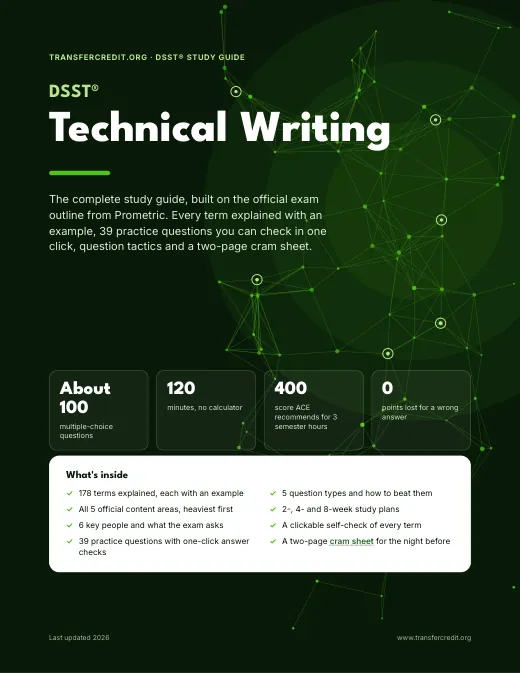
Page 1 of the DSST Technical Writing Study Guide: the cover
Page 1 The cover
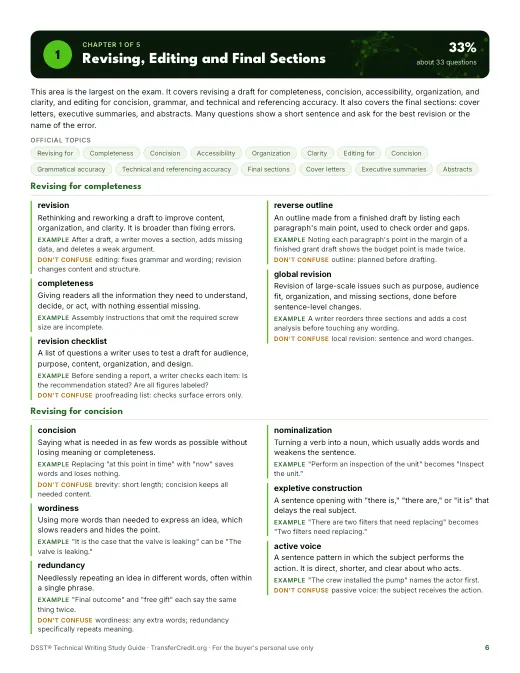
Page 6 of the DSST Technical Writing Study Guide: the Chapter 1 opener
Page 6 The Chapter 1 opener
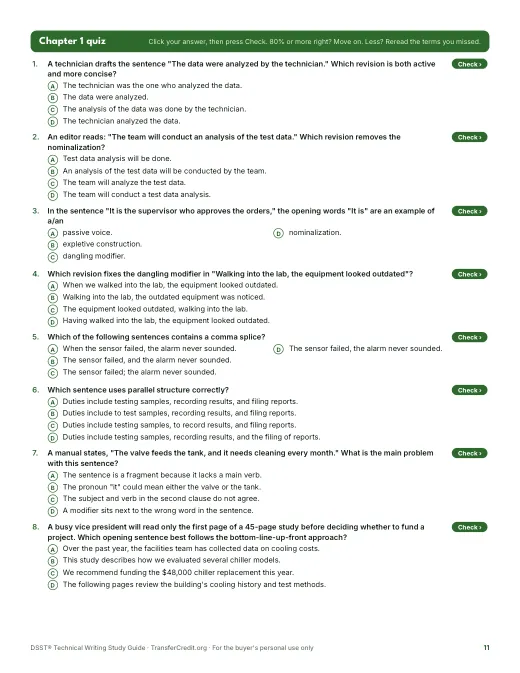
Page 11 of the DSST Technical Writing Study Guide: a chapter quiz
Page 11 A chapter quiz
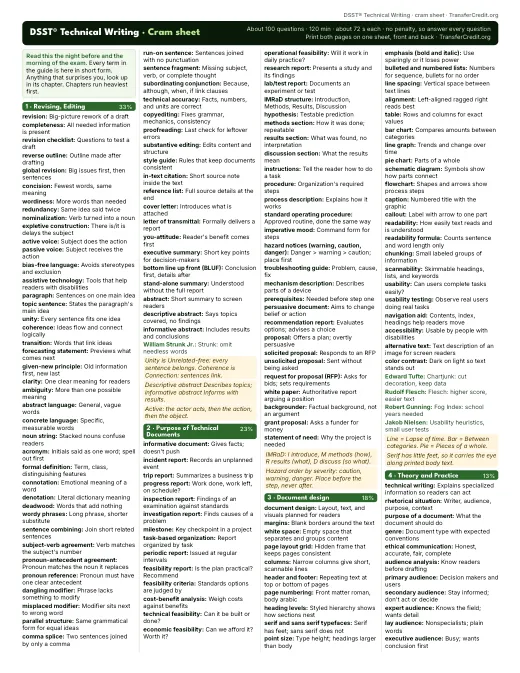
Page 34 of the DSST Technical Writing Study Guide: the 2-page cram sheet
Page 34 The 2-page cram sheet

What you get for $5

One chapter for each official content area, in the order the exam weighs them.

  • 📘35pages, printable
  • 🧭5chapters, heaviest first
  • 🔑178terms with examples
  • ✍️39practice questions, answers explained
  • ⚠️15exam traps to avoid
  • 📄2page cram sheet

Try 10 free Technical Writing questions

In the style of the real exam, from all 5 areas. About 10 minutes, with every answer explained and a score by area.

10 questions  
  1. Question 1 · Revising, Editing and Final Sections

    A technician drafts the sentence "The data were analyzed by the technician." Which revision is both active and more concise?

    Show the answer

    Answer: A. The technician analyzed the data.. Putting the actor first makes the verb active and cuts words, so the sentence is direct and shorter.

    The trap: "The data were analyzed" is shorter, but it is still passive and drops who did the work, so it fails the active-voice test.

  2. Question 2 · Purpose of Technical Documents

    A city engineer studies whether a proposed light-rail line can be built and funded and then recommends whether the city should go ahead. This document is a

    Show the answer

    Answer: B. feasibility report.. It studies whether a plan is practical and recommends an action, which defines a feasibility report.

    The trap: Inspection report is tempting because the engineer examines conditions, but an inspection checks something that exists against standards.

  3. Question 3 · Document design

    A quality engineer needs to compare the total number of defects found at each of five factories during March. Which graphic is the best choice?

    Show the answer

    Answer: D. Bar chart. Defects at five separate factories are categories compared on one measure. A bar chart makes the differences in bar length easy to see.

    The trap: Line graph is tempting because it shows numbers, but it implies continuous change over time. The factories are separate categories, not points in time.

  4. Question 4 · Theory and Practice of Technical Writing

    A report asks a plant manager to approve a new ventilation system. Floor workers also receive copies so they know what is planned, but they will not act on the report. The floor workers are best described as a

    Show the answer

    Answer: C. secondary audience.. Readers who need to stay informed but will not act on the document are a secondary audience. The plant manager, who will decide, is the primary audience.

    The trap: Primary audience is tempting because the workers receive the report and are affected by it, but the primary reader is the manager who acts on it.

  5. Question 5 · Technical Writing Process

    Four writers edit the same report in separate copies, and no one can tell which changes are current. Which practice would solve this problem?

    Show the answer

    Answer: A. Version control. Version control tracks which draft is current so changes are not lost or overwritten.

    The trap: Subject matter expert review checks technical accuracy; it does not tell the team which file is the latest version.

  6. Question 6 · Revising, Editing and Final Sections

    An editor reads: "The team will conduct an analysis of the test data." Which revision removes the nominalization?

    Show the answer

    Answer: C. The team will analyze the test data.. "Conduct an analysis" turns the verb "analyze" into a noun. Restoring the verb is shorter, stronger, and keeps the actor.

    The trap: "Test data analysis will be done" is shorter, but it still uses the noun "analysis," adds a noun string, and drops who does the work.

  7. Question 7 · Purpose of Technical Documents

    A contractor writes the client every Friday to say the roof is 60 percent done, the electrician is delayed and the project remains on budget. This is a

    Show the answer

    Answer: B. progress report.. It tells readers how much work is complete, what remains and whether the project is on track.

    The trap: Feasibility report is wrong because the plan has already been approved and is under way.

  8. Question 8 · Document design

    A figure in a report shows a photo of a pump. The writer wants to label the whole photo with "Figure 4. Cutaway view of the pump housing." What is this label called?

    Show the answer

    Answer: D. A caption. A caption identifies the entire graphic by number and title, usually next to it.

    The trap: A callout is tempting because it is also a label, but a callout points with a line or arrow to one specific part of the graphic rather than naming the whole figure.

  9. Question 9 · Theory and Practice of Technical Writing

    A survey meant to gauge customer satisfaction mostly asks how much free time respondents have. The survey's main weakness is a lack of

    Show the answer

    Answer: C. validity.. Validity means measuring what you claim to measure. These questions measure something else, so the data do not answer the research question.

    The trap: Reliability is tempting, but a survey can give consistent results every time and still measure the wrong thing.

  10. Question 10 · Technical Writing Process

    A firm must formally confirm the terms of a contract to a client at another company. Which medium is the best choice?

    Show the answer

    Answer: D. A business letter on letterhead. A business letter is the formal medium for outside readers, and it creates a signed record.

    The trap: An internal memo is tempting because it is short and formal, but memos circulate inside an organization, not to outside clients.

The DSST Technical Writing exam at a glance

The DSST Technical Writing exam is a 120-minute, computer-based test from Prometric with about 100 multiple-choice questions. A score of 400 on the 200–500 scale earns an ACE credit recommendation of 3 semester hours, though each college sets its own policy. The exam covers 5 content areas; the heaviest is Revising, Editing and Final Sections at 33%.

Questions
About 100multiple choice
Time
120 minabout 72 seconds a question
Passing score
400on a 200–500 scale
ACE credit
3semester hours
Exam fee
$100paid to Prometric
Calculator
Nonot allowed

Source: official DSST Technical Writing exam page.

What the exam covers

5 areas, heaviest first. The guide's chapters follow this order.

  1. Revising, Editing and Final Sections33%
  2. Purpose of Technical Documents23%
  3. Document design18%
  4. Theory and Practice of Technical Writing13%
  5. Technical Writing Process13%

How it works

  1. 1Buy once, $5Secure checkout. No subscription needed.
  2. 2Download the PDFFrom your TransferCredit.org account, right away and any time later.
  3. 3Study the heaviest areas firstFollow the 2-, 4- or 8-week plan, then read the cram sheet the night before.

Questions students ask

What's in the full DSST Technical Writing study guide?
35 pages: 5 chapters, one per official content area, heaviest first. 178 terms, each with a plain-English definition and an example, 6 key people, common traps and memory tricks, 39 practice questions with an answer key that explains every answer, question tactics, 2-, 4- and 8-week study plans and a 2-page cram sheet.
How much is the full DSST Technical Writing study guide?
The full 35-page PDF is $5, a one-time payment. The 10 practice questions on this page are free, with no account.
What does the $29 plan include?
$29 a month gives you all DSST subjects: every DSST study guide plus the full prep course for each subject, and you can cancel anytime. If you only need this exam, the guide on its own is a one-time $5.
How do I get the full guide?
Choose Buy this guide ($5) and check out. Then sign in to your TransferCredit.org account, then open the course and its Download Your Study Guide lesson. The PDF is yours to keep, and you can download it again from your account at any time.
Can I print the guide or use it on my phone?
Yes. It's a PDF, so it opens on phones, tablets and computers, and printing is allowed. Its tick boxes and answer bubbles work in PDF readers that support forms. Copying and editing are turned off.
Is this an official DSST study guide?
No. DSST® is a registered trademark of Prometric, which was not involved in producing this guide and does not endorse it. TransferCredit.org is independent. We built the guide from the official exam outline, and the exam details were checked against Prometric's published exam information in 2026.
Why is this study guide better than a generic review?
It follows the official outline area by area and spends the most pages on what the exam weighs most. Every term comes with an example, each chapter names the traps the exam sets, and the answer key explains why the most tempting wrong answer is wrong, not just which answer is right. It ends with a 2-page cram sheet for the night before.
What is the DSST Technical Writing exam?
The DSST Technical Writing exam is a 120-minute, computer-based test from Prometric with about 100 multiple-choice questions. A score of 400 on the 200–500 scale earns an ACE credit recommendation of 3 semester hours, though each college sets its own policy. The exam covers 5 content areas; the heaviest is Revising, Editing and Final Sections at 33%.
More questions about the DSST Technical Writing exam (23)
How many questions are on the DSST Technical Writing exam, and how long is it?
It has 100 questions to be answered in 2 hours, and the ACE-recommended minimum score is 400 for 3 semester hours of lower-level baccalaureate credit.
What is the passing score for DSST Technical Writing?
The passing score is 400 on a 200–500 scale. At 400 or above, the American Council on Education (ACE) recommends 3 semester hours. Each college sets its own passing score and credit award, so check your school's policy before you book.
How much does the DSST Technical Writing exam cost?
The exam fee is $100, paid to Prometric. Test centers may add their own administration fee. Eligible U.S. military service members can usually test for free through DANTES.
How many college credits is DSST Technical Writing worth?
ACE recommends 3 semester hours for a passing score of 400. Your college decides how many credits it awards and which course they replace. Check your college's policy.
Can I use a calculator on the DSST Technical Writing exam?
No. This exam doesn't allow a calculator.
Is there a penalty for guessing on DSST Technical Writing?
No. Your score counts only correct answers, so a wrong answer costs nothing. Never leave a question blank: rule out what you can and pick your best guess.
What topics are on the DSST Technical Writing exam?
5 content areas, from the official outline: Revising, Editing and Final Sections (33%); Purpose of Technical Documents (23%); Document design (18%); Theory and Practice of Technical Writing (13%); Technical Writing Process (13%).
Which DSST Technical Writing topics should I study first?
Start with the three heaviest: Revising, Editing and Final Sections (33%), Purpose of Technical Documents (23%) and Document design (18%). Together they are about 74% of the exam, roughly 74 of 100 questions. The guide's chapters run in that order, heaviest first.
Is the DSST Technical Writing exam hard?
It depends on what you already know. A few big areas decide most of your score: Revising, Editing and Final Sections alone is 33% of the exam, while Technical Writing Process is 13%. Take the free diagnostic above to see where you stand in about 10 minutes.
What kinds of questions are on the DSST Technical Writing exam?
The guide sorts them into 5 types: “Match the document to its purpose”, “Pick the best graphic or format”, “Audience and style judgment”, “Fix the sentence” and “Definition and contrast”. Every question has 4 answer choices. Try the 10 free questions above to see the style.
How long should I study for DSST Technical Writing?
Use the diagnostic to decide. If you already know most areas, two weeks of daily review is often enough; if the subject is new to you, plan on eight. The full guide has 2-, 4- and 8-week plans built from the exam weights.
How should I pace myself on the DSST Technical Writing exam?
On average you have about 72 seconds per question (120 minutes for 100 questions). Be past question 33 a third of the way through and past question 67 two-thirds through. If a question takes more than a minute, pick your best guess, mark it and come back.
What happens if I don't pass DSST Technical Writing?
You can retake a DSST exam after 30 days. Use the wait to work through the areas the score report and the diagnostic show you missed.
Do colleges accept DSST Technical Writing for credit?
DSST exams are accepted at more than 1,500 colleges and universities, but each school decides which exams it accepts, the score it requires and the credit it gives. Look up your college's DSST policy before you book.
How is the guide different from the DSST Technical Writing course?
The guide is a 35-page PDF for review and self-testing. The DSST Technical Writing course is a full online course with lessons, quizzes and a practice exam, for $19 with lifetime access. Many students use the guide first, then take the course for the areas the diagnostic flags.
How up to date is this DSST Technical Writing guide?
Last updated 2026. The exam details were checked against Prometric's published exam information in 2026. Exams change, so confirm the details on the official exam page before you register.
What should I do the night before the exam?
Read the cram sheet once, slowly. Check your test time, the location or remote-proctoring setup, and the ID you need. Then sleep: a rested brain recalls more than a crammed one. In the morning, skim the memory tricks and common traps, then stop studying.
Does DSST Technical Writing have an essay?
No. The exam is 100 multiple-choice questions. You'll judge and revise passages rather than write your own.
What's the difference between a progress report and a feasibility report on DSST Technical Writing?
A progress report tells readers how an ongoing project is going: work completed, work remaining and any problems. A feasibility report evaluates whether a proposed project or option is practical and usually ends with a recommendation. Both are informing documents in the Purpose of Technical Documents area, 23% of the exam.
Does DSST Technical Writing test grammar?
Yes. Editing for grammatical accuracy, concision, and technical and referencing accuracy is part of Revising, Editing and Final Sections, the largest area at 33%. Expect to spot wordiness, passive constructions and errors in short passages.
What types of documents are on DSST Technical Writing?
Progress and inspection reports, feasibility reports, research and lab reports, instructions and process descriptions, proposals, white papers and grants, plus cover letters, executive summaries and abstracts.
Is DSST Technical Writing the same as English composition?
No. Composition focuses on academic essays and argument. Technical writing covers workplace documents — reports, proposals, instructions — and designing them for specific readers.
Can I take DSST Technical Writing online?
Yes. DSST exams can be taken at a test center or online with a remote Prometric proctor.

Choose how you want to study

Start with the guide, or get everything for DSST in one plan.

This study guide
$5one-time
  • 35-page printable PDF
  • 178 terms with examples
  • 39 practice questions, answers explained
  • 2-page cram sheet and study plans
Get the guide · $5
Best value Get it all
$29/month
  • Every DSST study guide
  • Prep courses for all DSST subjects
  • Cancel anytime
Get it all · $29/mo

DSST® is a registered trademark of Prometric, which was not involved in producing this guide and does not endorse it. TransferCredit.org is independent and not affiliated with Prometric. © 2026 UPI Globale Edu Inc.