← DSST Math for Liberal Arts course
DSST® Study Guide Printable PDF · 33 pages

DSST Math for Liberal Arts Study Guide

Everything the DSST Math for Liberal Arts exam tests, in one PDF you can print. Built from Prometric's official outline, heaviest topics first.

  • 180 key terms, each with an example
  • 42 practice questions with every answer explained
  • A 2-page cram sheet for the night before
  • 2-, 4- and 8-week study plans built from the exam weights
Not sure yet? Try 10 free questions

Last updated 2026 · exam details checked against Prometric's published exam information in 2026

Look inside the guide

Real pages from the 33-page PDF.

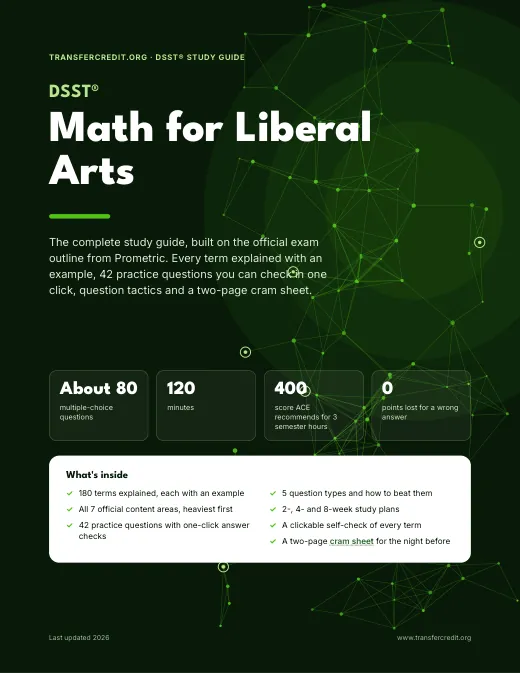
Page 1 of the DSST Math for Liberal Arts Study Guide: the cover
Page 1 The cover
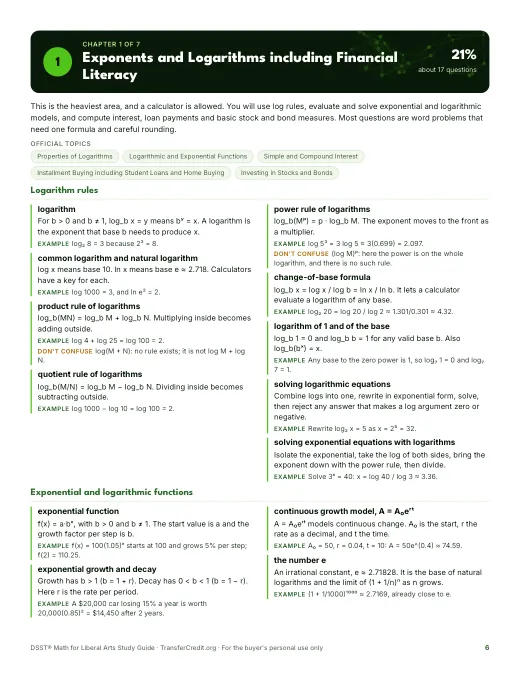
Page 6 of the DSST Math for Liberal Arts Study Guide: the Chapter 1 opener
Page 6 The Chapter 1 opener
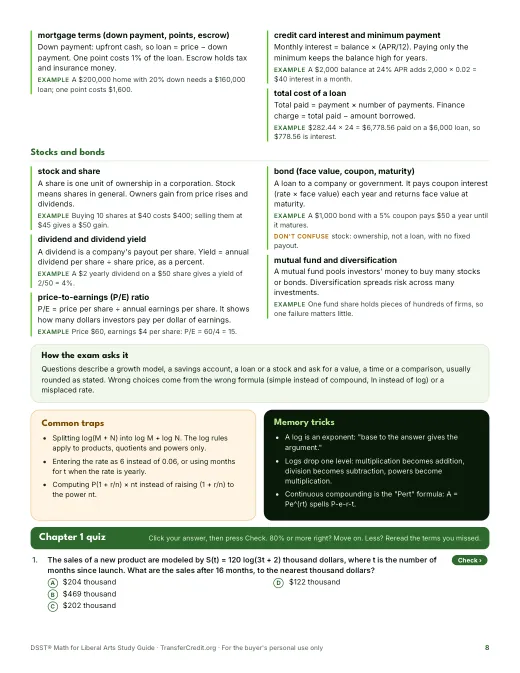
Page 8 of the DSST Math for Liberal Arts Study Guide: a chapter quiz
Page 8 A chapter quiz
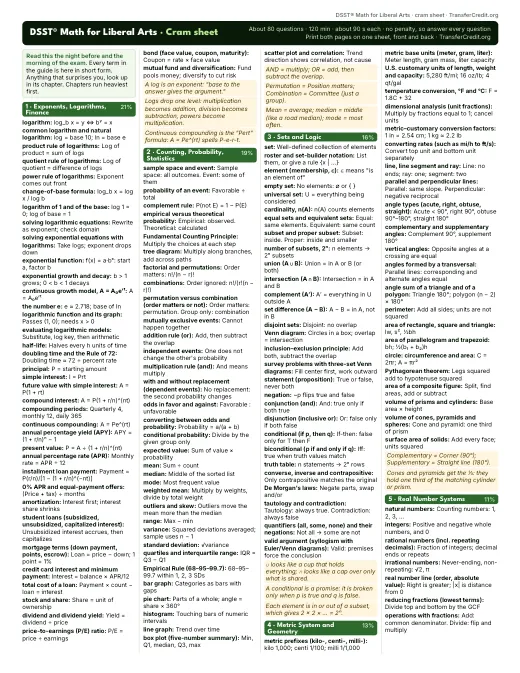
Page 32 of the DSST Math for Liberal Arts Study Guide: the 2-page cram sheet
Page 32 The 2-page cram sheet

What you get for $5

One chapter for each official content area, in the order the exam weighs them.

  • 📘33pages, printable
  • 🧭7chapters, heaviest first
  • 🔑180terms with examples
  • ✍️42practice questions, answers explained
  • ⚠️21exam traps to avoid
  • 📄2page cram sheet

Try 10 free Math for Liberal Arts questions

In the style of the real exam, from all 7 areas. About 15 minutes, with every answer explained and a score by area.

10 questions  
  1. Question 1 · Exponents and Logarithms including Financial Literacy

    The sales of a new product are modeled by S(t) = 120 log(3t + 2) thousand dollars, where t is the number of months since launch. What are the sales after 16 months, to the nearest thousand dollars?

    Show the answer

    Answer: B. $204 thousand. 3(16) + 2 = 50. Then log 50 ≈ 1.699, and 120 × 1.699 ≈ 203.9, which rounds to 204.

    The trap: "$469 thousand" uses the natural log (ln 50 ≈ 3.912). A plain "log" with no base written means the common log, base 10.

  2. Question 2 · Counting, Probability Theory and Statistics

    A club of 10 members elects a president, a vice president and a treasurer. No member may hold two offices. How many different outcomes are possible?

    Show the answer

    Answer: D. 720. Order matters because the offices differ: P(10, 3) = 10 × 9 × 8 = 720.

    The trap: 120 is C(10, 3), which counts groups of 3. Here the same three people in different offices count as different outcomes.

  3. Question 3 · Sets and Logic

    Each of a gym's 800 members takes yoga, spin or both. Of all members, 5% take both classes. If 520 members take spin, how many take yoga?

    Show the answer

    Answer: C. 320. Both classes: 5% of 800 = 40. By inclusion–exclusion, 800 = n(yoga) + 520 − 40, so n(yoga) = 800 − 520 + 40 = 320.

    The trap: "280" is 800 − 520, the members who take only yoga. The 40 who take both also take yoga, so add them back.

  4. Question 4 · Metric system, conversions and geometry

    A car travels at 45 miles per hour. Using 1 mile ≈ 1.609 kilometers, about how fast is this in kilometers per hour, to the nearest whole number?

    Show the answer

    Answer: A. 72 km/h. Multiply by the unit fraction 1.609 km/1 mi: 45 × 1.609 = 72.405, which rounds to 72 km/h. The miles cancel and leave kilometers.

    The trap: 28 km/h comes from dividing by 1.609. A kilometer is shorter than a mile, so the number must grow, not shrink.

  5. Question 5 · Real Number Systems

    A jacket priced at $80 is on sale for 25% off. Sales tax of 6% is charged on the sale price. How much does the buyer pay in all?

    Show the answer

    Answer: C. $63.60. The sale price is 0.75 × 80 = $60. The tax is 0.06 × 60 = $3.60, so the buyer pays 60 + 3.60 = $63.60.

    The trap: $64.80 takes the 6% tax on the original $80 instead of on the $60 sale price (the same as netting the percents to 19% off).

  6. Question 6 · Algebra, graphs and functions

    A taxi charges a flat $3.50 plus $2.25 per mile. Using C = 3.50 + 2.25m, what is the cost of an 8-mile ride?

    Show the answer

    Answer: B. $21.50. Multiply before adding: 2.25 × 8 = 18.00, then 3.50 + 18.00 = $21.50.

    The trap: "$46.00" adds 3.50 + 2.25 first and then multiplies by 8, which breaks the order of operations.

  7. Question 7 · Linear Systems and Inequalities

    A theater sold 150 tickets for a total of $1,620. Adult tickets cost $15 and child tickets cost $8. How many adult tickets were sold?

    Show the answer

    Answer: D. 60. Let a be adult and c be child tickets: a + c = 150 and 15a + 8c = 1,620. Substituting c = 150 − a gives 7a + 1,200 = 1,620, so a = 60.

    The trap: The value 90 is the number of child tickets, which the system also finds but the question does not ask for.

  8. Question 8 · Exponents and Logarithms including Financial Literacy

    A town's population is 5,000 and grows 4% per year. About how many years until it reaches 7,000? Round to the nearest tenth.

    Show the answer

    Answer: A. 8.6 years. Solve 5,000(1.04)ᵗ = 7,000, so 1.04ᵗ = 1.4. Then t = ln 1.4 / ln 1.04 ≈ 0.3365/0.0392 ≈ 8.6 years.

    The trap: "8.4 years" divides ln 1.4 by 0.04, the rate, instead of dividing by ln 1.04, the log of the growth factor.

  9. Question 9 · Counting, Probability Theory and Statistics

    A committee must have 2 men chosen from 6 and 3 women chosen from 5. How many different committees are possible?

    Show the answer

    Answer: C. 150. Order does not matter within each group. C(6, 2) = 15 and C(5, 3) = 10, and the Counting Principle gives 15 × 10 = 150.

    The trap: The value 300 uses a permutation for the men (30) instead of a combination (15). A committee has no ranking.

  10. Question 10 · Sets and Logic

    A pizza shop offers 5 toppings. A customer may choose any set of toppings, including none. How many different sets of toppings are possible?

    Show the answer

    Answer: A. 32. Each topping is either on or off, so there are 2⁵ = 32 subsets, and the empty set (plain pizza) counts.

    The trap: "31" is 2⁵ − 1, the number of proper subsets. It leaves out one set, but the question counts all sets, including plain.

The DSST Math for Liberal Arts exam at a glance

The DSST Math for Liberal Arts exam is a 120-minute, computer-based test from Prometric with about 80 multiple-choice questions. A score of 400 on the 200–500 scale earns an ACE credit recommendation of 3 semester hours, though each college sets its own policy. The exam covers 7 content areas; the heaviest is Exponents and Logarithms including Financial Literacy at 21%.

Questions
About 80multiple choice
Time
120 minabout 2 minutes a question
Passing score
400on a 200–500 scale
ACE credit
3semester hours
Exam fee
$100paid to Prometric
Calculator
Yesnon-programmable allowed

Source: official DSST Math for Liberal Arts exam page.

What the exam covers

7 areas, heaviest first. The guide's chapters follow this order.

  1. Exponents and Logarithms including Financial Literacy21%
  2. Counting, Probability Theory and Statistics19%
  3. Sets and Logic16%
  4. Metric system, conversions and geometry13%
  5. Real Number Systems11%
  6. Algebra, graphs and functions11%
  7. Linear Systems and Inequalities9%

How it works

  1. 1Buy once, $5Secure checkout. No subscription needed.
  2. 2Download the PDFFrom your TransferCredit.org account, right away and any time later.
  3. 3Study the heaviest areas firstFollow the 2-, 4- or 8-week plan, then read the cram sheet the night before.

Questions students ask

What's in the full DSST Math for Liberal Arts study guide?
33 pages: 7 chapters, one per official content area, heaviest first. 180 terms, each with a plain-English definition and an example, common traps and memory tricks, 42 practice questions with an answer key that explains every answer, question tactics, 2-, 4- and 8-week study plans and a 2-page cram sheet.
How much is the full DSST Math for Liberal Arts study guide?
The full 33-page PDF is $5, a one-time payment. The 10 practice questions on this page are free, with no account.
What does the $29 plan include?
$29 a month gives you all DSST subjects: every DSST study guide plus the full prep course for each subject, and you can cancel anytime. If you only need this exam, the guide on its own is a one-time $5.
How do I get the full guide?
Choose Buy this guide ($5) and check out. Then sign in to your TransferCredit.org account, then open the course and its Download Your Study Guide lesson. The PDF is yours to keep, and you can download it again from your account at any time.
Can I print the guide or use it on my phone?
Yes. It's a PDF, so it opens on phones, tablets and computers, and printing is allowed. Its tick boxes and answer bubbles work in PDF readers that support forms. Copying and editing are turned off.
Is this an official DSST study guide?
No. DSST® is a registered trademark of Prometric, which was not involved in producing this guide and does not endorse it. TransferCredit.org is independent. We built the guide from the official exam outline, and the exam details were checked against Prometric's published exam information in 2026.
Why is this study guide better than a generic review?
It follows the official outline area by area and spends the most pages on what the exam weighs most. Every term comes with an example, each chapter names the traps the exam sets, and the answer key explains why the most tempting wrong answer is wrong, not just which answer is right. It ends with a 2-page cram sheet for the night before.
What is the DSST Math for Liberal Arts exam?
The DSST Math for Liberal Arts exam is a 120-minute, computer-based test from Prometric with about 80 multiple-choice questions. A score of 400 on the 200–500 scale earns an ACE credit recommendation of 3 semester hours, though each college sets its own policy. The exam covers 7 content areas; the heaviest is Exponents and Logarithms including Financial Literacy at 21%.
More questions about the DSST Math for Liberal Arts exam (22)
How many questions are on the DSST Math for Liberal Arts exam, and how long is it?
It has 80 questions (75 scored and 5 unscored) to be answered in 2 hours.
What is the passing score for DSST Math for Liberal Arts?
The passing score is 400 on a 200–500 scale. At 400 or above, the American Council on Education (ACE) recommends 3 semester hours. Each college sets its own passing score and credit award, so check your school's policy before you book.
How much does the DSST Math for Liberal Arts exam cost?
The exam fee is $100, paid to Prometric. Test centers may add their own administration fee. Eligible U.S. military service members can usually test for free through DANTES.
How many college credits is DSST Math for Liberal Arts worth?
ACE recommends 3 semester hours for a passing score of 400. Your college decides how many credits it awards and which course they replace. Check your college's policy.
Can I use a calculator on the DSST Math for Liberal Arts exam?
A non-programmable calculator is permitted.
Is there a penalty for guessing on DSST Math for Liberal Arts?
No. Your score counts only correct answers, so a wrong answer costs nothing. Never leave a question blank: rule out what you can and pick your best guess.
What topics are on the DSST Math for Liberal Arts exam?
7 content areas, from the official outline: Exponents and Logarithms including Financial Literacy (21%); Counting, Probability Theory and Statistics (19%); Sets and Logic (16%); Metric system, conversions and geometry (13%); Real Number Systems (11%); Algebra, graphs and functions (11%); Linear Systems and Inequalities (9%).
Which DSST Math for Liberal Arts topics should I study first?
Start with the three heaviest: Exponents and Logarithms including Financial Literacy (21%), Counting, Probability Theory and Statistics (19%) and Sets and Logic (16%). Together they are about 56% of the exam, roughly 45 of 80 questions. The guide's chapters run in that order, heaviest first.
Is the DSST Math for Liberal Arts exam hard?
It depends on what you already know. No single area dominates: the largest, Exponents and Logarithms including Financial Literacy, is 21% and the smallest, Linear Systems and Inequalities, is 9%, so broad coverage matters more than deep expertise in one topic. Take the free diagnostic above to see where you stand in about 15 minutes.
What kinds of questions are on the DSST Math for Liberal Arts exam?
The guide sorts them into 5 types: “Money word problem”, “Evaluate a model with a log or ln”, “Area of a combined or cut-out figure”, “Logic and set statements” and “Count or choose”. Every question has 4 answer choices. Try the 10 free questions above to see the style.
How long should I study for DSST Math for Liberal Arts?
Use the diagnostic to decide. If you already know most areas, two weeks of daily review is often enough; if the subject is new to you, plan on eight. The full guide has 2-, 4- and 8-week plans built from the exam weights.
How should I pace myself on the DSST Math for Liberal Arts exam?
On average you have about 2 minutes per question (120 minutes for 80 questions). Be past question 27 a third of the way through and past question 53 two-thirds through. If a question takes more than about 3 minutes, pick your best guess, mark it and come back.
What happens if I don't pass DSST Math for Liberal Arts?
You can retake a DSST exam after 30 days. Use the wait to work through the areas the score report and the diagnostic show you missed.
Do colleges accept DSST Math for Liberal Arts for credit?
DSST exams are accepted at more than 1,500 colleges and universities, but each school decides which exams it accepts, the score it requires and the credit it gives. Look up your college's DSST policy before you book.
How is the guide different from the DSST Math for Liberal Arts course?
The guide is a 33-page PDF for review and self-testing. The DSST Math for Liberal Arts course is a full online course with lessons, quizzes and a practice exam, for $19 with lifetime access. Many students use the guide first, then take the course for the areas the diagnostic flags.
How up to date is this DSST Math for Liberal Arts guide?
Last updated 2026. The exam details were checked against Prometric's published exam information in 2026. Exams change, so confirm the details on the official exam page before you register.
What should I do the night before the exam?
Read the cram sheet once, slowly. Check your test time, the location or remote-proctoring setup, and the ID you need. Then sleep: a rested brain recalls more than a crammed one. In the morning, skim the memory tricks and common traps, then stop studying.
How is DSST Math for Liberal Arts different from CLEP College Mathematics?
They cover similar ground — sets, logic, probability, statistics and financial math — but they're separate exams. The DSST exam adds the metric system, geometry, linear systems and logarithms, has 80 questions in two hours, and needs a score of 400. Check which one your college accepts.
What financial math is on DSST Math for Liberal Arts?
Simple and compound interest, installment buying including student loans and home buying, and investing in stocks and bonds. These sit in the Exponents and Logarithms including Financial Literacy area, the largest on the exam at 21%, so practice the compound interest formula on your calculator.
Are truth tables on DSST Math for Liberal Arts?
Yes. Sets and Logic is 16% of the exam and covers set-builder notation, subsets, set operations and Venn diagrams, plus conjunctions, disjunctions, conditional and biconditional statements, and truth tables.
What probability and statistics are on DSST Math for Liberal Arts?
Expect the counting principle, permutations and combinations, simple and compound events, odds and conditional probability, and mean, median, mode, range, variance and standard deviation. You should also be able to read bar graphs, pie charts, histograms, line graphs, box plots and scatter plots. The area is 19% of the exam.
Can I take DSST Math for Liberal Arts online?
Yes. DSST exams can be taken at a test center or online with a remote Prometric proctor.

Choose how you want to study

Start with the guide, or get everything for DSST in one plan.

This study guide
$5one-time
  • 33-page printable PDF
  • 180 terms with examples
  • 42 practice questions, answers explained
  • 2-page cram sheet and study plans
Get the guide · $5
Best value Get it all
$29/month
  • Every DSST study guide
  • Prep courses for all DSST subjects
  • Cancel anytime
Get it all · $29/mo

DSST® is a registered trademark of Prometric, which was not involved in producing this guide and does not endorse it. TransferCredit.org is independent and not affiliated with Prometric. © 2026 UPI Globale Edu Inc.