
$5one-time
- 33-page printable PDF
- 180 terms with examples
- 40 practice questions, answers explained
- 2-page cram sheet and study plans
Everything the DSST Principles of Statistics exam tests, in one PDF you can print. Built from Prometric's official outline, heaviest topics first.
Last updated 2026 · exam details checked against Prometric's published exam information in 2026
Real pages from the 33-page PDF.
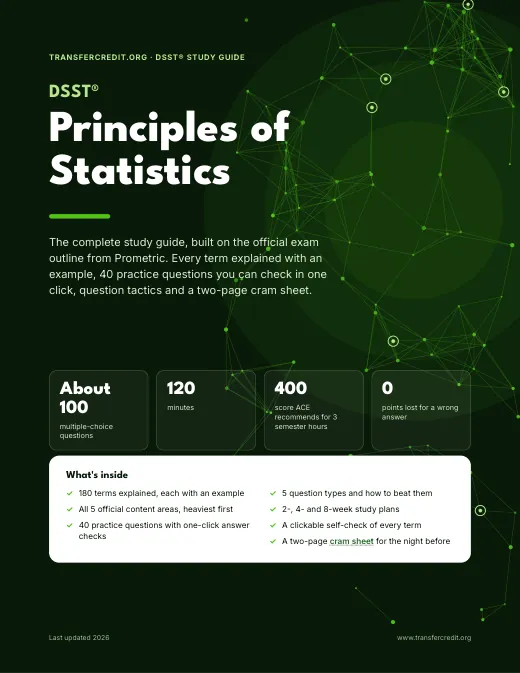
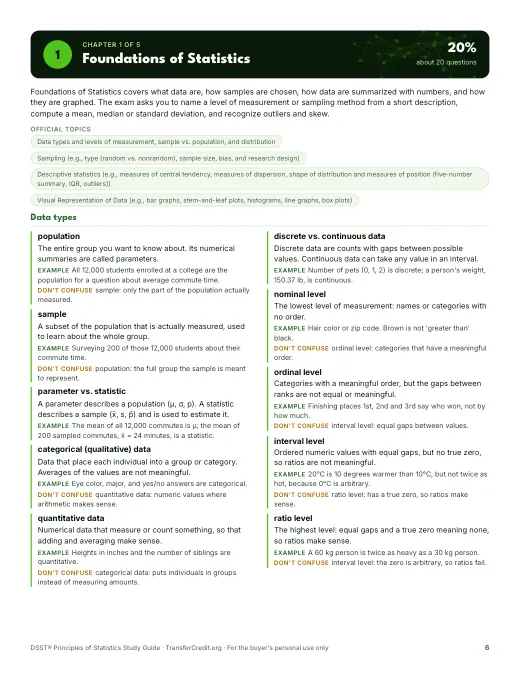
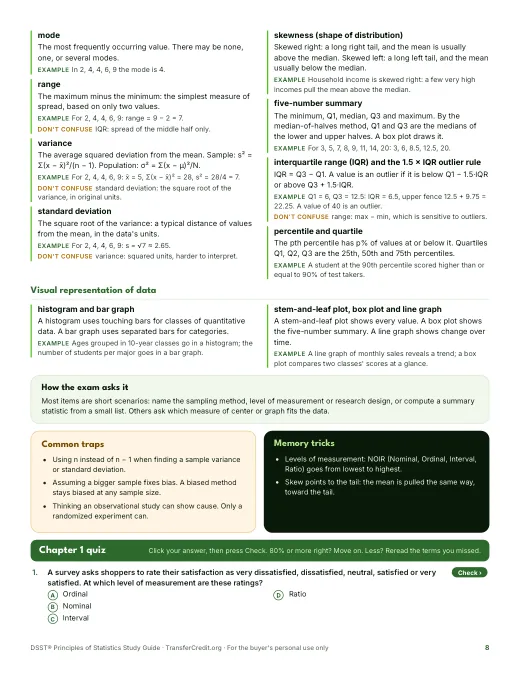
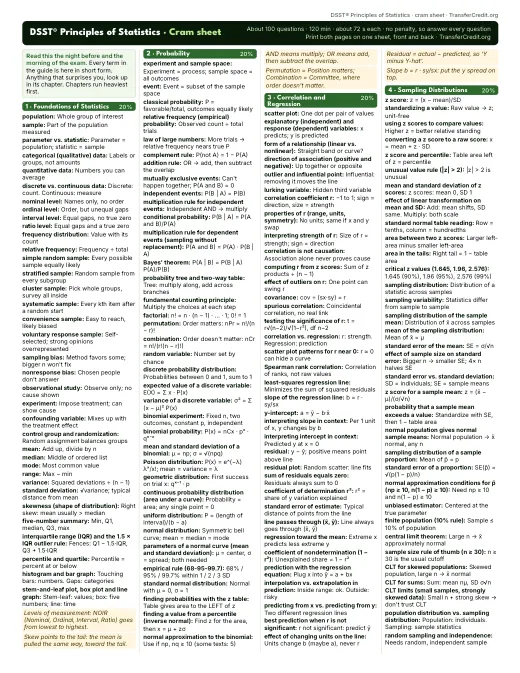
One chapter for each official content area, in the order the exam weighs them.
In the style of the real exam, from all 5 areas. About 10 minutes, with every answer explained and a score by area.
A survey asks shoppers to rate their satisfaction as very dissatisfied, dissatisfied, neutral, satisfied or very satisfied. At which level of measurement are these ratings?
Answer: A. Ordinal. The ratings have a clear order, but the distance between 'satisfied' and 'very satisfied' is not known to equal the distance between other neighbors. That is the ordinal level.
The trap: Nominal is wrong because nominal categories have no natural order, and these ratings clearly rank from low to high.
The ratings have a clear order, but the distance between 'satisfied' and 'very satisfied' is not known to equal the distance between other neighbors. That is the ordinal level.
The trap: Nominal is wrong because nominal categories have no natural order, and these ratings clearly rank from low to high.
In a survey of households, 40% subscribe to cable, 30% subscribe to a streaming service, and 10% subscribe to both. What is the probability that a randomly chosen household subscribes to at least one of the two?
Answer: D. 0.60. By the addition rule, P(cable or streaming) = 0.40 + 0.30 − 0.10 = 0.60. The 0.10 is subtracted because those households were counted in both groups.
The trap: 0.70 comes from adding 0.40 and 0.30 without subtracting the overlap, which counts the households that have both services twice.
By the addition rule, P(cable or streaming) = 0.40 + 0.30 − 0.10 = 0.60. The 0.10 is subtracted because those households were counted in both groups.
The trap: 0.70 comes from adding 0.40 and 0.30 without subtracting the overlap, which counts the households that have both services twice.
The correlation between daily hours of television watched and grade point average for a group of students is r = −0.85. Which statement is correct?
Answer: B. A strong negative linear relationship: more TV time tends to go with a lower GPA. A value of |r| = 0.85 is close to 1, so the linear relationship is strong, and the negative sign says GPA tends to fall as viewing time rises.
The trap: The 85% claim confuses r with r². The proportion of variation explained is r² = (−0.85)² ≈ 0.72, or about 72%.
A value of |r| = 0.85 is close to 1, so the linear relationship is strong, and the negative sign says GPA tends to fall as viewing time rises.
The trap: The 85% claim confuses r with r². The proportion of variation explained is r² = (−0.85)² ≈ 0.72, or about 72%.
Maya scored 82 on a test with mean 70 and standard deviation 8. Jon scored 640 on a different test with mean 600 and standard deviation 20. Which statement is correct?
Answer: C. Jon did better relative to his test, since his z score is 2.0 and Maya's is 1.5. Maya's z = (82 − 70)/8 = 1.5 and Jon's z = (640 − 600)/20 = 2.0. Jon is further above his test mean in standard deviation units.
The trap: 12 and 40 are raw distances from each mean, not z scores. They ignore that the two tests have different standard deviations.
Maya's z = (82 − 70)/8 = 1.5 and Jon's z = (640 − 600)/20 = 2.0. Jon is further above his test mean in standard deviation units.
The trap: 12 and 40 are raw distances from each mean, not z scores. They ignore that the two tests have different standard deviations.
A random sample of n = 49 values has x̄ = 82. The population standard deviation is known to be σ = 14. What is the 95% confidence interval for the population mean?
Answer: A. (78.08, 85.92). The standard error is 14/√49 = 2 and the margin of error is 1.96 × 2 = 3.92. The interval is 82 ± 3.92 = (78.08, 85.92).
The trap: (78.71, 85.29) uses 1.645, the critical value for 90% confidence, not 95%.
The standard error is 14/√49 = 2 and the margin of error is 1.96 × 2 = 3.92. The interval is 82 ± 3.92 = (78.08, 85.92).
The trap: (78.71, 85.29) uses 1.645, the critical value for 90% confidence, not 95%.
A school has an alphabetical list of 1,200 students. The registrar picks a random starting number between 1 and 10 and then takes every 10th name after it. Which sampling method is this?
Answer: B. Systematic sample. Selecting every kth name from a list after a random start is the definition of a systematic sample. Here k = 10, giving 120 students.
The trap: Simple random sample is wrong because not every group of 120 students is equally likely. Neighbors 10 apart on the list always come together.
Selecting every kth name from a list after a random start is the definition of a systematic sample. Here k = 10, giving 120 students.
The trap: Simple random sample is wrong because not every group of 120 students is equally likely. Neighbors 10 apart on the list always come together.
A basketball player makes 70% of her free throws, and each shot is independent. If she takes 6 shots, what is the probability that she makes exactly 4? Round to three decimal places.
Answer: C. 0.324. This is binomial with n = 6, p = 0.7, x = 4: 6C4 · 0.7⁴ · 0.3² = 15 · 0.2401 · 0.09 = 0.324.
The trap: 0.022 is 0.7⁴ · 0.3² with the 6C4 = 15 ways to place the four makes left out. The make and miss orders must be counted.
This is binomial with n = 6, p = 0.7, x = 4: 6C4 · 0.7⁴ · 0.3² = 15 · 0.2401 · 0.09 = 0.324.
The trap: 0.022 is 0.7⁴ · 0.3² with the 6C4 = 15 ways to place the four makes left out. The make and miss orders must be counted.
A study finds r = 0.6, sx = 5 and sy = 15 for the relationship between two variables. What is the slope of the least-squares line for predicting y from x?
Answer: D. 1.8. The slope is b = r · sy/sx = 0.6 × 15/5 = 0.6 × 3 = 1.8.
The trap: 0.2 comes from inverting the ratio, 0.6 × 5/15, which is the slope for predicting x from y rather than y from x.
The slope is b = r · sy/sx = 0.6 × 15/5 = 0.6 × 3 = 1.8.
The trap: 0.2 comes from inverting the ratio, 0.6 × 5/15, which is the slope for predicting x from y rather than y from x.
Scores on a standardized test are approximately normal with mean 50 and standard deviation 6. A student has a z score of −1.25. What is the student's raw score?
Answer: B. 42.5. Use x = μ + zσ = 50 + (−1.25)(6) = 50 − 7.5 = 42.5.
The trap: 57.5 comes from adding 7.5 instead of subtracting it, losing the negative sign of z. A negative z means the score is below the mean.
Use x = μ + zσ = 50 + (−1.25)(6) = 50 − 7.5 = 42.5.
The trap: 57.5 comes from adding 7.5 instead of subtracting it, losing the negative sign of z. A negative z means the score is below the mean.
A researcher wants a 95% confidence interval for a mean with a margin of error of no more than 4. The population standard deviation is σ = 20. What is the smallest sample size that works?
Answer: D. 97. n = (z*σ/E)² = (1.96 × 20/4)² = 9.8² = 96.04. Sample size is always rounded up, so n = 97.
The trap: 96 comes from rounding 96.04 down, which would give a margin of error slightly larger than 4.
n = (z*σ/E)² = (1.96 × 20/4)² = 9.8² = 96.04. Sample size is always rounded up, so n = 97.
The trap: 96 comes from rounding 96.04 down, which would give a margin of error slightly larger than 4.
The DSST Principles of Statistics exam is a 120-minute, computer-based test from Prometric with about 100 multiple-choice questions. A score of 400 on the 200–500 scale earns an ACE credit recommendation of 3 semester hours, though each college sets its own policy. The exam covers 5 content areas; the heaviest is Foundations of Statistics at 20%.
5 areas, heaviest first. The guide's chapters follow this order.
Start with the guide, or get everything for DSST in one plan.
DSST® is a registered trademark of Prometric, which was not involved in producing this guide and does not endorse it. TransferCredit.org is independent and not affiliated with Prometric. © 2026 UPI Globale Edu Inc.