APĀ® Study GuidePrintable PDF · 45 pages

TransferCredit.org Guide to APĀ® Calculus BC

APĀ® Calculus BC study guide: a printable PDF built from the College Board's official course and exam description, heaviest topics first.

  • 194 key terms, each with an example
  • 54 practice questions with every answer explained
  • A 2-page cram sheet for the night before
  • 2-, 4- and 8-week study plans built from the exam weights

Compare this page and the full guide

Last updated 2026 · exam details checked against the College Board's published exam information in 2026

APĀ® Calculus BC study guide: illustration of a spiral, an area under a curve and a graphing calculator in front of a study booklet
  • 45pages, printable
  • 10chapters
  • 194terms with examples
  • 54practice questions, answers explained
  • 30exam traps to avoid
  • 2page cram sheet

Look inside the guide

Real pages from the 45-page PDF.

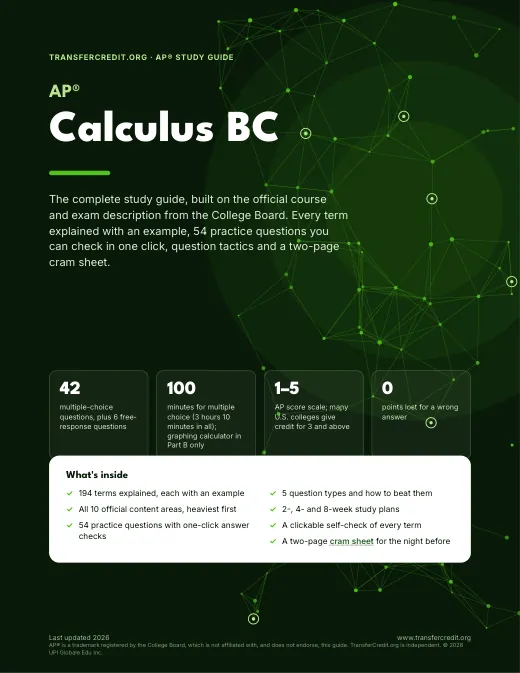
Page 1 of the TransferCredit.org Guide to APĀ® Calculus BC: the cover
Page 1 The cover
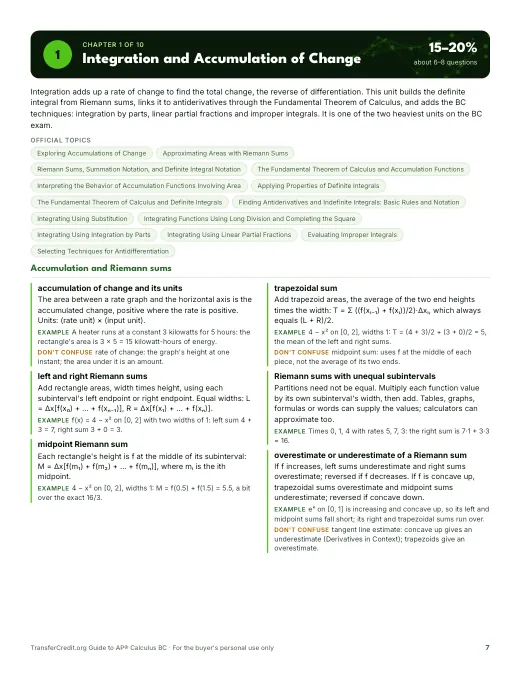
Page 7 of the TransferCredit.org Guide to APĀ® Calculus BC: the Chapter 1 opener
Page 7 The Chapter 1 opener
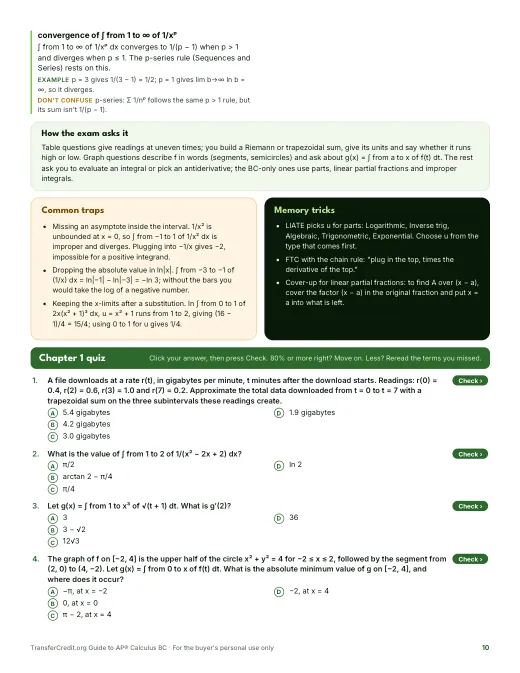
Page 10 of the TransferCredit.org Guide to APĀ® Calculus BC: a chapter quiz
Page 10 A chapter quiz
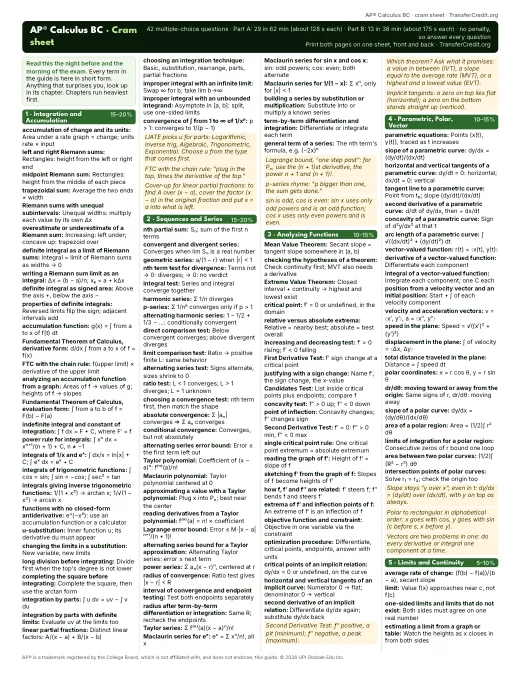
Page 44 of the TransferCredit.org Guide to APĀ® Calculus BC: the 2-page cram sheet
Page 44 The 2-page cram sheet

What you get for $5

One chapter for each area of the official course and exam description, heaviest topics first.

  • Instant download: a printable PDF you can keep
  • Built from the College Board's official course and exam description, heaviest topics first
  • Scored 1–5: many U.S. colleges give credit for 3 and above

Try 10 free APĀ® Calculus BC questions

Multiple-choice questions taken from the guide's chapter quizzes: one from each of the ten heaviest areas. About 25 minutes, with every answer explained and a score by area. The exam's free-response questions aren't in this quiz: see how the exam works.

10 questions  
  1. Question 1 · Integration and Accumulation
    A file downloads at a rate r(t), in gigabytes per minute, t minutes after the download starts. Readings: r(0) = 0.4, r(2) = 0.6, r(3) = 1.0 and r(7) = 0.2. Approximate the total data downloaded from t = 0 to t = 7 with a trapezoidal sum on the three subintervals these readings create.
    Show the answer

    Answer: A. 4.2 gigabytes. Multiply each trapezoid's average height by its own width: 2Ā·(0.4 + 0.6)/2 + 1Ā·(0.6 + 1.0)/2 + 4Ā·(1.0 + 0.2)/2 = 1.0 + 0.8 + 2.4 = 4.2. Gigabytes per minute times minutes gives gigabytes.

    The trap: 1.9 gigabytes averages each pair of readings but never multiplies by the widths 2, 1 and 4, so it isn't an area at all.

  2. Question 2 · Sequences and Series
    What is the sum of the series Ī£ from n = 1 to āˆž of 5(āˆ’1/4)ⁿ?
    Show the answer

    Answer: D. āˆ’1. It is geometric with ratio āˆ’1/4 and first term 5(āˆ’1/4) = āˆ’5/4. The sum is (āˆ’5/4)/(1 + 1/4) = (āˆ’5/4)/(5/4) = āˆ’1.

    The trap: 4 is 5/(1 + 1/4), the sum when the series starts at n = 0. Starting at n = 1, the first term is āˆ’5/4, not 5.

  3. Question 3 · Analyzing Functions
    A function f is differentiable for all real numbers, with f(1) = 3, f(4) = 9 and f(6) = 4. Which statement is guaranteed to be true?
    Show the answer

    Answer: B. f′(c) = 2 for some c with 1 < c < 4. f is differentiable, so it is also continuous, and the Mean Value Theorem applies on [1, 4]: f′ must equal the average rate (9 āˆ’ 3)/(4 āˆ’ 1) = 2 somewhere strictly between 1 and 4.

    The trap: f′ = āˆ’5 between 4 and 6 forgets to divide by the width 2. The MVT guarantees the slope (4 āˆ’ 9)/2 = āˆ’5/2 there, not āˆ’5.

  4. Question 4 · Parametric, Polar, Vector
    A curve is defined by x = ln t and y = t² for t > 0. What is the value of d²y/dx² at t = 2?
    Show the answer

    Answer: C. 16. dy/dx = 2t/(1/t) = 2t². Then d/dt(2t²) = 4t, and dividing by dx/dt = 1/t gives d²y/dx² = 4t². At t = 2 that is 16.

    The trap: 8 stops at d/dt(dy/dx) = 4t without dividing by dx/dt. It also matches dy/dx at t = 2, a second way to land on it.

  5. Question 5 · Limits and Continuity
    A graph of f is described in words. As x approaches 3 from either side, the graph approaches the height 2, but f(3) = 5. As x approaches 1 from the left, the graph approaches 4; from the right it approaches āˆ’1, and f(1) = āˆ’1. Which statement is true?
    Show the answer

    Answer: A. f has a removable discontinuity at x = 3.. At x = 3 both one-sided limits are 2, so the limit exists, but it doesn't equal f(3) = 5. A limit that exists but misses the function's value is a removable discontinuity.

    The trap: "lim x→1 f(x) = f(1) = āˆ’1" uses only the right side. The left side approaches 4, so the two-sided limit at x = 1 doesn't exist.

  6. Question 6 · Derivative Basics
    What is the value of lim h→0 (ln(e + h) āˆ’ 1)/h ?
    Show the answer

    Answer: B. 1/e. Since ln e = 1, the expression is the difference quotient of ln x at x = e. Its limit is the derivative 1/x evaluated at x = e, which is 1/e.

    The trap: "The limit does not exist" comes from seeing 0/0 when h = 0. Here 0/0 is the signal that the limit is a derivative, and that derivative exists.

  7. Question 7 · Chain, Implicit, Inverse
    Differentiable functions f and g have f(0) = 3, f′(0) = 2, g(0) = 4, g′(0) = āˆ’1, f(4) = 1, f′(4) = āˆ’5, g(4) = 0 and g′(4) = 6. If h(x) = f(g(x)), what is h′(0)?
    Show the answer

    Answer: C. 5. Chain rule: h′(0) = f′(g(0))Ā·g′(0) = f′(4)Ā·(āˆ’1) = (āˆ’5)(āˆ’1) = 5.

    The trap: āˆ’5 is f′(g(0)) alone. It skips the inner derivative g′(0) = āˆ’1.

  8. Question 8 · Derivatives in Context
    E(m) is the elevation, in feet, of a hiking trail m miles from the trailhead. Which statement best interprets E′(3) = 250?
    Show the answer

    Answer: D. At 3 miles from the trailhead, the trail is climbing at 250 feet per mile.. E′(3) is the rate of change of elevation at the point 3 miles along the trail. Its unit is feet of elevation per mile of trail, and its positive sign means the trail is going uphill there.

    The trap: "The elevation of the trail is 250 feet" reads E′(3) as E(3), the elevation itself. The derivative is a rate, not an amount.

  9. Question 9 · Differential Equations
    Let y = f(x) be the solution to dy/dx = 1 + xy with f(0) = 2. Using Euler's method with two steps of equal size, starting at x = 0, what is the approximation for f(1)?
    Show the answer

    Answer: C. 3.625. Ī”x = 0.5. Step 1: slope at (0, 2) is 1 + 0 = 1, so y ā‰ˆ 2 + 1(0.5) = 2.5 at x = 0.5. Step 2: slope at (0.5, 2.5) is 1 + 1.25 = 2.25, so y ā‰ˆ 2.5 + 2.25(0.5) = 3.625.

    The trap: 3 comes from one step of size 1, or from reusing the first slope for both steps. The slope must be recomputed at the new point.

  10. Question 10 · Applications of Integration
    The water level in a reservoir t days after a storm is H(t) = 60 + 6√t feet, for 0 ≤ t ≤ 9. What is the average water level over these 9 days?
    Show the answer

    Answer: D. 72 feet. Average value = (1/9)∫ from 0 to 9 of (60 + 6√t) dt = (1/9)(540 + 4·27) = 648/9 = 72 feet.

    The trap: 69 feet averages only the first and last levels, H(0) = 60 and H(9) = 78. The average value uses every level in between, through the integral.

The APĀ® Calculus BC exam at a glance

The APĀ® Calculus BC exam is from the College Board. It has 42 multiple-choice questions, plus 6 free-response questions. You get 100 minutes for multiple choice (3 hours 10 minutes in all); graphing calculator in Part B only. The score scale is 1–5 (APĀ® score scale; many U.S. colleges give credit for 3 and above). The guide has 10 chapters, one for each area of the official course and exam description; the heaviest is Integration and Accumulation of Change at 15–20%.

Questions
42multiple-choice questions, plus 6 free-response questions
Time
100 minfor the 42 multiple-choice questions, in 2 parts timed separately
Score
1–5APĀ® score scale; many U.S. colleges give credit for 3 and above
Fee
$99per exam in the U.S. and Canada in 2026-27; your school may charge more
Calculator
Yesgraphing calculator in Part B only
Wrong answers
No penaltya wrong answer costs nothing
  • Section I has 42 multiple-choice questions in 1 hour 40 minutes (50% of your score): Part A is 29 questions in 62 minutes with no calculator (35%); Part B is 13 questions in 38 minutes with a graphing calculator required (15%).
  • Section II has 6 free-response questions in 1 hour 30 minutes (50%): Part A is 2 questions in 30 minutes with a graphing calculator required (16.7%); Part B is 4 questions in 60 minutes with no calculator (33.3%). Three of the six are shared with the AB exam and test AB content.
  • The exam is hybrid digital: you answer the multiple-choice questions and read the free-response questions in the Bluebook app, and you handwrite your free-response answers in a paper booklet. In the calculator parts you can use Bluebook's built-in Desmos graphing calculator or an approved handheld graphing calculator.
  • Your multiple-choice score is the number of questions you answer correctly, so a wrong answer costs nothing.
  • Integration and Accumulation of Change and Infinite Sequences and Series are 15–20% of the multiple-choice section each; Analytical Applications of Differentiation and Parametric Equations, Polar Coordinates, and Vector-Valued Functions are 10–15% each; the other six units are 5–10% each. Calculus AB and BC share one course description: the BC exam tests every AB topic plus the BC-only topics, including all of the parametric, polar and vector unit and the series unit.

Source: official APĀ® Calculus BC page and the official course and exam description. Last updated 2026.

What the exam covers

10 chapters, heaviest first, with each area's official weight. The guide's chapters follow this order.

  1. Integration and Accumulation of Change15–20% · ~6–8 Q
  2. Infinite Sequences and Series15–20% · ~6–8 Q
  3. Analytical Applications of Differentiation10–15% · ~4–6 Q
  4. Parametric Equations, Polar Coordinates, and Vector-Valued Functions10–15% · ~4–6 Q
  5. Limits and Continuity5–10% · ~2–4 Q
  6. Differentiation: Definition and Fundamental Properties5–10% · ~2–4 Q
  7. Differentiation: Composite, Implicit, and Inverse Functions5–10% · ~2–4 Q
  8. Contextual Applications of Differentiation5–10% · ~2–4 Q
  9. Differential Equations5–10% · ~2–4 Q
  10. Applications of Integration5–10% · ~2–4 Q

Where to start: the 4 heaviest areas (marked in the map) carry about 25 of the 42 questions. The guide puts them first, so working front to back covers the most points earliest.

APĀ® Calculus BC study guide by area

The 2 heaviest areas are open to read now. The full guide has a chapter for every area, each with all its terms, a quiz and an answer key.

2 of 10 chapters open  ·  in the guide's order
15–20% · about 6–8 questions · free preview Integration and Accumulation of Change Chapter 1 of the guide

Integration adds up a rate of change to find the total change, the reverse of differentiation. This unit builds the definite integral from Riemann sums, links it to antiderivatives through the Fundamental Theorem of Calculus, and adds the BC techniques: integration by parts, linear partial fractions and improper integrals. It is one of the two heaviest units on the BC exam.

Key terms, with examples

accumulation of change and its units
The area between a rate graph and the horizontal axis is the accumulated change, positive where the rate is positive. Units: (rate unit) Ɨ (input unit).
Example: A heater runs at a constant 3 kilowatts for 5 hours: the rectangle's area is 3 Ɨ 5 = 15 kilowatt-hours of energy.
definite integral as a limit of Riemann sums
Riemann sums Ī£ f(xįµ¢*)Ī”xįµ¢ add value-times-width products, xįµ¢* in piece i. As the widest Ī”xįµ¢ shrinks to 0, they approach ∫ from a to b of f(x) dx.
Example: Right sums for 4 āˆ’ x² on [0, 2]: 3 with n = 2, 4.25 with n = 4, ā‰ˆ 5.29 with n = 100, nearing 16/3.
accumulation function
g(x) = ∫ from a to x of f(t) dt, with a fixed and x the input: g(x) is the signed area under f from a to x.
Example: g(x) = ∫ from 2 to x of 4 dt = 4x āˆ’ 8: g(5) = 12, a 3-by-4 rectangle, and g(2) = 0.
indefinite integral and constant of integration
Every antiderivative of f has the form F(x) + C, written ∫ f(x) dx, where F′ = f and C is a constant. Check by differentiating.
Example: ∫ 4x³ dx = x⁓ + C: x⁓ + 7 and x⁓ āˆ’ 1 both have derivative 4x³.
u-substitution
Undo the chain rule: pick u, an inner expression whose derivative du = u′(x) dx sits in the integrand (up to a constant). Integrate in u, then put x back.
Example: ∫ cos(5x) dx: u = 5x and du = 5 dx, so the integral is (1/5)sin(5x) + C.
integration by parts
For a product, pick u to differentiate and dv to integrate: ∫ u dv = uv āˆ’ ∫ v du. It reverses the product rule; choose u so that ∫ v du is simpler.
Example: ∫ x eĖ£ dx: u = x and dv = eĖ£ dx give xeĖ£ āˆ’ ∫ eĖ£ dx = xeĖ£ āˆ’ eĖ£ + C.
improper integral with an infinite limit
Replace āˆž with b and take a limit: ∫ from a to āˆž of f(x) dx = lim bā†’āˆž ∫ from a to b of f(x) dx. A finite limit means it converges.
Example: ∫ from 0 to āˆž of 1/(x + 2)² dx = lim bā†’āˆž (1/2 āˆ’ 1/(b + 2)) = 1/2, so it converges.
left and right Riemann sums
Add rectangle areas, width times height, using each subinterval's left endpoint or right endpoint. Equal widths: L = Ī”x[f(xā‚€) + … + f(xₙ₋₁)], R = Ī”x[f(x₁) + … + f(xā‚™)].
Example: f(x) = 4 āˆ’ x² on [0, 2] with two widths of 1: left sum 4 + 3 = 7, right sum 3 + 0 = 3.
writing a Riemann sum limit as an integral
In lim nā†’āˆž Ī£ f(a + kĪ”x)Ī”x, read off f and a; Ī”x = (b āˆ’ a)/n gives b. The limit is ∫ from a to b of f(x) dx.
Example: Ī£ sin(kĻ€/n)Ā·(Ļ€/n), k = 1 to n, tends to ∫ from 0 to Ļ€ of sin x dx = 2: Ī”x = Ļ€/n.
Fundamental Theorem of Calculus, derivative form
For continuous f, d/dx [∫ from a to x of f(t) dt] = f(x) on any interval containing a: differentiating an accumulation function returns the integrand at x.
Example: d/dx ∫ from 2 to x of cos(t²) dt = cos(x²), even though cos(t²) has no simple antiderivative.
power rule for integrals
For n ≠ āˆ’1, ∫ xⁿ dx = xⁿ⁺¹/(n + 1) + C: raise the exponent by 1, then divide by the new exponent. Rewrite roots and reciprocals as powers first.
Example: ∫ āˆ›x dx = ∫ x^(1/3) dx = x^(4/3)/(4/3) + C = (3/4)x^(4/3) + C.
changing the limits in a substitution
In a definite integral, convert the limits too: x = a becomes u = u(a) and x = b becomes u = u(b). Then evaluate in u without switching back.
Example: ∫ from 0 to Ļ€/2 of sin³x cos x dx: u = sin x with new limits 0 and 1 gives 1⁓/4 = 1/4.

What this area covers

Accumulation and Riemann sumsThe definite integralThe Fundamental Theorem of CalculusAntiderivatives and basic rulesSubstitution and rearrangingParts, partial fractions and choosing a methodImproper integrals

How the exam asks it

Table questions give readings at uneven times; you build a Riemann or trapezoidal sum, give its units and say whether it runs high or low. Graph questions describe f in words (segments, semicircles) and ask about g(x) = ∫ from a to x of f(t) dt. The rest ask you to evaluate an integral or pick an antiderivative; the BC-only ones use parts, linear partial fractions and improper integrals.

Common traps

Trap 1. Missing an asymptote inside the interval. 1/x² is unbounded at x = 0, so ∫ from āˆ’1 to 1 of 1/x² dx is improper and diverges. Plugging into āˆ’1/x gives āˆ’2, impossible for a positive integrand.

Trap 2. Dropping the absolute value in ln|x|. ∫ from āˆ’3 to āˆ’1 of (1/x) dx = ln|āˆ’1| āˆ’ ln|āˆ’3| = āˆ’ln 3; without the bars you would take the log of a negative number.

Trap 3. Keeping the x-limits after a substitution. In ∫ from 0 to 1 of 2x(x² + 1)³ dx, u = x² + 1 runs from 1 to 2, giving (16 āˆ’ 1)/4 = 15/4; using 0 to 1 for u gives 1/4.

Memory trick

LIATE picks u for parts: Logarithmic, Inverse trig, Algebraic, Trigonometric, Exponential. Choose u from the type that comes first.

FTC with the chain rule: "plug in the top, times the derivative of the top."

15–20% · about 6–8 questions · free preview Infinite Sequences and Series Chapter 2 of the guide

An infinite series adds infinitely many terms, and it has a sum only if its partial sums settle on a limit. This unit tests series for convergence, bounds the error of a partial sum, and builds Taylor polynomials and power series that turn functions into polynomials. It is BC-only and, with Integration and Accumulation, the most heavily weighted unit on the multiple-choice section (15–20% each).

Key terms, with examples

nth partial sum
Sā‚™ = a₁ + aā‚‚ + … + aā‚™ adds up the series' first n terms. The partial sums S₁, Sā‚‚, Sā‚ƒ, … form a sequence.
Example: For Ī£ 1/(k(k + 1)), Sā‚ƒ = 1/2 + 1/6 + 1/12 = 3/4.
nth term test for divergence
If lim nā†’āˆž aā‚™ ≠ 0, or the limit doesn't exist, then Ī£ aā‚™ diverges. If lim aā‚™ = 0, the test says nothing: the series may still diverge.
Example: Σ n/(3n + 2): the terms approach 1/3, not 0, so the series diverges.
direct comparison test
If 0 ≤ aā‚™ ≤ bā‚™ for every n: Ī£ bā‚™ converges ⇒ Ī£ aā‚™ converges, and Ī£ aā‚™ diverges ⇒ Ī£ bā‚™ diverges.
Example: 0 < 1/(3ⁿ + 2) < 1/3ⁿ, and Σ 1/3ⁿ is geometric with r = 1/3, so Σ 1/(3ⁿ + 2) converges.
absolute convergence
Σ aₙ converges absolutely if Σ |aₙ| converges. Absolute convergence implies convergence, and any rearranging or regrouping of the terms keeps the same sum.
Example: Ī£ (āˆ’1)ⁿ/n² converges absolutely, because Ī£ 1/n² is a convergent p-series.
Taylor polynomial
The coefficient of (x āˆ’ a)įµ is fā½įµā¾(a)/k!: Pā‚™(x) = f(a) + f′(a)(x āˆ’ a) + … + f⁽ⁿ⁾(a)(x āˆ’ a)ⁿ/n!.
Example: f(2) = 1, f′(2) = 3, f″(2) = āˆ’4: Pā‚‚(x) = 1 + 3(x āˆ’ 2) āˆ’ 2(x āˆ’ 2)².
power series
Ī£ from n = 0 to āˆž of aā‚™(x āˆ’ r)ⁿ, centered at x = r. It converges at x = r only, on an interval around r, or for all x.
Example: Ī£ (x āˆ’ 3)ⁿ/2ⁿ at x = 4 is Ī£ (1/2)ⁿ, which equals 2.
Taylor series
The infinite version of the Taylor polynomial: Ī£ from n = 0 to āˆž of f⁽ⁿ⁾(a)(x āˆ’ a)ⁿ/n!. Each Taylor polynomial is one of its partial sums.
Example: 1/x centered at 1: f⁽ⁿ⁾(1) = (āˆ’1)ⁿn!, so the series is Ī£ (āˆ’1)ⁿ(x āˆ’ 1)ⁿ.
convergent and divergent series
A series converges to S if its partial sums Sā‚™ approach S as n → āˆž; S is then its sum. If the partial sums have no finite limit, it diverges.
Example: Σ 1/(k(k + 1)): Sₙ = n/(n + 1) approaches 1 as n grows, so the sum is 1.
integral test
If f is positive, continuous and decreasing for x ≄ 1 with f(n) = aā‚™, then Ī£ aā‚™ and ∫ from 1 to āˆž of f(x) dx both converge or both diverge.
Example: ∫ from 1 to āˆž of 1/(2x + 1) dx = lim bā†’āˆž (1/2)ln((2b + 1)/3) = āˆž, so Ī£ 1/(2n + 1) diverges.
limit comparison test
For positive aā‚™ and bā‚™, if lim aā‚™/bā‚™ = L with 0 < L < āˆž, then Ī£ aā‚™ and Ī£ bā‚™ both converge or both diverge.
Example: aā‚™ = (2n + 1)/(n³ + 4) behaves like bā‚™ = 1/n²: the ratio → 2, and Ī£ 1/n² converges, so Ī£ aā‚™ does too.
conditional convergence
Σ aₙ converges conditionally if it converges but Σ |aₙ| diverges. It is usually an alternating series whose all-positive version diverges.
Example: Ī£ (āˆ’1)ⁿ/√n converges by the alternating series test, but Ī£ 1/√n is a divergent p-series.
Maclaurin polynomial
A Taylor polynomial centered at a = 0, so its terms are f⁽ⁿ⁾(0)xⁿ/n!.
Example: f(x) = √(1 + x): f(0) = 1, f′(0) = 1/2, f″(0) = āˆ’1/4, so Pā‚‚(x) = 1 + x/2 āˆ’ x²/8.

What this area covers

Series and their sumsThe nth term test, the integral test and p-seriesComparison, alternating series and ratio testsAbsolute and conditional convergence; alternating series errorTaylor polynomials and their errorPower series and where they convergeTaylor and Maclaurin series

How the exam asks it

Expect lists of series with "which converge?" or "which converges conditionally?", a power series and its interval of convergence, a Taylor polynomial built from a table of derivatives, the coefficient of one power in a series, or the most an approximation can be off. Free-response questions may name the test to use and want its conditions checked in words.

Common traps

Trap 1. Forgetting the factorials. The coefficient of (x āˆ’ a)ⁿ is f⁽ⁿ⁾(a)/n!, so f″(a) = 6 gives 3 as the coefficient of (x āˆ’ a)², not 6.

Trap 2. Skipping the endpoints. The ratio test says nothing where |x āˆ’ r| = R, so an interval of convergence isn't finished until each endpoint has been tested.

Trap 3. Using the n = 0 formula on a series that starts at n = 1. Ī£ from n = 1 to āˆž of 3(1/2)ⁿ has first term 3/2, so its sum is 3, not 6.

Memory trick

Lagrange bound, "one step past": for Pā‚™, use the (n + 1)st derivative, the power n + 1 and (n + 1)!.

p-series rhyme: "p bigger than one, the sum gets done."

How APĀ® Calculus BC questions are written

The exam has 42 multiple-choice questions, plus 6 free-response questions. The guide sorts the questions into 5 types; spot the type and you'll know what the question wants before you read the choices.

Type 1

Compute a value from a formula

A function, limit, integral or series written out, then "What is the value of …?" or "Which of the following is …?". 29 of the 42 multiple-choice questions allow no calculator, so their numbers come out clean: Ļ€/4, e, small fractions.

  • Name the rule from the outermost operation (product, chain, substitution, geometric series) before you write anything.
  • Work it all the way, then compare. Wrong choices are what a dropped chain-rule factor, a sign slip or a missing factorial produce.
  • If your answer isn't there, recheck inner derivatives and signs first.
Type 2

Read a table

A short table of values of f, f′ or a rate at a few inputs, which may be unevenly spaced, then an estimate: a derivative, a Riemann or trapezoidal sum, a Taylor polynomial, or what a theorem guarantees. This guide writes the table out in one line.

  • Note what the table gives (f or f′) and its units before choosing a method.
  • Use the data points closest to the input you need, and the real widths between them.
  • Attach units: the rate of a rate is "per unit, per unit".
Type 3

Read a graph described in words

On the exam a graph is drawn: of f, of f′, a slope field or a polar curve. This guide can't draw, so it describes the graph in words: where it crosses the axis, where it rises or falls, its key points.

  • Check which function the graph shows: f, f′ or f″. Many wrong answers come from reading a graph of f′ as if it were f.
  • Make a quick sketch on scrap paper from the description, marking zeros and turning points.
  • Answer only what is asked: an x-value, a value of the function, or an interval.
Type 4

Which must be true

A few facts about a function or a series, then "Which of the following must be true?" Each choice is a statement to judge; this guide also bundles two or three statements as I, II and III. They test whether a theorem or test really applies.

  • Judge each statement on its own: guaranteed, or not guaranteed.
  • For a theorem (IVT, MVT, EVT) or a series test, check that its conditions are given before you use it.
  • "Must be true" means true for every function that fits the facts, so one counterexample rules a statement out.
Type 5

Calculator-active question

Part B of multiple choice (13 questions, graphing calculator required) has questions that need a numerical integral, a derivative at a point, or the solution of an equation. The CED's sample calculator questions give decimal answers to three places. In this guide such questions start "(Calculator allowed.)".

  • Write the setup first: the integral, derivative or equation the calculator will evaluate.
  • Check that the calculator is in radian mode, then evaluate and round only at the end.
  • Choices that are close to yours often come from a missing starting value or the wrong function.

Test-day habits that add points

  1. Answer every question. There's no penalty for a wrong answer. A blank is always worth zero, so never leave one.
  2. Predict, then look. Name the answer before reading the choices. It protects you from distractors written to sound right.
  3. Eliminate. Cross out choices you know are wrong. Every choice you rule out raises your odds on a guess.
  4. Mark and move on. If a question is taking more than about 3 minutes, pick your best guess, mark it and come back if time allows. Part A gives you 62 minutes for 29 questions (about 2 each); Part B gives 38 minutes for 13 (about 3 each).
  5. Estimate the sign and size. Before you compute, ask whether the answer should be positive or negative and roughly how big: a rising graph means f′ > 0, an integral of a positive rate is positive. One quick estimate often rules out two choices.
  6. Change answers for a reason. Switch an answer only when you can say why the new one is better, such as a detail you missed.
  7. The free-response section. Section II has 6 questions in 1 hour 30 minutes, 50% of your score. Part A: 2 questions in 30 minutes with a graphing calculator required (16.7%). Part B: 4 questions in 60 minutes with no calculator (33.3%). You read the questions in Bluebook and handwrite your answers in a paper booklet. At least two questions use a real-world context, and three are shared with the AB exam and test AB content. The CED's sample questions are worth 9 points each, split over their parts. When the calculator gives you a result, write the setup (the equation, derivative or integral) as well as the answer. Task verbs tell you what to show: justify means name the definition, theorem or test, say why it applies, then apply it; explain means give the reason; interpret means say what a value means in the context, often with units.

Pacing: Part A, no calculator: 29 questions in 62 minutes, about 128 seconds a question. Part B, graphing calculator: 13 questions in 38 minutes, about 175 seconds a question.

APĀ® Calculus BC flashcards

Try the first 8 cards free. Read the term, say the definition out loud, then select the card to check yourself. Arrow keys move between cards.

Free card 1 of 8 (deck total: 194)

How to study for APĀ® Calculus BC: a 5-step plan

Follow the steps, then enter your test date. The planner gives you a dated plan that starts with the heaviest areas and saves the last days for review.

  1. Take the 10 free questionsSee which APĀ® Calculus BC areas you already know.
  2. Study the heaviest areas firstStart with Integration and Accumulation of Change, Infinite Sequences and Series and Analytical Applications of Differentiation, then work down the exam map.
  3. Learn each term with an exampleSay the definition out loud, then check it with the flashcards. A term you can't use in an example isn't learned yet.
  4. Quiz yourself and study the trapsAfter each area, answer its quiz and read why the tempting wrong answer is wrong.
  5. Plan backwards from your exam dateBuild a dated plan, keep the last days for a full review, and read the cram sheet the night before.

How it works

  1. Check out

    Select Get the guide · $5 and pay on TransferCredit.org's secure checkout.

  2. Download the PDF

    From your TransferCredit.org account.

  3. Study the heaviest areas first

    Follow the 2-, 4- or 8-week plan, then read the cram sheet the night before.

This page or the full guide

Everything on this page is free with no account. The full guide is a PDF you keep.

What's on this page and in the full study guide
Study toolThis pageFull study guide ($5)
ChaptersA preview of 2 of 10All 10
Terms explainedA sample from the open chaptersAll 194, each with an example
Practice questions10 free questions54, with an answer key
Flashcards8 cardsAll 194 terms on the self-check list
Study planDated planner2-, 4- and 8-week plans
Cram sheet—2 pages, for the night before
FormatWeb page45-page PDF, printable

Questions students ask

Is the APĀ® Calculus BC exam hard?
It depends on what you already know. The largest area, Integration and Accumulation of Change, is 15–20%, and the smallest, Applications of Integration, is 5–10%. Try the 10 free questions above to see where you stand in about 25 minutes.
How do I study for and pass the APĀ® Calculus BC exam?
Five steps, all on this page. 1. Take the 10 free questions: See which APĀ® Calculus BC areas you already know. 2. Study the heaviest areas first: Start with Integration and Accumulation of Change, Infinite Sequences and Series and Analytical Applications of Differentiation, then work down the exam map. 3. Learn each term with an example: Say the definition out loud, then check it with the flashcards. A term you can't use in an example isn't learned yet. 4. Quiz yourself and study the traps: After each area, answer its quiz and read why the tempting wrong answer is wrong. 5. Plan backwards from your exam date: Build a dated plan, keep the last days for a full review, and read the cram sheet the night before. Then take the free APĀ® Calculus BC practice test (25 questions, every answer explained).
What's in the full APĀ® Calculus BC study guide?
45 pages: 10 chapters, one for each area of the College Board's official course and exam description, heaviest topics first. 194 terms, each with a plain-English definition and an example, common traps and memory tricks, 54 practice questions with an answer key that explains every answer, question tactics, 2-, 4- and 8-week study plans and a 2-page cram sheet.
How much is the full APĀ® Calculus BC study guide?
The full 45-page PDF is $5. The 10 practice questions on this page are free.
What topics are on the APĀ® Calculus BC exam?
10 areas, from the official course and exam description: Integration and Accumulation of Change (15–20%); Infinite Sequences and Series (15–20%); Analytical Applications of Differentiation (10–15%); Parametric Equations, Polar Coordinates, and Vector-Valued Functions (10–15%); Limits and Continuity (5–10%); Differentiation: Definition and Fundamental Properties (5–10%); Differentiation: Composite, Implicit, and Inverse Functions (5–10%); Contextual Applications of Differentiation (5–10%); Differential Equations (5–10%); Applications of Integration (5–10%).
Is there a free APĀ® Calculus BC practice test?
Yes. The free APĀ® Calculus BC practice test has 25 questions with an explanation for every answer, and this page has 10 more free questions from the guide. No account needed.
Can I try the APĀ® Calculus BC guide before I buy it?
Yes. This page has 10 questions from the guide's own chapter quizzes, a preview of the 2 heaviest areas, 8 flashcards and a study planner. No account needed.
Is this an official APĀ® study guide?
No. APĀ® is a trademark registered by the College Board, which is not affiliated with, and does not endorse, this guide. TransferCredit.org is independent. We built the guide from the College Board's official course and exam description, and the exam details were checked against the College Board's published exam information in 2026.
More questions about the APĀ® Calculus BC exam (20)
How do I get the full guide?
Select Get the guide Ā· $5 and check out on TransferCredit.org. Then sign in to your TransferCredit.org account to download the PDF.
Can I print the guide or use it on my phone?
Yes. It's a PDF, so it opens on phones, tablets and computers, and printing is allowed. Its tick boxes and answer bubbles work in PDF readers that support forms. Copying and editing are turned off.
How was this study guide made?
One chapter for each area of the official course and exam description, using its published weights. Each chapter was written, then fact-checked against the official exam information in a separate review. The practice questions are original: none are copied from the College Board's released questions.
How up to date is this APĀ® Calculus BC guide?
Last updated 2026. The exam details were checked against the College Board's published exam information in 2026. Exams change, so confirm the details on the official APĀ® Calculus BC page before you test.
What is the APĀ® Calculus BC exam?
The APĀ® Calculus BC exam is from the College Board. It has 42 multiple-choice questions, plus 6 free-response questions. You get 100 minutes for multiple choice (3 hours 10 minutes in all); graphing calculator in Part B only. The score scale is 1–5 (APĀ® score scale; many U.S. colleges give credit for 3 and above). The guide has 10 chapters, one for each area of the official course and exam description; the heaviest is Integration and Accumulation of Change at 15–20%.
How many questions are on the APĀ® Calculus BC exam, and how long is it?
Section I has 42 multiple-choice questions in 1 hour 40 minutes (50% of your score): Part A is 29 questions in 62 minutes with no calculator (35%); Part B is 13 questions in 38 minutes with a graphing calculator required (15%). Section II has 6 free-response questions in 1 hour 30 minutes (50%): Part A is 2 questions in 30 minutes with a graphing calculator required (16.7%); Part B is 4 questions in 60 minutes with no calculator (33.3%). Three of the six are shared with the AB exam and test AB content.
How is the APĀ® Calculus BC exam scored?
The score scale is 1–5: APĀ® score scale; many U.S. colleges give credit for 3 and above. Your multiple-choice score is the number of questions you answer correctly, so a wrong answer costs nothing.
What APĀ® Calculus BC score do I need for college credit?
Many U.S. colleges give credit for 3 and above. Each college sets its own credit policy, so check the one at your college before you count on the credit.
How much does the APĀ® Calculus BC exam cost?
The fee is $99: per exam in the U.S. and Canada in 2026-27; your school may charge more. Fees can change, so check the official page when you register.
Can I use a calculator on the APĀ® Calculus BC exam?
Section I has 42 multiple-choice questions in 1 hour 40 minutes (50% of your score): Part A is 29 questions in 62 minutes with no calculator (35%); Part B is 13 questions in 38 minutes with a graphing calculator required (15%). Section II has 6 free-response questions in 1 hour 30 minutes (50%): Part A is 2 questions in 30 minutes with a graphing calculator required (16.7%); Part B is 4 questions in 60 minutes with no calculator (33.3%). In the calculator parts you can use Bluebook's built-in Desmos graphing calculator or an approved handheld graphing calculator.
Is there a penalty for guessing on APĀ® Calculus BC?
No. There's no penalty for a wrong answer. A blank is always worth zero, so never leave one.
Which APĀ® Calculus BC topics should I study first?
The 4 heaviest areas (marked in the map) carry about 25 of the 42 questions. The guide puts them first, so working front to back covers the most points earliest.
What kinds of questions are on the APĀ® Calculus BC exam?
The exam has 42 multiple-choice questions, plus 6 free-response questions. The guide sorts the questions into 5 types: ā€œCompute a value from a formulaā€, ā€œRead a tableā€, ā€œRead a graph described in wordsā€, ā€œWhich must be trueā€ and ā€œCalculator-active questionā€. Multiple-choice questions have 4 answer choices. See how each type is written.
What are the free-response questions on the APĀ® Calculus BC exam?
Section II has 6 questions in 1 hour 30 minutes, 50% of your score. Part A: 2 questions in 30 minutes with a graphing calculator required (16.7%). Part B: 4 questions in 60 minutes with no calculator (33.3%). You read the questions in Bluebook and handwrite your answers in a paper booklet. At least two questions use a real-world context, and three are shared with the AB exam and test AB content. The CED's sample questions are worth 9 points each, split over their parts. When the calculator gives you a result, write the setup (the equation, derivative or integral) as well as the answer. Task verbs tell you what to show: justify means name the definition, theorem or test, say why it applies, then apply it; explain means give the reason; interpret means say what a value means in the context, often with units.
How should I pace myself on the APĀ® Calculus BC exam?
Part A, no calculator: 29 questions in 62 minutes, about 128 seconds a question. Part B, graphing calculator: 13 questions in 38 minutes, about 175 seconds a question. If a question is taking more than about 3 minutes, pick your best guess, mark it and come back if time allows. Part A gives you 62 minutes for 29 questions (about 2 each); Part B gives 38 minutes for 13 (about 3 each).
How long should I study for APĀ® Calculus BC?
Take the 10 free questions to see where you stand. The full guide has 2-, 4- and 8-week plans built from the exam weights, and the planner on this page builds a dated plan from your exam date.
How do I know I'm ready for the APĀ® Calculus BC exam?
The guide's readiness checklist: You can explain every term on the checklist without notes. You score 80% or better on every chapter quiz. You can read the cram sheet and nothing on it surprises you. You know the APĀ® score your college gives credit for, and your exam date.
What should I do the night before?
Read the 2-page cram sheet once, slowly. Check your exam time and room with your APĀ® coordinator. Multiple choice is in the Bluebook app; free-response answers are handwritten in a paper booklet. Bring an approved graphing calculator if you want your own; Bluebook's built-in Desmos graphing calculator is there in the calculator parts only. In the morning, skim the traps, then stop studying.
Can I self-study for the APĀ® Calculus BC exam?
This guide is built for studying on your own: 45 pages with a chapter for each area of the official course and exam description, 54 practice questions with every answer explained, 2-, 4- and 8-week study plans and a 2-page cram sheet, for $5. Start with the 10 free questions on this page, then the free APĀ® Calculus BC practice test (25 questions). For the full class online, the APĀ® Calculus BC prep course has 80 self-paced lessons, a quiz after each, 12 interactive labs and two full exams.
Is there an APĀ® Calculus BC prep course?
Yes. The APĀ® Calculus BC prep course teaches the whole subject: 80 self-paced lessons, a quiz after each, 12 interactive labs and two full exams. The guide is the printable review; the course is the full class online.

How we built this guide

We built one chapter for each area of the College Board's official course and exam description for APĀ® Calculus BC, using its published weights to order the chapters and size the quizzes. Each chapter was written, then fact-checked against the official exam information in a separate review. The exam details were checked against the College Board's published exam information in 2026.

Sources: official APĀ® Calculus BC page, official course and exam description. Last updated 2026.

APĀ® is a trademark registered by the College Board, which is not affiliated with, and does not endorse, this guide. TransferCredit.org is independent and not affiliated with the College Board. © 2026 UPI Globale Edu Inc.

Ready for the full APĀ® Calculus BC guide? 45 pages, 194 terms, 54 practice questions and a 2-page cram sheet, $5.

In the full guide

TransferCredit.org Guide to APĀ® Calculus BC

  • All 10 chapters
  • 194 terms with examples
  • 54 practice questions with an answer key
  • A 2-page cram sheet and 2-, 4- and 8-week plans
Get the guide · $5