← All AP® study guides
AP® Study Guide Printable PDF · 42 pages

TransferCredit.org Guide to AP® Computer Science Principles

AP® Computer Science Principles study guide: a printable PDF built from the College Board's official course and exam description, heaviest topics first.

  • 195 key terms, each with an example
  • 40 practice questions with every answer explained
  • A 2-page cram sheet for the night before
  • 2-, 4- and 8-week study plans built from the exam weights
Not sure yet? Try 10 free questions

Last updated 2026 · exam details checked against the College Board's published exam information in 2026

Look inside the guide

Real pages from the 42-page PDF.

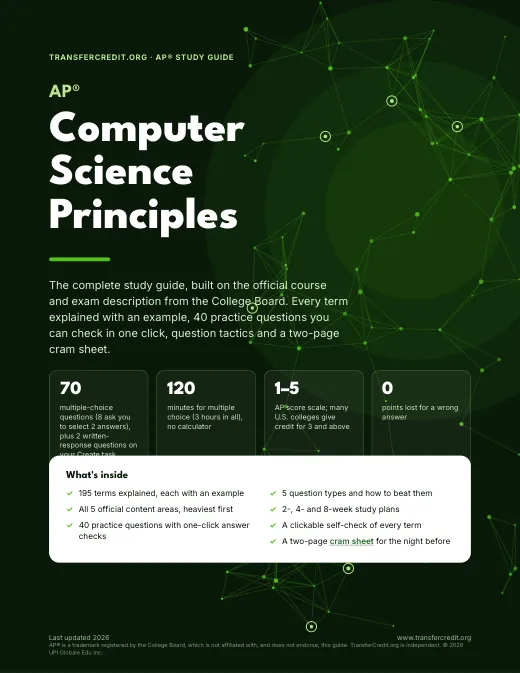
Page 1 of the TransferCredit.org Guide to AP® Computer Science Principles: the cover
Page 1 The cover
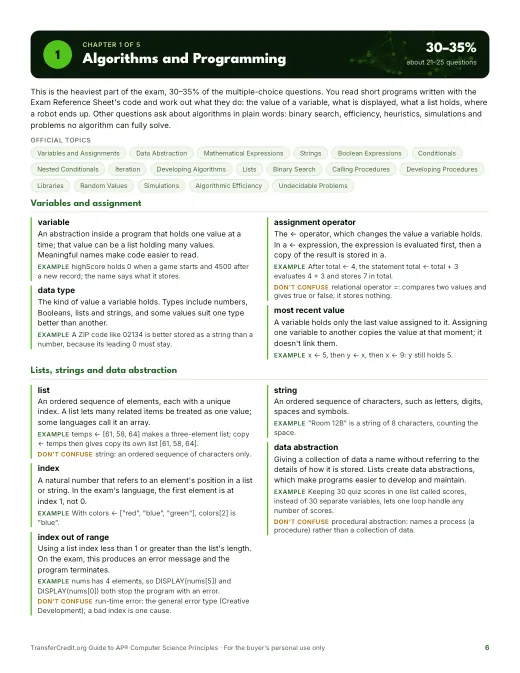
Page 6 of the TransferCredit.org Guide to AP® Computer Science Principles: the Chapter 1 opener
Page 6 The Chapter 1 opener
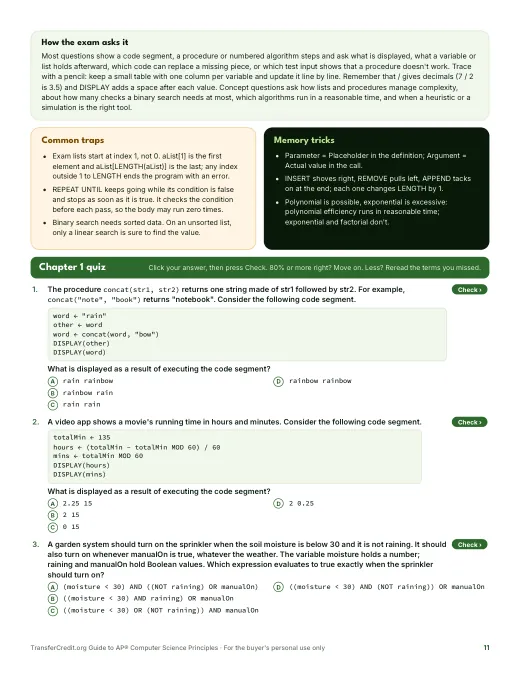
Page 11 of the TransferCredit.org Guide to AP® Computer Science Principles: a chapter quiz
Page 11 A chapter quiz
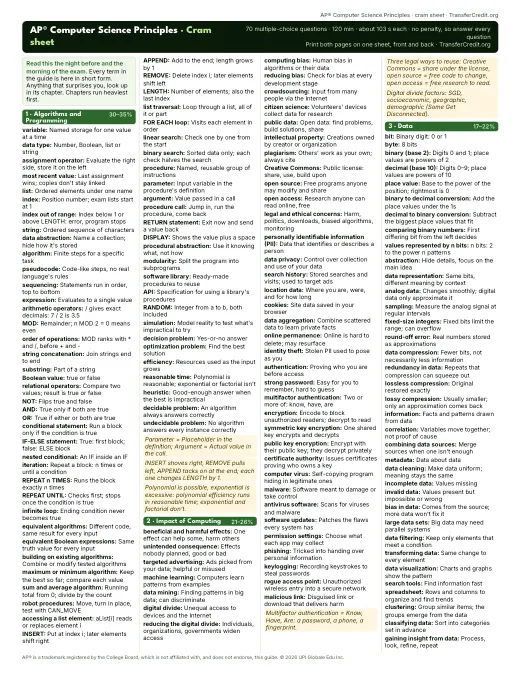
Page 41 of the TransferCredit.org Guide to AP® Computer Science Principles: the 2-page cram sheet
Page 41 The 2-page cram sheet

What you get for $5

One chapter for each area of the official course and exam description, heaviest topics first.

  • 📘42pages, printable
  • 🧭5chapters
  • 🔑195terms with examples
  • ✍️40practice questions, answers explained
  • ⚠️15exam traps to avoid
  • 📄2page cram sheet

Try 10 free AP® Computer Science Principles questions

Multiple-choice questions taken from the guide's chapter quizzes: 5 areas, heaviest first. About 15 minutes, with every answer explained and a score by area.

10 questions  
  1. Question 1 · Algorithms and Programming
    The procedure concat(str1, str2) returns one string made of str1 followed by str2. For example, concat("note", "book") returns "notebook". Consider the following code segment.
    word ← "rain"
    other ← word
    word ← concat(word, "bow")
    DISPLAY(other)
    DISPLAY(word)
    What is displayed as a result of executing the code segment?
    Show the answer

    Answer: A. rain rainbow. other ← word copies the value "rain" into other. Changing word afterward doesn't change other, so other still holds "rain" and word now holds "rainbow".

    The trap: rainbow rainbow treats other as linked to word. Assignment copies the value at that moment; afterward the two variables are separate.

  2. Question 2 · Impact of Computing
    A city launches an app that lets residents unlock rental bikes with their phones. The app records the start point, end point and time of every trip so that the city can plan new bike lanes. Which of the following is an effect of the app rather than its purpose?
    Show the answer

    Answer: C. Fewer cars park downtown because more residents ride bikes to work. The app was designed to unlock bikes and to give the city trip data for planning lanes; those are its purposes. Fewer parked cars downtown is a result of people using it, which makes it an effect.

    The trap: Recording each trip's start, end and time is something the app was built to do. It serves the purpose; it isn't an effect of using the app.

  3. Question 3 · Data
    A program stores three sensor readings as 8-bit binary numbers: 0110 0011, 0101 1011 and 0101 1100. Which of the following lists the readings in order from least to greatest?
    Show the answer

    Answer: D. 0101 1011, 0101 1100, 0110 0011. In decimal the readings are 91 (0101 1011), 92 (0101 1100) and 99 (0110 0011). Comparing from the left works too: 0110 0011 is the only one with a 1 in the 32s place, so it is largest; the other two first differ in the 4s place, where 0101 1100 has the 1.

    The trap: The order 0101 1100, 0110 0011, 0101 1011 comes from comparing the bits starting at the right. The rightmost bit is worth only 1, so compare from the left, where the bits are worth most.

  4. Question 4 · Computer Systems and Networks
    A photo is sent across the Internet from one computer to another. The receiving computer gets packet 9 of the photo before it gets packet 4. Why can this happen?
    Show the answer

    Answer: B. Each packet's route is chosen as it travels, so packet 9 may have used a faster path. Routing on the Internet is usually dynamic: the route isn't set in advance, so packets from one file can take different paths and arrive in order, out of order or not at all. The receiver uses each packet's metadata to put the photo back together.

    The trap: "Internet routes are fixed in advance" is false: routing is usually dynamic. Packets sent in order can still arrive out of order, so the arrival order doesn't show the sending order.

  5. Question 5 · Creative Development
    Three programmers, all expert home cooks who trained at the same cooking school, are building a voice-controlled recipe app for a wide range of users. Which of the following actions is MOST likely to help the team avoid bias in the app?
    Show the answer

    Answer: D. Interviewing cooks of many ages and backgrounds, including people with speech differences. Collaboration that includes diverse perspectives, and consulting the people who will use the app, helps avoid bias. Cooks with different backgrounds and ways of speaking can reveal commands that three similar team members would never think of.

    The trap: Pair programming is a real collaboration model, but the second reviewer is one of the same three similar programmers. It catches coding mistakes, not the perspectives the team is missing.

  6. Question 6 · Algorithms and Programming
    A video app shows a movie's running time in hours and minutes. Consider the following code segment.
    totalMin ← 135
    hours ← (totalMin - totalMin MOD 60) / 60
    mins ← totalMin MOD 60
    DISPLAY(hours)
    DISPLAY(mins)
    What is displayed as a result of executing the code segment?
    Show the answer

    Answer: C. 2 15. MOD is evaluated before subtraction: 135 MOD 60 is 15, then 135 - 15 = 120, and 120 / 60 = 2. mins is 135 MOD 60, which is 15.

    The trap: 0 15 comes from subtracting first: (135 - 135) MOD 60 is 0. MOD has the same precedence as * and /, so it goes before -.

  7. Question 7 · Impact of Computing
    A city's bike-rental app stores the start point, end point and time of every trip, linked to each rider's account. Which is the MOST likely privacy concern about these stored records?
    Show the answer

    Answer: B. Trip records could reveal a rider's routine, such as the time the rider leaves home. Location records tied to an account show where a person has been, when and for how long. Collected over time, they reveal a private routine that could be misused if shared or stolen.

    The trap: Riders without smartphones being left out is a real concern, but it is about the digital divide (access), not about the privacy of the data collected.

  8. Question 8 · Data
    A thermostat stores its temperature setting as an 8-bit binary number. Which of the following is stored when the setting is 75?
    Show the answer

    Answer: A. 0100 1011. 75 = 64 + 8 + 2 + 1, so the 64s, 8s, 2s and 1s places hold 1s and every other place holds 0: 0100 1011.

    The trap: 1101 0010 has the correct bits in reverse order. Place values grow from the right (the rightmost bit is worth 1), so the reversed pattern is 210, not 75.

  9. Question 9 · Computer Systems and Networks
    A small network has six devices, P, Q, R, S, T and U, and these direct connections: P–Q, P–R, Q–S, R–S, S–T and T–U. Which ONE new connection would let P still communicate with U if any single connection in the network fails?
    Show the answer

    Answer: B. A connection between S and U. Right now S–T and T–U are each a single point of failure: if either breaks, U is cut off. With S–U added, P can reach U through S–U when S–T or T–U fails, and every other connection already has a backup path.

    The trap: A connection between R and T fixes only half the problem. It gives a way around S–T, but if T–U fails, U still has no other connection.

  10. Question 10 · Creative Development
    In a music app, the procedure playNote is triggered each time the user taps a key on an on-screen piano. Which of the following best describes when the statements in playNote are executed?
    Show the answer

    Answer: D. Each time a piano key is tapped, no matter how often that happens. In event-driven programming, statements run when an event triggers them, not through the sequential flow of control. Each tap is an event, so playNote runs once per tap.

    The trap: "Once, right after the statements written above it" describes sequential flow. Code triggered by an event waits for that event instead of running in written order.

The AP® Computer Science Principles exam at a glance

The AP® Computer Science Principles exam is from the College Board. It has 70 multiple-choice questions (8 ask you to select 2 answers), plus 2 written-response questions on your Create task. You get 120 minutes for multiple choice (3 hours in all), no calculator. The score scale is 1–5 (AP® score scale; many U.S. colleges give credit for 3 and above). The guide has 5 chapters, one for each area of the official course and exam description; the heaviest is Algorithms and Programming at 30–35%.

Questions
70multiple-choice questions (8 ask you to select 2 answers), plus 2 written-response questions on your Create task
Time
120 minfor the 70 multiple-choice questions, about 103 seconds a question
Score
1–5AP® score scale; many U.S. colleges give credit for 3 and above
Fee
$99per exam in the U.S. and Canada in 2026-27; your school may charge more
Calculator
Nonot allowed
Wrong answers
No penaltya wrong answer costs nothing
  • Section I has 70 multiple-choice questions in 120 minutes (70% of your score): 57 single-select questions, a set of 5 on a reading passage about a computing innovation, and 8 multiple-select questions where you pick 2 answers. Each question has 4 answer options.
  • Section II (30%) is the Create performance task. In class you build a program and submit its code, a video and a Personalized Project Reference. On exam day you answer 2 written-response questions about your code in 60 minutes, with your Personalized Project Reference in front of you.
  • The end-of-course exam is 3 hours and fully digital, in the Bluebook testing app. You get the Exam Reference Sheet, which shows the pseudocode the questions use. No calculator is allowed.
  • Your multiple-choice score is the number of questions you answer correctly, so a wrong answer costs nothing.
  • Multiple-choice weights: Algorithms and Programming 30–35%, Impact of Computing 21–26%, Data 17–22%, Computer Systems and Networks 11–15%, Creative Development 10–13%.

Source: official AP® Computer Science Principles page and the official course and exam description. Last updated 2026.

What the exam covers

5 chapters, heaviest first, with each area's official weight. The guide's chapters follow this order.

  1. Algorithms and Programming30–35% · ~21–25 Q
  2. Impact of Computing21–26% · ~15–18 Q
  3. Data17–22% · ~12–15 Q
  4. Computer Systems and Networks11–15% · ~8–11 Q
  5. Creative Development10–13% · ~7–9 Q

Where to start: the 3 heaviest areas (marked in the map) carry about 53 of the 70 questions. The guide puts them first, so working front to back covers the most points earliest.

AP® Computer Science Principles study guide by area

The heaviest area is open to read now. The full guide has a chapter for every area, each with all its terms, a quiz and an answer key.

1 of 5 chapters open  ·  in the guide's order
30–35% · about 21–25 questions · free preview Algorithms and Programming Chapter 1 of the guide

This is the heaviest part of the exam, 30–35% of the multiple-choice questions. You read short programs written with the Exam Reference Sheet's code and work out what they do: the value of a variable, what is displayed, what a list holds, where a robot ends up. Other questions ask about algorithms in plain words: binary search, efficiency, heuristics, simulations and problems no algorithm can fully solve.

Key terms, with examples

variable
An abstraction inside a program that holds one value at a time; that value can be a list holding many values. Meaningful names make code easier to read.
Example: highScore holds 0 when a game starts and 4500 after a new record; the name says what it stores.
list
An ordered sequence of elements, each with a unique index. A list lets many related items be treated as one value; some languages call it an array.
Example: temps ← [61, 58, 64] makes a three-element list; copy ← temps then gives copy its own list [61, 58, 64].
algorithm
A finite set of instructions that accomplish a specific task. Algorithms that programs carry out are written in programming languages.
Example: A recipe's numbered steps for baking bread form an algorithm: a finite, ordered list aimed at one result.
Boolean value
A value that is either true or false. Relational operators produce Boolean values, and logical operators take them as operands.
Example: isRaining ← true stores a Boolean value; the expression 7 > 9 evaluates to false.
iteration
A repeating portion of an algorithm. Iteration statements repeat a set of statements a specified number of times or until a condition is met, possibly zero times.
Example: "Stir the sauce until it thickens" is iteration in a natural-language algorithm.
equivalent algorithms
Different algorithms that give the same result or side effect for every input. Algorithms that look similar can still give different results.
Example: Adding 1 to n three times and the single statement n ← n + 3 always leave n with the same value.
accessing a list element
Using aList[i] to work with the element at index i: x ← aList[i] copies it into x, and aList[i] ← x replaces it.
Example: With pets ← ["cat", "dog", "fish"], pets[3] ← "bird" changes the list to ["cat", "dog", "bird"].
procedure
A named group of programming instructions that may have parameters and return values. Other languages call it a method or a function.
Example: PROCEDURE greet(name) { DISPLAY("Hello") DISPLAY(name) } can be called whenever the program needs a greeting.
RANDOM
RANDOM(a, b) returns a random integer from a to b, including a and b, each equally likely. A program using it may give different results each run.
Example: RANDOM(1, 6) models one roll of a six-sided die: it returns 1, 2, 3, 4, 5 or 6.
decision problem
A problem with a yes-or-no answer. A problem is a general task; an instance of the problem also includes specific input.
Example: "Is this number prime?" is a decision problem; "Is 91 prime?" is one instance of it (no: 91 = 7 × 13).
data type
The kind of value a variable holds. Types include numbers, Booleans, lists and strings, and some values suit one type better than another.
Example: A ZIP code like 02134 is better stored as a string than a number, because its leading 0 must stay.
index
A natural number that refers to an element's position in a list or string. In the exam's language, the first element is at index 1, not 0.
Example: With colors ← ["red", "blue", "green"], colors[2] is "blue".

What this area covers

Variables and assignmentLists, strings and data abstractionAlgorithms, expressions and stringsBoolean logic and conditionalsIterationDeveloping algorithmsLists and searchingProcedures and librariesRandom values and simulationsEfficiency and the limits of computing

How the exam asks it

Most questions show a code segment, a procedure or numbered algorithm steps and ask what is displayed, what a variable or list holds afterward, which code can replace a missing piece, or which test input shows that a procedure doesn't work. Trace with a pencil: keep a small table with one column per variable and update it line by line. Remember that / gives decimals (7 / 2 is 3.5) and DISPLAY adds a space after each value. Concept questions ask how lists and procedures manage complexity, about how many checks a binary search needs at most, which algorithms run in a reasonable time, and when a heuristic or a simulation is the right tool.

Common traps

Trap 1. Exam lists start at index 1, not 0. aList[1] is the first element and aList[LENGTH(aList)] is the last; any index outside 1 to LENGTH ends the program with an error.

Trap 2. REPEAT UNTIL keeps going while its condition is false and stops as soon as it is true. It checks the condition before each pass, so the body may run zero times.

Trap 3. Binary search needs sorted data. On an unsorted list, only a linear search is sure to find the value.

Memory trick

Parameter = Placeholder in the definition; Argument = Actual value in the call.

INSERT shoves right, REMOVE pulls left, APPEND tacks on at the end; each one changes LENGTH by 1.

How AP® Computer Science Principles questions are written

The exam has 70 multiple-choice questions (8 ask you to select 2 answers), plus 2 written-response questions on your Create task. The guide sorts the questions into 5 types; spot the type and you'll know what the question wants before you read the choices.

Type 1

Trace the code

A short code segment in the Exam Reference Sheet's pseudocode, then "What is displayed as a result of executing the code segment?" Some use a robot on a grid instead of numbers.

  • Note which variable or output the question asks about before you start.
  • For a loop, write down the values after each pass, so you can count how many times its body runs.
  • Expect wrong choices that match common slips, such as skipping an IF or stopping a loop one pass early.
Type 2

Find the error or the test case

A code segment or numbered steps that are "intended to" do something but "do not work as intended", then which change fixes the problem or which input shows it.

  • Write down what the right result should be for a small input before reading the choices.
  • Trace the code with that input and with inputs at the edges: a boundary value, the smallest and largest values, a list of a different length.
  • Check each choice against more than one input; a real fix works in every case, not just one.
Type 3

Complete the algorithm

A program with a <MISSING CODE> or <MISSING CONDITION> box, or numbered steps with one or two steps missing, then "Which of the following can replace ... so that the algorithm works as intended?"

  • Decide what the missing piece must do (stop the loop, update a counter, pick a branch) before reading the choices.
  • Plug each choice in and trace a small case, watching the first and last pass, where off-by-one mistakes hide.
  • Check that the loop can end: a condition that never becomes true gives an infinite loop.
Type 4

Computing innovation scenario

A description of an app, device or online service, then "Which of the following is LEAST/MOST likely to be a benefit, harm or data privacy concern" or "an effect rather than a purpose".

  • Note what the innovation does, what data it collects or stores, and who uses it.
  • For LEAST or NOT questions, mark each choice true or false for this innovation; the odd one out is the answer.
  • Pick answers that follow from the description, not from what similar products might do.
Type 5

Explain the concept in context

A one- or two-sentence situation about networks, data or security, then "Which of the following best explains..." with four explanations that all sound technical.

  • Name the concept the situation is about (open protocols, fault tolerance, metadata, encryption) before reading the choices.
  • Reject choices that are true in general but don't explain this situation.
  • Watch for a nearby term swapped in, such as encryption for authentication or the Web for the Internet.

Test-day habits that add points

  1. Answer every question. There's no penalty for a wrong answer. A blank is always worth zero, so never leave one.
  2. Predict, then look. Name the answer before reading the choices. It protects you from distractors written to sound right.
  3. Eliminate. Cross out choices you know are wrong. Every choice you rule out raises your odds on a guess.
  4. Mark and move on. If a question takes more than a minute, pick your best guess, mark it and come back if time allows.
  5. Watch absolute words. Choices with "always", "never" or "only" are often wrong, because most rules and findings have exceptions. Treat this as a tiebreaker, not a rule.
  6. Change answers for a reason. Switch an answer only when you can say why the new one is better, such as a detail you missed.
  7. The Create performance task. Section II is 30% of your score. In class (9 hours) you build a program of your choice and submit its code, a video of it running and a Personalized Project Reference, as final in the AP® Digital Portfolio by the deadline: Apr 30, 2027, 11:59 PM ET. On exam day you answer 2 written-response questions in 60 minutes, with your Personalized Project Reference in front of you. They have 4 prompts: Written Response 1 (Program Design, Function, and Purpose), 2(a) Algorithm Development, 2(b) Errors and Testing, and 2(c) Data and Procedural Abstraction. Your reference can't include comments or course content, or the task scores 0. Code, media, data or information made by others or with generative AI tools must be acknowledged; unacknowledged use is plagiarism and also scores 0. This guide practices the multiple-choice section, but the terms in Creative Development and Algorithms and Programming are the vocabulary the written responses use.
  8. Select-two and reading-passage questions. The last 8 multiple-choice questions say "Select two answers": pick exactly 2 of the 4 choices. Judge each choice on its own as true or false instead of comparing them. Before those, one set of 5 single-select questions shares a reading passage about a computing innovation: read the passage once, then answer each question from it.
  9. Learn the reference sheet. The Exam Reference Sheet is in Bluebook, in the test preview and on exam day, and schools also get printed copies. It lists the pseudocode instructions the questions use, in block and text versions. Practice with it before exam day: the questions follow its rules even where the language you use in class works differently, as with lists that start at index 1.

Pacing: 70 questions in 120 minutes, about 103 seconds a question.

AP® Computer Science Principles flashcards

Try the first 8 cards free. Read the term, say the definition out loud, then select the card to check yourself. Arrow keys move between cards.

Free card 1 of 8 (deck total: 195)

How to study for AP® Computer Science Principles: a 5-step plan

Follow the steps, then enter your test date. The planner gives you a dated plan that starts with the heaviest areas and saves the last days for review.

  1. Take the 10 free questionsSee which AP® Computer Science Principles areas you already know.
  2. Study the heaviest areas firstStart with Algorithms and Programming, Impact of Computing and Data, then work down the exam map.
  3. Learn each term with an exampleSay the definition out loud, then check it with the flashcards. A term you can't use in an example isn't learned yet.
  4. Quiz yourself and study the trapsAfter each area, answer its quiz and read why the tempting wrong answer is wrong.
  5. Plan backwards from your exam dateBuild a dated plan, keep the last days for a full review, and read the cram sheet the night before.

How it works

  1. 1Check outSelect Get the guide · $5 and pay on TransferCredit.org's secure checkout.
  2. 2Download the PDFFrom your TransferCredit.org account.
  3. 3Study the heaviest areas firstFollow the 2-, 4- or 8-week plan, then read the cram sheet the night before.

This page or the full guide

Everything on this page is free with no account. The full guide is a PDF you keep.

What's on this page and in the full study guide
Study toolThis pageFull study guide ($5)
ChaptersA preview of 1 of 5All 5
Terms explainedA sample from the open chaptersAll 195, each with an example
Practice questions10 free questions40, with an answer key
Flashcards8 cardsAll 195 terms on the self-check list
Study planDated planner2-, 4- and 8-week plans
Cram sheet—2 pages, for the night before
FormatWeb page42-page PDF, printable

Questions students ask

What's in the full AP® Computer Science Principles study guide?
42 pages: 5 chapters, one for each area of the College Board's official course and exam description, heaviest topics first. 195 terms, each with a plain-English definition and an example, common traps and memory tricks, 40 practice questions with an answer key that explains every answer, question tactics, 2-, 4- and 8-week study plans and a 2-page cram sheet.
How much is the full AP® Computer Science Principles study guide?
The full 42-page PDF is $5. The 10 practice questions on this page are free.
How do I get the full guide?
Select Get the guide · $5 and check out on TransferCredit.org. Then sign in to your TransferCredit.org account to download the PDF.
Can I print the guide or use it on my phone?
Yes. It's a PDF, so it opens on phones, tablets and computers, and printing is allowed. Its tick boxes and answer bubbles work in PDF readers that support forms. Copying and editing are turned off.
Can I try the AP® Computer Science Principles guide before I buy it?
Yes. This page has 10 questions from the guide's own chapter quizzes, a preview of the heaviest area, 8 flashcards and a study planner. No account needed.
Is this an official AP® study guide?
No. AP® is a trademark registered by the College Board, which is not affiliated with, and does not endorse, this guide. TransferCredit.org is independent. We built the guide from the College Board's official course and exam description, and the exam details were checked against the College Board's published exam information in 2026.
How was this study guide made?
One chapter for each area of the official course and exam description, using its published weights. Each chapter was written, then fact-checked against the official exam information in a separate review. The practice questions are original: none are copied from the College Board's released questions.
How up to date is this AP® Computer Science Principles guide?
Last updated 2026. The exam details were checked against the College Board's published exam information in 2026. Exams change, so confirm the details on the official AP® Computer Science Principles page before you test.
More questions about the AP® Computer Science Principles exam (15)
What is the AP® Computer Science Principles exam?
The AP® Computer Science Principles exam is from the College Board. It has 70 multiple-choice questions (8 ask you to select 2 answers), plus 2 written-response questions on your Create task. You get 120 minutes for multiple choice (3 hours in all), no calculator. The score scale is 1–5 (AP® score scale; many U.S. colleges give credit for 3 and above). The guide has 5 chapters, one for each area of the official course and exam description; the heaviest is Algorithms and Programming at 30–35%.
How many questions are on the AP® Computer Science Principles exam, and how long is it?
Section I has 70 multiple-choice questions in 120 minutes (70% of your score): 57 single-select questions, a set of 5 on a reading passage about a computing innovation, and 8 multiple-select questions where you pick 2 answers. Each question has 4 answer options. Section II (30%) is the Create performance task. In class you build a program and submit its code, a video and a Personalized Project Reference. On exam day you answer 2 written-response questions about your code in 60 minutes, with your Personalized Project Reference in front of you.
How is the AP® Computer Science Principles exam scored?
The score scale is 1–5: AP® score scale; many U.S. colleges give credit for 3 and above. Your multiple-choice score is the number of questions you answer correctly, so a wrong answer costs nothing.
What AP® Computer Science Principles score do I need for college credit?
Many U.S. colleges give credit for 3 and above. Each college sets its own credit policy, so check the one at your college before you count on the credit.
How much does the AP® Computer Science Principles exam cost?
The fee is $99: per exam in the U.S. and Canada in 2026-27; your school may charge more. Fees can change, so check the official page when you register.
Can I use a calculator on the AP® Computer Science Principles exam?
No calculator is allowed.
Is there a penalty for guessing on AP® Computer Science Principles?
No. There's no penalty for a wrong answer. A blank is always worth zero, so never leave one.
What topics are on the AP® Computer Science Principles exam?
5 areas, from the official course and exam description: Algorithms and Programming (30–35%); Impact of Computing (21–26%); Data (17–22%); Computer Systems and Networks (11–15%); Creative Development (10–13%).
Which AP® Computer Science Principles topics should I study first?
The 3 heaviest areas (marked in the map) carry about 53 of the 70 questions. The guide puts them first, so working front to back covers the most points earliest.
Is the AP® Computer Science Principles exam hard?
It depends on what you already know. The largest area, Algorithms and Programming, is 30–35%, and the smallest, Creative Development, is 10–13%. Try the 10 free questions above to see where you stand in about 15 minutes.
What kinds of questions are on the AP® Computer Science Principles exam?
The exam has 70 multiple-choice questions (8 ask you to select 2 answers), plus 2 written-response questions on your Create task. The guide sorts the questions into 5 types: “Trace the code”, “Find the error or the test case”, “Complete the algorithm”, “Computing innovation scenario” and “Explain the concept in context”. Multiple-choice questions have 4 answer choices. See how each type is written.
How should I pace myself on the AP® Computer Science Principles exam?
70 questions in 120 minutes, about 103 seconds a question. If a question takes more than a minute, pick your best guess, mark it and come back if time allows.
How long should I study for AP® Computer Science Principles?
Take the 10 free questions to see where you stand. The full guide has 2-, 4- and 8-week plans built from the exam weights, and the planner on this page builds a dated plan from your exam date.
How do I know I'm ready for the AP® Computer Science Principles exam?
The guide's readiness checklist: You can explain every term on the checklist without notes. You score 80% or better on every chapter quiz. You can read the cram sheet and nothing on it surprises you. You know the AP® score your college gives credit for, and your exam date.
What should I do the night before?
Read the 2-page cram sheet once, slowly. Check your exam time and room with your AP® coordinator. The whole exam is taken in the Bluebook app. In the morning, skim the traps, then stop studying.

How we built this guide

We built one chapter for each area of the College Board's official course and exam description for AP® Computer Science Principles, using its published weights to order the chapters and size the quizzes. Each chapter was written, then fact-checked against the official exam information in a separate review. The exam details were checked against the College Board's published exam information in 2026.

Sources: official AP® Computer Science Principles page, official course and exam description. Last updated 2026.

AP® is a trademark registered by the College Board, which is not affiliated with, and does not endorse, this guide. TransferCredit.org is independent and not affiliated with the College Board. © 2026 UPI Globale Edu Inc.

Ready for the full AP® Computer Science Principles guide? 42 pages, 195 terms, 40 practice questions and a 2-page cram sheet, $5.

Get the guide · $5

In the full guide

TransferCredit.org Guide to AP® Computer Science Principles

  • All 5 chapters
  • 195 terms with examples
  • 40 practice questions with an answer key
  • A 2-page cram sheet and 2-, 4- and 8-week plans
Get the guide · $5