← All AP® study guides
AP® Study Guide Printable PDF · 32 pages

TransferCredit.org Guide to AP® Precalculus

AP® Precalculus study guide: a printable PDF built from the College Board's official course and exam description, heaviest topics first.

  • 182 key terms, each with an example
  • 40 practice questions with every answer explained
  • A 2-page cram sheet for the night before
  • 2-, 4- and 8-week study plans built from the exam weights
Not sure yet? Try 10 free questions

Last updated 2026 · exam details checked against the College Board's published exam information in 2026

Look inside the guide

Real pages from the 32-page PDF.

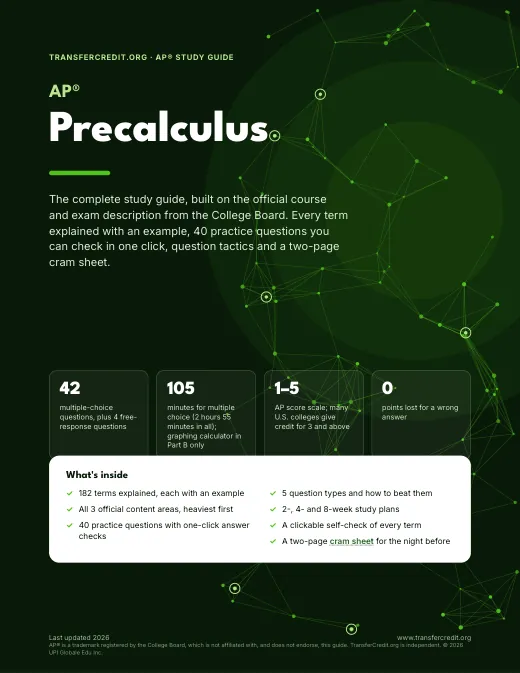
Page 1 of the TransferCredit.org Guide to AP® Precalculus: the cover
Page 1 The cover
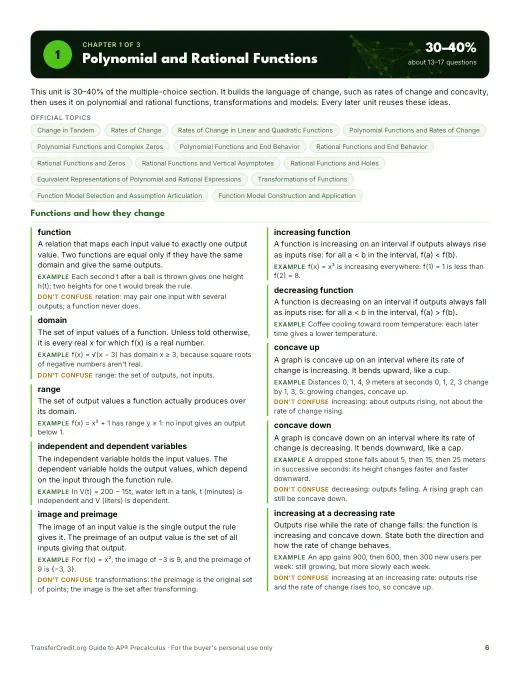
Page 6 of the TransferCredit.org Guide to AP® Precalculus: the Chapter 1 opener
Page 6 The Chapter 1 opener
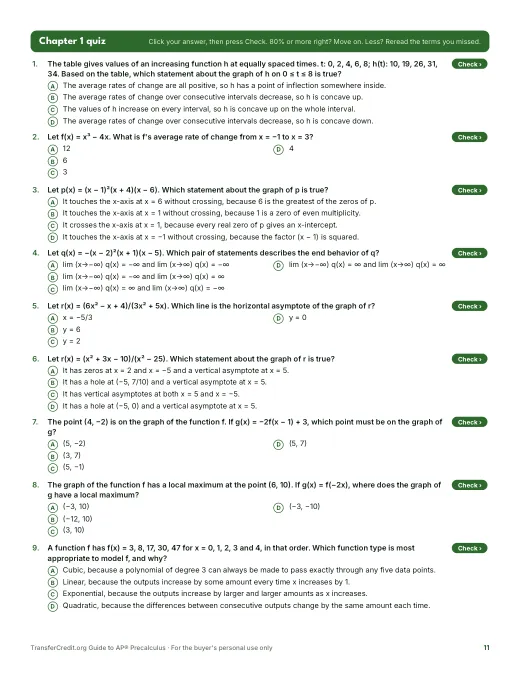
Page 11 of the TransferCredit.org Guide to AP® Precalculus: a chapter quiz
Page 11 A chapter quiz
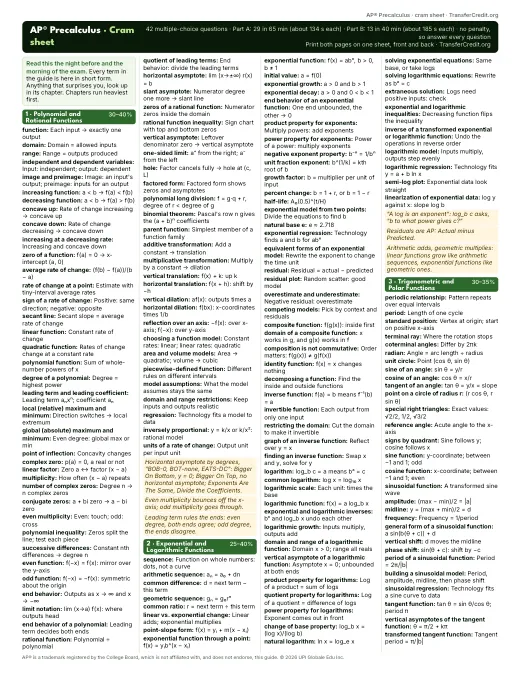
Page 31 of the TransferCredit.org Guide to AP® Precalculus: the 2-page cram sheet
Page 31 The 2-page cram sheet

What you get for $5

One chapter for each area of the official course and exam description, heaviest topics first.

  • 📘32pages, printable
  • 🧭3chapters
  • 🔑182terms with examples
  • ✍️40practice questions, answers explained
  • ⚠️9exam traps to avoid
  • 📄2page cram sheet

Try 10 free AP® Precalculus questions

Multiple-choice questions taken from the guide's chapter quizzes: 3 areas, heaviest first. About 25 minutes, with every answer explained and a score by area. The exam's free-response questions aren't in this quiz: see how the exam works.

10 questions  
  1. Question 1 · Polynomial and Rational Functions
    The table gives values of an increasing function h at equally spaced times. t: 0, 2, 4, 6, 8; h(t): 10, 19, 26, 31, 34. Based on the table, which statement about the graph of h on 0 ≤ t ≤ 8 is true?
    Show the answer

    Answer: C. The average rates of change over consecutive intervals decrease, so h is concave down.. The changes over each 2-unit interval are 9, 7, 5, 3, so the average rates of change 4.5, 3.5, 2.5, 1.5 decrease. A decreasing rate of change means the graph is concave down.

    The trap: "The values of h increase on every interval, so h is concave up on the whole interval" mixes up increasing with concave up. Concavity depends on whether the rate of change grows or shrinks.

  2. Question 2 · Exponential and Logarithmic Functions
    A geometric sequence has g₂ = 12 and g₅ = 96. What is g₀?
    Show the answer

    Answer: A. 3. From g₂ to g₅ is three steps, so r³ = 96/12 = 8 and r = 2. Going back two steps from g₂: g₀ = 12/2² = 3.

    The trap: −44 treats the sequence as arithmetic (adding 28 each step). A geometric sequence multiplies by the same ratio instead.

  3. Question 3 · Trigonometric and Polar Functions
    What is the exact value of sin(7π/6) + cos(3π/4)?
    Show the answer

    Answer: B. (−1 − √2)/2. 7π/6 is in Quadrant III with reference angle π/6, so its sine is −1/2. 3π/4 is in Quadrant II with reference angle π/4, so its cosine is −√2/2. The sum is (−1 − √2)/2.

    The trap: (1 − √2)/2 gives sin(7π/6) a positive sign. In Quadrant III, y is negative, so sine is negative.

  4. Question 4 · Polynomial and Rational Functions
    Let f(x) = x³ − 4x. What is f's average rate of change from x = −1 to x = 3?
    Show the answer

    Answer: D. 3. f(3) = 27 − 12 = 15 and f(−1) = −1 + 4 = 3. The average rate of change is (15 − 3)/(3 − (−1)) = 12/4 = 3.

    The trap: 12 is only the change in output. The average rate of change divides it by the change in input, 3 − (−1) = 4.

  5. Question 5 · Exponential and Logarithmic Functions
    A function f has f(0) = 5, f(2) = 15, f(4) = 45 and f(6) = 135. Which of the following could define f?
    Show the answer

    Answer: D. f(x) = 5(√3)ˣ. The outputs triple over each 2-unit interval, so the factor per unit is b with b² = 3, b = √3. Check: 5(√3)⁴ = 5·9 = 45.

    The trap: 5·3ˣ triples every 1 unit, so it gives f(2) = 45, not 15. The tripling here happens over 2 units.

  6. Question 6 · Trigonometric and Polar Functions
    A buoy bobs on the waves. Its height above the sea floor is least, 10 feet, at t = 0 seconds and next greatest, 14 feet, at t = 3 seconds, and the pattern repeats. Which function models the height h(t)?
    Show the answer

    Answer: B. h(t) = −2 cos((π/3)t) + 12. Amplitude (14 − 10)/2 = 2 and midline (14 + 10)/2 = 12. A minimum and the next maximum are half a cycle apart, so the period is 6 and b = 2π/6 = π/3. A negative cosine starts at its minimum, matching t = 0.

    The trap: −2 cos((2π/3)t) + 12 uses 3 seconds as the full period, but a minimum and the next maximum are only half a period apart.

  7. Question 7 · Polynomial and Rational Functions
    Let p(x) = (x − 1)²(x + 4)(x − 6). Which statement about the graph of p is true?
    Show the answer

    Answer: C. It touches the x-axis at x = 1 without crossing, because 1 is a zero of even multiplicity.. (x − 1)² makes 1 a zero of multiplicity 2, so p keeps the same sign on both sides of x = 1 and the graph touches the axis there. The zeros −4 and 6 have multiplicity 1, so the graph crosses at those.

    The trap: The choice with x = −1 reads the zero from (x − 1) with the wrong sign. The factor (x − a) gives the zero a, so the zero is 1.

  8. Question 8 · Exponential and Logarithmic Functions
    Which expression is equivalent to 4·2^(x + 3) for all real x?
    Show the answer

    Answer: A. 32·2ˣ. 2^(x + 3) = 2³·2ˣ = 8·2ˣ, so 4·2^(x + 3) = 32·2ˣ. A horizontal translation of an exponential function is a vertical dilation.

    The trap: 8^(x + 3) multiplies the base by 4, but the 4 multiplies the whole power, not the base.

  9. Question 9 · Trigonometric and Polar Functions
    The function g is defined by g(θ) = −3 sin(2(θ − π/6)) + 4. Which statement about g is true?
    Show the answer

    Answer: D. Its amplitude is 3, its period is π, and its midline is y = 4.. The amplitude is |−3| = 3 (the negative sign only reflects the graph), the period is 2π/2 = π, and the vertical shift puts the midline at y = 4.

    The trap: The period 4π multiplies 2π by 2 instead of dividing by 2. A factor b inside the sine shrinks the period to 2π/|b|.

  10. Question 10 · Polynomial and Rational Functions
    Let q(x) = −(x − 2)²(x + 1)(x − 5). Which pair of statements describes the end behavior of q?
    Show the answer

    Answer: B. lim (x→−∞) q(x) = −∞ and lim (x→∞) q(x) = −∞. Multiplying the leading terms of the factors gives −x²·x·x = −x⁴. Even degree with a negative leading coefficient sends both ends to −∞.

    The trap: Pairing lim (x→−∞) q(x) = ∞ with lim (x→∞) q(x) = −∞ is odd-degree behavior. Counting (x − 2) twice, q has four linear factors, so its degree is 4, which is even.

The AP® Precalculus exam at a glance

The AP® Precalculus exam is from the College Board. It has 42 multiple-choice questions, plus 4 free-response questions. You get 105 minutes for multiple choice (2 hours 55 minutes in all); graphing calculator in Part B only. The score scale is 1–5 (AP® score scale; many U.S. colleges give credit for 3 and above). The guide has 3 chapters, one for each area of the official course and exam description; the heaviest is Polynomial and Rational Functions at 30–40%.

Questions
42multiple-choice questions, plus 4 free-response questions
Time
105 minfor the 42 multiple-choice questions, in 2 parts timed separately
Score
1–5AP® score scale; many U.S. colleges give credit for 3 and above
Fee
$99per exam in the U.S. and Canada in 2026-27; your school may charge more
Calculator
Yesgraphing calculator in Part B only
Wrong answers
No penaltya wrong answer costs nothing
  • Section I has 42 multiple-choice questions in 1 hour 45 minutes (62.5% of your score): Part A is 29 questions in 65 minutes with no calculator (43.75%); Part B is 13 questions in 40 minutes with a graphing calculator required (18.75%), though only some Part B questions need it.
  • Section II has 4 free-response questions in 1 hour 10 minutes (37.5%), each worth 6 points: Part A is 2 questions in 35 minutes with a graphing calculator required; Part B is 2 questions in 35 minutes with no calculator. Keep your calculator in radian mode.
  • The exam is hybrid digital: you answer the multiple-choice questions and read the free-response questions in the Bluebook app, and you handwrite your free-response answers in a paper booklet. In the calculator parts you can use Bluebook's built-in Desmos graphing calculator or an approved handheld graphing calculator.
  • Your multiple-choice score is the number of questions you answer correctly, so a wrong answer costs nothing.
  • Only Units 1–3 are tested: polynomial and rational functions (30–40% of the multiple-choice section), exponential and logarithmic functions (25–40%), and trigonometric and polar functions (30–35%). Unit 4 (parameters, vectors and matrices) is not on the exam.

Source: official AP® Precalculus page and the official course and exam description. Last updated 2026.

What the exam covers

3 chapters, heaviest first, with each area's official weight. The guide's chapters follow this order.

  1. Polynomial and Rational Functions30–40% · ~13–17 Q
  2. Exponential and Logarithmic Functions25–40% · ~11–17 Q
  3. Trigonometric and Polar Functions30–35% · ~13–15 Q

Where to start: the 2 heaviest areas (marked in the map) carry about 28 of the 42 questions. The guide puts them first, so working front to back covers the most points earliest.

AP® Precalculus study guide by area

The heaviest area is open to read now. The full guide has a chapter for every area, each with all its terms, a quiz and an answer key.

1 of 3 chapters open  ·  in the guide's order
30–40% · about 13–17 questions · free preview Polynomial and Rational Functions Chapter 1 of the guide

This unit is 30–40% of the multiple-choice section. It builds the language of change, such as rates of change and concavity, then uses it on polynomial and rational functions, transformations and models. Every later unit reuses these ideas.

Key terms, with examples

function
A relation that maps each input value to exactly one output value. Two functions are equal only if they have the same domain and give the same outputs.
Example: Each second t after a ball is thrown gives one height h(t); two heights for one t would break the rule.
polynomial function
A function equivalent to p(x) = aₙxⁿ + … + a₂x² + a₁x + a₀, with n a positive integer, real coefficients and aₙ ≠ 0. A nonzero constant has degree zero.
Example: p(x) = 4x³ − x + 7 is a polynomial; g(x) = 2/x + 1 is not, since 2/x = 2x⁻¹.
rational function
A quotient of two polynomial functions, r(x) = p(x)/q(x). It measures the size of the numerator relative to the denominator at each input in its domain.
Example: r(x) = (x + 1)/(x² − 4) is rational; its domain leaves out x = 2 and x = −2.
parent function
The simplest function of a type, such as y = x² or y = √x. Transformations of it build models, and can change its domain and range.
Example: g(x) = √(x − 4) is the parent √x moved right 4, so its domain becomes x ≥ 4.
choosing a function model
Roughly constant rates of change suggest linear; roughly linear rates of change, or one symmetric maximum or minimum, suggest quadratic; several zeros or extrema suggest a higher-degree polynomial.
Example: Any five data points with different inputs can be fit exactly by a polynomial of degree 4 or less.
domain
The set of input values of a function. Unless told otherwise, it is every real x for which f(x) is a real number.
Example: f(x) = √(x − 3) has domain x ≥ 3, because square roots of negative numbers aren't real.
degree of a polynomial
The greatest exponent n with a nonzero coefficient. It gives the number of complex zeros and, with the sign of the leading coefficient, the end behavior.
Example: p(x) = 5 − 2x + 3x⁴ has degree 4, even though its terms are written in increasing order.
quotient of leading terms
For inputs of large magnitude, a rational function behaves like the numerator's leading term divided by the denominator's leading term.
Example: (6x³ + x)/(2x² − 5) behaves like 6x³/(2x²) = 3x, so it increases without bound as x → ∞.
additive transformation
Adding a constant to the output, f(x) + k, or to the input, f(x + h). It translates the graph vertically or horizontally without changing its shape.
Example: g(x) = f(x − 2) + 1 slides every point of the graph of f right 2 and up 1.
area and volume models
Contexts involving area, or two dimensions, are often modeled by quadratic functions. Contexts involving volume, or three dimensions, are often modeled by cubic functions.
Example: A square pen with side s meters has area s², a quadratic; a cube-shaped tank holds s³ cubic meters.
range
The set of output values a function actually produces over its domain.
Example: f(x) = x² + 1 has range y ≥ 1: no input gives an output below 1.
leading term and leading coefficient
In a polynomial of degree n, the leading term is aₙxⁿ and the leading coefficient is aₙ, in whatever order the terms are written.
Example: p(x) = 6x − x³ + 2: leading term −x³, leading coefficient −1.

What this area covers

Functions and how they changePolynomial functionsRational functions and equivalent formsTransformations of functionsBuilding and using function models

How the exam asks it

Expect a function given by a formula, a short table, a described graph or a real context, then a question about where it increases, its concavity, its zeros, its end behavior, its asymptotes and holes, or a transformation of it. Many choices pair a claim with a reason, often in limit notation. Modeling questions ask you to pick a function type for data, use the units of a rate, or name an assumption or restriction of a model.

Common traps

Trap 1. Changes inside the parentheses act on x the opposite way: f(x + 3) moves the graph left 3, and f(2x) halves the x-coordinates rather than doubling them.

Trap 2. Factor and compare multiplicities before naming asymptotes. A factor that cancels completely leaves a hole, which is neither a vertical asymptote nor a zero.

Trap 3. Concavity follows the rate of change, not the outputs. A function can rise the whole time and still be concave down, rising more and more slowly.

Memory trick

Horizontal asymptote by degrees, "BOB-0, BOT-none, EATS-DC": Bigger On Bottom, y = 0; Bigger On Top, no horizontal asymptote; Exponents Are The Same, Divide the Coefficients.

Even multiplicity bounces off the x-axis; odd multiplicity goes through.

How AP® Precalculus questions are written

The exam has 42 multiple-choice questions, plus 4 free-response questions. The guide sorts the questions into 5 types; spot the type and you'll know what the question wants before you read the choices.

Type 1

Read a table or a described graph

A short table of values or a graph described in words, then a question about where the function increases or decreases, its concavity, or an average rate of change.

  • Find the changes between consecutive outputs; their signs show increasing or decreasing.
  • Compare those changes: growing changes mean concave up, shrinking changes mean concave down.
  • For a rate, divide the change in output by the change in input, not by the number of steps.
Type 2

Exact answers by hand (no calculator)

An exponential, logarithmic or trigonometric equation or expression with friendly numbers: solve it, rewrite it in an equivalent form, or give an exact value.

  • Name the rule you need (an exponent rule, a log property or an identity) before you start.
  • Work one step at a time and keep exact values such as ln 5 or √3/2.
  • Check each answer in the original equation and drop extraneous solutions.
Type 3

Which statement is true? (claim and reason)

Four statements, each a claim plus a reason ("…, so …"), about end behavior, asymptotes, holes, zeros or limits.

  • Work out the facts yourself first: degrees, leading terms, factors and multiplicities.
  • Check both halves of each choice; a true claim with a false reason is still wrong.
  • Watch the limit notation: which input x approaches, and from which side.
Type 4

Models in context

A real situation (money, population, temperature, a tank or a ride) with a rule, a table or a description; you choose or build a model, interpret a value with units, or name an assumption or a sensible domain.

  • Name the input and output and their units before you calculate.
  • Match the pattern: equal differences mean linear, equal ratios mean exponential, a repeating cycle means sinusoidal.
  • Answer in the context's words and units, and check the input is inside the model's sensible domain.
Type 5

Graphing calculator questions (Part B)

A function or data set too messy to handle by hand. You graph it, find a zero, an intersection or a maximum or minimum, or run a regression, and round to three decimal places.

  • Use radian mode and a window that shows the whole interval in the question.
  • Use the calculator's zero, intersect, maximum, minimum or regression tool rather than reading the graph by eye.
  • Keep full precision while working; round only the final answer.

Test-day habits that add points

  1. Answer every question. There's no penalty for a wrong answer. A blank is always worth zero, so never leave one.
  2. Predict, then look. Name the answer before reading the choices. It protects you from distractors written to sound right.
  3. Eliminate. Cross out choices you know are wrong. Every choice you rule out raises your odds on a guess.
  4. Mark and move on. Part A gives you about 2 minutes a question (29 in 65 minutes) and Part B about 3 (13 in 40). If one question runs well past that, pick your best guess, mark it and come back if time allows.
  5. Watch absolute words. Choices with "always", "never" or "only" are often wrong, because most rules and findings have exceptions. Treat this as a tiebreaker, not a rule.
  6. Change answers for a reason. Switch an answer only when you can say why the new one is better, such as a detail you missed.
  7. The four free-response questions. Section II has 4 questions in 70 minutes (37.5% of your score), each worth 6 points; you read them in Bluebook and handwrite your answers in a paper booklet. Part A (35 minutes, graphing calculator required): Question 1, Function Concepts, and Question 2, Modeling a Non-Periodic Context, where you build a model from a real situation, find average rates of change with units, and judge an assumption or limit of the model. Part B (35 minutes, no calculator): Question 3, Modeling a Periodic Context (a sinusoidal model: key points, midline, amplitude, period, phase shift), and Question 4, Symbolic Manipulations (solve exponential, logarithmic and trigonometric equations, rewrite expressions, give exact values). Show your work: answers without supporting work may not earn credit.
  8. Use the calculator only where it helps. A graphing calculator is required in Section I Part B and Section II Part A, and not allowed anywhere else; Bluebook's built-in Desmos graphing calculator appears only in those parts, and you may bring up to 2 approved handheld calculators. Keep it in radian mode. Use it for graphs, tables, zeros, intersections, maximums and minimums, and regressions. Most of the exam is done by hand, so practice exact values, factoring and exponent and log rules without it.

Pacing: Part A, no calculator: 29 questions in 65 minutes, about 134 seconds a question. Part B, graphing calculator: 13 questions in 40 minutes, about 185 seconds a question.

AP® Precalculus flashcards

Try the first 8 cards free. Read the term, say the definition out loud, then select the card to check yourself. Arrow keys move between cards.

Free card 1 of 8 (deck total: 182)

How to study for AP® Precalculus: a 5-step plan

Follow the steps, then enter your test date. The planner gives you a dated plan that starts with the heaviest areas and saves the last days for review.

  1. Take the 10 free questionsSee which AP® Precalculus areas you already know.
  2. Study the heaviest areas firstStart with Polynomial and Rational Functions and Exponential and Logarithmic Functions, then work down the exam map.
  3. Learn each term with an exampleSay the definition out loud, then check it with the flashcards. A term you can't use in an example isn't learned yet.
  4. Quiz yourself and study the trapsAfter each area, answer its quiz and read why the tempting wrong answer is wrong.
  5. Plan backwards from your exam dateBuild a dated plan, keep the last days for a full review, and read the cram sheet the night before.

How it works

  1. 1Check outSelect Get the guide · $5 and pay on TransferCredit.org's secure checkout.
  2. 2Download the PDFFrom your TransferCredit.org account.
  3. 3Study the heaviest areas firstFollow the 2-, 4- or 8-week plan, then read the cram sheet the night before.

This page or the full guide

Everything on this page is free with no account. The full guide is a PDF you keep.

What's on this page and in the full study guide
Study toolThis pageFull study guide ($5)
ChaptersA preview of 1 of 3All 3
Terms explainedA sample from the open chaptersAll 182, each with an example
Practice questions10 free questions40, with an answer key
Flashcards8 cardsAll 182 terms on the self-check list
Study planDated planner2-, 4- and 8-week plans
Cram sheet—2 pages, for the night before
FormatWeb page32-page PDF, printable

Questions students ask

What's in the full AP® Precalculus study guide?
32 pages: 3 chapters, one for each area of the College Board's official course and exam description, heaviest topics first. 182 terms, each with a plain-English definition and an example, common traps and memory tricks, 40 practice questions with an answer key that explains every answer, question tactics, 2-, 4- and 8-week study plans and a 2-page cram sheet.
How much is the full AP® Precalculus study guide?
The full 32-page PDF is $5. The 10 practice questions on this page are free.
How do I get the full guide?
Select Get the guide · $5 and check out on TransferCredit.org. Then sign in to your TransferCredit.org account to download the PDF.
Can I print the guide or use it on my phone?
Yes. It's a PDF, so it opens on phones, tablets and computers, and printing is allowed. Its tick boxes and answer bubbles work in PDF readers that support forms. Copying and editing are turned off.
Can I try the AP® Precalculus guide before I buy it?
Yes. This page has 10 questions from the guide's own chapter quizzes, a preview of the heaviest area, 8 flashcards and a study planner. No account needed.
Is this an official AP® study guide?
No. AP® is a trademark registered by the College Board, which is not affiliated with, and does not endorse, this guide. TransferCredit.org is independent. We built the guide from the College Board's official course and exam description, and the exam details were checked against the College Board's published exam information in 2026.
How was this study guide made?
One chapter for each area of the official course and exam description, using its published weights. Each chapter was written, then fact-checked against the official exam information in a separate review. The practice questions are original: none are copied from the College Board's released questions.
How up to date is this AP® Precalculus guide?
Last updated 2026. The exam details were checked against the College Board's published exam information in 2026. Exams change, so confirm the details on the official AP® Precalculus page before you test.
More questions about the AP® Precalculus exam (16)
What is the AP® Precalculus exam?
The AP® Precalculus exam is from the College Board. It has 42 multiple-choice questions, plus 4 free-response questions. You get 105 minutes for multiple choice (2 hours 55 minutes in all); graphing calculator in Part B only. The score scale is 1–5 (AP® score scale; many U.S. colleges give credit for 3 and above). The guide has 3 chapters, one for each area of the official course and exam description; the heaviest is Polynomial and Rational Functions at 30–40%.
How many questions are on the AP® Precalculus exam, and how long is it?
Section I has 42 multiple-choice questions in 1 hour 45 minutes (62.5% of your score): Part A is 29 questions in 65 minutes with no calculator (43.75%); Part B is 13 questions in 40 minutes with a graphing calculator required (18.75%), though only some Part B questions need it. Section II has 4 free-response questions in 1 hour 10 minutes (37.5%), each worth 6 points: Part A is 2 questions in 35 minutes with a graphing calculator required; Part B is 2 questions in 35 minutes with no calculator. Keep your calculator in radian mode.
How is the AP® Precalculus exam scored?
The score scale is 1–5: AP® score scale; many U.S. colleges give credit for 3 and above. Your multiple-choice score is the number of questions you answer correctly, so a wrong answer costs nothing.
What AP® Precalculus score do I need for college credit?
Many U.S. colleges give credit for 3 and above. Each college sets its own credit policy, so check the one at your college before you count on the credit.
How much does the AP® Precalculus exam cost?
The fee is $99: per exam in the U.S. and Canada in 2026-27; your school may charge more. Fees can change, so check the official page when you register.
Can I use a calculator on the AP® Precalculus exam?
Section I has 42 multiple-choice questions in 1 hour 45 minutes (62.5% of your score): Part A is 29 questions in 65 minutes with no calculator (43.75%); Part B is 13 questions in 40 minutes with a graphing calculator required (18.75%), though only some Part B questions need it. Section II has 4 free-response questions in 1 hour 10 minutes (37.5%), each worth 6 points: Part A is 2 questions in 35 minutes with a graphing calculator required; Part B is 2 questions in 35 minutes with no calculator. Keep your calculator in radian mode. In the calculator parts you can use Bluebook's built-in Desmos graphing calculator or an approved handheld graphing calculator.
Is there a penalty for guessing on AP® Precalculus?
No. There's no penalty for a wrong answer. A blank is always worth zero, so never leave one.
What topics are on the AP® Precalculus exam?
3 areas, from the official course and exam description: Polynomial and Rational Functions (30–40%); Exponential and Logarithmic Functions (25–40%); Trigonometric and Polar Functions (30–35%).
Which AP® Precalculus topics should I study first?
The 2 heaviest areas (marked in the map) carry about 28 of the 42 questions. The guide puts them first, so working front to back covers the most points earliest.
Is the AP® Precalculus exam hard?
It depends on what you already know. There are only 3 areas, so each one carries real weight: Polynomial and Rational Functions (30–40%), Exponential and Logarithmic Functions (25–40%) and Trigonometric and Polar Functions (30–35%). Try the 10 free questions above to see where you stand in about 25 minutes.
What kinds of questions are on the AP® Precalculus exam?
The exam has 42 multiple-choice questions, plus 4 free-response questions. The guide sorts the questions into 5 types: “Read a table or a described graph”, “Exact answers by hand (no calculator)”, “Which statement is true? (claim and reason)”, “Models in context” and “Graphing calculator questions (Part B)”. Multiple-choice questions have 4 answer choices. See how each type is written.
What are the free-response questions on the AP® Precalculus exam?
Section II has 4 questions in 70 minutes (37.5% of your score), each worth 6 points; you read them in Bluebook and handwrite your answers in a paper booklet. Part A (35 minutes, graphing calculator required): Question 1, Function Concepts, and Question 2, Modeling a Non-Periodic Context, where you build a model from a real situation, find average rates of change with units, and judge an assumption or limit of the model. Part B (35 minutes, no calculator): Question 3, Modeling a Periodic Context (a sinusoidal model: key points, midline, amplitude, period, phase shift), and Question 4, Symbolic Manipulations (solve exponential, logarithmic and trigonometric equations, rewrite expressions, give exact values). Show your work: answers without supporting work may not earn credit.
How should I pace myself on the AP® Precalculus exam?
Part A, no calculator: 29 questions in 65 minutes, about 134 seconds a question. Part B, graphing calculator: 13 questions in 40 minutes, about 185 seconds a question. Part A gives you about 2 minutes a question (29 in 65 minutes) and Part B about 3 (13 in 40). If one question runs well past that, pick your best guess, mark it and come back if time allows.
How long should I study for AP® Precalculus?
Take the 10 free questions to see where you stand. The full guide has 2-, 4- and 8-week plans built from the exam weights, and the planner on this page builds a dated plan from your exam date.
How do I know I'm ready for the AP® Precalculus exam?
The guide's readiness checklist: You can explain every term on the checklist without notes. You score 80% or better on every chapter quiz. You can read the cram sheet and nothing on it surprises you. You know the AP® score your college gives credit for, and your exam date.
What should I do the night before?
Read the 2-page cram sheet once, slowly. Check your exam time and room with your AP® coordinator. Multiple choice is in the Bluebook app; free-response answers are handwritten in a paper booklet. Bring an approved graphing calculator if you want your own; Bluebook's built-in Desmos graphing calculator is there in the calculator parts only. In the morning, skim the traps, then stop studying.

How we built this guide

We built one chapter for each area of the College Board's official course and exam description for AP® Precalculus, using its published weights to order the chapters and size the quizzes. Each chapter was written, then fact-checked against the official exam information in a separate review. The exam details were checked against the College Board's published exam information in 2026.

Sources: official AP® Precalculus page, official course and exam description. Last updated 2026.

AP® is a trademark registered by the College Board, which is not affiliated with, and does not endorse, this guide. TransferCredit.org is independent and not affiliated with the College Board. © 2026 UPI Globale Edu Inc.

Ready for the full AP® Precalculus guide? 32 pages, 182 terms, 40 practice questions and a 2-page cram sheet, $5.

Get the guide · $5

In the full guide

TransferCredit.org Guide to AP® Precalculus

  • All 3 chapters
  • 182 terms with examples
  • 40 practice questions with an answer key
  • A 2-page cram sheet and 2-, 4- and 8-week plans
Get the guide · $5