
$5one-time
- 39-page printable PDF
- 181 terms with examples
- 46 practice questions, answers explained
- 2-page cram sheet and study plans
Everything the DSST Astronomy exam tests, in one PDF you can print. Built from Prometric's official outline, heaviest topics first.
Last updated 2026 · exam details checked against Prometric's published exam information in 2026
Real pages from the 39-page PDF.
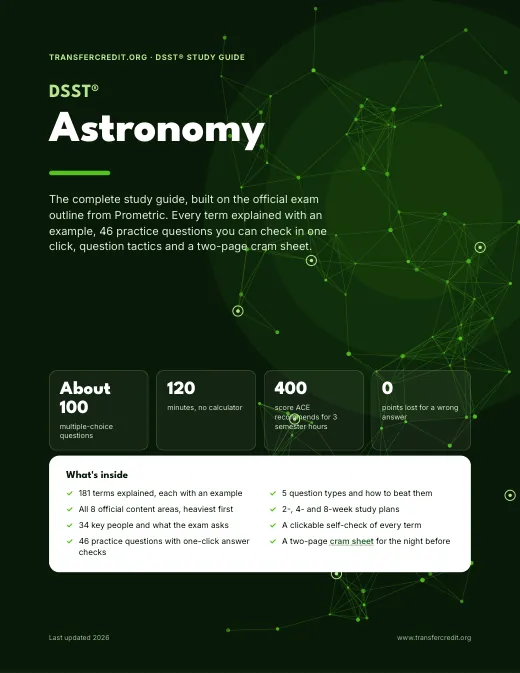
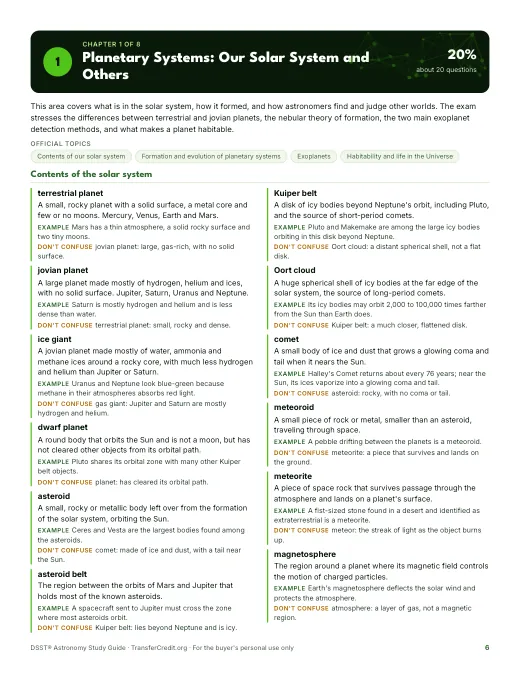
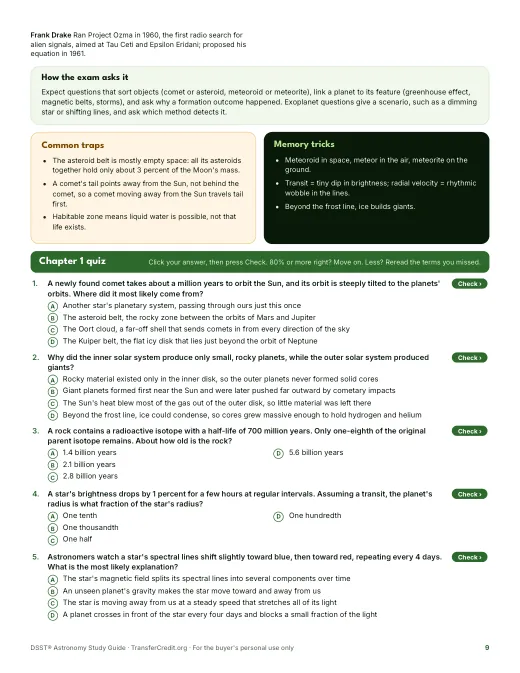
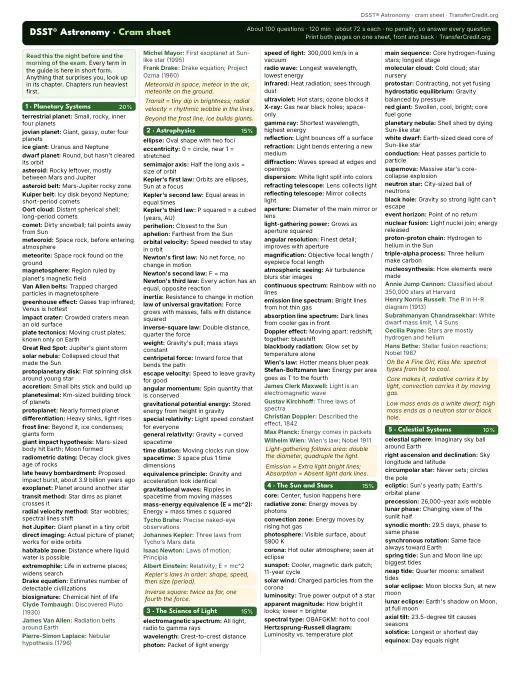
One chapter for each official content area, in the order the exam weighs them.
In the style of the real exam, from all 8 areas. About 10 minutes, with every answer explained and a score by area.
A newly found comet takes about a million years to orbit the Sun, and its orbit is steeply tilted to the planets' orbits. Where did it most likely come from?
Answer: C. The Oort cloud, a far-off shell that sends comets in from every direction of the sky. Comets with periods of thousands of years or more, on orbits tilted at any angle, fall in from the Oort cloud, a roughly spherical shell far beyond the planets.
The trap: The Kuiper belt is tempting, but it is a flat disk that mainly supplies short-period comets orbiting close to the plane of the planets.
Comets with periods of thousands of years or more, on orbits tilted at any angle, fall in from the Oort cloud, a roughly spherical shell far beyond the planets.
The trap: The Kuiper belt is tempting, but it is a flat disk that mainly supplies short-period comets orbiting close to the plane of the planets.
An asteroid orbits the Sun with a semimajor axis of 9 AU. According to Kepler's third law, what is its orbital period?
Answer: B. 27 years. Kepler's third law gives P^2 = a^3. With a = 9 AU, a^3 = 729, and the square root of 729 is 27 years.
The trap: Setting the period equal to the distance (9 years) ignores that the law uses the square of the period and the cube of the distance.
Kepler's third law gives P^2 = a^3. With a = 9 AU, a^3 = 729, and the square root of 729 is 27 years.
The trap: Setting the period equal to the distance (9 years) ignores that the law uses the square of the period and the cube of the distance.
A star's spectrum is found to peak at a wavelength of about 1,000 nanometers. Using Wien's law with a constant of 2.9 million nm-K, what is the star's approximate surface temperature?
Answer: D. 2,900 K. Wien's law gives T = 2,900,000 / wavelength. Dividing 2,900,000 by 1,000 gives 2,900 K, a cool star that peaks in the infrared.
The trap: 5,800 K is the Sun's temperature, which peaks near 500 nm. A peak at twice that wavelength means half the Sun's temperature.
Wien's law gives T = 2,900,000 / wavelength. Dividing 2,900,000 by 1,000 gives 2,900 K, a cool star that peaks in the infrared.
The trap: 5,800 K is the Sun's temperature, which peaks near 500 nm. A peak at twice that wavelength means half the Sun's temperature.
Astronomers photograph the Sun's surface and see a pattern of bright cells, each about the size of Texas, that change over minutes. What do these cells show?
Answer: A. Hot gas rising to the surface in the convection zone. Bright granules are the tops of rising columns of hot gas, with cooler gas sinking between them. This is convection, the way energy crosses the Sun's outer interior.
The trap: Heat spreading by contact describes conduction, which is far too slow in the Sun's gas to carry its energy outward.
Bright granules are the tops of rising columns of hot gas, with cooler gas sinking between them. This is convection, the way energy crosses the Sun's outer interior.
The trap: Heat spreading by contact describes conduction, which is far too slow in the Sun's gas to carry its energy outward.
Which statement best explains why the northern hemisphere is warmer in June than in December?
Answer: C. Earth's axis tilts the northern hemisphere toward the Sun in June. Earth's axis is tilted, so in June sunlight strikes the northern hemisphere more directly and for more hours each day.
The trap: Earth is actually closest to the Sun in early January, and its distance changes by only about 3 percent over the year, so distance is not the cause.
Earth's axis is tilted, so in June sunlight strikes the northern hemisphere more directly and for more hours each day.
The trap: Earth is actually closest to the Sun in early January, and its distance changes by only about 3 percent over the year, so distance is not the cause.
A star's measured parallax is 0.05 arcsecond. What is its distance from the Sun?
Answer: B. 20 parsecs. Distance in parsecs is 1 divided by parallax in arcseconds: 1 / 0.05 = 20 parsecs, which is about 65 light-years.
The trap: 0.05 parsecs comes from reading the parallax angle itself as a distance rather than taking its reciprocal.
Distance in parsecs is 1 divided by parallax in arcseconds: 1 / 0.05 = 20 parsecs, which is about 65 light-years.
The trap: 0.05 parsecs comes from reading the parallax angle itself as a distance rather than taking its reciprocal.
A galaxy is receding at 14,000 km/s. If the Hubble constant is 70 km/s per megaparsec, how far away is the galaxy?
Answer: D. 200 megaparsecs. Hubble's law gives d = v / H. Dividing 14,000 by 70 gives 200 megaparsecs.
The trap: Multiplying speed by H (980,000) uses the law backward; the distance is the speed divided by the Hubble constant.
Hubble's law gives d = v / H. Dividing 14,000 by 70 gives 200 megaparsecs.
The trap: Multiplying speed by H (980,000) uses the law backward; the distance is the speed divided by the Hubble constant.
A newspaper column says that people born under one constellation will soon "meet someone who changes their life", with no time or details given. Why is this claim not scientific?
Answer: A. No possible observation could show it to be wrong. A claim that cannot be contradicted by any observation is not falsifiable, so it cannot be tested scientifically.
The trap: Predicting the future is not the problem; scientific claims also predict future events. The issue is that this claim could never be shown wrong.
A claim that cannot be contradicted by any observation is not falsifiable, so it cannot be tested scientifically.
The trap: Predicting the future is not the problem; scientific claims also predict future events. The issue is that this claim could never be shown wrong.
Why did the inner solar system produce only small, rocky planets, while the outer solar system produced giants?
Answer: D. Beyond the frost line, ice could condense, so cores grew massive enough to hold hydrogen and helium. Only rock and metal could condense near the Sun. Beyond the frost line, ice added much more solid material, so cores grew large enough to gravitationally capture nebular gas.
The trap: The claim that the Sun blew gas away reverses the cause: the outer disk was rich in material, which is why giants could build up.
Only rock and metal could condense near the Sun. Beyond the frost line, ice added much more solid material, so cores grew large enough to gravitationally capture nebular gas.
The trap: The claim that the Sun blew gas away reverses the cause: the outer disk was rich in material, which is why giants could build up.
A comet is moving fastest at one point in its elliptical orbit around the Sun. Where is the comet at that moment?
Answer: C. At the point closest to the Sun. By Kepler's second law, a planet or comet sweeps equal areas in equal times, so it must move fastest where it is closest to the Sun, at perihelion.
The trap: The point farthest from the Sun is aphelion, where the comet moves slowest. The speed is highest when the distance is smallest.
By Kepler's second law, a planet or comet sweeps equal areas in equal times, so it must move fastest where it is closest to the Sun, at perihelion.
The trap: The point farthest from the Sun is aphelion, where the comet moves slowest. The speed is highest when the distance is smallest.
The DSST Astronomy exam is a 120-minute, computer-based test from Prometric with about 100 multiple-choice questions. A score of 400 on the 200–500 scale earns an ACE credit recommendation of 3 semester hours, though each college sets its own policy. The exam covers 8 content areas; the heaviest is Planetary Systems: Our Solar System and Others at 20%.
Source: official DSST Astronomy exam page.
8 areas, heaviest first. The guide's chapters follow this order.
Start with the guide, or get everything for DSST in one plan.
DSST® is a registered trademark of Prometric, which was not involved in producing this guide and does not endorse it. TransferCredit.org is independent and not affiliated with Prometric. © 2026 UPI Globale Edu Inc.