
$5one-time
- 33-page printable PDF
- 180 terms with examples
- 41 practice questions, answers explained
- 2-page cram sheet and study plans
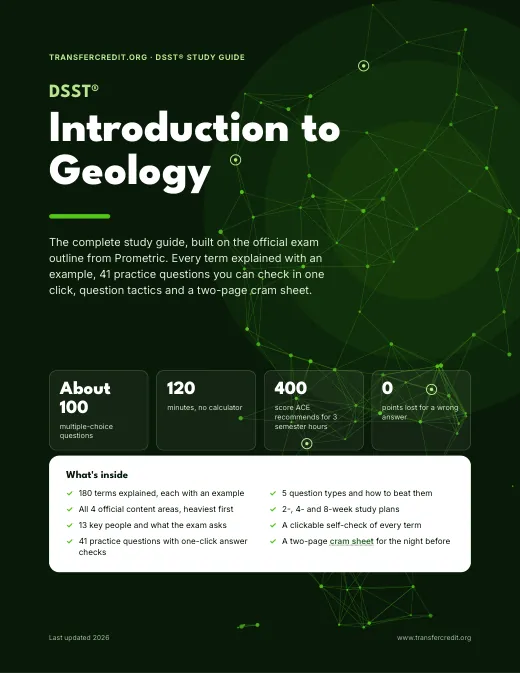
Everything the DSST Introduction to Geology exam tests, in one PDF you can print. Built from Prometric's official outline, heaviest topics first.
Last updated 2026 · exam details checked against Prometric's published exam information in 2026
Real pages from the 33-page PDF.
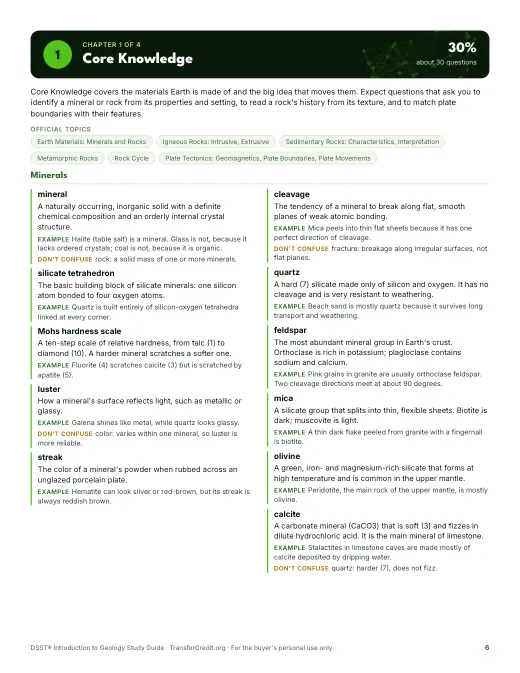

One chapter for each official content area, in the order the exam weighs them.
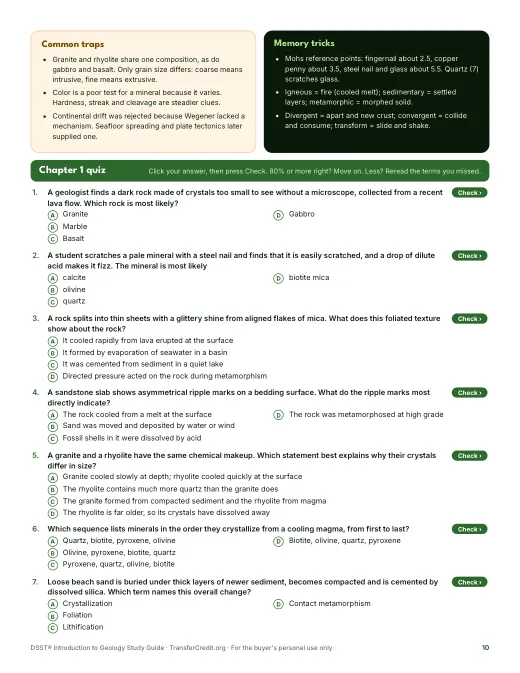
In the style of the real exam, from all 4 areas. About 10 minutes, with every answer explained and a score by area.
A geologist finds a dark rock made of crystals too small to see without a microscope, collected from a recent lava flow. Which rock is most likely?
Answer: D. Basalt. Fine crystals and a lava-flow setting mean quick cooling at the surface. A dark, fine-grained extrusive rock is basalt.
The trap: Gabbro has the same dark composition, but it is coarse-grained because it cooled slowly underground.
Fine crystals and a lava-flow setting mean quick cooling at the surface. A dark, fine-grained extrusive rock is basalt.
The trap: Gabbro has the same dark composition, but it is coarse-grained because it cooled slowly underground.
A granite outcrop high in the Rockies is split by cracks, with angular blocks piled at its base. In summer, meltwater seeps into the cracks by day, and at night the temperature drops below freezing. Which process is breaking the rock?
Answer: B. Frost wedging. Water that freezes in cracks expands by about 9 percent and pries the rock apart, leaving angular fragments. This is frost wedging.
The trap: Exfoliation is tempting for granite, but it peels off curved sheets as pressure is released, with no freeze-thaw cycle involved.
Water that freezes in cracks expands by about 9 percent and pries the rock apart, leaving angular fragments. This is frost wedging.
The trap: Exfoliation is tempting for granite, but it peels off curved sheets as pressure is released, with no freeze-thaw cycle involved.
A dike of basalt cuts vertically through three horizontal sandstone beds. Which statement about relative age is correct?
Answer: C. The dike is younger than all three of the sandstone beds. A feature that cuts through rock must be younger than the rock it cuts, by the principle of cross-cutting relationships.
The trap: Calling the dike older than the lowest bed misapplies superposition, which ranks stacked layers, not an intrusion that cuts across them.
A feature that cuts through rock must be younger than the rock it cuts, by the principle of cross-cutting relationships.
The trap: Calling the dike older than the lowest bed misapplies superposition, which ranks stacked layers, not an intrusion that cuts across them.
Prospectors find gold flakes in the gravel bars of a mountain stream, kilometers downstream from any gold-bearing bedrock. What type of deposit are they working?
Answer: A. A placer deposit. Gold eroded from distant bedrock is so dense that it settles out where the stream slows, collecting in the gravel bars. Such water-sorted concentrations are placer deposits.
The trap: Gold does form in hydrothermal quartz veins, but those lie in bedrock. Flakes collected in stream gravel far from any bedrock source make a placer.
Gold eroded from distant bedrock is so dense that it settles out where the stream slows, collecting in the gravel bars. Such water-sorted concentrations are placer deposits.
The trap: Gold does form in hydrothermal quartz veins, but those lie in bedrock. Flakes collected in stream gravel far from any bedrock source make a placer.
A student scratches a pale mineral with a steel nail and finds that it is easily scratched, and a drop of dilute acid makes it fizz. The mineral is most likely
Answer: B. calcite. Easy scratching by a nail (hardness about 5.5) and fizzing in acid together identify calcite, a soft carbonate.
The trap: Quartz is too hard for a steel nail to scratch, and it does not react with acid.
Easy scratching by a nail (hardness about 5.5) and fizzing in acid together identify calcite, a soft carbonate.
The trap: Quartz is too hard for a steel nail to scratch, and it does not react with acid.
A soil on a hillside in a tropical rain forest is deep red, rich in iron and aluminum oxides, and poor in plant nutrients. Which process mainly formed this soil?
Answer: A. Heavy rain leaching soluble nutrients out of the soil. In hot, wet climates, heavy rain leaches nutrients and soluble minerals out of the soil, leaving the iron and aluminum oxides that make a laterite red.
The trap: Rain forests drop plenty of leaf litter, but it decays and is recycled so fast that little organic matter builds up, and the soil stays poor.
In hot, wet climates, heavy rain leaches nutrients and soluble minerals out of the soil, leaving the iron and aluminum oxides that make a laterite red.
The trap: Rain forests drop plenty of leaf litter, but it decays and is recycled so fast that little organic matter builds up, and the soil stays poor.
Of the following geologic periods, which is the oldest?
Answer: C. Ordovician. The Ordovician comes right after the Cambrian in the Paleozoic Era, long before the Mesozoic periods Jurassic and Cretaceous.
The trap: The Carboniferous is also Paleozoic, but it is younger than the Ordovician.
The Ordovician comes right after the Cambrian in the Paleozoic Era, long before the Mesozoic periods Jurassic and Cretaceous.
The trap: The Carboniferous is also Paleozoic, but it is younger than the Ordovician.
Drillers find oil in a porous sandstone layer. A thick layer of impermeable shale lies directly above it and bends over the top of an anticline. What role does the shale play?
Answer: D. It is the cap rock that stops the oil from rising further. A petroleum trap needs a porous reservoir and a seal above it. Shale is impermeable, so it acts as the cap rock and holds the oil in place.
The trap: Reservoir rock is the porous layer that holds oil, which here is the sandstone. Shale is too tight to store much oil.
A petroleum trap needs a porous reservoir and a seal above it. Shale is impermeable, so it acts as the cap rock and holds the oil in place.
The trap: Reservoir rock is the porous layer that holds oil, which here is the sandstone. Shale is too tight to store much oil.
A rock splits into thin sheets with a glittery shine from aligned flakes of mica. What does this foliated texture show about the rock?
Answer: D. Directed pressure acted on the rock during metamorphism. Aligned platy minerals are produced by directed pressure, so the rock is metamorphic, such as schist.
The trap: Cementation in a lake gives sedimentary layers, but those layers are not made of aligned, shiny metamorphic mica flakes.
Aligned platy minerals are produced by directed pressure, so the rock is metamorphic, such as schist.
The trap: Cementation in a lake gives sedimentary layers, but those layers are not made of aligned, shiny metamorphic mica flakes.
Surveyors notice that fence posts on a grassy hillside lean downhill and the trunks of trees curve upward near their bases. There is no scarp and no sign of a sudden failure. Which type of mass wasting is occurring?
Answer: A. Creep, the slow movement of soil. Leaning posts and curved tree trunks are classic signs of creep, the slow, steady downslope movement of soil. It is too slow to see from day to day.
The trap: Slump moves as a block along a curved surface and leaves a crescent-shaped scarp. Neither a scarp nor a sudden movement is present here.
Leaning posts and curved tree trunks are classic signs of creep, the slow, steady downslope movement of soil. It is too slow to see from day to day.
The trap: Slump moves as a block along a curved surface and leaves a crescent-shaped scarp. Neither a scarp nor a sudden movement is present here.
The DSST Introduction to Geology exam is a 120-minute, computer-based test from Prometric with about 100 multiple-choice questions. A score of 400 on the 200–500 scale earns an ACE credit recommendation of 3 semester hours, though each college sets its own policy. The exam covers 4 content areas; the heaviest is Core Knowledge at 30%.
4 areas, heaviest first. The guide's chapters follow this order.
Start with the guide, or get everything for DSST in one plan.
DSST® is a registered trademark of Prometric, which was not involved in producing this guide and does not endorse it. TransferCredit.org is independent and not affiliated with Prometric. © 2026 UPI Globale Edu Inc.