
$5one-time
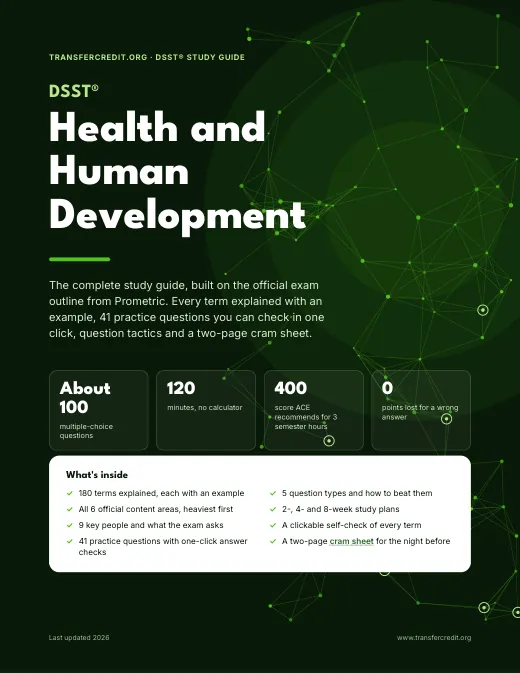
- 35-page printable PDF
- 180 terms with examples
- 41 practice questions, answers explained
- 2-page cram sheet and study plans
Everything the DSST Health and Human Development exam tests, in one PDF you can print. Built from Prometric's official outline, heaviest topics first.
Last updated 2026 · exam details checked against Prometric's published exam information in 2026
Real pages from the 35-page PDF.
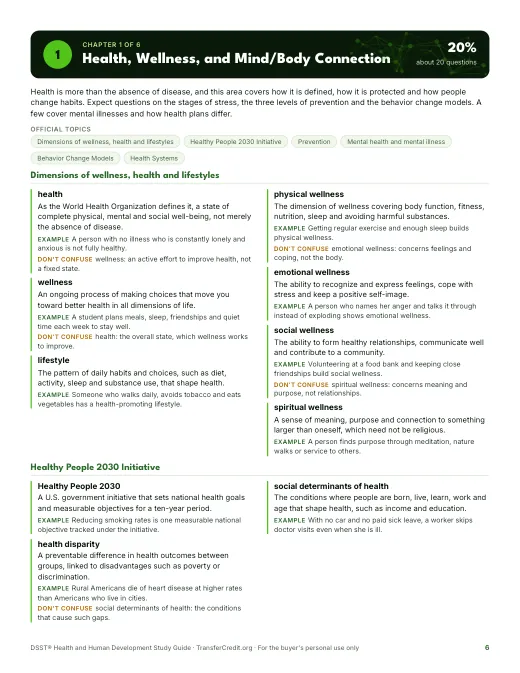
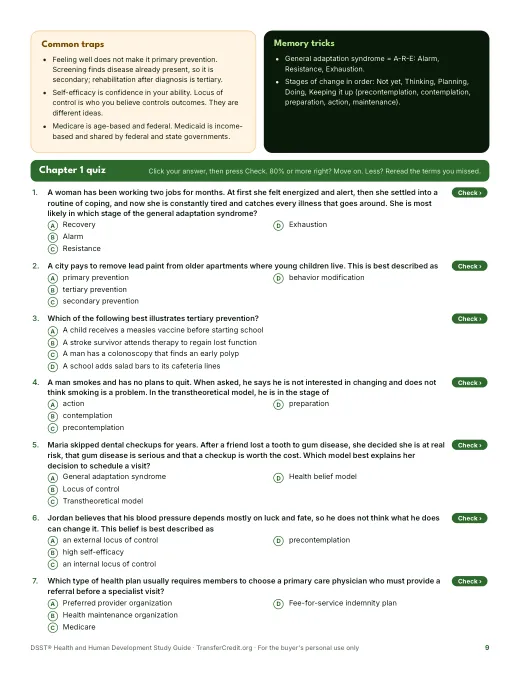
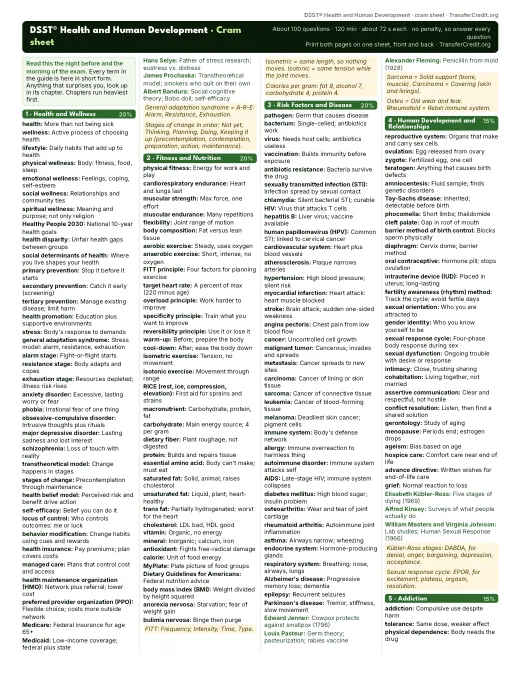
One chapter for each official content area, in the order the exam weighs them.
In the style of the real exam, from all 6 areas. About 10 minutes, with every answer explained and a score by area.
A woman has been working two jobs for months. At first she felt energized and alert, then she settled into a routine of coping, and now she is constantly tired and catches every illness that goes around. She is most likely in which stage of the general adaptation syndrome?
Answer: A. Exhaustion. Constant fatigue and frequent illness after long-term stress mean the body's coping resources are depleted. That is the exhaustion stage.
The trap: Resistance is tempting because she is still coping on the surface, but the stage ends when her resources run out and illness appears.
Constant fatigue and frequent illness after long-term stress mean the body's coping resources are depleted. That is the exhaustion stage.
The trap: Resistance is tempting because she is still coping on the surface, but the stage ends when her resources run out and illness appears.
Dana's best bench press is 100 pounds, a weight she can lift only one time. Which component of fitness does this result measure?
Answer: B. Muscular strength. The most force a muscle can produce in one effort is muscular strength.
The trap: Muscular endurance is tempting because it also involves muscles, but it measures repeated effort over time, not a single maximum.
The most force a muscle can produce in one effort is muscular strength.
The trap: Muscular endurance is tempting because it also involves muscles, but it measures repeated effort over time, not a single maximum.
A woman's uterine tumor started in the muscle of the uterine wall, not in its inner lining. This cancer is classified as a
Answer: C. sarcoma. Cancers that start in muscle, bone, fat or other supporting tissue are sarcomas.
The trap: Carcinoma is tempting because most uterine cancers are carcinomas, but those start in the inner lining, not the muscle wall.
Cancers that start in muscle, bone, fat or other supporting tissue are sarcomas.
The trap: Carcinoma is tempting because most uterine cancers are carcinomas, but those start in the inner lining, not the muscle wall.
A woman drinks heavily throughout her first trimester. Which term describes a substance such as alcohol that can harm the developing embryo?
Answer: D. Teratogen. A teratogen is any agent that can cause birth defects when an embryo or fetus is exposed to it. Alcohol is a well-known example.
The trap: Carcinogen is tempting because it also means a harmful agent, but carcinogens cause cancer, not birth defects.
A teratogen is any agent that can cause birth defects when an embryo or fetus is exposed to it. Alcohol is a well-known example.
The trap: Carcinogen is tempting because it also means a harmful agent, but carcinogens cause cancer, not birth defects.
A patient recovering from surgery finds that the dose of pain medicine that once worked no longer relieves his pain. Which term describes this change?
Answer: B. Tolerance. Needing more of a drug to get the same effect is tolerance.
The trap: Withdrawal is tempting because it also follows drug use, but it refers to symptoms after stopping a drug, not to needing more.
Needing more of a drug to get the same effect is tolerance.
The trap: Withdrawal is tempting because it also follows drug use, but it refers to symptoms after stopping a drug, not to needing more.
Mountain lakes downwind of several coal-burning plants have become too acidic for fish to survive. Which gas released by the plants is mainly responsible?
Answer: D. sulfur dioxide. Burning coal releases sulfur dioxide, which reacts with water in the air to form sulfuric acid that falls as acid rain.
The trap: Carbon monoxide also comes from burning fuel, but it is a poisonous gas that affects blood oxygen and does not form acid rain.
Burning coal releases sulfur dioxide, which reacts with water in the air to form sulfuric acid that falls as acid rain.
The trap: Carbon monoxide also comes from burning fuel, but it is a poisonous gas that affects blood oxygen and does not form acid rain.
A city pays to remove lead paint from older apartments where young children live. This is best described as
Answer: A. primary prevention. Removing the hazard keeps lead poisoning from ever starting, so it is primary prevention.
The trap: Secondary prevention would mean testing children's blood to find lead poisoning that has already begun; removing the paint stops it from starting.
Removing the hazard keeps lead poisoning from ever starting, so it is primary prevention.
The trap: Secondary prevention would mean testing children's blood to find lead poisoning that has already begun; removing the paint stops it from starting.
A 40-year-old estimates her maximum heart rate as 220 minus her age. She wants to exercise at 70 percent of that rate. What target heart rate should she aim for?
Answer: C. 126 beats per minute. Her maximum is 220 - 40 = 180, and 70 percent of 180 is 126 beats per minute.
The trap: 154 comes from taking 70 percent of 220 without subtracting her age first; 180 is her maximum, not her target.
Her maximum is 220 - 40 = 180, and 70 percent of 180 is 126 beats per minute.
The trap: 154 comes from taking 70 percent of 220 without subtracting her age first; 180 is her maximum, not her target.
A man has crushing chest pain that does not ease with rest, and tests show a blood clot has blocked a coronary artery. His condition is best described as
Answer: A. a myocardial infarction. A blocked coronary artery that damages heart muscle is a heart attack, or myocardial infarction.
The trap: Angina also causes chest pain, but it is temporary and eases with rest because the heart tissue is not dying.
A blocked coronary artery that damages heart muscle is a heart attack, or myocardial infarction.
The trap: Angina also causes chest pain, but it is temporary and eases with rest because the heart tissue is not dying.
A woman wants birth control that lasts for years and needs no action each day or before sex. Which method fits?
Answer: B. Intrauterine device. An IUD is placed in the uterus by a clinician and works for 3 to 10 years with nothing to do each day or before sex.
The trap: Oral contraceptive is tempting because it is a common, reliable method, but the pill must be taken every day.
An IUD is placed in the uterus by a clinician and works for 3 to 10 years with nothing to do each day or before sex.
The trap: Oral contraceptive is tempting because it is a common, reliable method, but the pill must be taken every day.
The DSST Health and Human Development exam is a 120-minute, computer-based test from Prometric with about 100 multiple-choice questions. A score of 400 on the 200–500 scale earns an ACE credit recommendation of 3 semester hours, though each college sets its own policy. The exam covers 6 content areas; the heaviest is Health, Wellness, and Mind/Body Connection at 20%.
Source: official DSST Health and Human Development exam page.
6 areas, heaviest first. The guide's chapters follow this order.
Start with the guide, or get everything for DSST in one plan.
DSST® is a registered trademark of Prometric, which was not involved in producing this guide and does not endorse it. TransferCredit.org is independent and not affiliated with Prometric. © 2026 UPI Globale Edu Inc.