← DSST Environmental Science course
DSST® Study Guide Printable PDF · 33 pages

DSST Environmental Science Study Guide

Everything the DSST Environmental Science exam tests, in one PDF you can print. Built from Prometric's official outline, heaviest topics first.

  • 180 key terms, each with an example
  • 40 practice questions with every answer explained
  • A 2-page cram sheet for the night before
  • 2-, 4- and 8-week study plans built from the exam weights
Not sure yet? Try 10 free questions

Last updated 2026 · exam details checked against Prometric's published exam information in 2026

Look inside the guide

Real pages from the 33-page PDF.

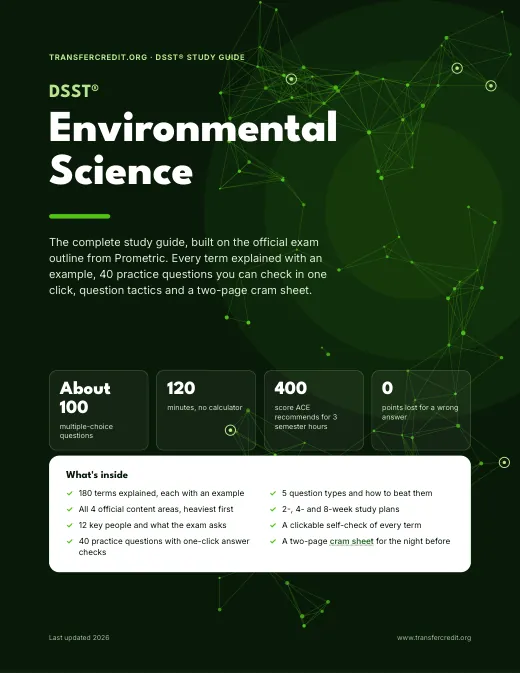
Page 1 of the DSST Environmental Science Study Guide: the cover
Page 1 The cover
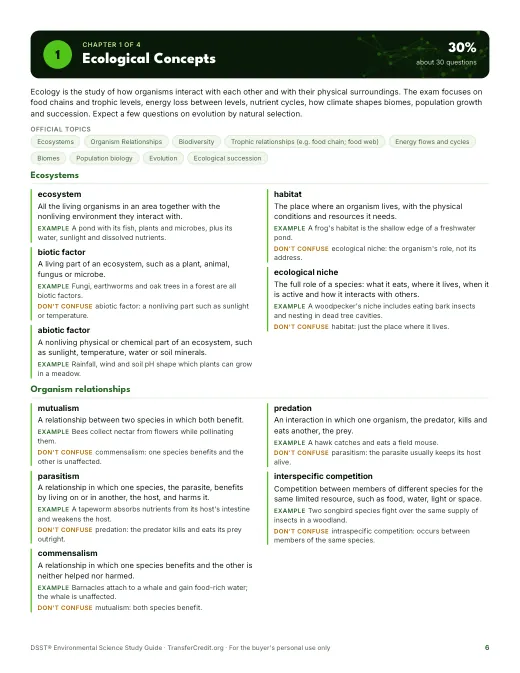
Page 6 of the DSST Environmental Science Study Guide: the Chapter 1 opener
Page 6 The Chapter 1 opener
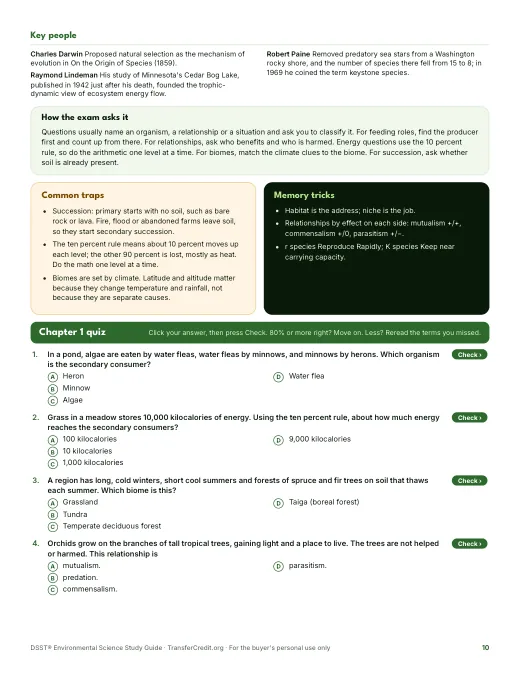
Page 10 of the DSST Environmental Science Study Guide: a chapter quiz
Page 10 A chapter quiz
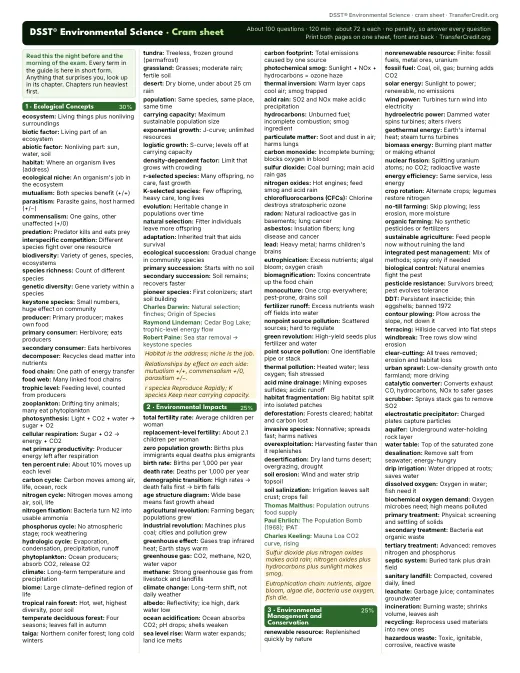
Page 32 of the DSST Environmental Science Study Guide: the 2-page cram sheet
Page 32 The 2-page cram sheet

What you get for $5

One chapter for each official content area, in the order the exam weighs them.

  • 📘33pages, printable
  • 🧭4chapters, heaviest first
  • 🔑180terms with examples
  • ✍️40practice questions, answers explained
  • ⚠️12exam traps to avoid
  • 📄2page cram sheet

Try 10 free Environmental Science questions

In the style of the real exam, from all 4 areas. About 10 minutes, with every answer explained and a score by area.

10 questions  
  1. Question 1 · Ecological Concepts

    In a pond, algae are eaten by water fleas, water fleas by minnows, and minnows by herons. Which organism is the secondary consumer?

    Show the answer

    Answer: A. Minnow. Algae are the producers. The water flea eats algae, so it is the primary consumer. The minnow eats the primary consumer, which makes it the secondary consumer.

    The trap: Water flea is tempting because it is the first animal in the chain, but it eats producers directly, so it is a primary consumer.

  2. Question 2 · Environmental Impacts

    A country's age structure diagram has a very wide base of young children and narrows sharply toward the top. What does this predict for the country's population?

    Show the answer

    Answer: D. Rapid growth. A wide base means many young people will soon have children of their own, so the population will grow quickly.

    The trap: An aging population with few young workers describes a narrow base, the opposite shape.

  3. Question 3 · Environmental Management and Conservation

    A farmer plants soybeans in a field that grew corn the year before, partly to restore soil nitrogen. Which practice is this?

    Show the answer

    Answer: B. Crop rotation. Alternating different crops, with legumes like soybeans adding nitrogen, is crop rotation.

    The trap: No-till farming is tempting because it also protects soil, but it means planting without plowing, not changing crops.

  4. Question 4 · Social Processes and the Environment

    Residents of a low-income, mostly Hispanic neighborhood learn that a hazardous waste incinerator will be built nearby, though other sites were available. They argue the burden falls unfairly on them because of their race and income. Which principle are they invoking?

    Show the answer

    Answer: C. Environmental justice. Their complaint is that the burden of a hazard is unequal by race and income. That is the core of environmental justice.

    The trap: NIMBY is opposition to a nearby facility. It is not an argument about unequal treatment of groups, which is what these residents make.

  5. Question 5 · Ecological Concepts

    Grass in a meadow stores 10,000 kilocalories of energy. Using the ten percent rule, about how much energy reaches the secondary consumers?

    Show the answer

    Answer: D. 100 kilocalories. Producers have 10,000. Primary consumers receive about 10 percent, or 1,000. Secondary consumers receive about 10 percent of that, or 100 kilocalories.

    The trap: 1,000 kilocalories is the energy that reaches the primary consumers; the question asks for one more step.

  6. Question 6 · Environmental Impacts

    A country has a total fertility rate of 1.6 and almost no immigration. What is the likely long-term result?

    Show the answer

    Answer: A. The population will eventually decline. A rate below replacement level (about 2.1) means each generation is smaller than the last, so the population eventually shrinks.

    The trap: Staying the same size needs about 2.1 children per woman, so 1.6 is too low to hold the population steady.

  7. Question 7 · Environmental Management and Conservation

    A farmer on a sloping field plows along the lines of equal elevation instead of up and down the hill. What is the main benefit?

    Show the answer

    Answer: C. Slower water runoff and less soil erosion. Furrows that follow the contour act as small dams that slow runoff and hold soil on the slope.

    The trap: Windbreaks protect against wind erosion; contour plowing works mainly against erosion by flowing water.

  8. Question 8 · Social Processes and the Environment

    A federal agency plans a highway that would fill a large wetland. Under the National Environmental Policy Act, which detailed report must it prepare before deciding?

    Show the answer

    Answer: B. An environmental impact statement. NEPA requires federal agencies to study the environmental effects of major actions, and the report is an environmental impact statement.

    The trap: A zoning variance is tempting for a land-use project, but zoning is a local tool and is not required by NEPA.

  9. Question 9 · Ecological Concepts

    A region has long, cold winters, short cool summers and forests of spruce and fir trees on soil that thaws each summer. Which biome is this?

    Show the answer

    Answer: C. Taiga (boreal forest). Cold climate with evergreen conifers describes the taiga, or boreal forest.

    The trap: Tundra is also cold, but its permafrost and short growing season prevent trees from growing, so there is no spruce forest.

  10. Question 10 · Environmental Impacts

    A farmer irrigates a desert field for decades. Crop yields now fall, and a white crust covers the soil. What process is most likely responsible?

    Show the answer

    Answer: A. Soil salinization. Irrigation water evaporates in dry climates and leaves salts behind, which build up and damage crops.

    The trap: Soil erosion removes topsoil but does not leave a salt crust, so it does not fit the clue.

The DSST Environmental Science exam at a glance

The DSST Environmental Science exam is a 120-minute, computer-based test from Prometric with about 100 multiple-choice questions. A score of 400 on the 200–500 scale earns an ACE credit recommendation of 3 semester hours, though each college sets its own policy. The exam covers 4 content areas; the heaviest is Ecological Concepts at 30%.

Questions
About 100multiple choice
Time
120 minabout 72 seconds a question
Passing score
400on a 200–500 scale
ACE credit
3semester hours
Exam fee
$100paid to Prometric
Calculator
Nonot allowed

Source: official DSST Environmental Science exam page.

What the exam covers

4 areas, heaviest first. The guide's chapters follow this order.

  1. Ecological Concepts30%
  2. Environmental Impacts25%
  3. Environmental Management and Conservation25%
  4. Social Processes and the Environment20%

How it works

  1. 1Buy once, $5Secure checkout. No subscription needed.
  2. 2Download the PDFFrom your TransferCredit.org account, right away and any time later.
  3. 3Study the heaviest areas firstFollow the 2-, 4- or 8-week plan, then read the cram sheet the night before.

Questions students ask

What's in the full DSST Environmental Science study guide?
33 pages: 4 chapters, one per official content area, heaviest first. 180 terms, each with a plain-English definition and an example, 12 key people, common traps and memory tricks, 40 practice questions with an answer key that explains every answer, question tactics, 2-, 4- and 8-week study plans and a 2-page cram sheet.
How much is the full DSST Environmental Science study guide?
The full 33-page PDF is $5, a one-time payment. The 10 practice questions on this page are free, with no account.
What does the $29 plan include?
$29 a month gives you all DSST subjects: every DSST study guide plus the full prep course for each subject, and you can cancel anytime. If you only need this exam, the guide on its own is a one-time $5.
How do I get the full guide?
Choose Buy this guide ($5) and check out. Then sign in to your TransferCredit.org account, then open the course and its Download Your Study Guide lesson. The PDF is yours to keep, and you can download it again from your account at any time.
Can I print the guide or use it on my phone?
Yes. It's a PDF, so it opens on phones, tablets and computers, and printing is allowed. Its tick boxes and answer bubbles work in PDF readers that support forms. Copying and editing are turned off.
Is this an official DSST study guide?
No. DSST® is a registered trademark of Prometric, which was not involved in producing this guide and does not endorse it. TransferCredit.org is independent. We built the guide from the official exam outline, and the exam details were checked against Prometric's published exam information in 2026.
Why is this study guide better than a generic review?
It follows the official outline area by area and spends the most pages on what the exam weighs most. Every term comes with an example, each chapter names the traps the exam sets, and the answer key explains why the most tempting wrong answer is wrong, not just which answer is right. It ends with a 2-page cram sheet for the night before.
What is the DSST Environmental Science exam?
The DSST Environmental Science exam is a 120-minute, computer-based test from Prometric with about 100 multiple-choice questions. A score of 400 on the 200–500 scale earns an ACE credit recommendation of 3 semester hours, though each college sets its own policy. The exam covers 4 content areas; the heaviest is Ecological Concepts at 30%.
More questions about the DSST Environmental Science exam (23)
How many questions are on the DSST Environmental Science exam, and how long is it?
It has 100 questions to be answered in 2 hours.
What is the passing score for DSST Environmental Science?
The passing score is 400 on a 200–500 scale. At 400 or above, the American Council on Education (ACE) recommends 3 semester hours. Each college sets its own passing score and credit award, so check your school's policy before you book.
How much does the DSST Environmental Science exam cost?
The exam fee is $100, paid to Prometric. Test centers may add their own administration fee. Eligible U.S. military service members can usually test for free through DANTES.
How many college credits is DSST Environmental Science worth?
ACE recommends 3 semester hours for a passing score of 400. Your college decides how many credits it awards and which course they replace. Check your college's policy.
Can I use a calculator on the DSST Environmental Science exam?
No. This exam doesn't allow a calculator.
Is there a penalty for guessing on DSST Environmental Science?
No. Your score counts only correct answers, so a wrong answer costs nothing. Never leave a question blank: rule out what you can and pick your best guess.
What topics are on the DSST Environmental Science exam?
4 content areas, from the official outline: Ecological Concepts (30%); Environmental Impacts (25%); Environmental Management and Conservation (25%); Social Processes and the Environment (20%).
Which DSST Environmental Science topics should I study first?
Start with the three heaviest: Ecological Concepts (30%), Environmental Impacts (25%) and Environmental Management and Conservation (25%). Together they are about 80% of the exam, roughly 80 of 100 questions. The guide's chapters run in that order, heaviest first.
Is the DSST Environmental Science exam hard?
It depends on what you already know. The exam has only 4 content areas, so each one carries real weight: Ecological Concepts (30%), Environmental Impacts (25%), Environmental Management and Conservation (25%) and Social Processes and the Environment (20%). Take the free diagnostic above to see where you stand in about 10 minutes.
What kinds of questions are on the DSST Environmental Science exam?
The guide sorts them into 5 types: “Classify the example”, “Match the tool to the problem”, “Identify the main cause”, “Apply a number or threshold” and “Scenario to concept”. Every question has 4 answer choices. Try the 10 free questions above to see the style.
How long should I study for DSST Environmental Science?
Use the diagnostic to decide. If you already know most areas, two weeks of daily review is often enough; if the subject is new to you, plan on eight. The full guide has 2-, 4- and 8-week plans built from the exam weights.
How should I pace myself on the DSST Environmental Science exam?
On average you have about 72 seconds per question (120 minutes for 100 questions). Be past question 33 a third of the way through and past question 67 two-thirds through. If a question takes more than a minute, pick your best guess, mark it and come back.
What happens if I don't pass DSST Environmental Science?
You can retake a DSST exam after 30 days. Use the wait to work through the areas the score report and the diagnostic show you missed.
Do colleges accept DSST Environmental Science for credit?
DSST exams are accepted at more than 1,500 colleges and universities, but each school decides which exams it accepts, the score it requires and the credit it gives. Look up your college's DSST policy before you book.
How is the guide different from the DSST Environmental Science course?
The guide is a 33-page PDF for review and self-testing. The DSST Environmental Science course is a full online course with lessons, quizzes and a practice exam, for $19 with lifetime access. Many students use the guide first, then take the course for the areas the diagnostic flags.
How up to date is this DSST Environmental Science guide?
Last updated 2026. The exam details were checked against Prometric's published exam information in 2026. Exams change, so confirm the details on the official exam page before you register.
What should I do the night before the exam?
Read the cram sheet once, slowly. Check your test time, the location or remote-proctoring setup, and the ID you need. Then sleep: a rested brain recalls more than a crammed one. In the morning, skim the memory tricks and common traps, then stop studying.
Does DSST Environmental Science count as a lab science?
The exam itself has no lab component. Some colleges accept it as a science general education course without a lab; check how your college applies it.
Which environmental laws and treaties should I know for DSST Environmental Science?
The outline lists policy and global environmental governance without naming specific laws, so know the major ones: the Clean Air Act, Clean Water Act, Endangered Species Act, National Environmental Policy Act and Superfund (CERCLA) in the U.S., and the Montreal Protocol, Kyoto Protocol and Paris Agreement globally. Social processes are 20% of the exam.
What ecology concepts should I know for DSST Environmental Science?
Ecological Concepts is the largest area at 30%. Know food chains and webs and energy flow between trophic levels, the carbon, nitrogen and water cycles, biomes and how climate shapes them, population biology, organism relationships such as predation and symbiosis, evolution and ecological succession.
Is there a CLEP environmental science exam?
No. CLEP covers environmental topics only inside its broader Natural Sciences exam, so DSST Environmental Science is the dedicated credit-by-exam option for this subject.
Can I take DSST Environmental Science online?
Yes. DSST exams can be taken at a test center or online with a remote Prometric proctor.
How much math is on DSST Environmental Science?
Very little. You may see simple percentages or population growth reasoning, but the exam tests concepts rather than calculation.

Choose how you want to study

Start with the guide, or get everything for DSST in one plan.

This study guide
$5one-time
  • 33-page printable PDF
  • 180 terms with examples
  • 40 practice questions, answers explained
  • 2-page cram sheet and study plans
Get the guide · $5
Best value Get it all
$29/month
  • Every DSST study guide
  • Prep courses for all DSST subjects
  • Cancel anytime
Get it all · $29/mo

DSST® is a registered trademark of Prometric, which was not involved in producing this guide and does not endorse it. TransferCredit.org is independent and not affiliated with Prometric. © 2026 UPI Globale Edu Inc.