
$5one-time
- 33-page printable PDF
- 182 terms with examples
- 41 practice questions, answers explained
- 2-page cram sheet and study plans
Everything the DSST Ethics in America exam tests, in one PDF you can print. Built from Prometric's official outline, heaviest topics first.
Last updated 2026 · exam details checked against Prometric's published exam information in 2026
Real pages from the 33-page PDF.
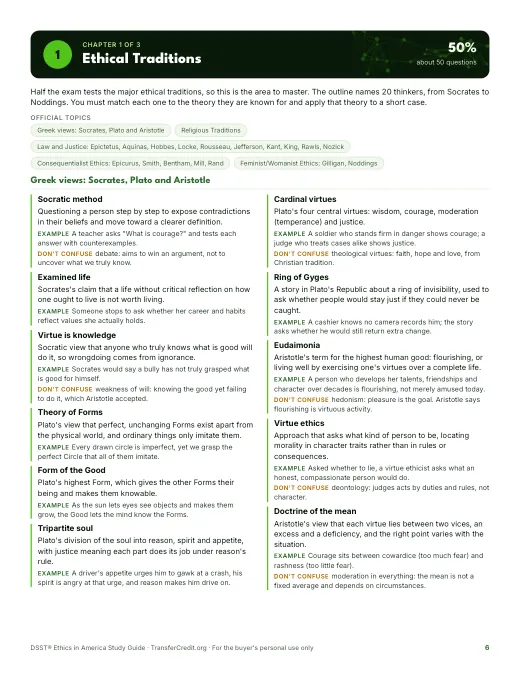
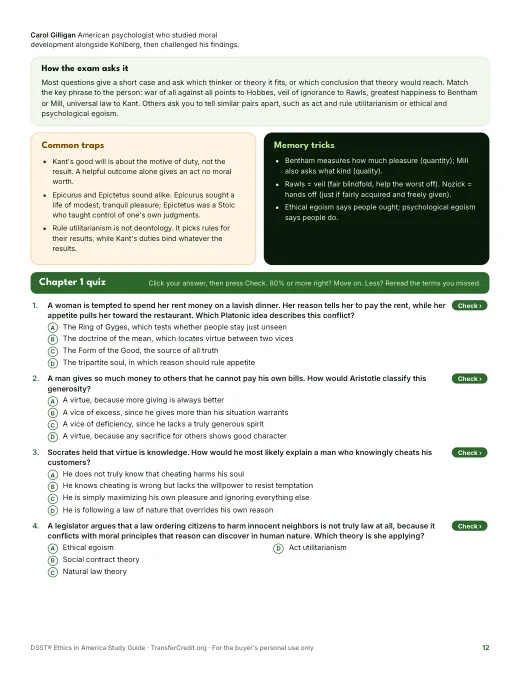
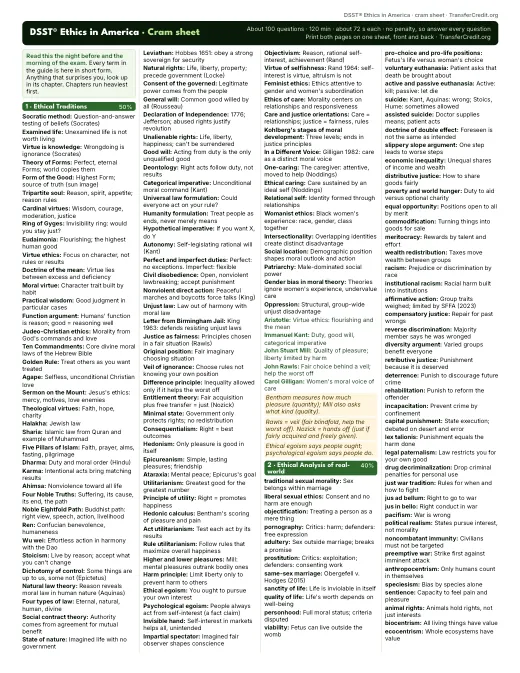
One chapter for each official content area, in the order the exam weighs them.
In the style of the real exam, from all 3 areas. About 10 minutes, with every answer explained and a score by area.
A woman is tempted to spend her rent money on a lavish dinner. Her reason tells her to pay the rent, while her appetite pulls her toward the restaurant. Which Platonic idea describes this conflict?
Answer: C. The tripartite soul, in which reason should rule appetite. Plato divides the soul into reason, spirit and appetite. Her reason and appetite are pulling apart, and in a just soul reason governs.
The trap: The Ring of Gyges concerns whether people act justly when unobserved. The woman's problem is a split between parts of her own soul.
Plato divides the soul into reason, spirit and appetite. Her reason and appetite are pulling apart, and in a just soul reason governs.
The trap: The Ring of Gyges concerns whether people act justly when unobserved. The woman's problem is a split between parts of her own soul.
A judge tells a convicted arsonist, 'You will serve this sentence because you earned it, whether or not it ever stops anyone else from setting fires.' Her reasoning is mainly
Answer: B. retributive. She justifies the sentence by what the offender deserves, not by its future effects, which is the retributive view.
The trap: Deterrence is tempting because punishment is involved, but she explicitly sets aside effects on other people.
She justifies the sentence by what the offender deserves, not by its future effects, which is the retributive view.
The trap: Deterrence is tempting because punishment is involved, but she explicitly sets aside effects on other people.
A visiting student writes that a host country's table customs are primitive, because they differ from the customs she grew up with. Her judgment is best described as
Answer: D. ethnocentrism. She measures another culture against her own and ranks it lower, which is ethnocentrism.
The trap: Cultural relativism is tempting because culture is involved, but relativists refuse to judge other cultures by outside standards.
She measures another culture against her own and ranks it lower, which is ethnocentrism.
The trap: Cultural relativism is tempting because culture is involved, but relativists refuse to judge other cultures by outside standards.
A man gives so much money to others that he cannot pay his own bills. How would Aristotle classify this generosity?
Answer: A. A vice of excess, since he gives more than his situation warrants. For Aristotle, generosity is a mean between stinginess and wastefulness. Giving beyond one's means is the excess.
The trap: Calling it a virtue because more is always better ignores the doctrine of the mean. Aristotle does not value any trait in unlimited amounts.
For Aristotle, generosity is a mean between stinginess and wastefulness. Giving beyond one's means is the excess.
The trap: Calling it a virtue because more is always better ignores the doctrine of the mean. Aristotle does not value any trait in unlimited amounts.
A physician gives a dying patient a large dose of painkiller, intending to relieve her agony and foreseeing, but not intending, that it may hasten her death. Which principle is usually used to defend this act?
Answer: C. The doctrine of double effect. The good intended effect is relief; the bad effect is foreseen and not the means, matching double effect.
The trap: Voluntary euthanasia intends death as the means to end suffering, whereas here death is a foreseen side effect only.
The good intended effect is relief; the bad effect is foreseen and not the means, matching double effect.
The trap: Voluntary euthanasia intends death as the means to end suffering, whereas here death is a foreseen side effect only.
A defense lawyer argues that her client's genes and upbringing made his crime inevitable, that nobody ever acts freely, and that he therefore cannot be blamed. Which position is she taking?
Answer: B. Hard determinism. She says every act is caused and that this removes free will and blame, which is hard determinism.
The trap: Compatibilism accepts that acts are caused but still counts people as free and responsible, so it would not excuse him on these grounds.
She says every act is caused and that this removes free will and blame, which is hard determinism.
The trap: Compatibilism accepts that acts are caused but still counts people as free and responsible, so it would not excuse him on these grounds.
Socrates held that virtue is knowledge. How would he most likely explain a man who knowingly cheats his customers?
Answer: A. He does not truly know that cheating harms his soul. If virtue is knowledge, no one who truly understands the good does wrong on purpose. Cheating therefore reveals ignorance of what is truly good for him.
The trap: Lack of willpower is the view that one can know the good and still fail to do it. Socrates denied this.
If virtue is knowledge, no one who truly understands the good does wrong on purpose. Cheating therefore reveals ignorance of what is truly good for him.
The trap: Lack of willpower is the view that one can know the good and still fail to do it. Socrates denied this.
At his patient's repeated request, a doctor injects a lethal drug to end her suffering from terminal illness. This is best classified as
Answer: D. active voluntary euthanasia. The doctor directly causes death and the patient requested it, making it active and voluntary.
The trap: Assisted suicide is tempting, but in that case the patient performs the final act; here the doctor does.
The doctor directly causes death and the patient requested it, making it active and voluntary.
The trap: Assisted suicide is tempting, but in that case the patient performs the final act; here the doctor does.
A speaker who says 'Cheating is wrong' means only to voice disapproval and to move her listeners to share it; she is not stating any fact. Which view does she hold?
Answer: B. Emotivism. She treats moral statements as expressions of feeling meant to influence others, which is emotivism, associated with Ayer.
The trap: Subjectivism is close, but it says the statement reports the speaker's own attitude and so is true or false.
She treats moral statements as expressions of feeling meant to influence others, which is emotivism, associated with Ayer.
The trap: Subjectivism is close, but it says the statement reports the speaker's own attitude and so is true or false.
A legislator argues that a law ordering citizens to harm innocent neighbors is not truly law at all, because it conflicts with moral principles that reason can discover in human nature. Which theory is she applying?
Answer: D. Natural law theory. Natural law theory, developed by Aquinas, holds that moral principles come from human nature and that an unjust human law lacks genuine authority.
The trap: Social contract theory grounds authority in agreement among people. Her argument appeals to moral principles in human nature instead.
Natural law theory, developed by Aquinas, holds that moral principles come from human nature and that an unjust human law lacks genuine authority.
The trap: Social contract theory grounds authority in agreement among people. Her argument appeals to moral principles in human nature instead.
The DSST Ethics in America exam is a 120-minute, computer-based test from Prometric with about 100 multiple-choice questions. A score of 400 on the 200–500 scale earns an ACE credit recommendation of 3 semester hours, though each college sets its own policy. The exam covers 3 content areas; the heaviest is Ethical Traditions at 50%.
3 areas, heaviest first. The guide's chapters follow this order.
Start with the guide, or get everything for DSST in one plan.
DSST® is a registered trademark of Prometric, which was not involved in producing this guide and does not endorse it. TransferCredit.org is independent and not affiliated with Prometric. © 2026 UPI Globale Edu Inc.