← DSST Advanced English Composition course
DSST® Study Guide Printable PDF · 34 pages

DSST Advanced English Composition Study Guide

Official exam name: Principles of Advanced English Composition

Everything the DSST Advanced English Composition exam tests, in one PDF you can print. Built from Prometric's official outline, heaviest topics first.

  • 182 key terms, each with an example
  • 43 practice questions with every answer explained
  • A 2-page cram sheet for the night before
  • 2-, 4- and 8-week study plans built from the exam weights
Not sure yet? Try 10 free questions

Last updated 2026 · exam details checked against Prometric's published exam information in 2026

Look inside the guide

Real pages from the 34-page PDF.

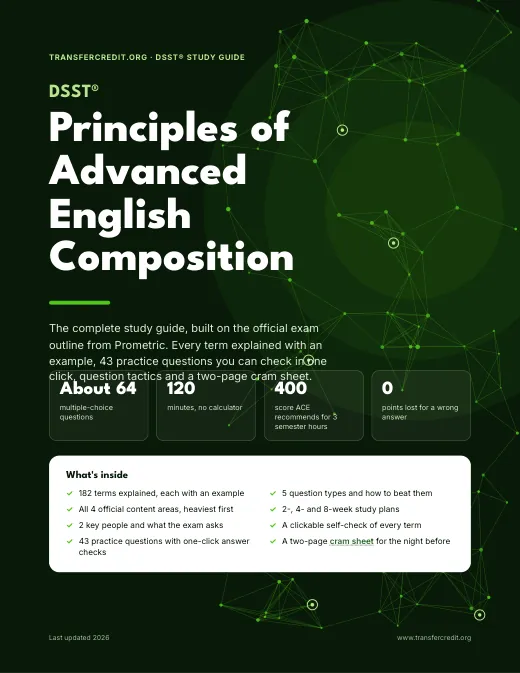
Page 1 of the DSST Advanced English Composition Study Guide: the cover
Page 1 The cover
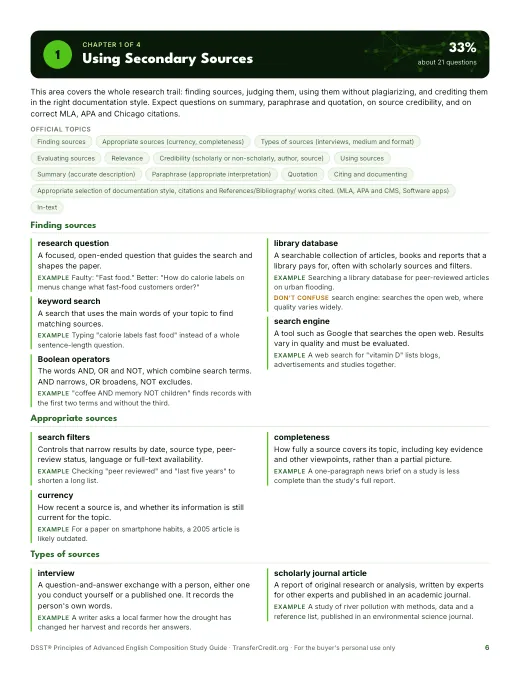
Page 6 of the DSST Advanced English Composition Study Guide: the Chapter 1 opener
Page 6 The Chapter 1 opener
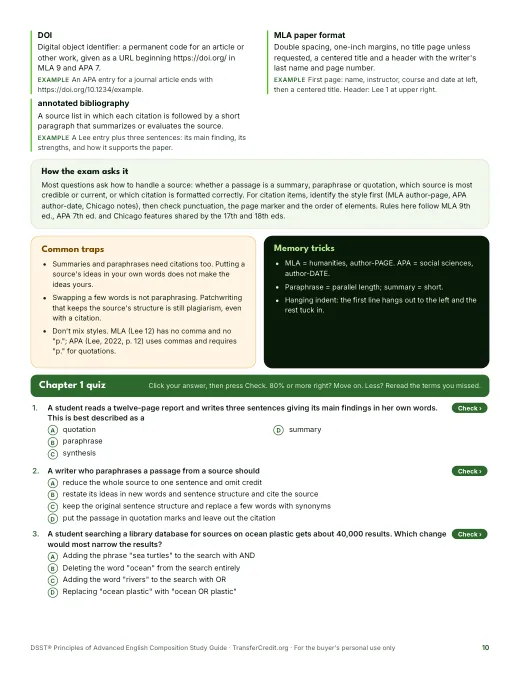
Page 10 of the DSST Advanced English Composition Study Guide: a chapter quiz
Page 10 A chapter quiz
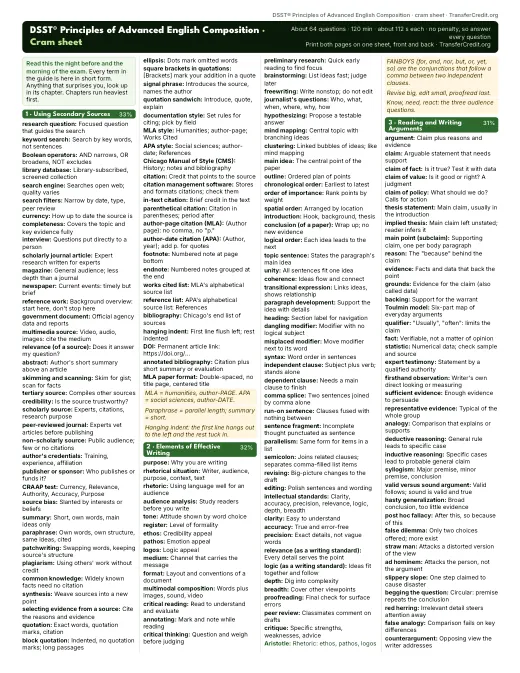
Page 33 of the DSST Advanced English Composition Study Guide: the 2-page cram sheet
Page 33 The 2-page cram sheet

What you get for $5

One chapter for each official content area, in the order the exam weighs them.

  • 📘34pages, printable
  • 🧭4chapters, heaviest first
  • 🔑182terms with examples
  • ✍️43practice questions, answers explained
  • ⚠️12exam traps to avoid
  • 📄2page cram sheet

Try 10 free Advanced English Composition questions

In the style of the real exam, from all 4 areas. About 20 minutes, with every answer explained and a score by area.

10 questions  
  1. Question 1 · Using Secondary Sources

    A student reads a twelve-page report and writes three sentences giving its main findings in her own words. This is best described as a

    Show the answer

    Answer: A. summary. Condensing a long source to its main ideas, in your own words, is a summary.

    The trap: Paraphrase is tempting because the words are her own, but a paraphrase restates a specific passage at roughly the same length, not a whole report in three sentences.

  2. Question 2 · Elements of Effective Writing

    Before drafting a grant proposal, a writer asks what the review committee already knows, what it still needs to learn and how it may react. The writer is doing

    Show the answer

    Answer: D. audience analysis.. Asking what readers know, need and how they will respond is audience analysis.

    The trap: Peer review is wrong because it involves other writers commenting on a draft, which has not been written yet.

  3. Question 3 · Reading and Writing Arguments

    A writer argues, "Our county should replace its paper ballots with touch-screen machines." This is best classified as a claim of

    Show the answer

    Answer: C. policy. The word "should" calls for a specific action, which marks a claim of policy. A claim of definition, a type some textbooks add, argues what something is, not what to do.

    The trap: A claim of value is tempting because the writer prefers one system, but value claims judge worth. This one calls for an action.

  4. Question 4 · Types of Writing

    A writer describes how a flood destroyed her family's farm, presenting events in the order they happened and using “I” throughout, to show what the experience taught her. This writing is best classified as

    Show the answer

    Answer: B. narrative writing.. The text tells a personal story in time order to reveal its meaning, which defines narrative writing.

    The trap: Informative writing is wrong because the passage is mainly telling a story, not explaining a topic.

  5. Question 5 · Using Secondary Sources

    A writer who paraphrases a passage from a source should

    Show the answer

    Answer: D. restate its ideas in new words and sentence structure and cite the source. A true paraphrase changes both wording and structure while keeping the meaning. The ideas still belong to the source, so a citation is required.

    The trap: Replacing a few words with synonyms is patchwriting. It keeps the source's structure and is still plagiarism.

  6. Question 6 · Elements of Effective Writing

    A health department needs to alert residents within minutes that tap water must be boiled before drinking. Which medium and format best fit the purpose?

    Show the answer

    Answer: A. A text-message alert with brief, direct instructions. The purpose is speed and clarity, so a brief, direct alert in a fast medium fits.

    The trap: The printed report is wrong because it is slow to produce and too long for an urgent warning.

  7. Question 7 · Reading and Writing Arguments

    Which sentence would work best as the thesis statement of a short argumentative essay?

    Show the answer

    Answer: B. Cities should fund free public transit because it eases traffic and widens access to jobs.. A thesis takes a position and previews the reasons. Only this sentence makes an arguable claim and gives two supporting points.

    The trap: The announcement about discussing history, funding and ridership names what the paper covers but takes no position, so it is a plan, not a thesis.

  8. Question 8 · Types of Writing

    A student summarizes a new film, then argues that its slow pacing weakens the story and cites three scenes as support. The student has written

    Show the answer

    Answer: C. a critical response.. The student summarizes a work and then judges it with specific details from the work, which is a critical response.

    The trap: An informative report is wrong because the student judges the film instead of only explaining it.

  9. Question 9 · Using Secondary Sources

    A student searching a library database for sources on ocean plastic gets about 40,000 results. Which change would most narrow the results?

    Show the answer

    Answer: C. Adding the phrase "sea turtles" to the search with AND. AND requires every term to appear, so each added term shrinks the results.

    The trap: Connecting "rivers" with OR is wrong because OR broadens a search by accepting results that contain either term.

  10. Question 10 · Elements of Effective Writing

    A writer sets a timer for ten minutes and writes without stopping, even when sentences are unpolished, to find out what she thinks about her topic. This invention technique is

    Show the answer

    Answer: B. freewriting.. Continuous, unedited writing for a set time is freewriting.

    The trap: Clustering is wrong because it groups related ideas visually instead of producing continuous sentences.

The DSST Advanced English Composition exam at a glance

The DSST Principles of Advanced English Composition exam is a 120-minute, computer-based test from Prometric with about 64 multiple-choice questions. A score of 400 on the 200–500 scale earns an ACE credit recommendation of 3 semester hours, though each college sets its own policy. The exam covers 4 content areas; the heaviest is Using Secondary Sources at 33%.

Questions
About 64multiple choice
Time
120 minabout 2 minutes a question
Passing score
400on a 200–500 scale
ACE credit
3semester hours
Exam fee
$100paid to Prometric
Calculator
Nonot allowed

Source: official DSST Principles of Advanced English Composition exam page.

What the exam covers

4 areas, heaviest first. The guide's chapters follow this order.

  1. Using Secondary Sources33%
  2. Elements of Effective Writing32%
  3. Reading and Writing Arguments31%
  4. Types of Writing4%

How it works

  1. 1Buy once, $5Secure checkout. No subscription needed.
  2. 2Download the PDFFrom your TransferCredit.org account, right away and any time later.
  3. 3Study the heaviest areas firstFollow the 2-, 4- or 8-week plan, then read the cram sheet the night before.

Questions students ask

What's in the full DSST Advanced English Composition study guide?
34 pages: 4 chapters, one per official content area, heaviest first. 182 terms, each with a plain-English definition and an example, 2 key people, common traps and memory tricks, 43 practice questions with an answer key that explains every answer, question tactics, 2-, 4- and 8-week study plans and a 2-page cram sheet.
How much is the full DSST Advanced English Composition study guide?
The full 34-page PDF is $5, a one-time payment. The 10 practice questions on this page are free, with no account.
What does the $29 plan include?
$29 a month gives you all DSST subjects: every DSST study guide plus the full prep course for each subject, and you can cancel anytime. If you only need this exam, the guide on its own is a one-time $5.
How do I get the full guide?
Choose Buy this guide ($5) and check out. Then sign in to your TransferCredit.org account, then open the course and its Download Your Study Guide lesson. The PDF is yours to keep, and you can download it again from your account at any time.
Can I print the guide or use it on my phone?
Yes. It's a PDF, so it opens on phones, tablets and computers, and printing is allowed. Its tick boxes and answer bubbles work in PDF readers that support forms. Copying and editing are turned off.
Is this an official DSST study guide?
No. DSST® is a registered trademark of Prometric, which was not involved in producing this guide and does not endorse it. TransferCredit.org is independent. We built the guide from the official exam outline, and the exam details were checked against Prometric's published exam information in 2026.
Why is this study guide better than a generic review?
It follows the official outline area by area and spends the most pages on what the exam weighs most. Every term comes with an example, each chapter names the traps the exam sets, and the answer key explains why the most tempting wrong answer is wrong, not just which answer is right. It ends with a 2-page cram sheet for the night before.
What is the DSST Advanced English Composition exam?
The DSST Principles of Advanced English Composition exam is a 120-minute, computer-based test from Prometric with about 64 multiple-choice questions. A score of 400 on the 200–500 scale earns an ACE credit recommendation of 3 semester hours, though each college sets its own policy. The exam covers 4 content areas; the heaviest is Using Secondary Sources at 33%.
More questions about the DSST Advanced English Composition exam (21)
How many questions are on the DSST Advanced English Composition exam, and how long is it?
It contains 64 questions, some associated to passages, to be answered in 2 hours.
What is the passing score for DSST Advanced English Composition?
The passing score is 400 on a 200–500 scale. At 400 or above, the American Council on Education (ACE) recommends 3 semester hours. Each college sets its own passing score and credit award, so check your school's policy before you book.
How much does the DSST Advanced English Composition exam cost?
The exam fee is $100, paid to Prometric. Test centers may add their own administration fee. Eligible U.S. military service members can usually test for free through DANTES.
How many college credits is DSST Advanced English Composition worth?
ACE recommends 3 semester hours for a passing score of 400. Your college decides how many credits it awards and which course they replace. Check your college's policy.
Is there a penalty for guessing on DSST Advanced English Composition?
No. Your score counts only correct answers, so a wrong answer costs nothing. Never leave a question blank: rule out what you can and pick your best guess.
What topics are on the DSST Advanced English Composition exam?
4 content areas, from the official outline: Using Secondary Sources (33%); Elements of Effective Writing (32%); Reading and Writing Arguments (31%); Types of Writing (4%).
Which DSST Advanced English Composition topics should I study first?
Start with the three heaviest: Using Secondary Sources (33%), Elements of Effective Writing (32%) and Reading and Writing Arguments (31%). Together they are about 96% of the exam, roughly 61 of 64 questions. The guide's chapters run in that order, heaviest first.
Is the DSST Advanced English Composition exam hard?
It depends on what you already know. The exam has only 4 content areas, so each one carries real weight: Using Secondary Sources (33%), Elements of Effective Writing (32%), Reading and Writing Arguments (31%) and Types of Writing (4%). Take the free diagnostic above to see where you stand in about 20 minutes.
What kinds of questions are on the DSST Advanced English Composition exam?
The guide sorts them into 5 types: “Complete the definition”, “Revise or find the error”, “Analyze an argument”, “Choose the best use of a source” and “Choose the correct citation form”. Every question has 4 answer choices. Try the 10 free questions above to see the style.
How long should I study for DSST Advanced English Composition?
Use the diagnostic to decide. If you already know most areas, two weeks of daily review is often enough; if the subject is new to you, plan on eight. The full guide has 2-, 4- and 8-week plans built from the exam weights.
How should I pace myself on the DSST Advanced English Composition exam?
On average you have about 2 minutes per question (120 minutes for 64 questions). Be past question 21 a third of the way through and past question 43 two-thirds through. If a question takes more than a minute, pick your best guess, mark it and come back.
What happens if I don't pass DSST Advanced English Composition?
You can retake a DSST exam after 30 days. Use the wait to work through the areas the score report and the diagnostic show you missed.
Do colleges accept DSST Advanced English Composition for credit?
DSST exams are accepted at more than 1,500 colleges and universities, but each school decides which exams it accepts, the score it requires and the credit it gives. Look up your college's DSST policy before you book.
How is the guide different from the DSST Advanced English Composition course?
The guide is a 34-page PDF for review and self-testing. The DSST Advanced English Composition course is a full online course with lessons, quizzes and a practice exam, for $19 with lifetime access. Many students use the guide first, then take the course for the areas the diagnostic flags.
How up to date is this DSST Advanced English Composition guide?
Last updated 2026. The exam details were checked against Prometric's published exam information in 2026. Exams change, so confirm the details on the official exam page before you register.
What should I do the night before the exam?
Read the cram sheet once, slowly. Check your test time, the location or remote-proctoring setup, and the ID you need. Then sleep: a rested brain recalls more than a crammed one. In the morning, skim the memory tricks and common traps, then stop studying.
Is DSST Advanced English Composition upper-level credit?
Yes. Under the January 2026 fact sheet, ACE recommends 3 semester hours at the upper-level baccalaureate level, which some programs need for upper-division requirements.
Does the exam include an essay?
No. The current exam is 64 multiple-choice questions, some based on passages. You'll analyze and revise writing rather than write an essay.
What are warrants and assumptions on DSST Advanced English Composition?
A warrant is the often unstated assumption that links a claim to its evidence. The outline lists warrants and assumptions under argument analysis, part of Reading and Writing Arguments (31%), alongside claims, evidence and conclusions.
Does DSST Advanced English Composition test grammar?
Yes, within Elements of Effective Writing (32%). The outline lists sentence structure — dangling modifiers, syntax, clauses and punctuation — along with paragraph structure, transitions and proofreading.
Which citation styles are on the exam?
The outline lists MLA, APA and CMS (Chicago). Know how each handles in-text citations and the reference list or works cited.

Choose how you want to study

Start with the guide, or get everything for DSST in one plan.

This study guide
$5one-time
  • 34-page printable PDF
  • 182 terms with examples
  • 43 practice questions, answers explained
  • 2-page cram sheet and study plans
Get the guide · $5
Best value Get it all
$29/month
  • Every DSST study guide
  • Prep courses for all DSST subjects
  • Cancel anytime
Get it all · $29/mo

DSST® is a registered trademark of Prometric, which was not involved in producing this guide and does not endorse it. TransferCredit.org is independent and not affiliated with Prometric. © 2026 UPI Globale Edu Inc.