
$5one-time
- 45-page printable PDF
- 189 terms with examples
- 59 practice questions, answers explained
- 2-page cram sheet and study plans
Official exam name: Introduction to World Religions
Everything the DSST World Religions exam tests, in one PDF you can print. Built from Prometric's official outline, heaviest topics first.
Last updated 2026 · exam details checked against Prometric's published exam information in 2026
Real pages from the 45-page PDF.
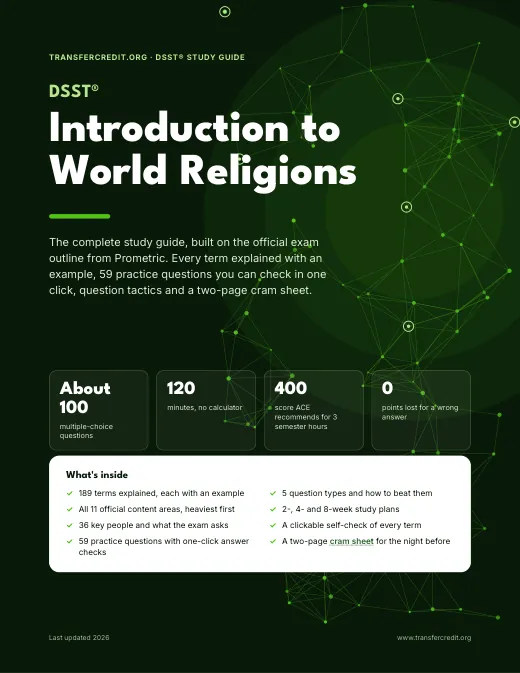
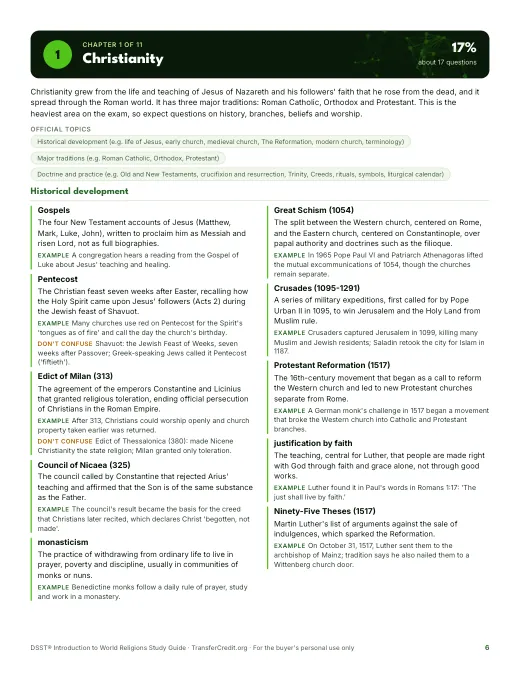
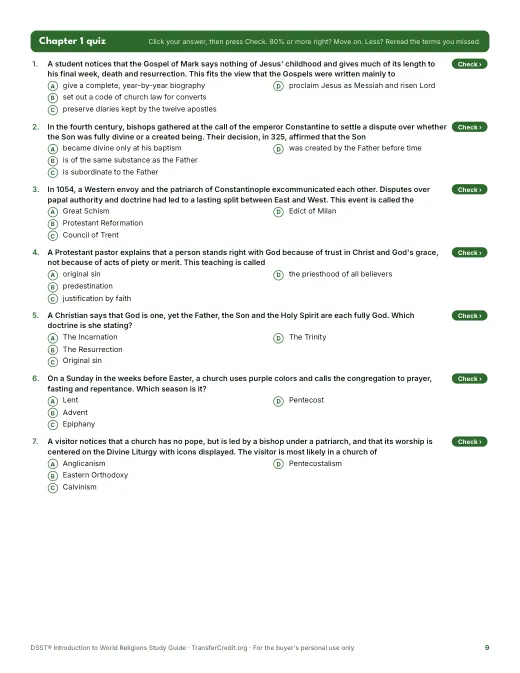
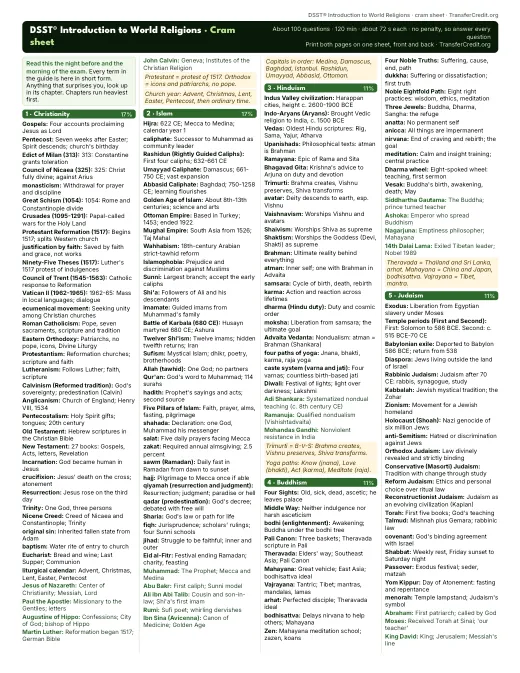
One chapter for each official content area, in the order the exam weighs them.
In the style of the real exam, one from each of the ten heaviest areas. About 10 minutes, with every answer explained and a score by area.
A student notices that the Gospel of Mark says nothing of Jesus' childhood and gives much of its length to his final week, death and resurrection. This fits the view that the Gospels were written mainly to
Answer: D. proclaim Jesus as Messiah and risen Lord. The Gospels select and arrange events to proclaim Jesus as Messiah and risen Lord, which is why his death and resurrection fill so much of them.
The trap: The diaries choice is tempting because tradition links the Gospels to apostles, but scholars date them decades after Jesus, and Mark and Luke were not among the Twelve.
The Gospels select and arrange events to proclaim Jesus as Messiah and risen Lord, which is why his death and resurrection fill so much of them.
The trap: The diaries choice is tempting because tradition links the Gospels to apostles, but scholars date them decades after Jesus, and Mark and Luke were not among the Twelve.
Which event do Muslims use as the starting point of the Islamic calendar?
Answer: A. Muhammad's move from Mecca to Medina in 622 CE. The Hijra, the migration to Medina, marks year 1 of the Islamic calendar because it founded the first Muslim community.
The trap: The first revelation is tempting because it began Muhammad's mission. But the calendar was set from the migration, not from the first revelation.
The Hijra, the migration to Medina, marks year 1 of the Islamic calendar because it founded the first Muslim community.
The trap: The first revelation is tempting because it began Muhammad's mission. But the calendar was set from the migration, not from the first revelation.
A student reads a text in which a teacher tells a pupil that the true self within is not different from the ultimate reality behind the universe. This text is most likely one of the
Answer: C. Upanishads. The Upanishads are late Vedic philosophical texts teaching that atman, the true self, is Brahman, the ultimate reality.
The trap: Vedic hymns are tempting because the Upanishads are also called Vedic, but the hymns mainly praise gods and guide rituals; they do not teach this identity.
The Upanishads are late Vedic philosophical texts teaching that atman, the true self, is Brahman, the ultimate reality.
The trap: Vedic hymns are tempting because the Upanishads are also called Vedic, but the hymns mainly praise gods and guide rituals; they do not teach this identity.
A Buddhist vows to put off final release from rebirth until every living being has also awakened. This vow expresses which Buddhist ideal?
Answer: B. The bodhisattva. The bodhisattva delays final nirvana out of compassion in order to help others awaken. This is the central Mahayana ideal.
The trap: The arhat is tempting because it is also a Buddhist ideal. But the arhat seeks his or her own nirvana, which is the Theravada goal.
The bodhisattva delays final nirvana out of compassion in order to help others awaken. This is the central Mahayana ideal.
The trap: The arhat is tempting because it is also a Buddhist ideal. But the arhat seeks his or her own nirvana, which is the Theravada goal.
After Jerusalem fell in 586 BCE, many Judeans were deported far from home. Without the Temple, they preserved their scriptures and laws until Persia allowed them to return. This period is called the
Answer: A. Babylonian exile. The Babylonian exile followed the fall of Jerusalem in 586 BCE and ended when Cyrus of Persia let exiles return in 538 BCE. It taught Jews to keep their faith without a Temple.
The trap: Second Temple period is tempting because it comes right after, but it began when the returning exiles rebuilt the Temple, not while they were away.
The Babylonian exile followed the fall of Jerusalem in 586 BCE and ended when Cyrus of Persia let exiles return in 538 BCE. It taught Jews to keep their faith without a Temple.
The trap: Second Temple period is tempting because it comes right after, but it began when the returning exiles rebuilt the Temple, not while they were away.
A priest in ancient Persia teaches that the world is the field of a struggle between truth and falsehood, and that each person's choices join one side or the other. This idea is best called
Answer: D. cosmic dualism. The idea of a cosmic struggle between two opposed forces of good and evil is cosmic dualism, central to Zoroastrianism.
The trap: Syncretism is wrong because it names the blending of traditions. Nothing in the scenario describes a blend, only a view of the cosmos as a conflict.
The idea of a cosmic struggle between two opposed forces of good and evil is cosmic dualism, central to Zoroastrianism.
The trap: Syncretism is wrong because it names the blending of traditions. Nothing in the scenario describes a blend, only a view of the cosmos as a conflict.
A scholar visits a temple and records, without judging, how worshipers chant, what offerings they bring and what they say the rites mean. Which approach is she using?
Answer: C. Descriptive. She reports what followers believe and do without ruling on whether it is true. That is the descriptive approach.
The trap: The historical approach is tempting because she gathers facts, but it traces how a tradition changed over time. She only records what exists now.
She reports what followers believe and do without ruling on whether it is true. That is the descriptive approach.
The trap: The historical approach is tempting because she gathers facts, but it traces how a tradition changed over time. She only records what exists now.
A young Lakota man goes alone to a hilltop, fasts for several days and prays, hoping that spirits will give him direction for his life. What is this rite called?
Answer: B. Vision quest. A vision quest is a solitary period of fasting and prayer in which a person seeks guidance from spirits. It is a well-known Lakota practice.
The trap: Kachina dance is tempting because it is a Native American rite, but it is Hopi, is communal, and honors spirit beings rather than seeking a personal vision.
A vision quest is a solitary period of fasting and prayer in which a person seeks guidance from spirits. It is a well-known Lakota practice.
The trap: Kachina dance is tempting because it is a Native American rite, but it is Hopi, is communal, and honors spirit beings rather than seeking a personal vision.
After years of famine, flood and uprisings, a Chinese chronicler explains that the ruling dynasty has lost Heaven's approval. This reasoning is based on the
Answer: A. Mandate of Heaven. The Mandate of Heaven says a ruler keeps his right to rule only while he rules virtuously. Disaster and revolt signal that it has been withdrawn.
The trap: The Five Relationships might tempt because one bond is ruler and subject. But that teaching describes mutual duties, not Heaven's approval of a dynasty.
The Mandate of Heaven says a ruler keeps his right to rule only while he rules virtuously. Disaster and revolt signal that it has been withdrawn.
The trap: The Five Relationships might tempt because one bond is ruler and subject. But that teaching describes mutual duties, not Heaven's approval of a dynasty.
A mediator in a heated dispute does not force a settlement. She listens, lets tempers cool, then guides both sides toward the compromise they were already near. Which idea does her approach best reflect?
Answer: B. Wu wei. Wu wei means acting in harmony with the natural flow of things without forcing outcomes. She acts, but skillfully and without force.
The trap: Li is tempting because it concerns proper conduct between people, but it is the Confucian ideal of ritual propriety, not unforced action in tune with the Dao.
Wu wei means acting in harmony with the natural flow of things without forcing outcomes. She acts, but skillfully and without force.
The trap: Li is tempting because it concerns proper conduct between people, but it is the Confucian ideal of ritual propriety, not unforced action in tune with the Dao.
The DSST Introduction to World Religions exam is a 120-minute, computer-based test from Prometric with about 100 multiple-choice questions. A score of 400 on the 200–500 scale earns an ACE credit recommendation of 3 semester hours, though each college sets its own policy. The exam covers 11 content areas; the heaviest is Christianity at 17%.
Source: official DSST Introduction to World Religions exam page.
11 areas, heaviest first. The guide's chapters follow this order.
Start with the guide, or get everything for DSST in one plan.
DSST® is a registered trademark of Prometric, which was not involved in producing this guide and does not endorse it. TransferCredit.org is independent and not affiliated with Prometric. © 2026 UPI Globale Edu Inc.