← DSST Principles of Public Speaking course
DSST® Study Guide Printable PDF · 38 pages

DSST Principles of Public Speaking Study Guide

Everything the DSST Principles of Public Speaking exam tests, in one PDF you can print. Built from Prometric's official outline, heaviest topics first.

  • 181 key terms, each with an example
  • 45 practice questions with every answer explained
  • A 2-page cram sheet for the night before
  • 2-, 4- and 8-week study plans built from the exam weights
Not sure yet? Try 10 free questions

Last updated 2026 · exam details checked against Prometric's published exam information in 2026

Look inside the guide

Real pages from the 38-page PDF.

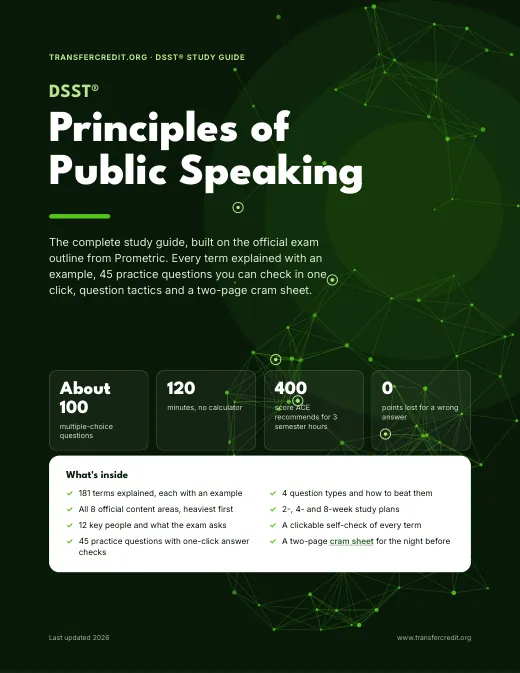
Page 1 of the DSST Principles of Public Speaking Study Guide: the cover
Page 1 The cover
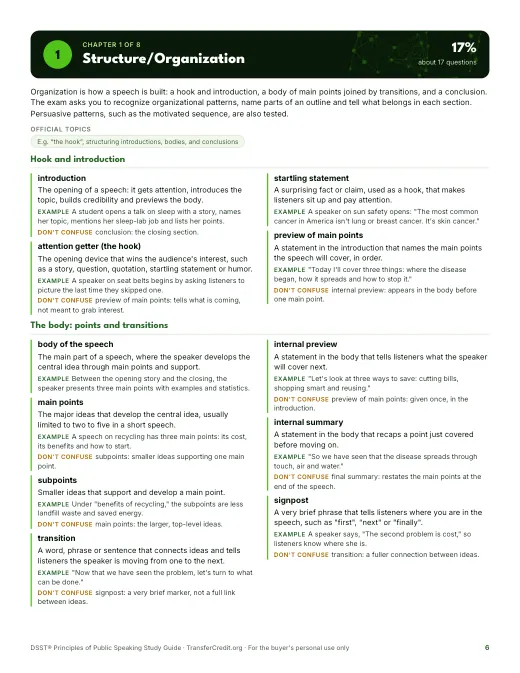
Page 6 of the DSST Principles of Public Speaking Study Guide: the Chapter 1 opener
Page 6 The Chapter 1 opener
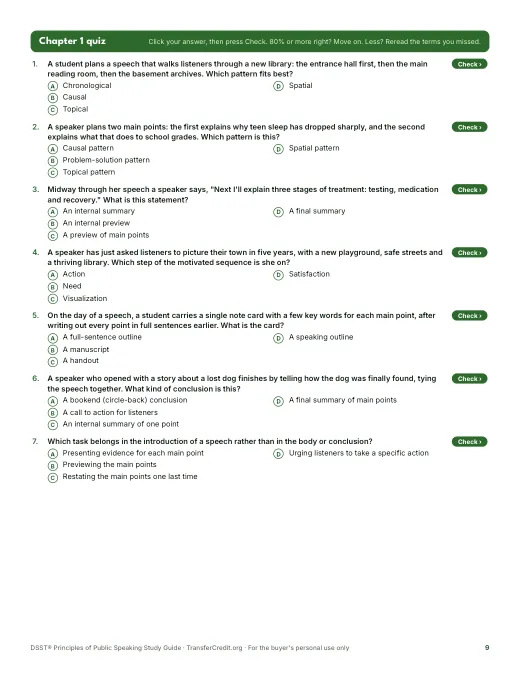
Page 9 of the DSST Principles of Public Speaking Study Guide: a chapter quiz
Page 9 A chapter quiz
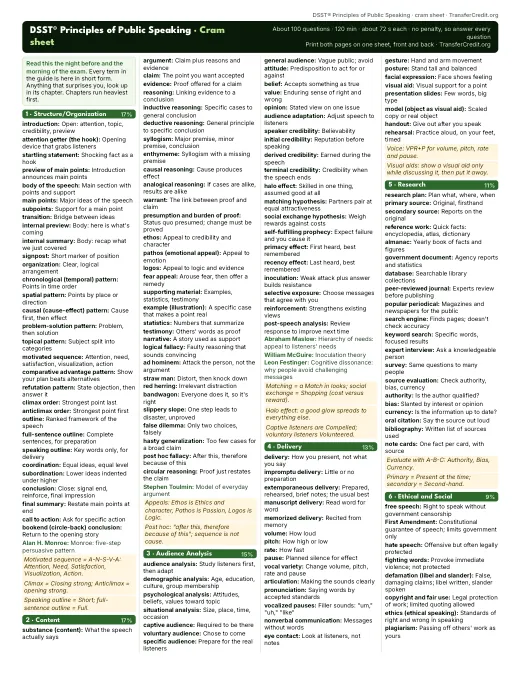
Page 37 of the DSST Principles of Public Speaking Study Guide: the 2-page cram sheet
Page 37 The 2-page cram sheet

What you get for $5

One chapter for each official content area, in the order the exam weighs them.

  • 📘38pages, printable
  • 🧭8chapters, heaviest first
  • 🔑181terms with examples
  • ✍️45practice questions, answers explained
  • ⚠️24exam traps to avoid
  • 📄2page cram sheet

Try 10 free Principles of Public Speaking questions

In the style of the real exam, from all 7 multiple-choice areas. About 10 minutes, with every answer explained and a score by area.

10 questions  
  1. Question 1 · Structure/Organization

    A student plans a speech that walks listeners through a new library: the entrance hall first, then the main reading room, then the basement archives. Which pattern fits best?

    Show the answer

    Answer: B. Spatial. The points are ordered by physical location as you move through the building, which is a spatial pattern.

    The trap: Chronological is tempting because a walk takes time, but the points are organized by where things are, not when they occur.

  2. Question 2 · Content

    A speaker says, "My roommate, my lab partner and two of my teammates each work two jobs to pay tuition. Many students here are struggling to afford college." Her reasoning moves from

    Show the answer

    Answer: A. specific cases to a general conclusion. She builds a broad claim about students from several specific people she knows, which is inductive reasoning.

    The trap: The general-principle choice describes deductive reasoning, which applies a rule it starts with instead of building a conclusion from cases.

  3. Question 3 · Audience Analysis, Adaptation and Effect

    Before a speech, a speaker learns that most of the audience are retired schoolteachers over 65 who volunteer at a public library. Which kind of audience analysis has she done?

    Show the answer

    Answer: D. Demographic analysis. Age, occupation and group membership are demographic traits. Gathering them is demographic analysis.

    The trap: Situational analysis is tempting because the audience is described, but it concerns the setting, such as room size and time of day.

  4. Question 4 · Delivery

    A speaker rehearses from a short keyword outline, knows her ideas well and chooses her exact words as she speaks. She is using which method of delivery?

    Show the answer

    Answer: C. extemporaneous. Speaking from brief notes after thorough preparation, with wording chosen in the moment, defines extemporaneous delivery.

    The trap: Impromptu is tempting because she words things on the spot, but impromptu speaking involves little or no preparation, which she did.

  5. Question 5 · Research

    A student preparing a speech on her town in the 1950s reads the original city council minutes from 1952. What kind of source is this?

    Show the answer

    Answer: A. A primary source. The minutes are original, firsthand records created at the time, so they are a primary source.

    The trap: A secondary source is wrong because it would be someone else's later report or interpretation of the minutes.

  6. Question 6 · Ethical, Social, and Theoretical Considerations of Public Speaking

    A student gives a speech and reads three paragraphs from a magazine article as if she had written them. She never mentions the author. Her main ethical failure is

    Show the answer

    Answer: D. plagiarism, because she presented someone else's words as her own. Presenting another's words as your own without credit is plagiarism, no matter how short the borrowed passage or how the speech is delivered.

    The trap: Defamation is wrong because it needs a false statement that harms someone's reputation; nothing false was said about the author.

  7. Question 7 · Language and Style

    A speaker says that two coworkers are "thrifty" and "cheap." Both words mean spending little, yet one sounds like praise and one like criticism. What explains the difference?

    Show the answer

    Answer: C. Their connotations. The literal meaning is the same, but each word carries different feelings. That difference is connotation.

    The trap: Denotation is tempting because it deals with meaning, but the two words share the same literal meaning; the difference is in the feelings attached.

  8. Question 8 · Structure/Organization

    A speaker plans two main points: the first explains why teen sleep has dropped sharply, and the second explains what that does to school grades. Which pattern is this?

    Show the answer

    Answer: B. Causal pattern. The first point covers causes and the second covers the effects, so the speech follows a causal (cause-effect) pattern.

    The trap: Problem-solution is wrong because the second point describes consequences rather than proposing a remedy.

  9. Question 9 · Content

    A candidate is asked about a rising crime rate and answers by describing how much he loves his hometown's football team. This is an example of a

    Show the answer

    Answer: B. red herring. Bringing in an unrelated topic to draw attention away from the real question is the red herring fallacy.

    The trap: Straw man is wrong because the candidate did not distort anyone's position; he simply changed the subject.

  10. Question 10 · Audience Analysis, Adaptation and Effect

    Before a student starts, her classmates already know she is the state debate champion, so they listen with respect. What kind of credibility is working here?

    Show the answer

    Answer: C. Initial credibility. Her reputation existed before she said a word, so it is initial credibility.

    The trap: Derived credibility is wrong because it is earned during the speech through what the speaker says and how she says it.

The DSST Principles of Public Speaking exam at a glance

The DSST Principles of Public Speaking exam is a computer-based test from Prometric. The exam contains 100 questions to be answered in 2 hours, and some of these are pretest questions that will not be scored. The exam consists of two parts, taken in order: Part 1 is multiple-choice and Part 2 requires the test taker to record an impromptu persuasive speech that will be scored by human raters. Students must pass both parts of the exam in order to receive credit. A score of 400 on the 200–500 scale earns an ACE credit recommendation of 3 semester hours, though each college sets its own policy. The exam covers 8 content areas; the heaviest is Structure/Organization at 17%.

Questions
About 100multiple choice
Time
120 minPart 1; Part 2 is separate
Passing score
400on a 200–500 scale
ACE credit
3semester hours
Exam fee
$100paid to Prometric
Calculator
Nonot allowed

Source: official DSST Principles of Public Speaking exam page.

What the exam covers

8 areas, heaviest first. The guide's chapters follow this order.

  1. Structure/Organization17%
  2. Content17%
  3. Audience Analysis, Adaptation and Effect15%
  4. Delivery13%
  5. Research11%
  6. Ethical, Social, and Theoretical Considerations of Public Speaking9%
  7. Topics and Purposes of Speeches9%
  8. Language and Style9%

How it works

  1. 1Buy once, $5Secure checkout. No subscription needed.
  2. 2Download the PDFFrom your TransferCredit.org account, right away and any time later.
  3. 3Study the heaviest areas firstFollow the 2-, 4- or 8-week plan, then read the cram sheet the night before.

Questions students ask

What's in the full DSST Principles of Public Speaking study guide?
38 pages: 8 chapters, one per official content area, heaviest first. 181 terms, each with a plain-English definition and an example, 12 key people, common traps and memory tricks, 45 practice questions with an answer key that explains every answer, question tactics, 2-, 4- and 8-week study plans and a 2-page cram sheet.
How much is the full DSST Principles of Public Speaking study guide?
The full 38-page PDF is $5, a one-time payment. The 10 practice questions on this page are free, with no account.
What does the $29 plan include?
$29 a month gives you all DSST subjects: every DSST study guide plus the full prep course for each subject, and you can cancel anytime. If you only need this exam, the guide on its own is a one-time $5.
How do I get the full guide?
Choose Buy this guide ($5) and check out. Then sign in to your TransferCredit.org account, then open the course and its Download Your Study Guide lesson. The PDF is yours to keep, and you can download it again from your account at any time.
Can I print the guide or use it on my phone?
Yes. It's a PDF, so it opens on phones, tablets and computers, and printing is allowed. Its tick boxes and answer bubbles work in PDF readers that support forms. Copying and editing are turned off.
Is this an official DSST study guide?
No. DSST® is a registered trademark of Prometric, which was not involved in producing this guide and does not endorse it. TransferCredit.org is independent. We built the guide from the official exam outline, and the exam details were checked against Prometric's published exam information in 2026.
Why is this study guide better than a generic review?
It follows the official outline area by area and spends the most pages on what the exam weighs most. Every term comes with an example, each chapter names the traps the exam sets, and the answer key explains why the most tempting wrong answer is wrong, not just which answer is right. It ends with a 2-page cram sheet for the night before.
What is the DSST Principles of Public Speaking exam?
The DSST Principles of Public Speaking exam is a computer-based test from Prometric. The exam contains 100 questions to be answered in 2 hours, and some of these are pretest questions that will not be scored. The exam consists of two parts, taken in order: Part 1 is multiple-choice and Part 2 requires the test taker to record an impromptu persuasive speech that will be scored by human raters. Students must pass both parts of the exam in order to receive credit. A score of 400 on the 200–500 scale earns an ACE credit recommendation of 3 semester hours, though each college sets its own policy. The exam covers 8 content areas; the heaviest is Structure/Organization at 17%.
More questions about the DSST Principles of Public Speaking exam (20)
How many questions are on the DSST Principles of Public Speaking exam, and how long is it?
The exam contains 100 questions to be answered in 2 hours, and some of these are pretest questions that will not be scored. The exam consists of two parts, taken in order: Part 1 is multiple-choice and Part 2 requires the test taker to record an impromptu persuasive speech that will be scored by human raters. Students must pass both parts of the exam in order to receive credit. Test takers have 20 minutes for Part 2 (5 minutes to record), and a speech shorter than 3 minutes or longer than 5 minutes is an automatic failure.
What is the passing score for DSST Principles of Public Speaking?
The passing score is 400 on a 200–500 scale. At 400 or above, the American Council on Education (ACE) recommends 3 semester hours. Each college sets its own passing score and credit award, so check your school's policy before you book.
How much does the DSST Principles of Public Speaking exam cost?
The exam fee is $100, paid to Prometric. Test centers may add their own administration fee. Eligible U.S. military service members can usually test for free through DANTES.
How many college credits is DSST Principles of Public Speaking worth?
ACE recommends 3 semester hours for a passing score of 400. Your college decides how many credits it awards and which course they replace. Check your college's policy.
Is there a penalty for guessing on DSST Principles of Public Speaking?
No. Your score counts only correct answers, so a wrong answer costs nothing. Never leave a question blank: rule out what you can and pick your best guess.
What topics are on the DSST Principles of Public Speaking exam?
8 content areas, from the official outline: Structure/Organization (17%); Content (17%); Audience Analysis, Adaptation and Effect (15%); Delivery (13%); Research (11%); Ethical, Social, and Theoretical Considerations of Public Speaking (9%); Topics and Purposes of Speeches (9%); Language and Style (9%).
Which DSST Principles of Public Speaking topics should I study first?
Start with the three heaviest: Structure/Organization (17%), Content (17%) and Audience Analysis, Adaptation and Effect (15%). Together they are about 49% of the exam. The guide's chapters run in that order, heaviest first.
Is the DSST Principles of Public Speaking exam hard?
It depends on what you already know. No single area dominates: the largest, Structure/Organization, is 17% and the smallest, Language and Style, is 9%, so broad coverage matters more than deep expertise in one topic. Take the free diagnostic above to see where you stand in about 10 minutes.
What kinds of questions are on the DSST Principles of Public Speaking exam?
The guide sorts them into 4 types: “Define the term”, “Name the pattern”, “Spot the error” and “Apply to the audience”. Every question has 4 answer choices. Try the 10 free questions above to see the style.
How long should I study for DSST Principles of Public Speaking?
Use the diagnostic to decide. If you already know most areas, two weeks of daily review is often enough; if the subject is new to you, plan on eight. The full guide has 2-, 4- and 8-week plans built from the exam weights.
How should I pace myself on the DSST Principles of Public Speaking exam?
On average you have about 72 seconds per question (120 minutes for 100 questions). Be past question 33 a third of the way through and past question 67 two-thirds through. If a question takes more than a minute, pick your best guess, mark it and come back.
What happens if I don't pass DSST Principles of Public Speaking?
You can retake a DSST exam after 30 days. Use the wait to work through the areas the score report and the diagnostic show you missed.
Do colleges accept DSST Principles of Public Speaking for credit?
DSST exams are accepted at more than 1,500 colleges and universities, but each school decides which exams it accepts, the score it requires and the credit it gives. Look up your college's DSST policy before you book.
How is the guide different from the DSST Principles of Public Speaking course?
The guide is a 38-page PDF for review and self-testing. The DSST Principles of Public Speaking course is a full online course with lessons, quizzes and a practice exam, for $19 with lifetime access. Many students use the guide first, then take the course for the areas the diagnostic flags.
How up to date is this DSST Principles of Public Speaking guide?
Last updated 2026. The exam details were checked against Prometric's published exam information in 2026. Exams change, so confirm the details on the official exam page before you register.
What should I do the night before the exam?
Read the cram sheet once, slowly. Check your test time, the location or remote-proctoring setup, and the ID you need. Then sleep: a rested brain recalls more than a crammed one. In the morning, skim the memory tricks and common traps, then stop studying.
How is the Part 2 speech scored?
College public speaking faculty score it on structure and organization (25%), delivery (25%), content and supporting material (20%), persuasive effect (20%) and language and style (10%).
Is Part 1 of DSST Public Speaking multiple choice only?
Yes. Part 1's 100 questions are all multiple choice, each with one correct answer and three incorrect options. The speaking is done only in Part 2, the recorded persuasive speech.
Which organizational patterns should I know for DSST Public Speaking?
Chronological, spatial, topical, cause-and-effect and problem-solution patterns, plus Monroe's motivated sequence for persuasive speeches. Structure and organization is one of the two largest Part 1 areas at 17%, and it's 25% of the Part 2 speech score.
Can I take DSST Public Speaking online?
DSST exams can be taken at a test center or online with a remote Prometric proctor. Check the current requirements for recording Part 2 when you book.

Choose how you want to study

Start with the guide, or get everything for DSST in one plan.

This study guide
$5one-time
  • 38-page printable PDF
  • 181 terms with examples
  • 45 practice questions, answers explained
  • 2-page cram sheet and study plans
Get the guide · $5
Best value Get it all
$29/month
  • Every DSST study guide
  • Prep courses for all DSST subjects
  • Cancel anytime
Get it all · $29/mo

DSST® is a registered trademark of Prometric, which was not involved in producing this guide and does not endorse it. TransferCredit.org is independent and not affiliated with Prometric. © 2026 UPI Globale Edu Inc.