
$5one-time
- 35-page printable PDF
- 175 terms with examples
- 44 practice questions, answers explained
- 2-page cram sheet and study plans
Everything the CLEP Financial Accounting exam tests, in one PDF you can print. Built from the College Board's official outline, heaviest topics first.
Last updated 2026 · exam details checked against the College Board's published exam information in 2026
Real pages from the 35-page PDF.
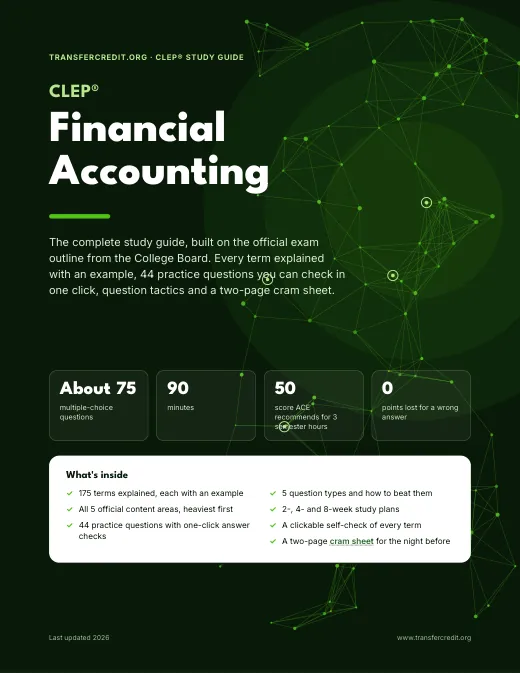
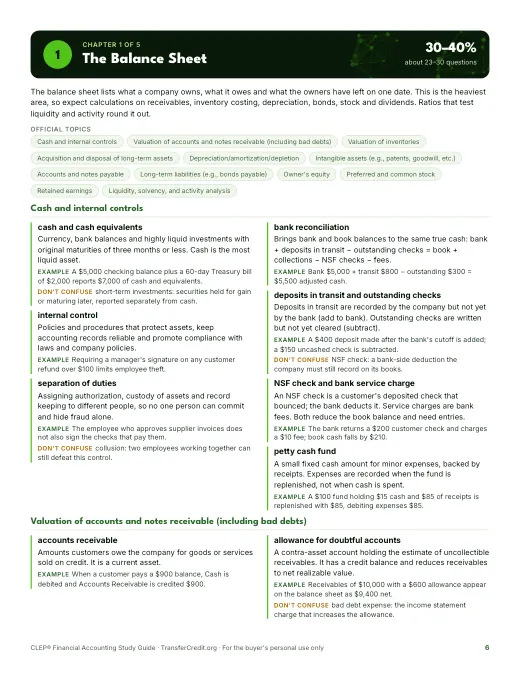
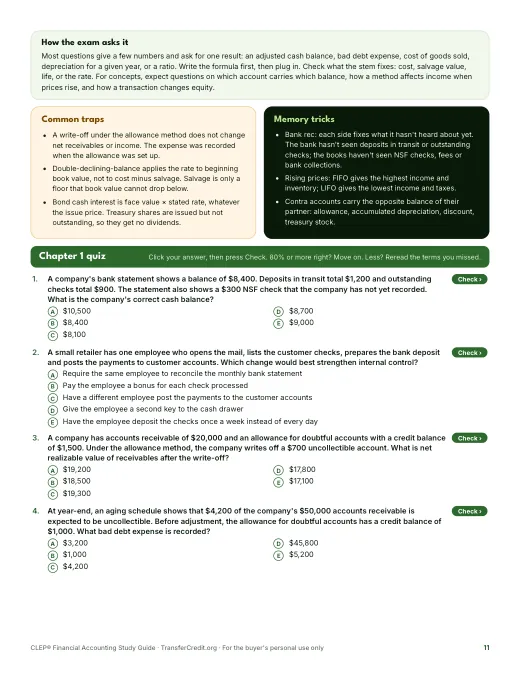
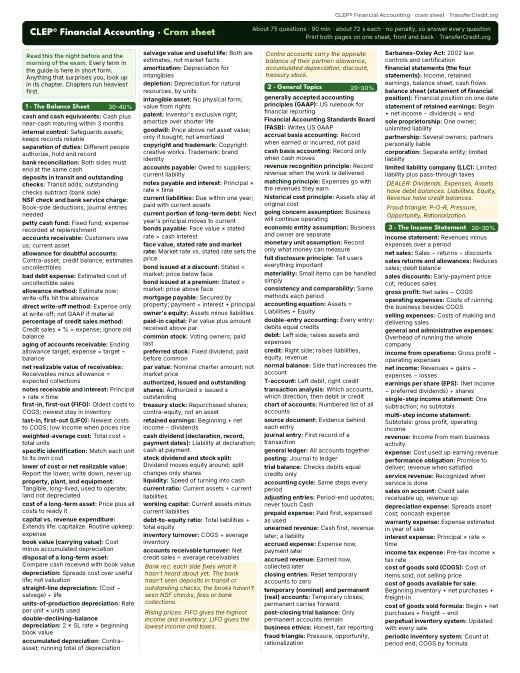
One chapter for each official content area, in the order the exam weighs them.
In the style of the real exam, from all 5 areas. About 10 minutes, with every answer explained and a score by area.
A company's bank statement shows a balance of $8,400. Deposits in transit total $1,200 and outstanding checks total $900. The statement also shows a $300 NSF check that the company has not yet recorded. What is the company's correct cash balance?
Answer: A. $8,700. Adjust the bank side: $8,400 + $1,200 − $900 = $8,700. The bank has already deducted the NSF check, so it adjusts only the book side, which must also end at $8,700.
The trap: $8,400 subtracts the NSF check on the bank side too. The bank has already deducted it, so it adjusts only the book balance.
Adjust the bank side: $8,400 + $1,200 − $900 = $8,700. The bank has already deducted the NSF check, so it adjusts only the book side, which must also end at $8,700.
The trap: $8,400 subtracts the NSF check on the bank side too. The bank has already deducted it, so it adjusts only the book balance.
A business has total assets of $80,000 and total liabilities of $30,000. It then buys equipment for $10,000 on account. After the purchase, what is the owner's equity?
Answer: C. $50,000. The purchase raises both assets and liabilities by $10,000, so equity is unchanged: $80,000 + $10,000 = $90,000 in assets, less $40,000 in liabilities, leaves $50,000.
The trap: $60,000 adds the equipment to assets but forgets that the amount owed rose by the same $10,000.
The purchase raises both assets and liabilities by $10,000, so equity is unchanged: $80,000 + $10,000 = $90,000 in assets, less $40,000 in liabilities, leaves $50,000.
The trap: $60,000 adds the equipment to assets but forgets that the amount owed rose by the same $10,000.
During the year a retailer had sales of $100,000, sales returns and allowances of $4,000, sales discounts of $2,000 and cost of goods sold of $60,000. Gross profit is
Answer: D. $34,000. Net sales = $100,000 − $4,000 − $2,000 = $94,000. Gross profit = $94,000 − $60,000 = $34,000.
The trap: $94,000 is net sales. Gross profit still requires subtracting cost of goods sold.
Net sales = $100,000 − $4,000 − $2,000 = $94,000. Gross profit = $94,000 − $60,000 = $34,000.
The trap: $94,000 is net sales. Gross profit still requires subtracting cost of goods sold.
A company reports net income of $30,000, depreciation expense of $6,000, a $4,000 increase in accounts receivable, a $2,000 increase in accounts payable and a $1,000 gain on the sale of equipment. Using the indirect method, what is net cash from operating activities?
Answer: E. $33,000. Start with $30,000. Add depreciation $6,000, subtract the receivables increase $4,000, add the payables increase $2,000 and subtract the gain $1,000: $33,000.
The trap: $35,000 adds the gain instead of subtracting it. The gain is not operating cash; the sale proceeds belong in investing.
Start with $30,000. Add depreciation $6,000, subtract the receivables increase $4,000, add the payables increase $2,000 and subtract the gain $1,000: $33,000.
The trap: $35,000 adds the gain instead of subtracting it. The gain is not operating cash; the sale proceeds belong in investing.
An investor pays $200,000 for 30% of a company's stock and has significant influence over it. During the year the investee reports net income of $80,000 and pays total dividends of $20,000. At year-end, what is the investment balance under the equity method?
Answer: B. $218,000. Investment = $200,000 + 30% of income ($24,000) − 30% of dividends ($6,000) = $218,000.
The trap: $224,000 adds the share of income but forgets that dividends received reduce the investment under the equity method.
Investment = $200,000 + 30% of income ($24,000) − 30% of dividends ($6,000) = $218,000.
The trap: $224,000 adds the share of income but forgets that dividends received reduce the investment under the equity method.
A small retailer has one employee who opens the mail, lists the customer checks, prepares the bank deposit and posts the payments to customer accounts. Which change would best strengthen internal control?
Answer: A. Have a different employee post the payments to the customer accounts. Internal control relies on separation of duties. When a second person handles the records, no single employee can take a payment and hide it.
The trap: Letting the same employee reconcile the bank statement adds another duty to the same person, so it weakens control rather than strengthening it.
Internal control relies on separation of duties. When a second person handles the records, no single employee can take a payment and hide it.
The trap: Letting the same employee reconcile the bank statement adds another duty to the same person, so it weakens control rather than strengthening it.
A dance studio receives $1,200 in advance for 12 lessons it will teach next month. Which entry records the receipt?
Answer: E. Debit Cash $1,200; credit Unearned Revenue $1,200. Cash increases (debit). The studio now owes lessons, which is a liability, so Unearned Revenue is credited. Revenue is recorded as the lessons are taught.
The trap: Crediting Service Revenue records revenue that has not been earned yet, because no lesson has been taught.
Cash increases (debit). The studio now owes lessons, which is a liability, so Unearned Revenue is credited. Revenue is recorded as the lessons are taught.
The trap: Crediting Service Revenue records revenue that has not been earned yet, because no lesson has been taught.
A company reports beginning inventory of $10,000, purchases of $40,000, purchase returns of $2,000, purchase discounts of $1,000, freight-in of $3,000 and ending inventory of $14,000. Cost of goods sold is
Answer: C. $36,000. Net purchases = $40,000 − $2,000 − $1,000 = $37,000. Goods available = $10,000 + $37,000 + $3,000 = $50,000. COGS = $50,000 − $14,000 = $36,000.
The trap: $50,000 is the cost of goods available for sale. Ending inventory must still be subtracted.
Net purchases = $40,000 − $2,000 − $1,000 = $37,000. Goods available = $10,000 + $37,000 + $3,000 = $50,000. COGS = $50,000 − $14,000 = $36,000.
The trap: $50,000 is the cost of goods available for sale. Ending inventory must still be subtracted.
Which of the following is reported as a financing activity on a US GAAP statement of cash flows?
Answer: D. Payment of cash dividends to shareholders. Dividends paid to the company's own shareholders are a return to owners, so they are a financing outflow.
The trap: Interest paid on a loan is tempting because the loan is financing, but US GAAP classifies interest paid as operating.
Dividends paid to the company's own shareholders are a return to owners, so they are a financing outflow.
The trap: Interest paid on a loan is tempting because the loan is financing, but US GAAP classifies interest paid as operating.
A company buys 100 shares of another corporation's stock at $40 per share. The small stake gives it no significant influence. At year-end the shares trade at $46. Under current US GAAP, how is the change reported?
Answer: B. A $600 unrealized gain in net income. Stock held without significant influence is carried at fair value, and unrealized gains and losses go to net income: 100 × ($46 − $40) = $600.
The trap: Other comprehensive income was used for available-for-sale stock under the old rules. Under current GAAP, only available-for-sale debt securities use it.
Stock held without significant influence is carried at fair value, and unrealized gains and losses go to net income: 100 × ($46 − $40) = $600.
The trap: Other comprehensive income was used for available-for-sale stock under the old rules. Under current GAAP, only available-for-sale debt securities use it.
The CLEP Financial Accounting exam is a 90-minute, computer-based test from the College Board with about 75 multiple-choice questions. A score of 50 on the 20–80 scale earns an ACE credit recommendation of 3 semester hours, though each college sets its own policy. The exam covers 5 content areas; the heaviest is the Balance Sheet at 30–40%.
5 areas, heaviest first. The guide's chapters follow this order.
Start with the guide, or get everything for CLEP in one plan.
CLEP® is a registered trademark of the College Board, which was not involved in producing this guide and does not endorse it. TransferCredit.org is independent and not affiliated with the College Board. © 2026 UPI Globale Edu Inc.