← CLEP Information Systems course
CLEP® Study Guide Printable PDF · 37 pages

CLEP Information Systems Study Guide

Everything the CLEP Information Systems exam tests, in one PDF you can print. Built from the College Board's official outline, heaviest topics first.

  • 179 key terms, each with an example
  • 41 practice questions with every answer explained
  • A 2-page cram sheet for the night before
  • 2-, 4- and 8-week study plans built from the exam weights
Not sure yet? Try 10 free questions

Last updated 2026 · exam details checked against the College Board's published exam information in 2026

Look inside the guide

Real pages from the 37-page PDF.

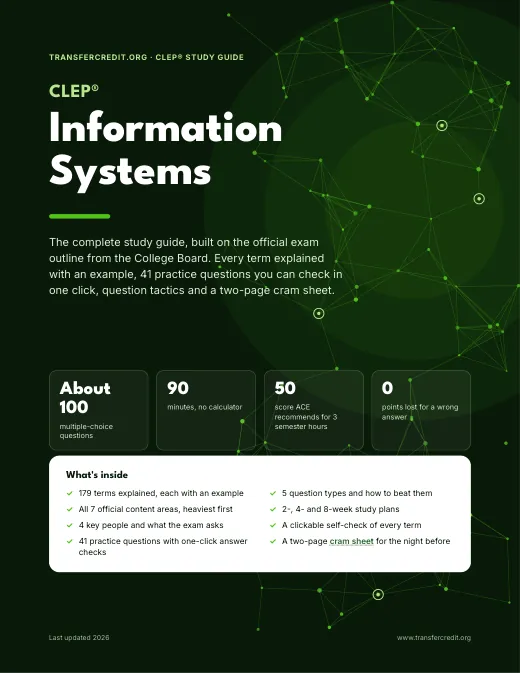
Page 1 of the CLEP Information Systems Study Guide: the cover
Page 1 The cover
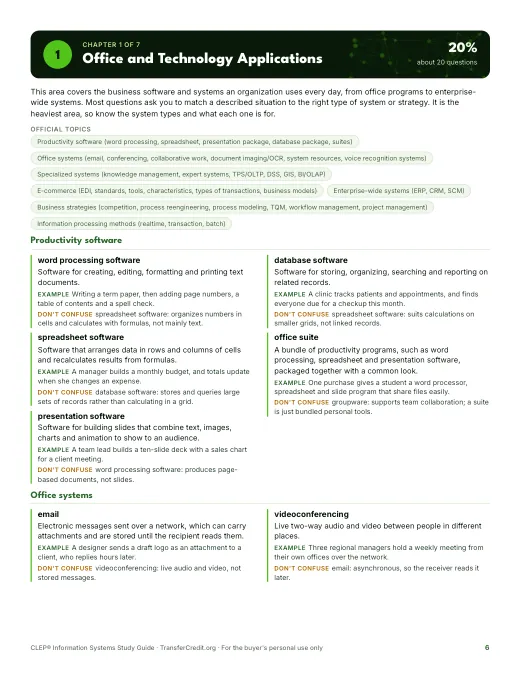
Page 6 of the CLEP Information Systems Study Guide: the Chapter 1 opener
Page 6 The Chapter 1 opener
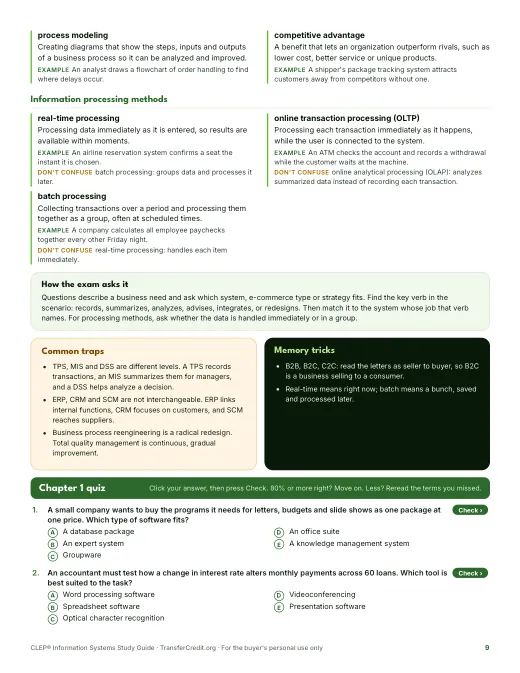
Page 9 of the CLEP Information Systems Study Guide: a chapter quiz
Page 9 A chapter quiz
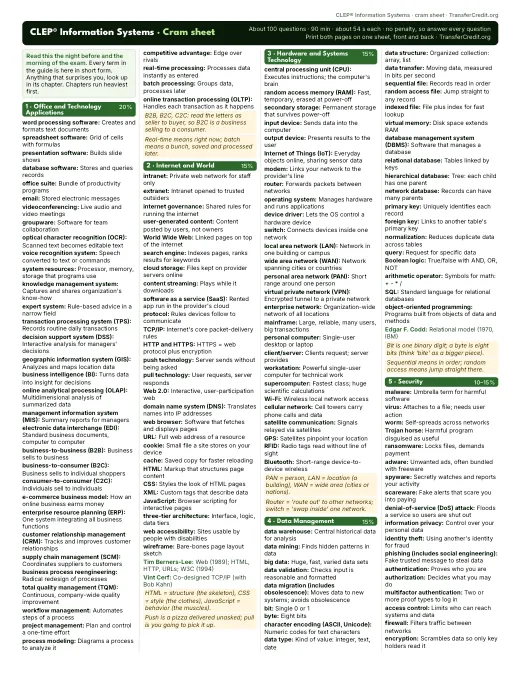
Page 36 of the CLEP Information Systems Study Guide: the 2-page cram sheet
Page 36 The 2-page cram sheet

What you get for $5

One chapter for each official content area, in the order the exam weighs them.

  • 📘37pages, printable
  • 🧭7chapters, heaviest first
  • 🔑179terms with examples
  • ✍️41practice questions, answers explained
  • ⚠️20exam traps to avoid
  • 📄2page cram sheet

Try 10 free Information Systems questions

In the style of the real exam, from all 7 areas. About 10 minutes, with every answer explained and a score by area.

10 questions  
  1. Question 1 · Office and Technology Applications

    A small company wants to buy the programs it needs for letters, budgets and slide shows as one package at one price. Which type of software fits?

    Show the answer

    Answer: C. An office suite. An office suite bundles word processing, spreadsheet and presentation programs.

    The trap: Groupware sounds right because it is used in offices, but it is built for team collaboration, not for bundling personal productivity tools.

  2. Question 2 · Internet and World Wide Web

    A company wants its suppliers, but not the public, to check delivery schedules through a browser using their own logins. Which network fits?

    Show the answer

    Answer: E. Extranet. An extranet extends a company's private web network to selected outsiders such as suppliers, who must log in.

    The trap: An intranet is tempting because it is also private, but it serves only the organization's own employees, not outside suppliers.

  3. Question 3 · Hardware and Systems Technology

    A user is editing a long document and the power fails before saving. The unsaved changes are gone, but older saved files are fine. Which component lost the unsaved work?

    Show the answer

    Answer: B. RAM. RAM is temporary working memory, so its contents disappear when power is lost.

    The trap: A solid-state drive is tempting because it stores files, but it is nonvolatile and keeps saved data without power.

  4. Question 4 · Data Management and Programming Concepts

    A retailer copies years of sales from all its stores into one repository so analysts can study trends. What is this repository?

    Show the answer

    Answer: D. A data warehouse. A central repository of integrated historical data built for analysis is a data warehouse.

    The trap: A transaction processing system records daily sales as they happen; it is not a historical store built for analysis.

  5. Question 5 · Security

    An employee opens an infected email attachment. The malicious code then inserts itself into other documents on her computer, and each of those spreads it further when opened. What is it?

    Show the answer

    Answer: A. A virus. A virus attaches to a legitimate file and spreads when a user opens or shares that file.

    The trap: A worm is tempting because it also spreads, but a worm is a standalone program that travels across networks by itself; it does not insert itself into other files.

  6. Question 6 · Social and Ethical Implications and Issues

    A U.S. bank closes its in-house payroll department and hires a company in India to process its paychecks. This decision is best described as both

    Show the answer

    Answer: B. outsourcing and offshoring. The work goes to an outside company (outsourcing) located in another country (offshoring).

    The trap: Insourcing is the opposite of outsourcing, since it keeps or returns work to the company's own staff.

  7. Question 7 · Software Development

    A bank is about to build a new loan system. Before assigning programmers, it asks whether the project is technically doable, whether savings exceed costs and whether staff can use it. Which activity is this?

    Show the answer

    Answer: A. A feasibility study. A feasibility study judges early whether a proposed system is practical, in technical, economic and operational terms.

    The trap: Systems design is tempting because it is an early phase, but it specifies how the system will work, after the project is judged worthwhile.

  8. Question 8 · Office and Technology Applications

    An accountant must test how a change in interest rate alters monthly payments across 60 loans. Which tool is best suited to the task?

    Show the answer

    Answer: D. Spreadsheet software. A spreadsheet recalculates formulas across rows of numbers when one value changes.

    The trap: Word processing software handles text documents; it can hold a table, but it is not built to recalculate formulas across many rows of numbers.

  9. Question 9 · Internet and World Wide Web

    A user types a website name into a browser, and the browser must find the server that hosts it. Which service converts the name into a numeric address?

    Show the answer

    Answer: E. Domain name system. DNS is the directory service that translates domain names into the IP addresses computers use to locate servers.

    The trap: HTTP is tempting because it moves web pages, but it requests and delivers pages after the address is already known.

  10. Question 10 · Hardware and Systems Technology

    A small office has twelve computers that must share files and a printer, and also reach the internet through a single connection. Which device forwards traffic between the office network and the internet?

    Show the answer

    Answer: C. Router. A router forwards packets between different networks, such as a local network and the internet.

    The trap: A switch is tempting because it also moves data, but it connects devices inside one network and does not link to the outside.

The CLEP Information Systems exam at a glance

The CLEP Information Systems exam is a 90-minute, computer-based test from the College Board with about 100 multiple-choice questions. A score of 50 on the 20–80 scale earns an ACE credit recommendation of 3 semester hours, though each college sets its own policy. The exam covers 7 content areas; the heaviest is Office and Technology Applications at 20%.

Questions
About 100multiple choice
Time
90 minabout 54 seconds a question
Passing score
50on a 20–80 scale
ACE credit
3semester hours
Exam fee
$97paid to College Board
Calculator
Nonot allowed

Source: official CLEP Information Systems exam page.

What the exam covers

7 areas, heaviest first. The guide's chapters follow this order.

  1. Office and Technology Applications20%
  2. Internet and World Wide Web15%
  3. Hardware and Systems Technology15%
  4. Data Management and Programming Concepts15%
  5. Security10–15%
  6. Social and Ethical Implications and Issues10–15%
  7. Software Development10%

How it works

  1. 1Buy once, $5Secure checkout. No subscription needed.
  2. 2Download the PDFFrom your TransferCredit.org account, right away and any time later.
  3. 3Study the heaviest areas firstFollow the 2-, 4- or 8-week plan, then read the cram sheet the night before.

Questions students ask

What's in the full CLEP Information Systems study guide?
37 pages: 7 chapters, one per official content area, heaviest first. 179 terms, each with a plain-English definition and an example, 4 key people, common traps and memory tricks, 41 practice questions with an answer key that explains every answer, question tactics, 2-, 4- and 8-week study plans and a 2-page cram sheet.
How much is the full CLEP Information Systems study guide?
The full 37-page PDF is $5, a one-time payment. The 10 practice questions on this page are free, with no account.
What does the $29 plan include?
$29 a month gives you all 28 CLEP subjects: every CLEP study guide plus the full prep course for each subject, and you can cancel anytime. If you only need this exam, the guide on its own is a one-time $5.
How do I get the full guide?
Choose Buy this guide ($5) and check out. Then sign in to your TransferCredit.org account, then open the course and its Download Your Study Guide lesson. The PDF is yours to keep, and you can download it again from your account at any time.
Can I print the guide or use it on my phone?
Yes. It's a PDF, so it opens on phones, tablets and computers, and printing is allowed. Its tick boxes and answer bubbles work in PDF readers that support forms. Copying and editing are turned off.
Is this an official CLEP study guide?
No. CLEP® is a registered trademark of the College Board, which was not involved in producing this guide and does not endorse it. TransferCredit.org is independent. We built the guide from the official exam outline, and the exam details were checked against the College Board's published exam information in 2026.
Why is this study guide better than a generic review?
It follows the official outline area by area and spends the most pages on what the exam weighs most. Every term comes with an example, each chapter names the traps the exam sets, and the answer key explains why the most tempting wrong answer is wrong, not just which answer is right. It ends with a 2-page cram sheet for the night before.
What is the CLEP Information Systems exam?
The CLEP Information Systems exam is a 90-minute, computer-based test from the College Board with about 100 multiple-choice questions. A score of 50 on the 20–80 scale earns an ACE credit recommendation of 3 semester hours, though each college sets its own policy. The exam covers 7 content areas; the heaviest is Office and Technology Applications at 20%.
More questions about the CLEP Information Systems exam (22)
How many questions are on the CLEP Information Systems exam, and how long is it?
The exam has approximately 100 questions to be answered in 90 minutes, and some are pretest questions that will not be scored.
What is the passing score for CLEP Information Systems?
The passing score is 50 on a 20–80 scale. At 50 or above, the American Council on Education (ACE) recommends 3 semester hours. Each college sets its own passing score and credit award, so check your school's policy before you book.
How much does the CLEP Information Systems exam cost?
The exam fee is $97, paid to the College Board. Test centers may add their own administration fee. Eligible U.S. military service members can usually test for free through DANTES.
How many college credits is CLEP Information Systems worth?
ACE recommends 3 semester hours for a passing score of 50. Your college decides how many credits it awards and which course they replace. Check your college's policy.
Can I use a calculator on the CLEP Information Systems exam?
No. This exam doesn't allow a calculator.
Is there a penalty for guessing on CLEP Information Systems?
No. Your score counts only correct answers, so a wrong answer costs nothing. Never leave a question blank: rule out what you can and pick your best guess.
What topics are on the CLEP Information Systems exam?
7 content areas, from the official outline: Office and Technology Applications (20%); Internet and World Wide Web (15%); Hardware and Systems Technology (15%); Data Management and Programming Concepts (15%); Security (10–15%); Social and Ethical Implications and Issues (10–15%); Software Development (10%).
Which CLEP Information Systems topics should I study first?
Start with the three heaviest: Office and Technology Applications (20%), Internet and World Wide Web (15%) and Hardware and Systems Technology (15%). Together they are about 50% of the exam, roughly 50 of 100 questions. The guide's chapters run in that order, heaviest first.
Is the CLEP Information Systems exam hard?
It depends on what you already know. No single area dominates: the largest, Office and Technology Applications, is 20% and the smallest, Software Development, is 10%, so broad coverage matters more than deep expertise in one topic. Take the free diagnostic above to see where you stand in about 10 minutes.
What kinds of questions are on the CLEP Information Systems exam?
The guide sorts them into 5 types: “Match the scenario to the system”, “Name the term from its definition”, “Which is the best choice”, “Compare two similar concepts” and “Apply logic or a process”. Every question has 5 answer choices. Try the 10 free questions above to see the style.
How long should I study for CLEP Information Systems?
Use the diagnostic to decide. If you already know most areas, two weeks of daily review is often enough; if the subject is new to you, plan on eight. The full guide has 2-, 4- and 8-week plans built from the exam weights.
How should I pace myself on the CLEP Information Systems exam?
On average you have about 54 seconds per question (90 minutes for 100 questions). Be past question 33 a third of the way through and past question 67 two-thirds through. If a question takes more than a minute, pick your best guess, mark it and come back.
What happens if I don't pass CLEP Information Systems?
You can retake a CLEP exam after three months. Use the wait to work through the areas the score report and the diagnostic show you missed.
Do colleges accept CLEP Information Systems for credit?
CLEP exams are accepted at more than 2,900 U.S. colleges and universities, but each school decides which exams it accepts, the score it requires and the credit it gives. Look up your college's CLEP policy before you book.
How is the guide different from the CLEP Information Systems course?
The guide is a 37-page PDF for review and self-testing. The CLEP Information Systems course is a full online course with lessons, quizzes and a practice exam, for $19 with lifetime access. Many students use the guide first, then take the course for the areas the diagnostic flags.
Should I take CLEP Information Systems or DSST Management Information Systems?
Both cover the same subject. CLEP Information Systems: about 100 questions, 90 minutes, passing score 50, fee $97. DSST Management Information Systems: about 100 questions, 120 minutes, passing score 400, fee $100. Take the one your college accepts; most colleges award the credit once, not for both. See the DSST Management Information Systems study guide.
How up to date is this CLEP Information Systems guide?
Last updated 2026. The exam details were checked against the College Board's published exam information in 2026. Exams change, so confirm the details on the official exam page before you register.
What should I do the night before the exam?
Read the cram sheet once, slowly. Check your test time, the location or remote-proctoring setup, and the ID you need. Then sleep: a rested brain recalls more than a crammed one. In the morning, skim the memory tricks and common traps, then stop studying.
Do I need to know programming for CLEP Information Systems?
No. You need programming concepts — Boolean logic, SQL basics, structured versus object-oriented approaches — but you won't write code.
Do I need to know Microsoft Word or Excel for CLEP Information Systems?
No specific product is required. The College Board says references to applications such as word processing or spreadsheets don't require knowledge of a particular program; questions focus on concepts that apply across products, such as what productivity software and office systems do for an organization.
How much math is on CLEP Information Systems?
Very little. The College Board assumes math at the level of a first-year high school algebra course, and what appears is mostly Boolean, arithmetic and SQL logic within the Data Management and Programming Concepts area, 15% of the exam.
Is CLEP Information Systems the same as DSST Management Information Systems?
No. They are separate exams from different providers with different outlines. CLEP Information Systems is broader on applications, the web and hardware; DSST MIS focuses more on data, decision-making and managing information systems in the enterprise.

Choose how you want to study

Start with the guide, or get everything for CLEP in one plan.

This study guide
$5one-time
  • 37-page printable PDF
  • 179 terms with examples
  • 41 practice questions, answers explained
  • 2-page cram sheet and study plans
Get the guide · $5
Best value Get it all
$29/month
  • Every CLEP study guide
  • Prep courses for all 28 CLEP subjects
  • Cancel anytime
Get it all · $29/mo

CLEP® is a registered trademark of the College Board, which was not involved in producing this guide and does not endorse it. TransferCredit.org is independent and not affiliated with the College Board. © 2026 UPI Globale Edu Inc.