
$5one-time
- 35-page printable PDF
- 180 terms with examples
- 40 practice questions, answers explained
- 2-page cram sheet and study plans
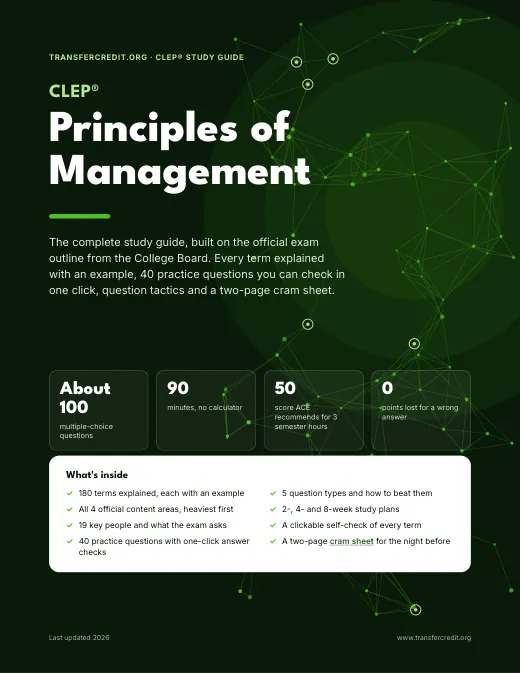
Everything the CLEP Principles of Management exam tests, in one PDF you can print. Built from the College Board's official outline, heaviest topics first.
Last updated 2026 · exam details checked against the College Board's published exam information in 2026
Real pages from the 35-page PDF.
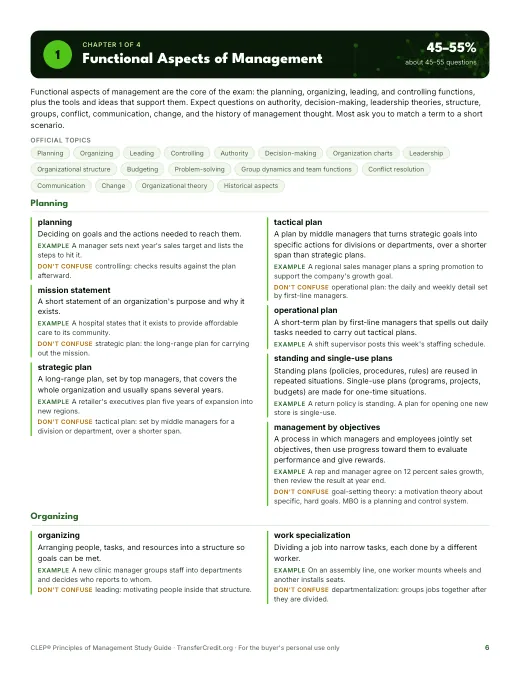
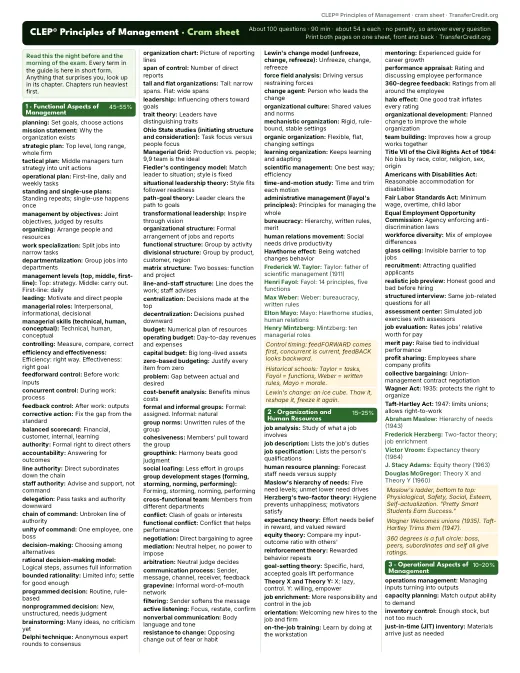
One chapter for each official content area, in the order the exam weighs them.
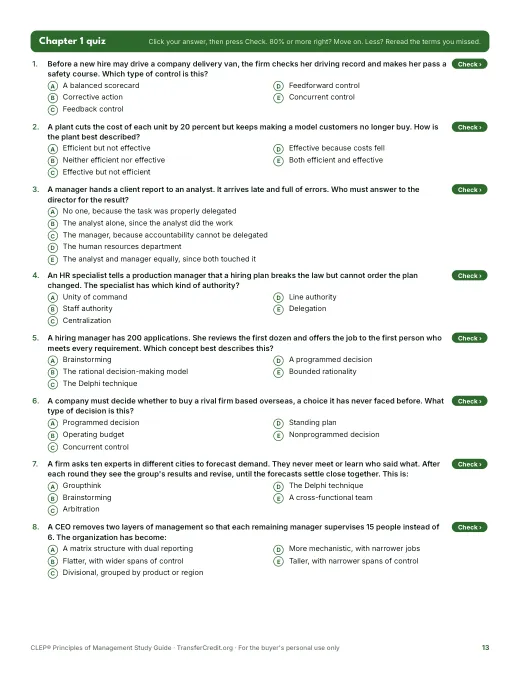
In the style of the real exam, from all 4 areas. About 10 minutes, with every answer explained and a score by area.
Before a new hire may drive a company delivery van, the firm checks her driving record and makes her pass a safety course. Which type of control is this?
Answer: E. Feedforward control. Screening and training an input, the driver, before any work begins is preventive, which defines feedforward control.
The trap: Concurrent control is wrong: it corrects work while it is happening, but these checks come before she ever drives.
Screening and training an input, the driver, before any work begins is preventive, which defines feedforward control.
The trap: Concurrent control is wrong: it corrects work while it is happening, but these checks come before she ever drives.
A company is posting a new accounting opening and wants a document that lists the education, certifications and experience a candidate must have. Which document should human resources prepare?
Answer: B. Job specification. A job specification lists the qualifications a person needs for the job. Education, certifications and experience are exactly those qualifications.
The trap: Job description is tempting because both documents come from job analysis, but it lists the duties and conditions of the job, not the person's qualifications.
A job specification lists the qualifications a person needs for the job. Education, certifications and experience are exactly those qualifications.
The trap: Job description is tempting because both documents come from job analysis, but it lists the duties and conditions of the job, not the person's qualifications.
A project has three separate chains of tasks that can run at the same time. They take 9 weeks, 14 weeks and 11 weeks. What is the earliest the whole project can finish?
Answer: A. 14 weeks. The project is finished only when every chain is done, so the longest chain, 14 weeks, sets the minimum time. That chain is the critical path.
The trap: 34 weeks is tempting because it adds the three chains, but they run at the same time, so their durations do not add up.
The project is finished only when every chain is done, so the longest chain, 14 weeks, sets the minimum time. That chain is the critical path.
The trap: 34 weeks is tempting because it adds the three chains, but they run at the same time, so their durations do not add up.
In one country, employees rarely question their managers' decisions and expect that bosses will hold much more power than subordinates. On Hofstede's dimensions, this culture is best described as having
Answer: C. high power distance. Accepting that power is distributed unequally, and deferring to those with more of it, is high power distance.
The trap: Low power distance is tempting if the terms get reversed. It describes cultures where people expect power to be shared fairly equally and readily question bosses.
Accepting that power is distributed unequally, and deferring to those with more of it, is high power distance.
The trap: Low power distance is tempting if the terms get reversed. It describes cultures where people expect power to be shared fairly equally and readily question bosses.
A plant cuts the cost of each unit by 20 percent but keeps making a model customers no longer buy. How is the plant best described?
Answer: D. Efficient but not effective. Lower cost per unit means resources are used well (efficient), but making an unwanted product fails the goal (not effective).
The trap: Effective but not efficient is the reverse of the situation: costs fell, so the plant is efficient.
Lower cost per unit means resources are used well (efficient), but making an unwanted product fails the goal (not effective).
The trap: Effective but not efficient is the reverse of the situation: costs fell, so the plant is efficient.
Employees are satisfied with their pay, benefits and working conditions but say their work is routine and unrewarding. According to Herzberg's two-factor theory, what would most increase their motivation?
Answer: A. Giving them more responsibility and recognition. Pay, conditions, supervision and policies are hygiene factors that only prevent dissatisfaction. Responsibility, achievement and recognition are motivators that create satisfaction.
The trap: Raising salaries is tempting, but pay is a hygiene factor and these employees are already satisfied with it, so more pay will not make the work more motivating.
Pay, conditions, supervision and policies are hygiene factors that only prevent dissatisfaction. Responsibility, achievement and recognition are motivators that create satisfaction.
The trap: Raising salaries is tempting, but pay is a hygiene factor and these employees are already satisfied with it, so more pay will not make the work more motivating.
Last month a plant made 480 units using 60 labor hours. This month it made 540 units using the same 60 labor hours. What is this month's labor productivity?
Answer: D. 9 units per labor hour. Labor productivity is output divided by labor hours: 540 divided by 60 is 9 units per labor hour.
The trap: 8 units per labor hour is tempting because it is last month's figure (480 divided by 60), not this month's.
Labor productivity is output divided by labor hours: 540 divided by 60 is 9 units per labor hour.
The trap: 8 units per labor hour is tempting because it is last month's figure (480 divided by 60), not this month's.
Four neighboring countries agree to remove tariffs on most goods traded among them. Each country keeps its own tariffs on goods from outside the group. This arrangement is best described as
Answer: C. a free trade agreement. Members that drop tariffs among themselves but keep separate tariffs toward outsiders have a free trade agreement, like the USMCA. A customs union, common market or economic union also sets one common outside tariff.
The trap: A customs union is tempting because its members also trade without tariffs, but they charge outsiders one common tariff. Here each country keeps its own.
Members that drop tariffs among themselves but keep separate tariffs toward outsiders have a free trade agreement, like the USMCA. A customs union, common market or economic union also sets one common outside tariff.
The trap: A customs union is tempting because its members also trade without tariffs, but they charge outsiders one common tariff. Here each country keeps its own.
A manager hands a client report to an analyst. It arrives late and full of errors. Who must answer to the director for the result?
Answer: B. The manager, because accountability cannot be delegated. Delegation passes the task and the authority to do it, but the manager stays accountable for the outcome.
The trap: The analyst alone is wrong: the analyst has responsibility for doing the task, but the manager answers upward.
Delegation passes the task and the authority to do it, but the manager stays accountable for the outcome.
The trap: The analyst alone is wrong: the analyst has responsibility for doing the task, but the manager answers upward.
A sales representative learns that a coworker with the same duties and experience earns a higher commission rate. She begins making fewer client calls. Which theory best explains her change in effort?
Answer: E. Equity theory. She compared her rewards for her effort with her coworker's and found them unfair, then reduced her inputs. That is equity theory.
The trap: Expectancy theory links effort to the belief that effort leads to a valued reward. Her change came from comparison with another person, not from doubting she could earn the reward.
She compared her rewards for her effort with her coworker's and found them unfair, then reduced her inputs. That is equity theory.
The trap: Expectancy theory links effort to the belief that effort leads to a valued reward. Her change came from comparison with another person, not from doubting she could earn the reward.
The CLEP Principles of Management exam is a 90-minute, computer-based test from the College Board with about 100 multiple-choice questions. A score of 50 on the 20–80 scale earns an ACE credit recommendation of 3 semester hours, though each college sets its own policy. The exam covers 4 content areas; the heaviest is Functional Aspects of Management at 45–55%.
4 areas, heaviest first. The guide's chapters follow this order.
Start with the guide, or get everything for CLEP in one plan.
CLEP® is a registered trademark of the College Board, which was not involved in producing this guide and does not endorse it. TransferCredit.org is independent and not affiliated with the College Board. © 2026 UPI Globale Edu Inc.