← CLEP Principles of Marketing course
CLEP® Study Guide Printable PDF · 32 pages

CLEP Principles of Marketing Study Guide

Everything the CLEP Principles of Marketing exam tests, in one PDF you can print. Built from the College Board's official outline, heaviest topics first.

  • 181 key terms, each with an example
  • 41 practice questions with every answer explained
  • A 2-page cram sheet for the night before
  • 2-, 4- and 8-week study plans built from the exam weights
Not sure yet? Try 10 free questions

Last updated 2026 · exam details checked against the College Board's published exam information in 2026

Look inside the guide

Real pages from the 32-page PDF.

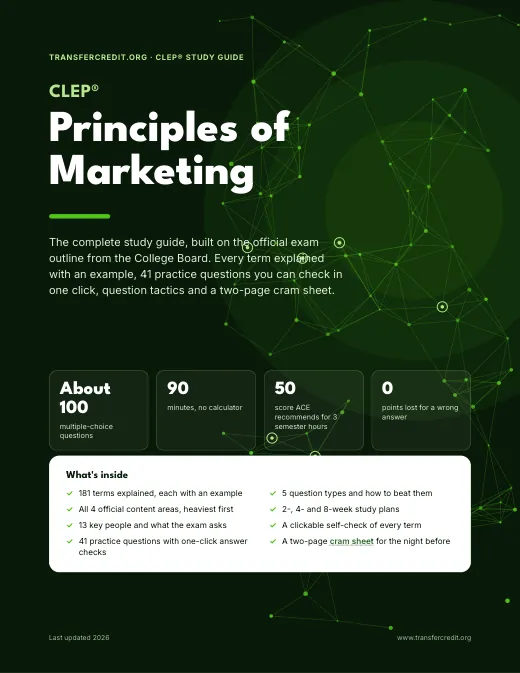
Page 1 of the CLEP Principles of Marketing Study Guide: the cover
Page 1 The cover
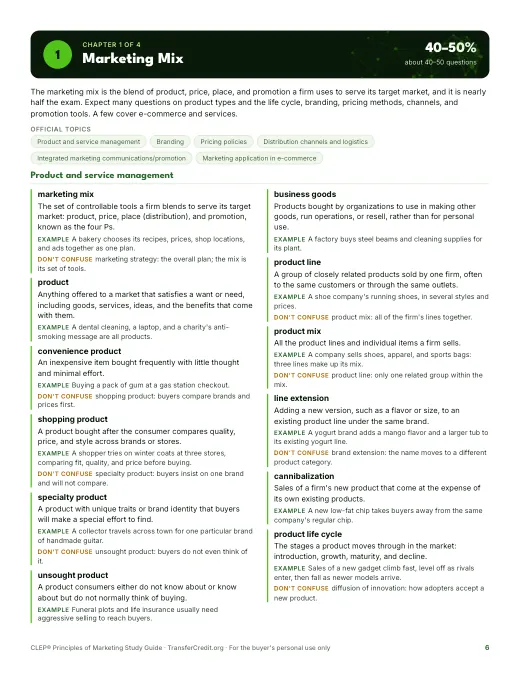
Page 6 of the CLEP Principles of Marketing Study Guide: the Chapter 1 opener
Page 6 The Chapter 1 opener
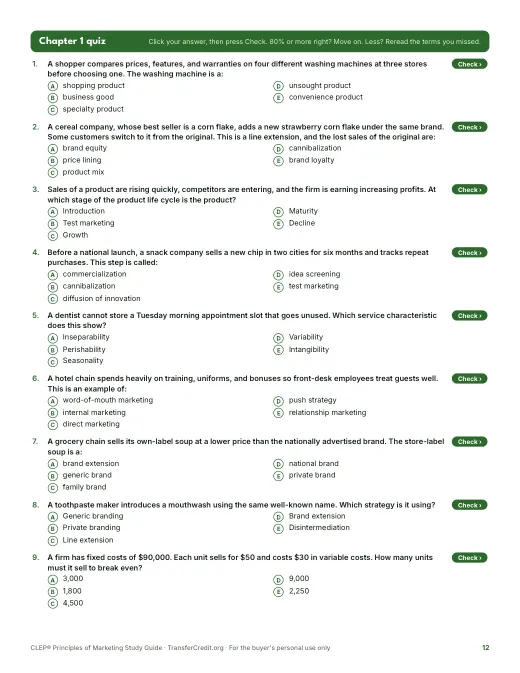
Page 12 of the CLEP Principles of Marketing Study Guide: a chapter quiz
Page 12 A chapter quiz
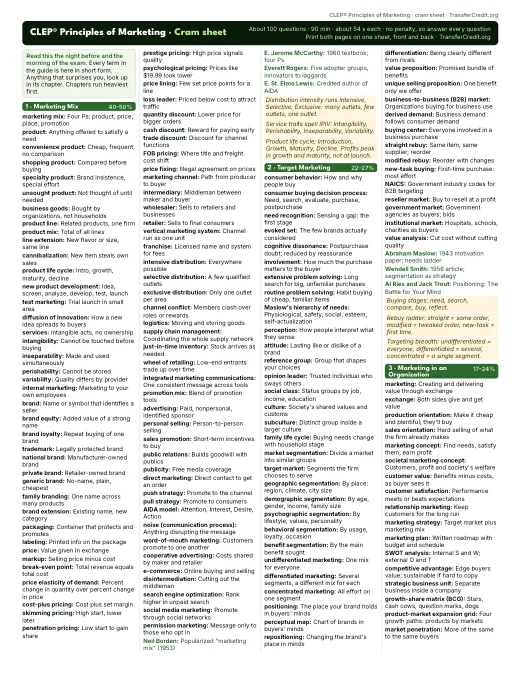
Page 31 of the CLEP Principles of Marketing Study Guide: the 2-page cram sheet
Page 31 The 2-page cram sheet

What you get for $5

One chapter for each official content area, in the order the exam weighs them.

  • 📘32pages, printable
  • 🧭4chapters, heaviest first
  • 🔑181terms with examples
  • ✍️41practice questions, answers explained
  • ⚠️12exam traps to avoid
  • 📄2page cram sheet

Try 10 free Principles of Marketing questions

In the style of the real exam, from all 4 areas. About 10 minutes, with every answer explained and a score by area.

10 questions  
  1. Question 1 · Marketing Mix

    A shopper compares prices, features, and warranties on four different washing machines at three stores before choosing one. The washing machine is a:

    Show the answer

    Answer: B. shopping product. Buyers compare quality, price, and style before purchase, which defines a shopping product.

    The trap: Specialty product is wrong because the shopper is willing to compare brands, not insisting on one.

  2. Question 2 · Target Marketing

    Two days after buying an expensive television, a customer keeps wondering whether a cheaper model would have been just as good. Which concept describes this feeling?

    Show the answer

    Answer: A. Cognitive dissonance. Doubt after a purchase about whether the right choice was made is cognitive dissonance.

    The trap: Need recognition is tempting because it is a stage of buying, but it is the first stage, before any purchase.

  3. Question 3 · Role of Marketing in an Organization

    A manufacturer assumes consumers will buy as long as products are cheap and easy to find, so it focuses on running its factories more efficiently and widening distribution. Which philosophy guides the firm?

    Show the answer

    Answer: D. Production orientation. The firm focuses on efficient production and availability, assuming buyers will take whatever is affordable and available. That is production orientation.

    The trap: Sales orientation is tempting because wider distribution sounds like selling, but a sales orientation relies on heavy persuasion, which the firm does not use.

  4. Question 4 · Role of Marketing in Society

    A country announces that no more than 40,000 imported bicycles may enter each year. Which trade barrier is this?

    Show the answer

    Answer: E. Quota. A quota limits the quantity of a product that may be imported. Here the limit is a number of bicycles per year.

    The trap: Embargo is tempting because both restrict imports, but an embargo bans trade outright rather than capping the amount.

  5. Question 5 · Marketing Mix

    A cereal company, whose best seller is a corn flake, adds a new strawberry corn flake under the same brand. Some customers switch to it from the original. This is a line extension, and the lost sales of the original are:

    Show the answer

    Answer: C. cannibalization. A new item taking sales from the firm's own existing item is cannibalization.

    The trap: Brand loyalty is wrong because those customers are staying with the brand; the sales are merely moving within it.

  6. Question 6 · Target Marketing

    A shopper knows ten brands of running shoes but seriously compares only three of them before buying. Those three brands make up her:

    Show the answer

    Answer: E. Evoked set. The brands a buyer actually considers, out of all the brands known, form the evoked set.

    The trap: Target market is tempting because it also involves a chosen few, but a target market is a group of buyers a firm chooses, not brands a shopper considers.

  7. Question 7 · Role of Marketing in an Organization

    Before designing a new tablet, a firm interviews buyers about their frustrations and then builds features to solve them. Which philosophy does this show?

    Show the answer

    Answer: B. The marketing concept. The firm starts with customer needs and designs to satisfy them. That is the marketing concept.

    The trap: Production orientation is tempting because the firm is making a product, but it starts from the factory, not from customer needs.

  8. Question 8 · Role of Marketing in Society

    A U.S. toy company lets a Mexican manufacturer produce and sell toys with the company's cartoon characters in return for royalties on each sale. The U.S. firm owns no part of the Mexican business. Which method of entering a foreign market is this?

    Show the answer

    Answer: C. Licensing. The firm grants rights to its characters for fees and keeps no ownership. That is licensing.

    The trap: Joint venture is tempting because a partner is involved, but a joint venture means shared ownership, which is absent here.

  9. Question 9 · Marketing Mix

    Sales of a product are rising quickly, competitors are entering, and the firm is earning increasing profits. At which stage of the product life cycle is the product?

    Show the answer

    Answer: D. Growth. Rapid sales gains, new competitors, and rising profits mark the growth stage.

    The trap: Maturity is wrong because sales growth has leveled off there and competition has already intensified.

  10. Question 10 · Target Marketing

    A family that has just lost its income cuts spending on streaming services and vacations but keeps buying groceries and paying rent. Which idea from Maslow's hierarchy of needs best explains this?

    Show the answer

    Answer: A. Lower-level needs are met before higher ones. Food and housing are basic needs, and in Maslow's ranking they come before higher needs such as leisure and status.

    The trap: Esteem needs before safety needs is tempting if trips seem like status symbols, but in Maslow's hierarchy safety is the lower, more basic need, so it comes first.

The CLEP Principles of Marketing exam at a glance

The CLEP Principles of Marketing exam is a 90-minute, computer-based test from the College Board with about 100 multiple-choice questions. A score of 50 on the 20–80 scale earns an ACE credit recommendation of 3 semester hours, though each college sets its own policy. The exam covers 4 content areas; the heaviest is Marketing Mix at 40–50%.

Questions
About 100multiple choice
Time
90 minabout 54 seconds a question
Passing score
50on a 20–80 scale
ACE credit
3semester hours
Exam fee
$97paid to College Board
Calculator
Nonot allowed

Source: official CLEP Principles of Marketing exam page.

What the exam covers

4 areas, heaviest first. The guide's chapters follow this order.

  1. Marketing Mix40–50%
  2. Target Marketing22–27%
  3. Role of Marketing in an Organization17–24%
  4. Role of Marketing in Society8–13%

How it works

  1. 1Buy once, $5Secure checkout. No subscription needed.
  2. 2Download the PDFFrom your TransferCredit.org account, right away and any time later.
  3. 3Study the heaviest areas firstFollow the 2-, 4- or 8-week plan, then read the cram sheet the night before.

Questions students ask

What's in the full CLEP Principles of Marketing study guide?
32 pages: 4 chapters, one per official content area, heaviest first. 181 terms, each with a plain-English definition and an example, 13 key people, common traps and memory tricks, 41 practice questions with an answer key that explains every answer, question tactics, 2-, 4- and 8-week study plans and a 2-page cram sheet.
How much is the full CLEP Principles of Marketing study guide?
The full 32-page PDF is $5, a one-time payment. The 10 practice questions on this page are free, with no account.
What does the $29 plan include?
$29 a month gives you all 28 CLEP subjects: every CLEP study guide plus the full prep course for each subject, and you can cancel anytime. If you only need this exam, the guide on its own is a one-time $5.
How do I get the full guide?
Choose Buy this guide ($5) and check out. Then sign in to your TransferCredit.org account, then open the course and its Download Your Study Guide lesson. The PDF is yours to keep, and you can download it again from your account at any time.
Can I print the guide or use it on my phone?
Yes. It's a PDF, so it opens on phones, tablets and computers, and printing is allowed. Its tick boxes and answer bubbles work in PDF readers that support forms. Copying and editing are turned off.
Is this an official CLEP study guide?
No. CLEP® is a registered trademark of the College Board, which was not involved in producing this guide and does not endorse it. TransferCredit.org is independent. We built the guide from the official exam outline, and the exam details were checked against the College Board's published exam information in 2026.
Why is this study guide better than a generic review?
It follows the official outline area by area and spends the most pages on what the exam weighs most. Every term comes with an example, each chapter names the traps the exam sets, and the answer key explains why the most tempting wrong answer is wrong, not just which answer is right. It ends with a 2-page cram sheet for the night before.
What is the CLEP Principles of Marketing exam?
The CLEP Principles of Marketing exam is a 90-minute, computer-based test from the College Board with about 100 multiple-choice questions. A score of 50 on the 20–80 scale earns an ACE credit recommendation of 3 semester hours, though each college sets its own policy. The exam covers 4 content areas; the heaviest is Marketing Mix at 40–50%.
More questions about the CLEP Principles of Marketing exam (22)
How many questions are on the CLEP Principles of Marketing exam, and how long is it?
The exam has approximately 100 questions to be answered in 90 minutes. Some of the questions are pretest questions that will not be scored.
What is the passing score for CLEP Principles of Marketing?
The passing score is 50 on a 20–80 scale. At 50 or above, the American Council on Education (ACE) recommends 3 semester hours. Each college sets its own passing score and credit award, so check your school's policy before you book.
How much does the CLEP Principles of Marketing exam cost?
The exam fee is $97, paid to the College Board. Test centers may add their own administration fee. Eligible U.S. military service members can usually test for free through DANTES.
How many college credits is CLEP Principles of Marketing worth?
ACE recommends 3 semester hours for a passing score of 50. Your college decides how many credits it awards and which course they replace. Check your college's policy.
Can I use a calculator on the CLEP Principles of Marketing exam?
No. This exam doesn't allow a calculator.
Is there a penalty for guessing on CLEP Principles of Marketing?
No. Your score counts only correct answers, so a wrong answer costs nothing. Never leave a question blank: rule out what you can and pick your best guess.
What topics are on the CLEP Principles of Marketing exam?
4 content areas, from the official outline: Marketing Mix (40–50%); Target Marketing (22–27%); Role of Marketing in an Organization (17–24%); Role of Marketing in Society (8–13%).
Which CLEP Principles of Marketing topics should I study first?
Start with the three heaviest: Marketing Mix (40–50%), Target Marketing (22–27%) and Role of Marketing in an Organization (17–24%). Together they are about 90% of the exam, roughly 90 of 100 questions. The guide's chapters run in that order, heaviest first.
Is the CLEP Principles of Marketing exam hard?
It depends on what you already know. The exam has only 4 content areas, so each one carries real weight: Marketing Mix (40–50%), Target Marketing (22–27%), Role of Marketing in an Organization (17–24%) and Role of Marketing in Society (8–13%). Take the free diagnostic above to see where you stand in about 10 minutes.
What kinds of questions are on the CLEP Principles of Marketing exam?
The guide sorts them into 5 types: “Term definition”, “Scenario identification”, “Similar terms compared”, “Marketing mix element” and “EXCEPT and odd-one-out”. Every question has 5 answer choices. Try the 10 free questions above to see the style.
How long should I study for CLEP Principles of Marketing?
Use the diagnostic to decide. If you already know most areas, two weeks of daily review is often enough; if the subject is new to you, plan on eight. The full guide has 2-, 4- and 8-week plans built from the exam weights.
How should I pace myself on the CLEP Principles of Marketing exam?
On average you have about 54 seconds per question (90 minutes for 100 questions). Be past question 33 a third of the way through and past question 67 two-thirds through. If a question takes more than a minute, pick your best guess, mark it and come back.
What happens if I don't pass CLEP Principles of Marketing?
You can retake a CLEP exam after three months. Use the wait to work through the areas the score report and the diagnostic show you missed.
Do colleges accept CLEP Principles of Marketing for credit?
CLEP exams are accepted at more than 2,900 U.S. colleges and universities, but each school decides which exams it accepts, the score it requires and the credit it gives. Look up your college's CLEP policy before you book.
How is the guide different from the CLEP Principles of Marketing course?
The guide is a 32-page PDF for review and self-testing. The CLEP Principles of Marketing course is a full online course with lessons, quizzes and a practice exam, for $19 with lifetime access. Many students use the guide first, then take the course for the areas the diagnostic flags.
How up to date is this CLEP Principles of Marketing guide?
Last updated 2026. The exam details were checked against the College Board's published exam information in 2026. Exams change, so confirm the details on the official exam page before you register.
What should I do the night before the exam?
Read the cram sheet once, slowly. Check your test time, the location or remote-proctoring setup, and the ID you need. Then sleep: a rested brain recalls more than a crammed one. In the morning, skim the memory tricks and common traps, then stop studying.
What are the 4 Ps of marketing?
Product, price, place (distribution) and promotion. Together they form the marketing mix, the largest area on the CLEP exam at 40–50%.
What's the difference between price skimming and penetration pricing?
Price skimming sets a high initial price for a new product and lowers it over time; penetration pricing sets a low initial price to win market share quickly. Pricing policies fall under the marketing mix, which is 40–50% of CLEP Principles of Marketing.
Does CLEP Principles of Marketing cover marketing research?
Yes. Marketing research is part of the Role of Marketing in an Organization area (17–24%), along with the marketing concept, marketing strategy, the marketing environment and marketing information systems.
Does CLEP Marketing include B2B marketing?
Yes. Business-to-business markets are part of the target marketing area, alongside consumer behavior, segmentation and positioning.
Is work experience helpful for CLEP Principles of Marketing?
It helps, especially in sales, retail or advertising, but the exam tests textbook terms. Learn the formal vocabulary even for ideas you already use at work.

Choose how you want to study

Start with the guide, or get everything for CLEP in one plan.

This study guide
$5one-time
  • 32-page printable PDF
  • 181 terms with examples
  • 41 practice questions, answers explained
  • 2-page cram sheet and study plans
Get the guide · $5
Best value Get it all
$29/month
  • Every CLEP study guide
  • Prep courses for all 28 CLEP subjects
  • Cancel anytime
Get it all · $29/mo

CLEP® is a registered trademark of the College Board, which was not involved in producing this guide and does not endorse it. TransferCredit.org is independent and not affiliated with the College Board. © 2026 UPI Globale Edu Inc.