
$5one-time
- 37-page printable PDF
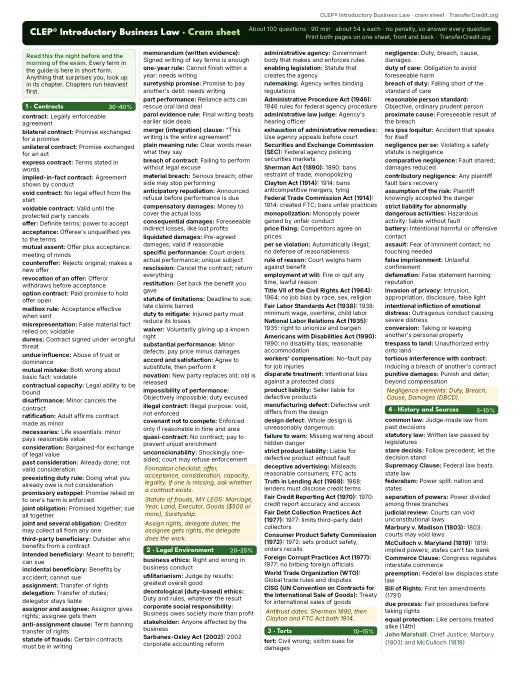
- 167 terms with examples
- 43 practice questions, answers explained
- 2-page cram sheet and study plans
Official exam name: Introductory Business Law
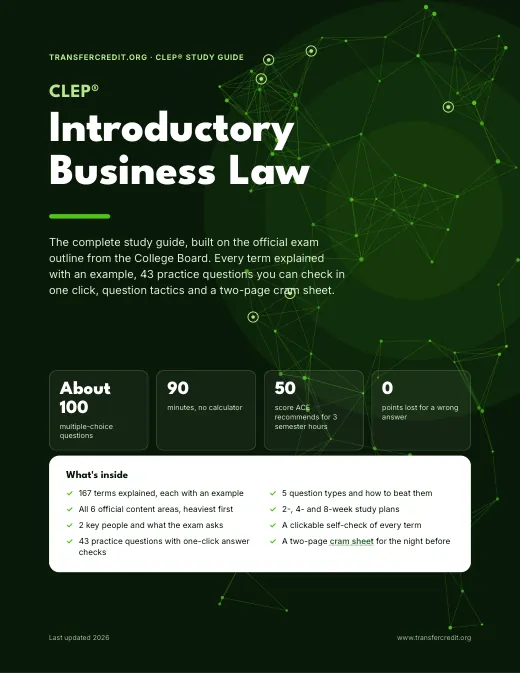
Everything the CLEP Business Law exam tests, in one PDF you can print. Built from the College Board's official outline, heaviest topics first.
Last updated 2026 · exam details checked against the College Board's published exam information in 2026
Real pages from the 37-page PDF.
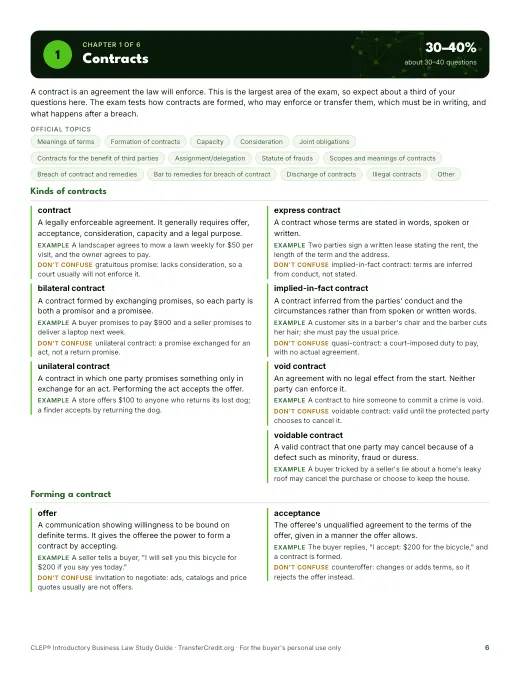
One chapter for each official content area, in the order the exam weighs them.
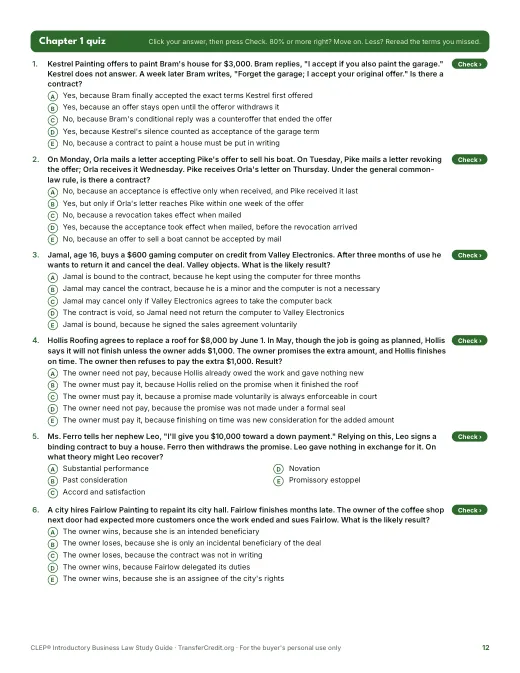
In the style of the real exam, from all 6 areas. About 10 minutes, with every answer explained and a score by area.
Kestrel Painting offers to paint Bram's house for $3,000. Bram replies, "I accept if you also paint the garage." Kestrel does not answer. A week later Bram writes, "Forget the garage; I accept your original offer." Is there a contract?
Answer: D. No, because Bram's conditional reply was a counteroffer that ended the offer. Bram's reply added a condition, so it was a counteroffer. A counteroffer rejects the original offer, so nothing remained for Bram to accept a week later.
The trap: The choice saying Bram finally accepted Kestrel's exact terms is tempting, but his conditional reply had already ended that offer.
Bram's reply added a condition, so it was a counteroffer. A counteroffer rejects the original offer, so nothing remained for Bram to accept a week later.
The trap: The choice saying Bram finally accepted Kestrel's exact terms is tempting, but his conditional reply had already ended that offer.
A company decides to recall a product that has caused no injuries so far because the manager believes a recall is simply the right thing to do whatever the cost. The manager's reasoning reflects
Answer: E. deontological ethics. Judging the action by duty or rule, regardless of cost or result, is deontological ethics.
The trap: Utilitarian cost-benefit analysis is tempting because the recall helps others, but the manager ignores overall costs and benefits and acts from duty.
Judging the action by duty or rule, regardless of cost or result, is deontological ethics.
The trap: Utilitarian cost-benefit analysis is tempting because the recall helps others, but the manager ignores overall costs and benefits and acts from duty.
A grocery clerk mops a floor but puts out no warning sign. A customer who is walking carefully slips on the wet floor and fractures an ankle. Which element of negligence does the clerk's failure to put out a sign most directly supply?
Answer: C. Breach of duty. The store owed customers a duty to act with reasonable care. Failing to warn about a known hazard falls short of that standard, which is a breach.
The trap: Duty of care is tempting because the store did owe one, but the question asks which element the failure to warn supplies, and the failure is the breach, not the duty.
The store owed customers a duty to act with reasonable care. Failing to warn about a known hazard falls short of that standard, which is a breach.
The trap: Duty of care is tempting because the store did owe one, but the question asks which element the failure to warn supplies, and the failure is the breach, not the duty.
A state passes a law that conflicts with a valid federal statute regulating the same product. Which constitutional provision makes the state law unenforceable?
Answer: A. The Supremacy Clause. Article VI makes valid federal law the supreme law of the land. When a state law conflicts with it, the federal law controls.
The trap: The Commerce Clause is tempting because it gives Congress the power to regulate, but it is the source of the federal power, not the rule that ranks federal law above state law.
Article VI makes valid federal law the supreme law of the land. When a state law conflicts with it, the federal law controls.
The trap: The Commerce Clause is tempting because it gives Congress the power to regulate, but it is the source of the federal power, not the rule that ranks federal law above state law.
Marta, a citizen of Georgia, sues a supplier incorporated and headquartered in Florida for $95,000 for breach of a sales contract. No federal law is involved. On what basis may a federal court hear the case?
Answer: B. Diversity jurisdiction. The parties are citizens of different states and more than $75,000 is at stake, which gives federal courts diversity jurisdiction.
The trap: Federal question jurisdiction is wrong because it requires a claim under federal law, and this is an ordinary state-law contract claim.
The parties are citizens of different states and more than $75,000 is at stake, which gives federal courts diversity jurisdiction.
The trap: Federal question jurisdiction is wrong because it requires a claim under federal law, and this is an ordinary state-law contract claim.
A delivery driver for Brightway Foods, while driving a company truck on her assigned route, carelessly hits a pedestrian. The pedestrian sues Brightway Foods. The company is most likely liable under
Answer: A. respondeat superior. An employer is liable for torts an employee commits within the scope of employment. A driver on her assigned route is acting within it.
The trap: Apparent authority is tempting because the driver is an agent, but it deals with an agent's power to bind a principal in contracts, not the employer's liability for torts.
An employer is liable for torts an employee commits within the scope of employment. A driver on her assigned route is acting within it.
The trap: Apparent authority is tempting because the driver is an agent, but it deals with an agent's power to bind a principal in contracts, not the employer's liability for torts.
On Monday, Orla mails a letter accepting Pike's offer to sell his boat. On Tuesday, Pike mails a letter revoking the offer; Orla receives it Wednesday. Pike receives Orla's letter on Thursday. Under the general common-law rule, is there a contract?
Answer: B. Yes, because the acceptance took effect when mailed, before the revocation arrived. Under the mailbox rule, Orla's acceptance was effective Monday when mailed. A revocation is effective only when received, which was too late.
The trap: The choice saying an acceptance counts only when received applies the rule for revocations, not acceptances.
Under the mailbox rule, Orla's acceptance was effective Monday when mailed. A revocation is effective only when received, which was too late.
The trap: The choice saying an acceptance counts only when received applies the rule for revocations, not acceptances.
A federal agency set up to regulate aviation safety begins issuing rules for cruise ships. To decide whether the agency has the power to do this, a court will look mainly at the
Answer: E. agency's enabling legislation. An agency has only the powers its enabling legislation gives it. If that statute covers only aviation, rules for cruise ships go beyond the agency's authority.
The trap: The Administrative Procedure Act is tempting because it governs how agencies act and lets courts review them, but it sets procedures for all agencies; the reach of this agency's power comes from the statute that created it.
An agency has only the powers its enabling legislation gives it. If that statute covers only aviation, rules for cruise ships go beyond the agency's authority.
The trap: The Administrative Procedure Act is tempting because it governs how agencies act and lets courts review them, but it sets procedures for all agencies; the reach of this agency's power comes from the statute that created it.
A jury finds that a plaintiff suffered $200,000 in damages and was 30% at fault. In a state with pure comparative negligence, the plaintiff recovers
Answer: C. $140,000. Under pure comparative negligence, damages are reduced by the plaintiff's share of fault: 30% of $200,000 is $60,000, and $200,000 minus $60,000 is $140,000.
The trap: Zero is the result under contributory negligence, which bars recovery whenever the plaintiff is at all at fault, but this state uses the comparative rule.
Under pure comparative negligence, damages are reduced by the plaintiff's share of fault: 30% of $200,000 is $60,000, and $200,000 minus $60,000 is $140,000.
The trap: Zero is the result under contributory negligence, which bars recovery whenever the plaintiff is at all at fault, but this state uses the comparative rule.
A state trial judge thinks an old ruling of the state's highest court on landlords' duties is outdated, but follows it anyway because that court has never overruled it. The judge is applying
Answer: D. stare decisis. Following a higher court's earlier decision on similar facts, even one the judge dislikes, is stare decisis. Lower courts must follow their higher court's precedents until that court overrules them.
The trap: Judicial review is tempting because one court is weighing another court's ruling, but judicial review means testing a law or government action against the Constitution.
Following a higher court's earlier decision on similar facts, even one the judge dislikes, is stare decisis. Lower courts must follow their higher court's precedents until that court overrules them.
The trap: Judicial review is tempting because one court is weighing another court's ruling, but judicial review means testing a law or government action against the Constitution.
The CLEP Introductory Business Law exam is a 90-minute, computer-based test from the College Board with about 100 multiple-choice questions. A score of 50 on the 20–80 scale earns an ACE credit recommendation of 3 semester hours, though each college sets its own policy. The exam covers 6 content areas; the heaviest is Contracts at 30–40%.
6 areas, heaviest first. The guide's chapters follow this order.
Start with the guide, or get everything for CLEP in one plan.
CLEP® is a registered trademark of the College Board, which was not involved in producing this guide and does not endorse it. TransferCredit.org is independent and not affiliated with the College Board. © 2026 UPI Globale Edu Inc.