← All AP® study guides
AP® Study Guide Printable PDF · 54 pages

TransferCredit.org Guide to AP® Biology

AP® Biology study guide: a printable PDF built from the College Board's official course and exam description, heaviest topics first.

  • 225 key terms, each with an example
  • 59 practice questions with every answer explained
  • A 2-page cram sheet for the night before
  • 2-, 4- and 8-week study plans built from the exam weights
Not sure yet? Try 10 free questions

Last updated 2026 · exam details checked against the College Board's published exam information in 2026

Look inside the guide

Real pages from the 54-page PDF.

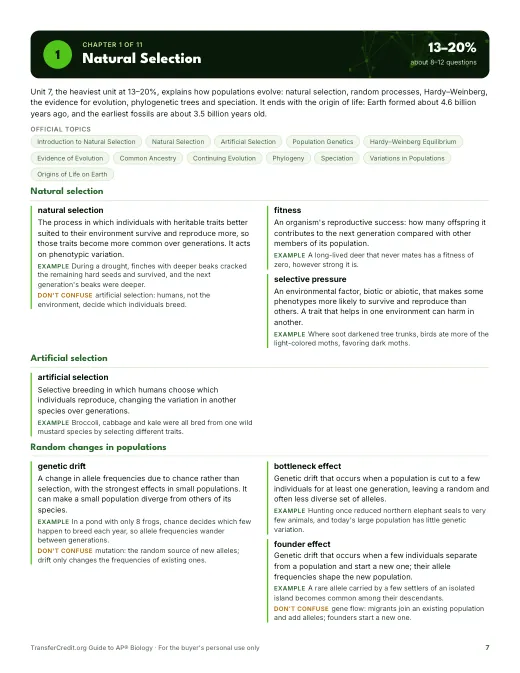
Page 1 of the TransferCredit.org Guide to AP® Biology: the cover
Page 1 The cover
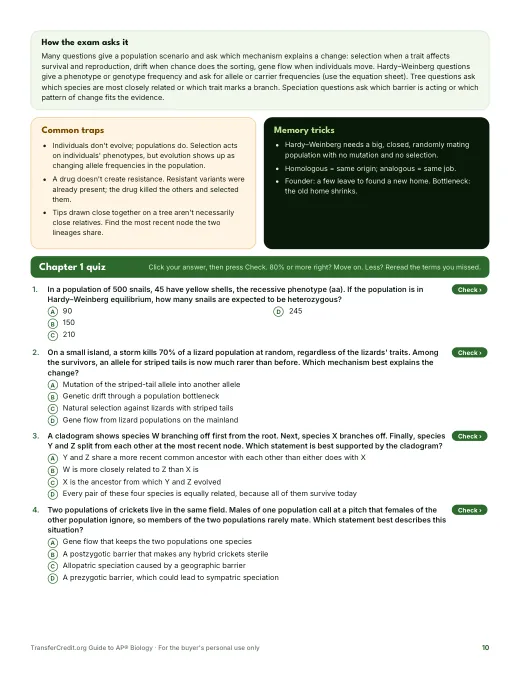
Page 7 of the TransferCredit.org Guide to AP® Biology: the Chapter 1 opener
Page 7 The Chapter 1 opener
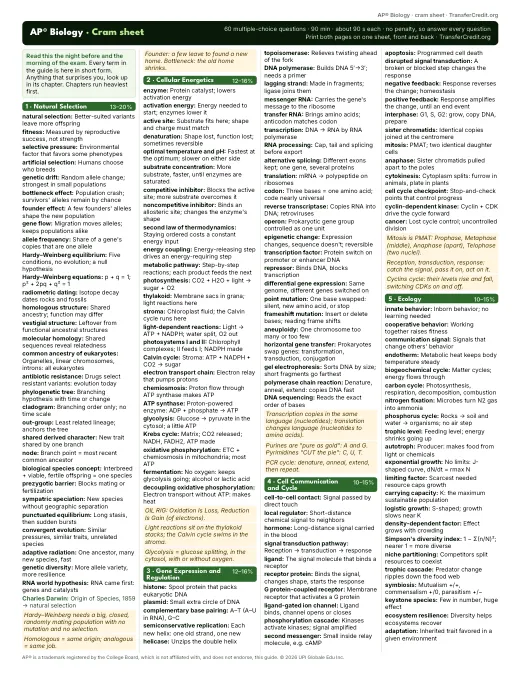
Page 10 of the TransferCredit.org Guide to AP® Biology: a chapter quiz
Page 10 A chapter quiz
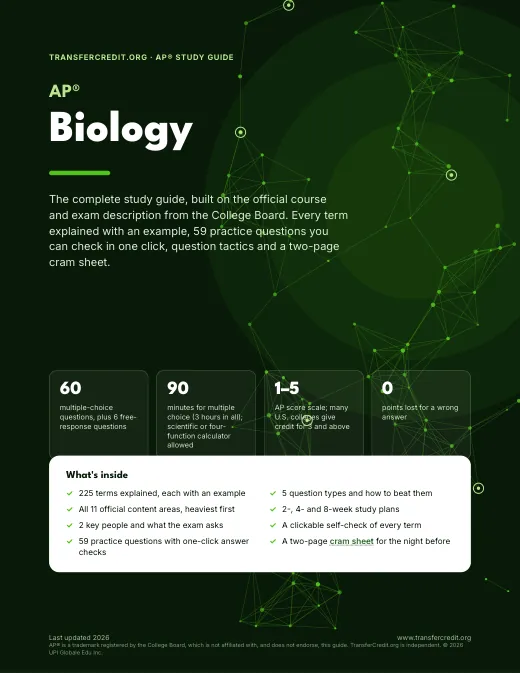
Page 53 of the TransferCredit.org Guide to AP® Biology: the 2-page cram sheet
Page 53 The 2-page cram sheet

What you get for $5

One chapter for each area of the official course and exam description, heaviest topics first.

  • 📘54pages, printable
  • 🧭11chapters
  • 🔑225terms with examples
  • ✍️59practice questions, answers explained
  • ⚠️33exam traps to avoid
  • 📄2page cram sheet

Try 10 free AP® Biology questions

Multiple-choice questions taken from the guide's chapter quizzes: one from each of the ten heaviest areas. About 15 minutes, with every answer explained and a score by area. The exam's free-response questions aren't in this quiz: see how the exam works.

10 questions  
  1. Question 1 · Natural Selection
    In a population of 500 snails, 45 have yellow shells, the recessive phenotype (aa). If the population is in Hardy–Weinberg equilibrium, how many snails are expected to be heterozygous?
    Show the answer

    Answer: C. 210. q² = 45/500 = 0.09, so q = 0.3 and p = 0.7. Heterozygotes are 2pq = 2(0.7)(0.3) = 0.42, and 0.42 × 500 = 210 snails.

    The trap: 245 is p² × 500 = 0.49 × 500, the expected number of homozygous dominant snails, not heterozygotes.

  2. Question 2 · Cellular Energetics
    An enzyme's reaction rate was measured at five temperatures: 20 °C, 12 units; 30 °C, 25; 40 °C, 41; 50 °C, 18; 60 °C, 2. Which statement best explains the drop in rate above 40 °C?
    Show the answer

    Answer: D. Heat disrupted bonds that hold the enzyme's shape, changing its active site. Above its optimal temperature the enzyme begins to denature: heat breaks the hydrogen bonds and other interactions that hold its shape, so the active site no longer fits the substrate.

    The trap: Slower molecules would explain a drop at low temperature. At higher temperatures molecules move faster, so collisions become more frequent, not less.

  3. Question 3 · Gene Expression and Regulation
    A DNA template strand reads 3′-TACAAGCTT-5′. Use these codons: AUG = methionine, UUC = phenylalanine, GAA = glutamate, UAC = tyrosine, AAG = lysine, CUU = leucine. Which amino acid sequence does this stretch encode?
    Show the answer

    Answer: B. Methionine–phenylalanine–glutamate. The mRNA is complementary to the template: 5′-AUG UUC GAA-3′, which codes for methionine, phenylalanine and glutamate.

    The trap: Tyrosine–lysine–leucine comes from reading the template itself as if it were mRNA (UAC AAG CUU); codons are read on the complementary mRNA.

  4. Question 4 · Cell Communication and Cycle
    In a cell, a hormone binds a membrane receptor that activates a G protein. The G protein activates an enzyme that makes cAMP, and cAMP activates a kinase that phosphorylates a target enzyme. A mutation leaves the G protein permanently active. Which outcome is most likely?
    Show the answer

    Answer: A. The target enzyme stays phosphorylated even when no hormone is present. Every step after the G protein depends on the G protein being active. If it is stuck on, cAMP is made, the kinase stays active and the target enzyme stays phosphorylated with or without the hormone.

    The trap: Saying the hormone can no longer bind confuses the receptor with the G protein; the mutation is downstream of the receptor, so binding is unaffected.

  5. Question 5 · Ecology
    A deer population has rmax = 0.4 per year and a carrying capacity of 800. According to the logistic growth model, how fast is the population growing when it has 600 deer?
    Show the answer

    Answer: B. 60 deer per year. dN/dt = rmax N((K − N)/K) = 0.4 × 600 × (200/800) = 0.4 × 600 × 0.25 = 60 deer per year.

    The trap: 240 deer per year is the exponential rate, rmax N, with no adjustment for how close the population is to its carrying capacity.

  6. Question 6 · Cells
    Cells in a gland make large amounts of a steroid hormone but secrete almost no protein. Which structure would these cells most likely have in unusually large amounts?
    Show the answer

    Answer: D. Smooth endoplasmic reticulum. Steroid hormones are lipids, and the smooth ER is where cells make lipids, including steroids. Ribosomes and rough ER build proteins, which these cells secrete very little of.

    The trap: Rough endoplasmic reticulum is tempting because it is also ER, but its ribosomes make proteins, and these cells secrete almost no protein.

  7. Question 7 · Questions and Methods
    A student tests whether temperature affects how fast germinating pea seeds use oxygen. She keeps seeds at 10 °C, 20 °C and 30 °C and measures the oxygen they use per minute. What is the dependent variable?
    Show the answer

    Answer: C. The rate of oxygen use by the seeds. The dependent variable is what is measured in response to the change: the rate at which the seeds use oxygen.

    The trap: Temperature is what the student deliberately changed, so it is the independent variable.

  8. Question 8 · Representing Data
    A student measures the mean height of bean plants grown under red, blue, green and white light, with error bars for each group. Which graph is most appropriate for these data?
    Show the answer

    Answer: A. A bar graph with one bar for each light color. Light color is a set of separate categories, and the dependent variable is a mean for each one, so a bar graph with error bars fits best.

    The trap: A line graph implies a continuous independent variable with meaningful values between the points; there is nothing between "red" and "blue" on this axis.

  9. Question 9 · Statistics and Calculations
    A cross of two heterozygous plants is expected to give a 3:1 ratio of purple to white flowers. Of 200 offspring, 140 are purple and 60 are white. Using the chi-square table at p = 0.05, which conclusion is correct?
    Show the answer

    Answer: C. χ² ≈ 2.67, below 3.84, so the null hypothesis is not rejected. Expected counts are 150 and 50. χ² = (140 − 150)²/150 + (60 − 50)²/50 = 0.67 + 2.00 = 2.67. With 1 degree of freedom the critical value is 3.84, and 2.67 is smaller, so the data are consistent with a 3:1 ratio.

    The trap: χ² ≈ 2.38 comes from dividing by the observed counts instead of the expected counts; each term must be divided by the expected value.

  10. Question 10 · Chemistry of Life
    A student stands a narrow glass tube and a wide glass tube in a dish of water. Water rises 3 cm inside the narrow tube but barely rises in the wide tube. Which properties of water best explain the rise?
    Show the answer

    Answer: A. Adhesion to the glass and cohesion among water molecules. Water molecules stick to the polar glass (adhesion) and pull neighboring water molecules along through hydrogen bonds (cohesion). In a narrow tube this pull lifts the water column higher.

    The trap: Specific heat and heat of vaporization are real properties of water, but they describe how water absorbs heat, not how it climbs a surface.

The AP® Biology exam at a glance

The AP® Biology exam is from the College Board. It has 60 multiple-choice questions, plus 6 free-response questions. You get 90 minutes for multiple choice (3 hours in all); scientific or four-function calculator allowed. The score scale is 1–5 (AP® score scale; many U.S. colleges give credit for 3 and above). The guide has 11 chapters, one for each area of the official course and exam description; the heaviest is Natural Selection at 13–20%.

Questions
60multiple-choice questions, plus 6 free-response questions
Time
90 minfor the 60 multiple-choice questions, about 90 seconds a question
Score
1–5AP® score scale; many U.S. colleges give credit for 3 and above
Fee
$99per exam in the U.S. and Canada in 2026-27; your school may charge more
Calculator
Yesscientific or four-function calculator allowed
Wrong answers
No penaltya wrong answer costs nothing
  • Section I has 60 multiple-choice questions in 90 minutes (50% of your score): single questions and sets of typically 4–5 questions on one shared stimulus. Section II has 6 free-response questions in 90 minutes (50%): 2 long questions worth 9 points each and 4 short questions worth 4 points each.
  • The exam is hybrid digital: you answer the multiple-choice questions and read the free-response questions in the Bluebook testing app, then handwrite your free-response answers in a paper exam booklet. An equations and formulas sheet is provided.
  • Calculators are allowed on both sections: a four-function (with square root) or scientific calculator, or the Desmos scientific calculator built into Bluebook. For 2027, graphing calculators and other handheld calculators with storage are not allowed.
  • Your multiple-choice score is the number of questions you answer correctly, so a wrong answer costs nothing.
  • The eight units range from 8–11% (Chemistry of Life, Heredity) to 13–20% (Natural Selection) of the multiple-choice section. Questions and methods, representing data, and statistics (8–14% each) are skills tested inside every unit.

Source: official AP® Biology page and the official course and exam description. Last updated 2026.

What the exam covers

11 chapters, heaviest first, with each area's official weight. The guide's chapters follow this order.

  1. Natural Selection13–20% · ~8–12 Q
  2. Cellular Energetics12–16% · ~7–10 Q
  3. Gene Expression and Regulation12–16% · ~7–10 Q
  4. Cell Communication and Cell Cycle10–15% · ~6–9 Q
  5. Ecology10–15% · ~6–9 Q
  6. Cells10–13% · ~6–8 Q
  7. Questions and Methods *8–14% · ~5–8 Q
  8. Representing and Describing Data *8–14% · ~5–8 Q
  9. Statistical Tests and Data Analysis *8–14% · ~5–8 Q
  10. Chemistry of Life8–11% · ~5–7 Q
  11. Heredity8–11% · ~5–7 Q

* Not units: skills tested inside every unit. Questions and Methods: questions about testable questions, hypotheses, variables and controls appear inside every unit, 8–14% of the multiple-choice section. Representing and Describing Data: graph and table questions appear inside every unit, 8–14% of the multiple-choice section. Statistical Tests and Data Analysis: calculation and statistics questions appear inside every unit, 8–14% of the multiple-choice section. These weights are a share of the same multiple-choice questions, so the weights add up to more than 100%.

Where to start: the 5 heaviest areas (marked in the map) carry about 42 of the 60 questions. The guide puts them first, so working front to back covers the most points earliest.

AP® Biology study guide by area

The 2 heaviest areas are open to read now. The full guide has a chapter for every area, each with all its terms, a quiz and an answer key.

2 of 11 chapters open  ·  in the guide's order
13–20% · about 8–12 questions · free preview Natural Selection Chapter 1 of the guide

Unit 7, the heaviest unit at 13–20%, explains how populations evolve: natural selection, random processes, Hardy–Weinberg, the evidence for evolution, phylogenetic trees and speciation. It ends with the origin of life: Earth formed about 4.6 billion years ago, and the earliest fossils are about 3.5 billion years old.

Key terms, with examples

natural selection
The process in which individuals with heritable traits better suited to their environment survive and reproduce more, so those traits become more common over generations. It acts on phenotypic variation.
Example: During a drought, finches with deeper beaks cracked the remaining hard seeds and survived, and the next generation's beaks were deeper.
artificial selection
Selective breeding in which humans choose which individuals reproduce, changing the variation in another species over generations.
Example: Broccoli, cabbage and kale were all bred from one wild mustard species by selecting different traits.
genetic drift
A change in allele frequencies due to chance rather than selection, with the strongest effects in small populations. It can make a small population diverge from others of its species.
Example: In a pond with only 8 frogs, chance decides which few happen to breed each year, so allele frequencies wander between generations.
Hardy–Weinberg equilibrium
A model of a non-evolving population whose allele frequencies stay constant when five conditions hold: a large population, no migration, no new mutations, random mating and no natural selection.
Example: Real populations never meet all five conditions, so biologists use the model as a null hypothesis: a departure from it suggests evolution.
radiometric dating
Dating rocks and fossils from the known decay rates of radioactive isotopes, such as carbon-14. Together with the age of the rock layers, it places fossils in time.
Example: Carbon-14's half-life is about 5,730 years, so a bone with one-quarter of its original carbon-14 is about 11,500 years old.
phylogenetic tree
A branching diagram of hypothesized evolutionary relationships that also shows the amount of change over time, calibrated with fossils or a molecular clock.
Example: A tree whose branch lengths are drawn in millions of years shows when each pair of lineages split.
biological species concept
A species is a group that can interbreed and exchange genetic information to produce viable, fertile offspring. Speciation occurs when populations become reproductively isolated.
Example: Horses and donkeys can mate, but their offspring, mules, are sterile, so horses and donkeys are separate species.
genetic diversity
The variety of alleles in a population or species. Diverse populations are more resilient to environmental change; those with little diversity are at risk of decline or extinction.
Example: Nearly all black-footed ferrets alive today descend from just 7 wild ancestors, so the species carries little genetic variety and remains at risk.
fitness
An organism's reproductive success: how many offspring it contributes to the next generation compared with other members of its population.
Example: A long-lived deer that never mates has a fitness of zero, however strong it is.
bottleneck effect
Genetic drift that occurs when a population is cut to a few individuals for at least one generation, leaving a random and often less diverse set of alleles.
Example: Hunting once reduced northern elephant seals to very few animals, and today's large population has little genetic variation.
Hardy–Weinberg equations
p + q = 1 and p² + 2pq + q² = 1, where p and q are the frequencies of two alleles; p², 2pq and q² give the expected genotype frequencies.
Example: With p = 0.8 and q = 0.2, expect p² = 64% AA, 2pq = 32% Aa and q² = 4% aa.
homologous structure
A structure that different species inherited from a common ancestor, similar in underlying anatomy even when it now serves different functions.
Example: A cactus's spines and a pea plant's tendrils are both modified leaves, inherited from a common ancestor but now used for defense and climbing.

What this area covers

Natural selectionArtificial selectionRandom changes in populationsHardy–WeinbergEvidence of evolution and common ancestryPhylogenySpeciationVariation and the origin of life

Key people

Charles DarwinSet out the theory of evolution by natural selection in On the Origin of Species (1859).

How the exam asks it

Many questions give a population scenario and ask which mechanism explains a change: selection when a trait affects survival and reproduction, drift when chance does the sorting, gene flow when individuals move. Hardy–Weinberg questions give a phenotype or genotype frequency and ask for allele or carrier frequencies (use the equation sheet). Tree questions ask which species are most closely related or which trait marks a branch. Speciation questions ask which barrier is acting or which pattern of change fits the evidence.

Common traps

Trap 1. Individuals don't evolve; populations do. Selection acts on individuals' phenotypes, but evolution shows up as changing allele frequencies in the population.

Trap 2. A drug doesn't create resistance. Resistant variants were already present; the drug killed the others and selected them.

Trap 3. Tips drawn close together on a tree aren't necessarily close relatives. Find the most recent node the two lineages share.

Memory trick

Hardy–Weinberg needs a big, closed, randomly mating population with no mutation and no selection.

Homologous = same origin; analogous = same job.

12–16% · about 7–10 questions · free preview Cellular Energetics Chapter 2 of the guide

Unit 3 covers how cells capture and use energy: enzymes, the energy rules living things follow, photosynthesis and cellular respiration. Questions expect you to trace energy, electrons and protons through a process, not to recite every step.

Key terms, with examples

enzyme
A protein that acts as a biological catalyst: it speeds up a chemical reaction in a cell by lowering its activation energy, and it is not used up.
Example: Catalase in liver cells rapidly breaks hydrogen peroxide into water and oxygen, and each catalase molecule is used again and again.
denaturation
Loss of a protein's shape when temperature, pH or the chemical environment disrupts its structure, so an enzyme can no longer catalyze. It is sometimes reversible.
Example: Cooking an egg turns its clear proteins white and solid because heat unfolds them.
second law of thermodynamics
Every energy transfer increases the disorder of the universe. Organisms stay highly ordered only because energy input exceeds energy loss; a large loss of order or energy flow means death.
Example: A houseplant stays alive and organized only while light keeps supplying energy; kept in total darkness, it eventually dies.
photosynthesis
The reactions that use carbon dioxide, water and light energy to make carbohydrates and oxygen. It first evolved in prokaryotes; cyanobacterial photosynthesis produced Earth's oxygenated atmosphere.
Example: A pond plant's leaves give off streams of oxygen bubbles in bright light but almost none in the dark.
electron transport chain
A series of membrane proteins that pass electrons along in oxidation-reduction reactions, using the energy to pump protons and build a gradient. ETCs work in chloroplasts, mitochondria and prokaryotic membranes.
Example: In aerobic respiration, oxygen accepts the electrons at the end of the chain and combines with protons to form water.
glycolysis
A pathway in the cytosol that breaks glucose into pyruvate, releasing energy that forms ATP (from ADP and phosphate) and NADH (from NAD+). It needs no oxygen.
Example: Mature red blood cells have no mitochondria, so they make all of their ATP by glycolysis.
activation energy
The energy reactants must absorb before a reaction can start. Enzymes lower it so reactions run fast at body temperature; they don't change the reaction's overall energy change.
Example: Table sugar doesn't burn at room temperature until a flame supplies enough energy to start the reaction.
optimal temperature and pH
The conditions at which an enzyme works fastest. Up to the optimal temperature, warming speeds collisions with substrate; outside the optimal range, structure changes and the rate drops.
Example: A stomach enzyme works best near pH 2, while an enzyme from the small intestine works best near pH 8.
energy coupling
Pairing a process that releases energy with one that requires energy, so the first drives the second. Breaking down ATP is the most common energy source.
Example: A muscle cell uses the energy released by breaking down ATP to power the protein movements of contraction.
thylakoid
A flattened membrane sac inside the chloroplast; stacks of them are grana. Thylakoid membranes hold chlorophyll, photosystems I and II and electron transport proteins, where the light reactions occur.
Example: In a microscope image of a chloroplast, the dark green stacks are grana built from thylakoids full of chlorophyll.
chemiosmosis
ATP synthesis powered by protons flowing down their electrochemical gradient, back across a membrane through ATP synthase. It occurs in thylakoids and in mitochondria.
Example: Thylakoids soaked in acid, then moved into a basic solution with ADP and phosphate, make ATP in the dark from the proton gradient alone.
Krebs cycle
Reactions in the mitochondrial matrix that oxidize carbon from pyruvate: carbon dioxide is released, ATP is made, and electrons pass to NAD+ and FAD, forming NADH and FADH2.
Example: Much of the carbon dioxide you breathe out was released from pyruvate's carbon atoms in your cells' mitochondrial matrix.

What this area covers

EnzymesWhat changes enzyme activityEnergy in living systemsPhotosynthesisElectron transport and ATP synthaseCellular respiration

How the exam asks it

Many questions describe an enzyme graph in words (rate against temperature, pH or substrate) and ask why the rate changes. Others describe a blocked step, such as an inhibitor, a leaky membrane, darkness or a lack of oxygen, and ask what happens to ATP, NADPH, oxygen or carbon dioxide. The CED excludes memorizing the steps, molecules and enzyme names of the Calvin cycle, glycolysis and the Krebs cycle (ATP synthase is the exception), so focus on inputs, outputs, locations and the proton gradient.

Common traps

Trap 1. Enzymes lower activation energy; they don't add energy to a reaction, and they aren't used up by it.

Trap 2. Extra substrate overcomes a competitive inhibitor but not a noncompetitive one. Check what happens to the rate when substrate is high.

Trap 3. The oxygen released in photosynthesis comes from water, not from carbon dioxide; the carbon in the sugar comes from CO2.

Memory trick

OIL RIG: Oxidation Is Loss, Reduction Is Gain (of electrons).

Light reactions sit on the thylakoid stacks; the Calvin cycle swims in the stroma.

How AP® Biology questions are written

The exam has 60 multiple-choice questions, plus 6 free-response questions. The guide sorts the questions into 5 types; spot the type and you'll know what the question wants before you read the choices.

Type 1

Explain a concept or process in a scenario

A short description of an organism, cell or process, then "which of the following best explains..." with four possible explanations.

  • Name the concept the scenario is about before you read the choices.
  • Choose the explanation that gives the mechanism (why or how), not one that only restates what was observed.
  • Cross out choices that are true statements but don't answer this question.
Type 2

Predict the effect of a change or disruption

A system is described, then one part is changed: a mutation, a drug, a removed species or a missing nutrient. You predict what happens next.

  • Trace the normal sequence step by step: what does each part do for the next?
  • Break the chain at the changed part and follow the effect forward only.
  • Reject choices that change parts upstream of the disruption.
Type 3

Analyze a model or visual representation

A diagram of a pathway, cell, food web, cladogram or graph (on the exam it is shown as an image), then a question about what one part shows or what the model predicts.

  • Read the title, labels and arrows first: what does each arrow mean (eats, becomes, activates)?
  • Find the part the question asks about and follow its arrows.
  • Answer from the model, not from a memory of a similar diagram.
Type 4

Experimental design: questions, hypotheses, variables and controls

A short investigation, then a question about its testable question, null hypothesis, variables, controls or how to improve it.

  • Identify what was changed on purpose (independent variable) and what was measured (dependent variable).
  • Find the comparison group: no treatment (negative control) or a known effect (positive control).
  • For improvements, look for a missing control, an uncontrolled variable or too small a sample.
Type 5

Data and calculations

A small table or a described graph, then a calculation (mean, rate, percent change, ratio, standard error, chi-square, Hardy–Weinberg, water potential) or a judgment about what the numbers show.

  • Write down the formula from the equation sheet before plugging in numbers.
  • Check units and which values the question asks for (an interval, a total, a change).
  • Estimate first, then confirm with the calculator (scientific or four-function only in 2027).

Test-day habits that add points

  1. Answer every question. There's no penalty for a wrong answer. A blank is always worth zero, so never leave one.
  2. Predict, then look. Name the answer before reading the choices. It protects you from distractors written to sound right.
  3. Eliminate. Cross out choices you know are wrong. Every choice you rule out raises your odds on a guess.
  4. Mark and move on. If a question takes more than a minute, pick your best guess, mark it and come back if time allows.
  5. Watch absolute words. Choices with "always", "never" or "only" are often wrong, because most rules and findings have exceptions. Treat this as a tiebreaker, not a rule.
  6. Change answers for a reason. Switch an answer only when you can say why the new one is better, such as a detail you missed.
  7. The six free-response questions. Section II has 6 free-response questions in 90 minutes (50% of your score). You read them in the Bluebook app and handwrite your answers in a paper exam booklet. Two long questions are worth 9 points each: Interpreting and Evaluating Experimental Results (Part A 1 point, Part B 3, Part C 3, Part D 2) and Interpreting and Evaluating Experimental Results with Graphing (Part A 1, Part B 4 for constructing the appropriate graph, Part C 2, Part D 2). Four short questions are worth 4 points each, one point per part: Scientific Investigation, Conceptual Analysis, Analyze Model or Visual Representation of a Biological Concept or Process, and Analyze Data. Each short question focuses on a different big idea and a different unit.

Pacing: 60 questions in 90 minutes, about 90 seconds a question.

AP® Biology flashcards

Try the first 8 cards free. Read the term, say the definition out loud, then select the card to check yourself. Arrow keys move between cards.

Free card 1 of 8 (deck total: 225)

How to study for AP® Biology: a 5-step plan

Follow the steps, then enter your test date. The planner gives you a dated plan that starts with the heaviest areas and saves the last days for review.

  1. Take the 10 free questionsSee which AP® Biology areas you already know.
  2. Study the heaviest areas firstStart with Natural Selection, Cellular Energetics and Gene Expression and Regulation, then work down the exam map.
  3. Learn each term with an exampleSay the definition out loud, then check it with the flashcards. A term you can't use in an example isn't learned yet.
  4. Quiz yourself and study the trapsAfter each area, answer its quiz and read why the tempting wrong answer is wrong.
  5. Plan backwards from your exam dateBuild a dated plan, keep the last days for a full review, and read the cram sheet the night before.

How it works

  1. 1Check outSelect Get the guide · $5 and pay on TransferCredit.org's secure checkout.
  2. 2Download the PDFFrom your TransferCredit.org account.
  3. 3Study the heaviest areas firstFollow the 2-, 4- or 8-week plan, then read the cram sheet the night before.

This page or the full guide

Everything on this page is free with no account. The full guide is a PDF you keep.

What's on this page and in the full study guide
Study toolThis pageFull study guide ($5)
ChaptersA preview of 2 of 11All 11
Terms explainedA sample from the open chaptersAll 225, each with an example
Practice questions10 free questions59, with an answer key
Flashcards8 cardsAll 225 terms on the self-check list
Study planDated planner2-, 4- and 8-week plans
Cram sheet—2 pages, for the night before
FormatWeb page54-page PDF, printable

Questions students ask

What's in the full AP® Biology study guide?
54 pages: 11 chapters, one for each area of the College Board's official course and exam description, heaviest topics first. 225 terms, each with a plain-English definition and an example, 2 key people, common traps and memory tricks, 59 practice questions with an answer key that explains every answer, question tactics, 2-, 4- and 8-week study plans and a 2-page cram sheet.
How much is the full AP® Biology study guide?
The full 54-page PDF is $5. The 10 practice questions on this page are free.
How do I get the full guide?
Select Get the guide · $5 and check out on TransferCredit.org. Then sign in to your TransferCredit.org account to download the PDF.
Can I print the guide or use it on my phone?
Yes. It's a PDF, so it opens on phones, tablets and computers, and printing is allowed. Its tick boxes and answer bubbles work in PDF readers that support forms. Copying and editing are turned off.
Can I try the AP® Biology guide before I buy it?
Yes. This page has 10 questions from the guide's own chapter quizzes, a preview of the 2 heaviest areas, 8 flashcards and a study planner. No account needed.
Is this an official AP® study guide?
No. AP® is a trademark registered by the College Board, which is not affiliated with, and does not endorse, this guide. TransferCredit.org is independent. We built the guide from the College Board's official course and exam description, and the exam details were checked against the College Board's published exam information in 2026.
How was this study guide made?
One chapter for each area of the official course and exam description, using its published weights. Each chapter was written, then fact-checked against the official exam information in a separate review. The practice questions are original: none are copied from the College Board's released questions.
How up to date is this AP® Biology guide?
Last updated 2026. The exam details were checked against the College Board's published exam information in 2026. Exams change, so confirm the details on the official AP® Biology page before you test.
More questions about the AP® Biology exam (16)
What is the AP® Biology exam?
The AP® Biology exam is from the College Board. It has 60 multiple-choice questions, plus 6 free-response questions. You get 90 minutes for multiple choice (3 hours in all); scientific or four-function calculator allowed. The score scale is 1–5 (AP® score scale; many U.S. colleges give credit for 3 and above). The guide has 11 chapters, one for each area of the official course and exam description; the heaviest is Natural Selection at 13–20%.
How many questions are on the AP® Biology exam, and how long is it?
Section I has 60 multiple-choice questions in 90 minutes (50% of your score): single questions and sets of typically 4–5 questions on one shared stimulus. Section II has 6 free-response questions in 90 minutes (50%): 2 long questions worth 9 points each and 4 short questions worth 4 points each.
How is the AP® Biology exam scored?
The score scale is 1–5: AP® score scale; many U.S. colleges give credit for 3 and above. Your multiple-choice score is the number of questions you answer correctly, so a wrong answer costs nothing.
What AP® Biology score do I need for college credit?
Many U.S. colleges give credit for 3 and above. Each college sets its own credit policy, so check the one at your college before you count on the credit.
How much does the AP® Biology exam cost?
The fee is $99: per exam in the U.S. and Canada in 2026-27; your school may charge more. Fees can change, so check the official page when you register.
Can I use a calculator on the AP® Biology exam?
Calculators are allowed on both sections: a four-function (with square root) or scientific calculator, or the Desmos scientific calculator built into Bluebook. For 2027, graphing calculators and other handheld calculators with storage are not allowed.
Is there a penalty for guessing on AP® Biology?
No. There's no penalty for a wrong answer. A blank is always worth zero, so never leave one.
What topics are on the AP® Biology exam?
8 areas, from the official course and exam description: Natural Selection (13–20%); Cellular Energetics (12–16%); Gene Expression and Regulation (12–16%); Cell Communication and Cell Cycle (10–15%); Ecology (10–15%); Cells (10–13%); Chemistry of Life (8–11%); Heredity (8–11%). Tested inside every unit: Questions and Methods (8–14%); Representing and Describing Data (8–14%); Statistical Tests and Data Analysis (8–14%).
Which AP® Biology topics should I study first?
The 5 heaviest areas (marked in the map) carry about 42 of the 60 questions. The guide puts them first, so working front to back covers the most points earliest.
Is the AP® Biology exam hard?
It depends on what you already know. The largest area, Natural Selection, is 13–20%, and the smallest, Heredity, is 8–11%. Try the 10 free questions above to see where you stand in about 15 minutes.
What kinds of questions are on the AP® Biology exam?
The exam has 60 multiple-choice questions, plus 6 free-response questions. The guide sorts the questions into 5 types: “Explain a concept or process in a scenario”, “Predict the effect of a change or disruption”, “Analyze a model or visual representation”, “Experimental design: questions, hypotheses, variables and controls” and “Data and calculations”. Multiple-choice questions have 4 answer choices. See how each type is written.
What are the free-response questions on the AP® Biology exam?
Section II has 6 free-response questions in 90 minutes (50% of your score). You read them in the Bluebook app and handwrite your answers in a paper exam booklet. Two long questions are worth 9 points each: Interpreting and Evaluating Experimental Results (Part A 1 point, Part B 3, Part C 3, Part D 2) and Interpreting and Evaluating Experimental Results with Graphing (Part A 1, Part B 4 for constructing the appropriate graph, Part C 2, Part D 2). Four short questions are worth 4 points each, one point per part: Scientific Investigation, Conceptual Analysis, Analyze Model or Visual Representation of a Biological Concept or Process, and Analyze Data. Each short question focuses on a different big idea and a different unit.
How should I pace myself on the AP® Biology exam?
60 questions in 90 minutes, about 90 seconds a question. If a question takes more than a minute, pick your best guess, mark it and come back if time allows.
How long should I study for AP® Biology?
Take the 10 free questions to see where you stand. The full guide has 2-, 4- and 8-week plans built from the exam weights, and the planner on this page builds a dated plan from your exam date.
How do I know I'm ready for the AP® Biology exam?
The guide's readiness checklist: You can explain every term on the checklist without notes. You score 80% or better on every chapter quiz. You can say what each person in the key people lists is known for. You can read the cram sheet and nothing on it surprises you. You know the AP® score your college gives credit for, and your exam date.
What should I do the night before?
Read the 2-page cram sheet once, slowly. Check your exam time and room with your AP® coordinator. Bring an approved scientific or four-function calculator, not a graphing one. In the morning, skim the traps, then stop studying.

How we built this guide

We built one chapter for each area of the College Board's official course and exam description for AP® Biology, using its published weights to order the chapters and size the quizzes. Each chapter was written, then fact-checked against the official exam information in a separate review. The exam details were checked against the College Board's published exam information in 2026.

Sources: official AP® Biology page, official course and exam description. Last updated 2026.

AP® is a trademark registered by the College Board, which is not affiliated with, and does not endorse, this guide. TransferCredit.org is independent and not affiliated with the College Board. © 2026 UPI Globale Edu Inc.

Ready for the full AP® Biology guide? 54 pages, 225 terms, 59 practice questions and a 2-page cram sheet, $5.

Get the guide · $5

In the full guide

TransferCredit.org Guide to AP® Biology

  • All 11 chapters
  • 225 terms with examples and 2 key people
  • 59 practice questions with an answer key
  • A 2-page cram sheet and 2-, 4- and 8-week plans
Get the guide · $5