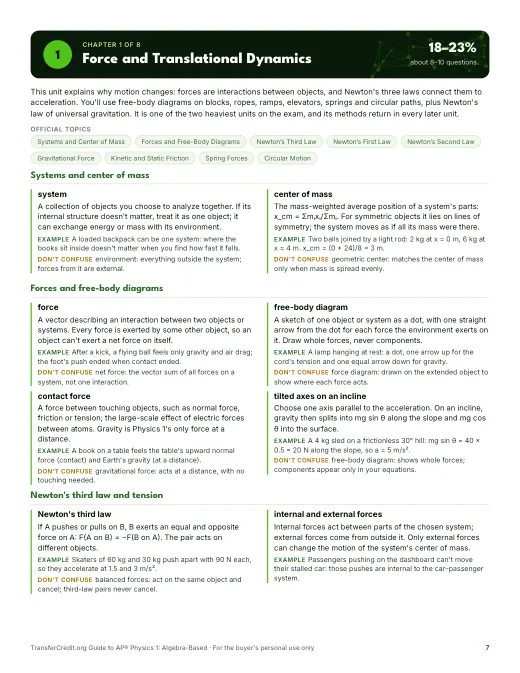
This unit explains why motion changes: forces are interactions between objects, and Newton's three laws connect them to acceleration. You'll use free-body diagrams on blocks, ropes, ramps, elevators, springs and circular paths, plus Newton's law of universal gravitation. It is one of the two heaviest units on the exam, and its methods return in every later unit.
- system
- A collection of objects you choose to analyze together. If its internal structure doesn't matter, treat it as one object; it can exchange energy or mass with its environment.
- Example: A loaded backpack can be one system: where the books sit inside doesn't matter when you find how fast it falls.
- force
- A vector describing an interaction between two objects or systems. Every force is exerted by some other object, so an object can't exert a net force on itself.
- Example: After a kick, a flying ball feels only gravity and air drag; the foot's push ended when contact ended.
- Newton's third law
- If A pushes or pulls on B, B exerts an equal and opposite force on A: F(A on B) = −F(B on A). The pair acts on different objects.
- Example: Skaters of 60 kg and 30 kg push apart with 90 N each, so they accelerate at 1.5 and 3 m/s².
- net force
- The vector sum of all forces exerted on a system. Forces can balance along one axis and not another; velocity then changes only along the unbalanced axis.
- Example: A sled pulled with 50 N east against 20 N of friction west has a net force of 30 N east.
- Newton's law of universal gravitation
- Any two masses attract along the line joining their centers with force F_g = Gm₁m₂/r². Doubling the distance between centers cuts the force to one-fourth.
- Example: A satellite moved from 1 to 3 Earth radii from Earth's center feels (1/3)² = 1/9 of its surface weight.
- normal force
- The perpendicular component of a surface's force on an object, pointing away from the surface. It is not always mg: it changes on inclines, with extra pushes or vertical acceleration.
- Example: Press down with 5 N on a 2 kg book resting on a table: the normal force is 20 + 5 = 25 N.
- Hooke's law
- An ideal spring's force is proportional to its stretch or compression from its relaxed length and points back toward equilibrium: F_s = −kΔx, with the spring constant k in N/m.
- Example: A spring with k = 200 N/m stretched 0.05 m pulls back with 200 × 0.05 = 10 N toward its relaxed length.
- centripetal acceleration
- The part of an object's acceleration that points toward the center of its circular path: a_c = v²/r, where v is the speed and r the radius.
- Example: A cyclist on a circular track of radius 20 m at 10 m/s has a_c = 10²/20 = 5 m/s² toward the center.
- center of mass
- The mass-weighted average position of a system's parts: x_cm = Σmᵢxᵢ/Σmᵢ. For symmetric objects it lies on lines of symmetry; the system moves as if all its mass were there.
- Example: Two balls joined by a light rod: 2 kg at x = 0 m, 6 kg at x = 4 m. x_cm = (0 + 24)/8 = 3 m.
- contact force
- A force between touching objects, such as normal force, friction or tension; the large-scale effect of electric forces between atoms. Gravity is Physics 1's only force at a distance.
- Example: A book on a table feels the table's upward normal force (contact) and Earth's gravity (at a distance).
- internal and external forces
- Internal forces act between parts of the chosen system; external forces come from outside it. Only external forces can change the motion of the system's center of mass.
- Example: Passengers pushing on the dashboard can't move their stalled car: those pushes are internal to the car–passenger system.
- translational equilibrium
- The state in which the net force on a system is zero, ΣF = 0, in every direction. The system is at rest or moving at constant velocity.
- Example: A 5 kg box pushed with 15 N slides at constant speed, so friction on it must be exactly 15 N.