← All AP® study guides
AP® Study Guide Printable PDF · 47 pages

TransferCredit.org Guide to AP® Chemistry

AP® Chemistry study guide: a printable PDF built from the College Board's official course and exam description, heaviest topics first.

  • 194 key terms, each with an example
  • 48 practice questions with every answer explained
  • A 2-page cram sheet for the night before
  • 2-, 4- and 8-week study plans built from the exam weights
Not sure yet? Try 10 free questions

Last updated 2026 · exam details checked against the College Board's published exam information in 2026

Look inside the guide

Real pages from the 47-page PDF.

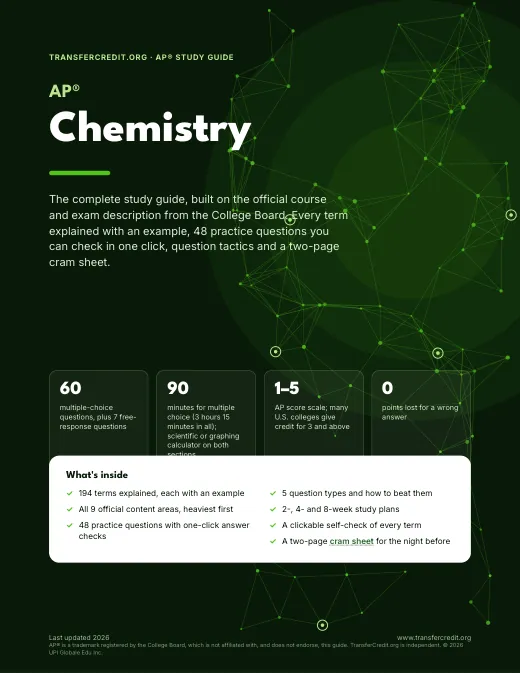
Page 1 of the TransferCredit.org Guide to AP® Chemistry: the cover
Page 1 The cover
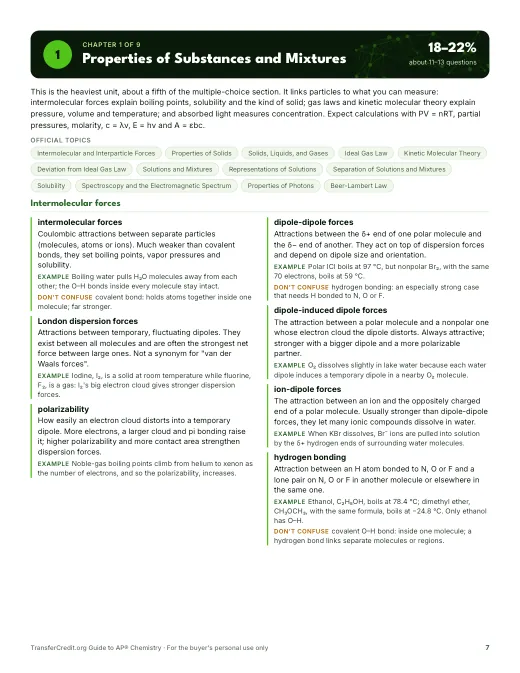
Page 7 of the TransferCredit.org Guide to AP® Chemistry: the Chapter 1 opener
Page 7 The Chapter 1 opener
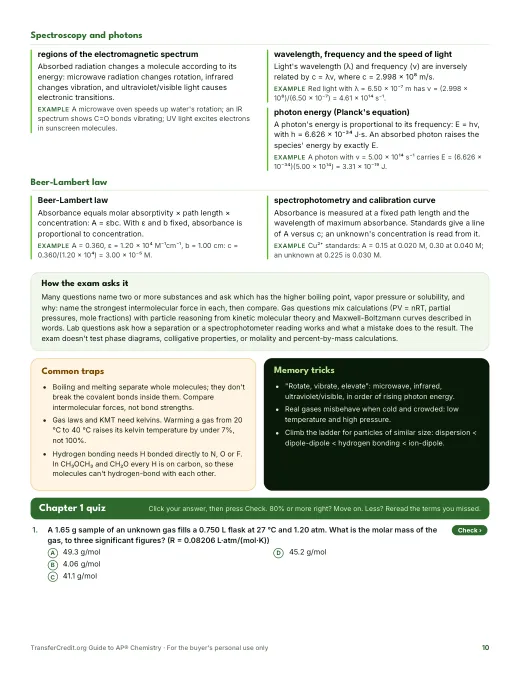
Page 10 of the TransferCredit.org Guide to AP® Chemistry: a chapter quiz
Page 10 A chapter quiz
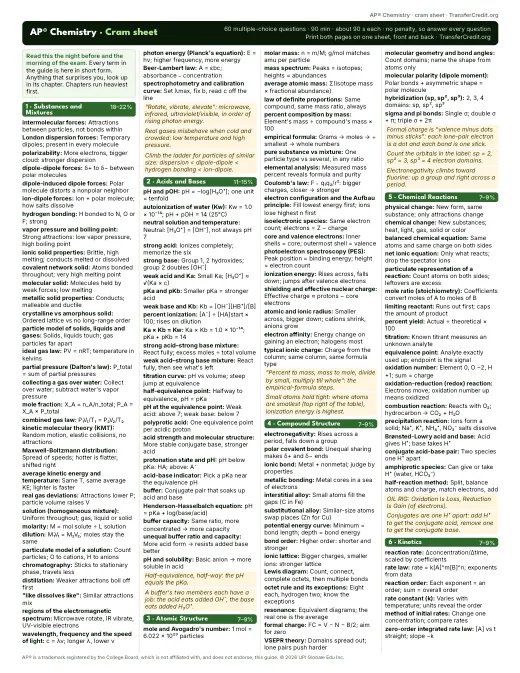
Page 46 of the TransferCredit.org Guide to AP® Chemistry: the 2-page cram sheet
Page 46 The 2-page cram sheet

What you get for $5

One chapter for each area of the official course and exam description, heaviest topics first.

  • 📘47pages, printable
  • 🧭9chapters
  • 🔑194terms with examples
  • ✍️48practice questions, answers explained
  • ⚠️27exam traps to avoid
  • 📄2page cram sheet

Try 10 free AP® Chemistry questions

Multiple-choice questions taken from the guide's chapter quizzes: 9 areas, heaviest first. About 15 minutes, with every answer explained and a score by area. The exam's free-response questions aren't in this quiz: see how the exam works.

10 questions  
  1. Question 1 · Substances and Mixtures
    A 1.65 g sample of an unknown gas fills a 0.750 L flask at 27 °C and 1.20 atm. What is the molar mass of the gas, to three significant figures? (R = 0.08206 L·atm/(mol·K))
    Show the answer

    Answer: A. 45.2 g/mol. T = 27 + 273.15 = 300.15 K. n = PV/RT = (1.20)(0.750)/((0.08206)(300.15)) = 0.0365 mol. Molar mass = 1.65 g ÷ 0.0365 mol = 45.2 g/mol.

    The trap: 4.06 g/mol uses 27 instead of 300.15 for T. Gas-law temperatures must be in kelvins. (49.3 g/mol wrongly uses 22.4 L/mol, which holds only at STP.)

  2. Question 2 · Acids and Bases
    A 0.20 M solution of a weak monoprotic acid, HA, has a pH of 2.85 at 25°C. What is the value of Ka for HA?
    Show the answer

    Answer: C. 1.0 × 10⁻⁵. [H₃O⁺] = [A⁻] = 10^(−2.85) = 1.41 × 10⁻³ M, and [HA] stays close to 0.20 M. Ka = (1.41 × 10⁻³)² ÷ 0.20 = 1.0 × 10⁻⁵.

    The trap: 7.1 × 10⁻³ forgets to square. The Ka expression multiplies two equal concentrations on top, [H₃O⁺] and [A⁻].

  3. Question 3 · Atomic Structure
    The mass spectrum of a pure element shows two peaks: one at 69 amu with a relative abundance of 60.0%, and one at 71 amu with a relative abundance of 40.0%. What is the average atomic mass of the element?
    Show the answer

    Answer: D. 69.8 amu. Weight each isotope by its abundance: 69(0.600) + 71(0.400) = 41.4 + 28.4 = 69.8 amu. The average sits closer to 69 amu because that isotope is more common.

    The trap: 70.0 amu is the simple average of the two masses. It ignores that the 69 amu isotope makes up more of the sample.

  4. Question 4 · Compound Structure
    Four Lewis diagrams are proposed for the cyanate ion, OCN⁻, with carbon in the center and 16 valence electrons. Based on formal charges, which diagram is the best model?
    Show the answer

    Answer: B. O–C single bond and C≡N triple bond; O has three lone pairs, N has one. Formal charges on O, C and N: O–C≡N gives −1, 0, 0; O=C=N gives 0, 0, −1; O≡C–N gives +1, 0, −2; two single bonds give −1, +2, −2 and leave carbon without an octet. The best diagram has charges nearest zero with the −1 on oxygen, the most electronegative atom.

    The trap: The diagram with two double bonds also has just one nonzero formal charge, but it puts the −1 on nitrogen, which is less electronegative than oxygen.

  5. Question 5 · Chemical Reactions
    Aluminum reacts with chlorine gas: 2 Al(s) + 3 Cl₂(g) → 2 AlCl₃(s). A 5.40 g sample of Al is mixed with 10.65 g of Cl₂. What is the maximum mass of AlCl₃ that can form? (Molar masses: Al 26.98 g/mol, Cl₂ 70.90 g/mol, AlCl₃ 133.33 g/mol)
    Show the answer

    Answer: D. 13.4 g. Moles: Al = 5.40 ÷ 26.98 = 0.200 mol; Cl₂ = 10.65 ÷ 70.90 = 0.150 mol. The Al would need 0.200 × 3/2 = 0.300 mol Cl₂, so Cl₂ is limiting. AlCl₃ = 0.150 × 2/3 = 0.100 mol, and 0.100 mol × 133.33 g/mol = 13.4 g.

    The trap: 26.7 g treats Al as the limiting reactant. Al has more moles, but the 3 : 2 ratio means the Cl₂ runs out first.

  6. Question 6 · Kinetics
    Initial-rate data for the reaction A + 2 B → C are shown.
    Trial | [A] (M) | [B] (M) | Initial rate (M/s)
    1 | 0.10 | 0.10 | 2.0 × 10⁻⁴
    2 | 0.20 | 0.10 | 8.0 × 10⁻⁴
    3 | 0.10 | 0.30 | 2.0 × 10⁻⁴
    Which rate law and rate constant are consistent with the data?
    Show the answer

    Answer: C. rate = k[A]²; k = 0.020 M⁻¹s⁻¹. From trial 1 to trial 2, [A] doubles and the rate quadruples, so the reaction is second order in A. From trial 1 to trial 3, [B] triples and the rate doesn't change, so it is zero order in B. k = (2.0 × 10⁻⁴)/(0.10)² = 0.020 M⁻¹s⁻¹, the units for a second-order reaction.

    The trap: rate = k[A][B]² copies the coefficients of the balanced equation. Trial 3 shows that changing [B] has no effect, so B doesn't appear in the rate law.

  7. Question 7 · Thermochemistry
    A student dissolves 5.00 g of potassium nitrate, KNO₃ (molar mass 101.1 g/mol), in 95.0 g of water in a coffee-cup calorimeter. The temperature falls from 25.00°C to 20.87°C. Assume the 100.0 g of solution has a specific heat of 4.18 J/(g·°C) and no heat is exchanged with the surroundings. What is the molar enthalpy of solution of KNO₃?
    Show the answer

    Answer: B. +34.9 kJ/mol. The solution lost q = 100.0 g × 4.18 J/(g·°C) × 4.13°C = 1,726 J, and the dissolving salt absorbed it, so ΔH is positive. KNO₃ dissolved: 5.00 g ÷ 101.1 g/mol = 0.04946 mol. ΔH = 1.726 kJ ÷ 0.04946 mol = +34.9 kJ/mol.

    The trap: −34.9 kJ/mol has the wrong sign. The solution cooled, so the dissolving absorbed energy from it: the process is endothermic.

  8. Question 8 · Equilibrium
    At a certain temperature, Kc = 4.00 for CO(g) + H₂O(g) ⇄ CO₂(g) + H₂(g). A 1.00 L flask starts with 0.400 mol CO and 0.400 mol H₂O and no products. What is [H₂] at equilibrium?
    Show the answer

    Answer: A. 0.267 M. Let x = [H₂] = [CO₂] formed, so [CO] = [H₂O] = 0.400 − x. Then x²/(0.400 − x)² = 4.00. Taking square roots, x/(0.400 − x) = 2.00, so x = 0.800/3 = 0.267 M.

    The trap: 0.320 M solves x/(0.400 − x) = 4.00. Both sides of the K expression are squares, so the ratio must equal the square root of 4.00, which is 2.00.

  9. Question 9 · Thermodynamics and Electrochemistry
    For a certain reaction, ΔH° = +45.0 kJ/mol_rxn and ΔS° = +125 J/(mol_rxn·K). Assuming both values stay constant, under which condition is the reaction thermodynamically favored?
    Show the answer

    Answer: C. Above 360 K. ΔG° = ΔH° − TΔS° becomes negative once TΔS° outweighs ΔH°: T > 45,000 J/mol ÷ 125 J/(mol·K) = 360 K. With both signs positive, the reaction is favored only at high temperature.

    The trap: 0.360 K comes from dividing kJ by J without converting. ΔH° must first be changed to 45,000 J/mol.

  10. Question 10 · Substances and Mixtures
    A rigid container holds 0.150 mol N₂, 0.050 mol O₂ and 0.100 mol CO₂ at a total pressure of 2.40 atm. What is the partial pressure of O₂?
    Show the answer

    Answer: A. 0.40 atm. Total moles = 0.300, so X_O₂ = 0.050/0.300 = 0.167. P_O₂ = X_O₂ × P_total = 0.167 × 2.40 atm = 0.40 atm.

    The trap: 0.80 atm splits the total pressure equally among three gases (it is also CO₂'s partial pressure). Each gas's share follows its mole fraction, not the number of gases.

The AP® Chemistry exam at a glance

The AP® Chemistry exam is from the College Board. It has 60 multiple-choice questions, plus 7 free-response questions. You get 90 minutes for multiple choice (3 hours 15 minutes in all); scientific or graphing calculator on both sections. The score scale is 1–5 (AP® score scale; many U.S. colleges give credit for 3 and above). The guide has 9 chapters, one for each area of the official course and exam description; the heaviest is Properties of Substances and Mixtures at 18–22%.

Questions
60multiple-choice questions, plus 7 free-response questions
Time
90 minfor the 60 multiple-choice questions, about 90 seconds a question
Score
1–5AP® score scale; many U.S. colleges give credit for 3 and above
Fee
$99per exam in the U.S. and Canada in 2026-27; your school may charge more
Calculator
Yesscientific or graphing calculator on both sections
Wrong answers
No penaltya wrong answer costs nothing
  • Section I has 60 multiple-choice questions in 90 minutes (50% of your score); some stand alone and some come in sets that share a diagram or data table. Section II has 7 free-response questions in 105 minutes (50%): 3 long questions worth 10 points each and 4 short questions worth 4 points each.
  • This is a hybrid digital exam: you answer the multiple-choice questions and read the free-response questions in the Bluebook testing app, and you handwrite your free-response answers in a paper booklet.
  • A scientific or graphing calculator is recommended on both sections: Bluebook has a built-in Desmos scientific and graphing calculator, and you may bring up to 2 approved handheld calculators. You also get a periodic table and an equations-and-constants sheet.
  • Your multiple-choice score is the number of questions you answer correctly, so a wrong answer costs nothing.
  • Unit 3 (Properties of Substances and Mixtures, 18–22%) and Unit 8 (Acids and Bases, 11–15%) are the biggest units; each of the other seven is 7–9% of the multiple-choice section. Calculations (Mathematical Routines) are 35–42% of the multiple-choice questions.

Source: official AP® Chemistry page and the official course and exam description. Last updated 2026.

What the exam covers

9 chapters, heaviest first, with each area's official weight. The guide's chapters follow this order.

  1. Properties of Substances and Mixtures18–22% · ~11–13 Q
  2. Acids and Bases11–15% · ~7–9 Q
  3. Atomic Structure and Properties7–9% · ~4–5 Q
  4. Compound Structure and Properties7–9% · ~4–5 Q
  5. Chemical Reactions7–9% · ~4–5 Q
  6. Kinetics7–9% · ~4–5 Q
  7. Thermochemistry7–9% · ~4–5 Q
  8. Equilibrium7–9% · ~4–5 Q
  9. Thermodynamics and Electrochemistry7–9% · ~4–5 Q

Where to start: the 6 heaviest areas (marked in the map) carry about 39 of the 60 questions. The guide puts them first, so working front to back covers the most points earliest.

AP® Chemistry study guide by area

The 2 heaviest areas are open to read now. The full guide has a chapter for every area, each with all its terms, a quiz and an answer key.

2 of 9 chapters open  ·  in the guide's order
18–22% · about 11–13 questions · free preview Properties of Substances and Mixtures Chapter 1 of the guide

This is the heaviest unit, about a fifth of the multiple-choice section. It links particles to what you can measure: intermolecular forces explain boiling points, solubility and the kind of solid; gas laws and kinetic molecular theory explain pressure, volume and temperature; and absorbed light measures concentration. Expect calculations with PV = nRT, partial pressures, molarity, c = λν, E = hν and A = εbc.

Key terms, with examples

intermolecular forces
Coulombic attractions between separate particles (molecules, atoms or ions). Much weaker than covalent bonds, they set boiling points, vapor pressures and solubility.
Example: Boiling water pulls H₂O molecules away from each other; the O–H bonds inside every molecule stay intact.
vapor pressure and boiling point
Vapor pressure is the pressure of a liquid's vapor at equilibrium. Stronger intermolecular forces mean lower vapor pressure and a higher boiling point, reached when vapor pressure equals outside pressure.
Example: At 25 °C, diethyl ether's vapor pressure is far higher than water's, so ether evaporates faster and boils at only 35 °C.
crystalline vs amorphous solid
A crystalline solid has particles in a regular, repeating 3-D arrangement; an amorphous solid has no long-range order. In both, particles vibrate but don't move past each other.
Example: Quartz, crystalline SiO₂, melts at a sharp temperature; window glass, which is amorphous, softens gradually over a range.
ideal gas law
PV = nRT links the pressure, volume, moles and kelvin temperature of an ideal gas. With P in atm and V in liters, R = 0.08206 L·atm/(mol·K).
Example: 2.00 mol at 273.15 K and 1.00 atm: V = nRT/P = 44.8 L, or 22.4 L per mole at STP.
kinetic molecular theory (KMT)
A model of gas behavior: particles move constantly and randomly and collide elastically; in an ideal gas their own volume is negligible and they don't attract each other.
Example: Pumping more air into a bike tire raises its pressure because more particles strike the inner walls each second.
solution (homogeneous mixture)
A mixture whose properties are the same throughout; it can be a solid, liquid or gas. In a heterogeneous mixture, properties depend on where you sample.
Example: Air, vinegar and brass are solutions; sand stirred into water is a heterogeneous mixture.
chromatography
Separates components by their different attractions to a moving mobile phase and a fixed stationary phase. A component attracted more to the stationary phase travels less far.
Example: On a polar silica TLC plate, a nonpolar compound travels farther than a polar one, revealing their relative polarities.
regions of the electromagnetic spectrum
Absorbed radiation changes a molecule according to its energy: microwave radiation changes rotation, infrared changes vibration, and ultraviolet/visible light causes electronic transitions.
Example: A microwave oven speeds up water's rotation; an IR spectrum shows C=O bonds vibrating; UV light excites electrons in sunscreen molecules.
Beer-Lambert law
Absorbance equals molar absorptivity × path length × concentration: A = εbc. With ε and b fixed, absorbance is proportional to concentration.
Example: A = 0.360, ε = 1.20 × 10⁴ M⁻¹cm⁻¹, b = 1.00 cm: c = 0.360/(1.20 × 10⁴) = 3.00 × 10⁻⁵ M.
London dispersion forces
Attractions between temporary, fluctuating dipoles. They exist between all molecules and are often the strongest net force between large ones. Not a synonym for "van der Waals forces".
Example: Iodine, I₂, is a solid at room temperature while fluorine, F₂, is a gas: I₂'s big electron cloud gives stronger dispersion forces.
ionic solid properties
Strong attractions between ions give low vapor pressures and high melting and boiling points. Ionic solids are brittle and conduct electricity only when the ions can move: melted or dissolved.
Example: A hammer blow shatters a salt crystal: sliding one layer lines up like charges, which repel.
particle model of solids, liquids and gases
Solid and liquid particles touch, giving similar molar volumes; liquid particles also slide past each other. Gas particles are far apart, with no definite shape or volume.
Example: One mole of liquid water fills about 18 mL; as steam at 100 °C and 1 atm it fills about 30 L.

What this area covers

Intermolecular forcesProperties of solidsSolids, liquids and gasesGas lawsKinetic molecular theory and real gasesSolutionsSeparation and solubilitySpectroscopy and photonsBeer-Lambert law

How the exam asks it

Many questions name two or more substances and ask which has the higher boiling point, vapor pressure or solubility, and why: name the strongest intermolecular force in each, then compare. Gas questions mix calculations (PV = nRT, partial pressures, mole fractions) with particle reasoning from kinetic molecular theory and Maxwell-Boltzmann curves described in words. Lab questions ask how a separation or a spectrophotometer reading works and what a mistake does to the result. The exam doesn't test phase diagrams, colligative properties, or molality and percent-by-mass calculations.

Common traps

Trap 1. Boiling and melting separate whole molecules; they don't break the covalent bonds inside them. Compare intermolecular forces, not bond strengths.

Trap 2. Gas laws and KMT need kelvins. Warming a gas from 20 °C to 40 °C raises its kelvin temperature by under 7%, not 100%.

Trap 3. Hydrogen bonding needs H bonded directly to N, O or F. In CH₃OCH₃ and CH₂O every H is on carbon, so these molecules can't hydrogen-bond with each other.

Memory trick

"Rotate, vibrate, elevate": microwave, infrared, ultraviolet/visible, in order of rising photon energy.

Real gases misbehave when cold and crowded: low temperature and high pressure.

11–15% · about 7–9 questions · free preview Acids and Bases Chapter 2 of the guide

Acids and bases is the second-biggest unit (11–15%). Expect pH calculations for strong and weak acids and bases, mixtures of acids and bases, titration curves and buffers, plus questions on how molecular structure and pH decide which form of an acid is present.

Key terms, with examples

pH and pOH
Log scales of acidity: pH = −log[H₃O⁺] and pOH = −log[OH⁻]. Each unit is a tenfold change in concentration; a lower pH means more H₃O⁺.
Example: [H₃O⁺] = 1.0 × 10⁻³ M gives pH 3.00; a pH of 4.70 means [H₃O⁺] = 10^(−4.70) = 2.0 × 10⁻⁵ M.
strong acid
An acid that ionizes completely in water, so [H₃O⁺] equals the acid's starting concentration. The six to know: HCl, HBr, HI, HClO₄, H₂SO₄ and HNO₃.
Example: 0.020 M HNO₃ gives [H₃O⁺] = 0.020 M, so pH = −log(0.020) = 1.70.
weak acid and Ka
An acid that ionizes only slightly, so most molecules stay as HA. Ka = [H₃O⁺][A⁻]/[HA]; when ionization is small, [H₃O⁺] ≈ √(Ka × c).
Example: 0.10 M acetic acid, Ka = 1.8 × 10⁻⁵: [H₃O⁺] ≈ √(1.8 × 10⁻⁶) = 1.3 × 10⁻³ M, so pH = 2.87.
strong acid–strong base mixture
H₃O⁺ + OH⁻ → 2 H₂O goes to completion. Subtract moles, divide the excess reagent's moles by the total volume, then find the pH.
Example: Mixing 5.0 mmol HCl with 4.0 mmol NaOH leaves 1.0 mmol H₃O⁺ in 90.0 mL total, so pH = 1.95.
titration curve
A graph of pH versus volume of titrant added. The steep jump marks the equivalence point, where the moles of titrant equal the moles of analyte at the start.
Example: 25.00 mL of HCl needs 20.00 mL of 0.1000 M NaOH: 0.002000 mol ÷ 0.02500 L = 0.08000 M HCl.
acid strength and molecular structure
An acid is stronger when its conjugate base is more stable: electronegative atoms, inductive effects and resonance spread the negative charge. Carboxylic acids are weak; ammonia is a weak base.
Example: CCl₃COOH is far stronger than CH₃COOH: three electronegative chlorine atoms pull electron density away and stabilize the anion.
protonation state and pH
Compare pH with pKa: if pH < pKa, the acid form HA is the major species; if pH > pKa, the base form A⁻ is; at pH = pKa they're equal.
Example: Formic acid (pKa 3.75) at pH 7.4: the pH is far above the pKa, so it is almost all formate ion, HCOO⁻.
buffer
A solution with large amounts of both members of a conjugate pair. Its weak acid neutralizes added OH⁻ and its conjugate base neutralizes added H₃O⁺, so the pH barely changes.
Example: In an acetic acid/acetate buffer, added acid is used up: CH₃COO⁻ + H₃O⁺ → CH₃COOH + H₂O.
pH and solubility
A salt dissolves more at low pH when its anion is a weak base (such as F⁻ or CO₃²⁻) or OH⁻: H₃O⁺ removes the anion, shifting the dissolving equilibrium right.
Example: CaF₂ dissolves more in acid: H₃O⁺ + F⁻ → HF + H₂O lowers [F⁻], so more calcium fluoride dissolves.
autoionization of water (Kw)
Water transfers protons to itself: 2 H₂O(l) ⇄ H₃O⁺(aq) + OH⁻(aq). Kw = [H₃O⁺][OH⁻] = 1.0 × 10⁻¹⁴ at 25°C, so pH + pOH = 14.00.
Example: At 25°C, [OH⁻] = 1.0 × 10⁻⁴ M means [H₃O⁺] = 1.0 × 10⁻¹⁰ M and pH = 10.00.
strong base
A base that dissociates completely in water: the group 1 and group 2 hydroxides. [OH⁻] equals the concentration for NaOH but twice it for Ba(OH)₂.
Example: 0.0050 M Ba(OH)₂ gives [OH⁻] = 0.010 M: pOH = 2.00, so pH = 12.00.
pKa and pKb
pKa = −log Ka and pKb = −log Kb. A smaller pKa means a larger Ka and a stronger acid; a smaller pKb means a stronger base.
Example: An acid with Ka = 1.0 × 10⁻³ has pKa 3.00, so it is stronger than an acid with pKa 5.00.

What this area covers

pH, pOH and waterStrong acids and basesWeak acids and basesMixing acids and basesTitration curvesStructure and acid strengthpH and pKaBufferspH and solubility

How the exam asks it

Start every pH question by naming the major species. Strong acids and bases ionize completely, so [H₃O⁺] or [OH⁻] comes straight from the concentration; for a weak acid or base, set up Ka or Kb. For a mixture, react the strong acid or base completely first, then see what is left: excess strong reagent, a buffer, or a lone conjugate base or acid (a weak acid mixed with a weak base only reaches an equilibrium). Titration questions describe a curve in words; read pKa at the half-equivalence point and pick indicators by pKa. Ka and Kb values are given. The exam doesn't ask you to calculate a buffer's pH change after acid or base is added, or a salt's solubility at a given pH.

Common traps

Trap 1. pH 7 is neutral only at 25°C, and an equivalence point is at pH 7 only for a strong acid with a strong base. A weak acid titrated with a strong base ends above 7.

Trap 2. In the Henderson-Hasselbalch equation the base goes on top: log([A⁻]/[HA]). More base than acid puts the pH above the pKa, not below it.

Trap 3. React first, then calculate: after a strong base is added to a weak acid, use the moles left after the complete reaction, not the starting amounts.

Memory trick

Half-equivalence, half-way: the pH equals the pKa.

A buffer's two members each have a job: the acid eats added OH⁻, the base eats added H₃O⁺.

How AP® Chemistry questions are written

The exam has 60 multiple-choice questions, plus 7 free-response questions. The guide sorts the questions into 5 types; spot the type and you'll know what the question wants before you read the choices.

Type 1

Particle-level model (described in words)

On the exam you see a particle diagram, a Lewis diagram, a photoelectron spectrum or a drawing of a cell. This guide describes them in words. The question asks what the model shows, or which model matches an equation or a change.

  • Write the balanced equation or formula the model stands for, then count every particle or electron.
  • Check conservation: the same atoms before and after, with any leftover particles showing the excess reactant.
  • Reject choices that change the particles in a physical change or lose atoms in a chemical one.
Type 2

Calculation from given data

Numbers in the stem or in a short table (masses, volumes, concentrations, temperatures, K or E° values), then "What is the value of...?". The wrong choices come from common slips: a missed mole ratio, °C instead of K, a flipped sign.

  • Pick the relationship you need from the equation sheet and list the given quantities with their units.
  • Convert first: grams to moles, mL to L, °C to K, J to kJ.
  • Estimate the size of the answer, then check that your choice has sensible units and significant figures.
Type 3

Lab procedure and experimental error

A described experiment (a titration, calorimetry, gas collection, spectrophotometry) and a question about the best procedure, a source of error, or how a mistake changes the calculated result.

  • Write the equation the student uses to calculate the result.
  • Decide which measured quantity the mistake changes, and in which direction.
  • Carry that change through the equation: does the result come out too high, too low or unchanged?
Type 4

Data table or graph analysis

A table of measurements or a graph described in words (initial rates, successive ionization energies, a titration curve, a heating curve, a calibration line), then a question about what the pattern shows: a rate law, an ion's charge, a pKa, a phase change, a concentration.

  • Read the column heads or axis labels and their units before the numbers.
  • Compare rows or points where only one thing changes, and note by what factor the result changes.
  • Match the pattern to the rule it shows: doubled concentration and quadrupled rate means second order; a sudden jump in successive ionization energies means the next electron comes from the core.
Type 5

Explain with particles (claim and reasoning)

"Which of the following best explains...?" about a property or observation, often a comparison of two substances. Each choice gives a claim with a reason, and several state facts that are true but don't explain the observation.

  • Name the particle-level cause yourself first: the type and strength of forces, charge and distance (Coulomb's law), or structure.
  • Pick the choice whose reason actually causes the observation, not one that is merely true.
  • Watch for choices that confuse bonds inside molecules with attractions between them.

Test-day habits that add points

  1. Answer every question. There's no penalty for a wrong answer. A blank is always worth zero, so never leave one.
  2. Predict, then look. Name the answer before reading the choices. It protects you from distractors written to sound right.
  3. Eliminate. Cross out choices you know are wrong. Every choice you rule out raises your odds on a guess.
  4. Mark and move on. If a question takes more than a minute, pick your best guess, mark it and come back if time allows.
  5. Watch absolute words. Choices with "always", "never" or "only" are often wrong, because most rules and findings have exceptions. Treat this as a tiebreaker, not a rule.
  6. Change answers for a reason. Switch an answer only when you can say why the new one is better, such as a detail you missed.
  7. The seven free-response questions. Section II has 7 free-response questions in 1 hour 45 minutes (105 minutes), 50% of your score: 3 long questions worth 10 points each and 4 short questions worth 4 points each. You read the questions in Bluebook and handwrite your answers in a paper booklet. The questions assess all six science practices. When a part says calculate, show your setup with properly substituted numbers, and label units and significant figures, not just the final answer. When it says justify or explain, give the evidence (data or a model) and the chemical reasoning that links it to your claim.

Pacing: 60 questions in 90 minutes, about 90 seconds a question.

AP® Chemistry flashcards

Try the first 8 cards free. Read the term, say the definition out loud, then select the card to check yourself. Arrow keys move between cards.

Free card 1 of 8 (deck total: 194)

How to study for AP® Chemistry: a 5-step plan

Follow the steps, then enter your test date. The planner gives you a dated plan that starts with the heaviest areas and saves the last days for review.

  1. Take the 10 free questionsSee which AP® Chemistry areas you already know.
  2. Study the heaviest areas firstStart with Properties of Substances and Mixtures, Acids and Bases and Atomic Structure and Properties, then work down the exam map.
  3. Learn each term with an exampleSay the definition out loud, then check it with the flashcards. A term you can't use in an example isn't learned yet.
  4. Quiz yourself and study the trapsAfter each area, answer its quiz and read why the tempting wrong answer is wrong.
  5. Plan backwards from your exam dateBuild a dated plan, keep the last days for a full review, and read the cram sheet the night before.

How it works

  1. 1Check outSelect Get the guide · $5 and pay on TransferCredit.org's secure checkout.
  2. 2Download the PDFFrom your TransferCredit.org account.
  3. 3Study the heaviest areas firstFollow the 2-, 4- or 8-week plan, then read the cram sheet the night before.

This page or the full guide

Everything on this page is free with no account. The full guide is a PDF you keep.

What's on this page and in the full study guide
Study toolThis pageFull study guide ($5)
ChaptersA preview of 2 of 9All 9
Terms explainedA sample from the open chaptersAll 194, each with an example
Practice questions10 free questions48, with an answer key
Flashcards8 cardsAll 194 terms on the self-check list
Study planDated planner2-, 4- and 8-week plans
Cram sheet—2 pages, for the night before
FormatWeb page47-page PDF, printable

Questions students ask

What's in the full AP® Chemistry study guide?
47 pages: 9 chapters, one for each area of the College Board's official course and exam description, heaviest topics first. 194 terms, each with a plain-English definition and an example, common traps and memory tricks, 48 practice questions with an answer key that explains every answer, question tactics, 2-, 4- and 8-week study plans and a 2-page cram sheet.
How much is the full AP® Chemistry study guide?
The full 47-page PDF is $5. The 10 practice questions on this page are free.
How do I get the full guide?
Select Get the guide · $5 and check out on TransferCredit.org. Then sign in to your TransferCredit.org account to download the PDF.
Can I print the guide or use it on my phone?
Yes. It's a PDF, so it opens on phones, tablets and computers, and printing is allowed. Its tick boxes and answer bubbles work in PDF readers that support forms. Copying and editing are turned off.
Can I try the AP® Chemistry guide before I buy it?
Yes. This page has 10 questions from the guide's own chapter quizzes, a preview of the 2 heaviest areas, 8 flashcards and a study planner. No account needed.
Is this an official AP® study guide?
No. AP® is a trademark registered by the College Board, which is not affiliated with, and does not endorse, this guide. TransferCredit.org is independent. We built the guide from the College Board's official course and exam description, and the exam details were checked against the College Board's published exam information in 2026.
How was this study guide made?
One chapter for each area of the official course and exam description, using its published weights. Each chapter was written, then fact-checked against the official exam information in a separate review. The practice questions are original: none are copied from the College Board's released questions.
How up to date is this AP® Chemistry guide?
Last updated 2026. The exam details were checked against the College Board's published exam information in 2026. Exams change, so confirm the details on the official AP® Chemistry page before you test.
More questions about the AP® Chemistry exam (16)
What is the AP® Chemistry exam?
The AP® Chemistry exam is from the College Board. It has 60 multiple-choice questions, plus 7 free-response questions. You get 90 minutes for multiple choice (3 hours 15 minutes in all); scientific or graphing calculator on both sections. The score scale is 1–5 (AP® score scale; many U.S. colleges give credit for 3 and above). The guide has 9 chapters, one for each area of the official course and exam description; the heaviest is Properties of Substances and Mixtures at 18–22%.
How many questions are on the AP® Chemistry exam, and how long is it?
Section I has 60 multiple-choice questions in 90 minutes (50% of your score); some stand alone and some come in sets that share a diagram or data table. Section II has 7 free-response questions in 105 minutes (50%): 3 long questions worth 10 points each and 4 short questions worth 4 points each.
How is the AP® Chemistry exam scored?
The score scale is 1–5: AP® score scale; many U.S. colleges give credit for 3 and above. Your multiple-choice score is the number of questions you answer correctly, so a wrong answer costs nothing.
What AP® Chemistry score do I need for college credit?
Many U.S. colleges give credit for 3 and above. Each college sets its own credit policy, so check the one at your college before you count on the credit.
How much does the AP® Chemistry exam cost?
The fee is $99: per exam in the U.S. and Canada in 2026-27; your school may charge more. Fees can change, so check the official page when you register.
Can I use a calculator on the AP® Chemistry exam?
A scientific or graphing calculator is recommended on both sections: Bluebook has a built-in Desmos scientific and graphing calculator, and you may bring up to 2 approved handheld calculators.
Is there a penalty for guessing on AP® Chemistry?
No. There's no penalty for a wrong answer. A blank is always worth zero, so never leave one.
What topics are on the AP® Chemistry exam?
9 areas, from the official course and exam description: Properties of Substances and Mixtures (18–22%); Acids and Bases (11–15%); Atomic Structure and Properties (7–9%); Compound Structure and Properties (7–9%); Chemical Reactions (7–9%); Kinetics (7–9%); Thermochemistry (7–9%); Equilibrium (7–9%); Thermodynamics and Electrochemistry (7–9%).
Which AP® Chemistry topics should I study first?
The 6 heaviest areas (marked in the map) carry about 39 of the 60 questions. The guide puts them first, so working front to back covers the most points earliest.
Is the AP® Chemistry exam hard?
It depends on what you already know. The largest area, Properties of Substances and Mixtures, is 18–22%, and the smallest, Thermodynamics and Electrochemistry, is 7–9%. Try the 10 free questions above to see where you stand in about 15 minutes.
What kinds of questions are on the AP® Chemistry exam?
The exam has 60 multiple-choice questions, plus 7 free-response questions. The guide sorts the questions into 5 types: “Particle-level model (described in words)”, “Calculation from given data”, “Lab procedure and experimental error”, “Data table or graph analysis” and “Explain with particles (claim and reasoning)”. Multiple-choice questions have 4 answer choices. See how each type is written.
What are the free-response questions on the AP® Chemistry exam?
Section II has 7 free-response questions in 1 hour 45 minutes (105 minutes), 50% of your score: 3 long questions worth 10 points each and 4 short questions worth 4 points each. You read the questions in Bluebook and handwrite your answers in a paper booklet. The questions assess all six science practices. When a part says calculate, show your setup with properly substituted numbers, and label units and significant figures, not just the final answer. When it says justify or explain, give the evidence (data or a model) and the chemical reasoning that links it to your claim.
How should I pace myself on the AP® Chemistry exam?
60 questions in 90 minutes, about 90 seconds a question. If a question takes more than a minute, pick your best guess, mark it and come back if time allows.
How long should I study for AP® Chemistry?
Take the 10 free questions to see where you stand. The full guide has 2-, 4- and 8-week plans built from the exam weights, and the planner on this page builds a dated plan from your exam date.
How do I know I'm ready for the AP® Chemistry exam?
The guide's readiness checklist: You can explain every term on the checklist without notes. You score 80% or better on every chapter quiz. You can read the cram sheet and nothing on it surprises you. You know the AP® score your college gives credit for, and your exam date.
What should I do the night before?
Read the 2-page cram sheet once, slowly. Check your exam time and room with your AP® coordinator. Multiple choice is in the Bluebook app; free-response answers are handwritten in a paper booklet. Bluebook has a built-in scientific and graphing calculator, and you may bring up to 2 approved handheld calculators. The periodic table and equation sheet are provided. In the morning, skim the traps, then stop studying.

How we built this guide

We built one chapter for each area of the College Board's official course and exam description for AP® Chemistry, using its published weights to order the chapters and size the quizzes. Each chapter was written, then fact-checked against the official exam information in a separate review. The exam details were checked against the College Board's published exam information in 2026.

Sources: official AP® Chemistry page, official course and exam description. Last updated 2026.

AP® is a trademark registered by the College Board, which is not affiliated with, and does not endorse, this guide. TransferCredit.org is independent and not affiliated with the College Board. © 2026 UPI Globale Edu Inc.

Ready for the full AP® Chemistry guide? 47 pages, 194 terms, 48 practice questions and a 2-page cram sheet, $5.

Get the guide · $5

In the full guide

TransferCredit.org Guide to AP® Chemistry

  • All 9 chapters
  • 194 terms with examples
  • 48 practice questions with an answer key
  • A 2-page cram sheet and 2-, 4- and 8-week plans
Get the guide · $5