← All AP® study guides
AP® Study Guide Printable PDF · 55 pages

TransferCredit.org Guide to AP® Environmental Science

AP® Environmental Science study guide: a printable PDF built from the College Board's official course and exam description, heaviest topics first.

  • 245 key terms, each with an example
  • 63 practice questions with every answer explained
  • A 2-page cram sheet for the night before
  • 2-, 4- and 8-week study plans built from the exam weights
Not sure yet? Try 10 free questions

Last updated 2026 · exam details checked against the College Board's published exam information in 2026

Look inside the guide

Real pages from the 55-page PDF.

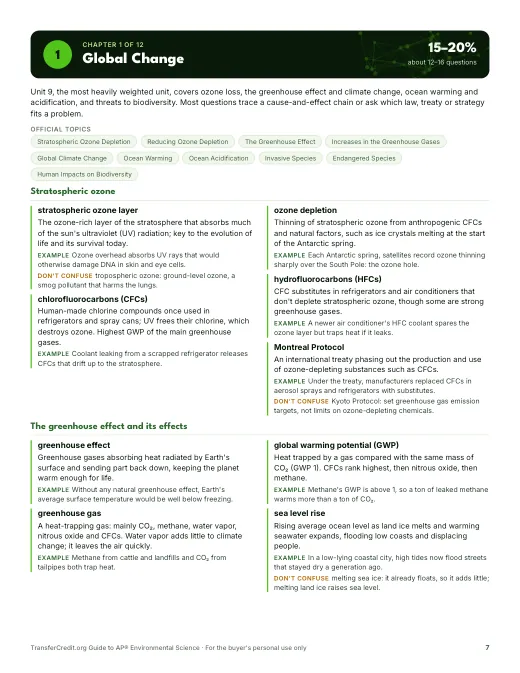
Page 1 of the TransferCredit.org Guide to AP® Environmental Science: the cover
Page 1 The cover
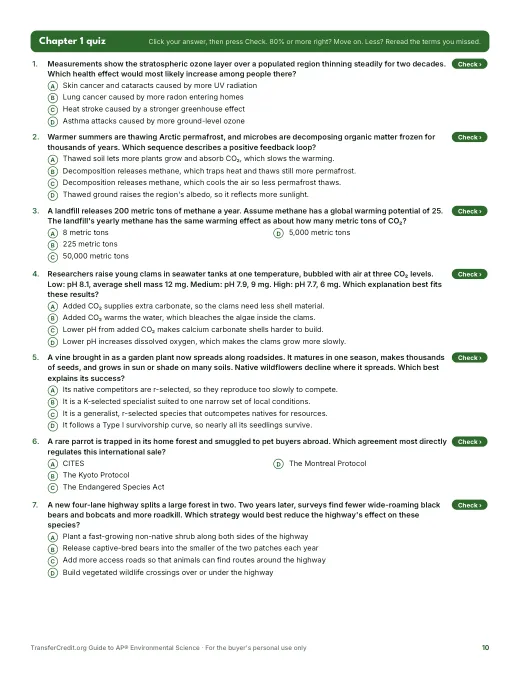
Page 7 of the TransferCredit.org Guide to AP® Environmental Science: the Chapter 1 opener
Page 7 The Chapter 1 opener
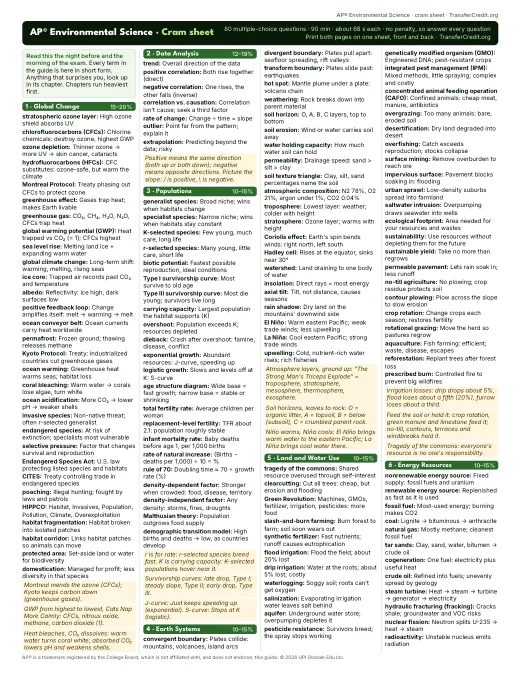
Page 10 of the TransferCredit.org Guide to AP® Environmental Science: a chapter quiz
Page 10 A chapter quiz
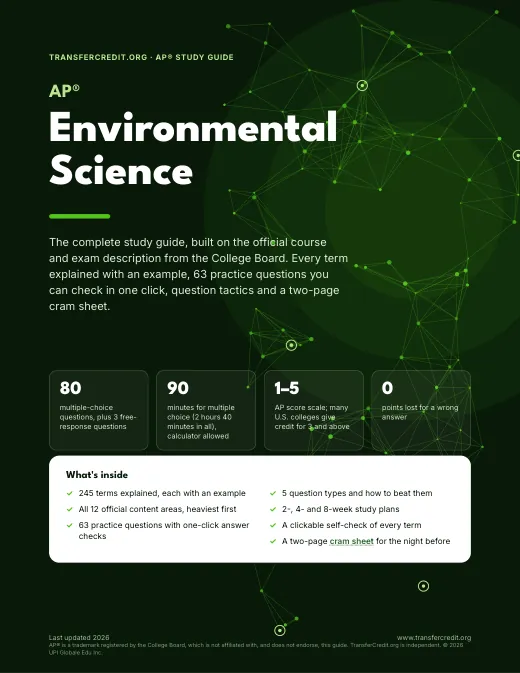
Page 54 of the TransferCredit.org Guide to AP® Environmental Science: the 2-page cram sheet
Page 54 The 2-page cram sheet

What you get for $5

One chapter for each area of the official course and exam description, heaviest topics first.

  • 📘55pages, printable
  • 🧭12chapters
  • 🔑245terms with examples
  • ✍️63practice questions, answers explained
  • ⚠️33exam traps to avoid
  • 📄2page cram sheet

Try 10 free AP® Environmental Science questions

Multiple-choice questions taken from the guide's chapter quizzes: one from each of the ten heaviest areas. About 10 minutes, with every answer explained and a score by area. The exam's free-response questions aren't in this quiz: see how the exam works.

10 questions  
  1. Question 1 · Global Change
    Measurements show the stratospheric ozone layer over a populated region thinning steadily for two decades. Which health effect would most likely increase among people there?
    Show the answer

    Answer: A. Skin cancer and cataracts caused by more UV radiation. Stratospheric ozone absorbs UV radiation. When it thins, more UV reaches the surface, and UV exposure causes skin cancer and cataracts.

    The trap: Asthma from ground-level ozone is wrong: losing ozone high in the stratosphere doesn't add ozone near the ground.

  2. Question 2 · Data Analysis
    A city's tree canopy covered this share of its land: 2000, 32%; 2005, 30%; 2010, 27%; 2015, 25%; 2020, 22%. Which statement best describes the data?
    Show the answer

    Answer: B. Cover fell steadily, by 10 percentage points. Each survey is lower than the last: a steady drop of 10 percentage points (32% to 22%), about 31% of the 2000 value (10 ÷ 32).

    The trap: A fall of 10% of the 2000 value would leave about 28.8% cover, not 22%.

  3. Question 3 · Populations
    A fish found only in a cold, stable mountain lake first breeds at about 9 years old, lays a few dozen large eggs a year, and guards its nest. Anglers release a fast-breeding minnow there. Which prediction is best supported?
    Show the answer

    Answer: C. It will likely be harmed more by the minnow than an r-selected native fish would be.. Late maturity, few large eggs and parental care mark a K-selected species, which invasive species typically harm more than r-selected ones.

    The trap: Type III fits r-selected species with many uncared-for young; K-selected species follow Type I or II curves.

  4. Question 4 · Earth Systems
    A line of volcanic islands crosses the middle of an oceanic plate, far from any boundary. Only the island at one end is active, and the islands get older with distance from it. Which explanation fits best?
    Show the answer

    Answer: D. The plate is moving over a stationary hot spot in the mantle. A hot spot stays fixed as the plate moves, so each island forms over it and is carried away; only the newest island is active.

    The trap: Island arcs are volcanic chains too, but they form at convergent boundaries; these islands lie far from any boundary.

  5. Question 5 · Land and Water Use
    A farm withdraws 600,000 liters of water a week to flood-irrigate a field. Using typical losses to evaporation and runoff, how many more liters would reach the crops each week with drip irrigation and the same withdrawal?
    Show the answer

    Answer: D. 90,000 liters. Flood loses about 20%, so 600,000 × 0.80 = 480,000 L reach the crops; drip loses about 5%, so 600,000 × 0.95 = 570,000 L do. Difference: 90,000 L.

    The trap: 120,000 liters is all the water flood irrigation loses; drip still loses about 30,000, so the gain is 90,000.

  6. Question 6 · Energy Resources
    A radioactive waste sample has an activity of 640 units, and its isotope's half-life is 6 hours. What activity remains after 24 hours?
    Show the answer

    Answer: A. 40 units. 24 ÷ 6 = 4 half-lives: 640 → 320 → 160 → 80 → 40 units, the same as 640 × (1/2)⁴.

    The trap: 160 units divides 640 by the number of half-lives; each half-life halves what remains.

  7. Question 7 · Atmospheric Pollution
    On a clear summer day, a city's nitrogen oxide levels peak at 8 a.m. and its ozone levels peak at 3 p.m. Which best explains why ozone peaks later?
    Show the answer

    Answer: C. Ozone forms as NOₓ and VOCs react in sunlight, which strengthens through the day.. Ozone is a secondary pollutant: morning NOₓ reacts with VOCs in sunlight and heat, so ozone builds up and peaks in the afternoon.

    The trap: Afternoon traffic is wrong: vehicles emit NOₓ and VOCs, not ozone; ozone forms from them in the air.

  8. Question 8 · Aquatic and Terrestrial Pollution
    A river's high nitrate levels come from fertilizer washing off hundreds of farms, and its high copper levels from one mine's drainage pipe. How should the two sources be classified?
    Show the answer

    Answer: B. Farm runoff is a nonpoint source; the mine pipe is a point source. The mine pipe is one identifiable discharge point, a point source; fertilizer washing off hundreds of farms is diffuse, a nonpoint source.

    The trap: Being measurable in the river doesn't make a source a point source; what matters is one entry point versus many diffuse ones.

  9. Question 9 · Mathematical Routines
    A school replaces 200 old 60-watt bulbs with 10-watt LED bulbs. The lights run 10 hours a day, 180 days a year, and electricity costs $0.15 per kilowatt-hour. How much does the school save on electricity each year?
    Show the answer

    Answer: A. $2,700. Power saved = 200 × (60 − 10) W = 10,000 W = 10 kW. Time = 10 h × 180 = 1,800 h. Energy = 10 kW × 1,800 h = 18,000 kWh; × $0.15/kWh = $2,700.

    The trap: $2,700,000 treats 10,000 watts as 10,000 kilowatts; divide watts by 1,000 before multiplying by hours.

  10. Question 10 · Ecosystems
    Two shorebird species share a mudflat. One has a short bill and picks small worms from the surface; the other has a long bill and probes deep for clams. Which concept best explains how both can feed there?
    Show the answer

    Answer: B. Resource partitioning. The species divide the food by depth and prey type, using the resource in different ways and places, which reduces competition.

    The trap: Commensalism requires one species to benefit from the other; here each species simply avoids competing.

The AP® Environmental Science exam at a glance

The AP® Environmental Science exam is from the College Board. It has 80 multiple-choice questions, plus 3 free-response questions. You get 90 minutes for multiple choice (2 hours 40 minutes in all), calculator allowed. The score scale is 1–5 (AP® score scale; many U.S. colleges give credit for 3 and above). The guide has 12 chapters, one for each area of the official course and exam description; the heaviest is Global Change at 15–20%.

Questions
80multiple-choice questions, plus 3 free-response questions
Time
90 minfor the 80 multiple-choice questions, about 68 seconds a question
Score
1–5AP® score scale; many U.S. colleges give credit for 3 and above
Fee
$99per exam in the U.S. and Canada in 2026-27; your school may charge more
Calculator
Yescalculator allowed
Wrong answers
No penaltya wrong answer costs nothing
  • Section I has 80 multiple-choice questions in 90 minutes (60% of your score). Section II has 3 free-response questions in 70 minutes (40%).
  • The free-response questions are Design an investigation, Analyze and interpret quantitative data, and Analyze an environmental problem doing calculations, 10 points each.
  • The exam is fully digital: you answer every question in the Bluebook testing app. A four-function (with square root) or scientific calculator is allowed on both sections, and Bluebook has a built-in Desmos scientific calculator. Graphing calculators are not allowed in 2027.
  • Your multiple-choice score is the number of questions you answer correctly, so a wrong answer costs nothing.
  • Each unit is 6–20% of the multiple-choice section. Data analysis (12–19%), math (6–9%) and experiment questions (2–4%) are skills tested inside every unit.

Source: official AP® Environmental Science page and the official course and exam description. Last updated 2026.

What the exam covers

12 chapters, heaviest first, with each area's official weight. The guide's chapters follow this order.

  1. Global Change15–20% · ~12–16 Q
  2. Data Analysis *12–19% · ~10–15 Q
  3. Populations10–15% · ~8–12 Q
  4. Earth Systems and Resources10–15% · ~8–12 Q
  5. Land and Water Use10–15% · ~8–12 Q
  6. Energy Resources and Consumption10–15% · ~8–12 Q
  7. Atmospheric Pollution7–10% · ~6–8 Q
  8. Aquatic and Terrestrial Pollution7–10% · ~6–8 Q
  9. Mathematical Routines *6–9% · ~5–7 Q
  10. The Living World: Ecosystems6–8% · ~5–6 Q
  11. The Living World: Biodiversity6–8% · ~5–6 Q
  12. Scientific Experiments *2–4% · ~2–3 Q

* Not units: skills tested inside every unit. Data Analysis: data questions appear inside every unit, about 12–19% of the multiple-choice section. Mathematical Routines: math questions appear inside every unit, about 6–9% of the multiple-choice section and 20% of the free-response section. Scientific Experiments: experiment questions appear inside every unit, about 2–4% of the multiple-choice section and 10–14% of the free-response section. These weights are a share of the same multiple-choice questions, so the weights add up to more than 100%.

Where to start: the 5 heaviest areas (marked in the map) carry about 54 of the 80 questions. The guide puts them first, so working front to back covers the most points earliest.

AP® Environmental Science study guide by area

The 2 heaviest areas are open to read now. The full guide has a chapter for every area, each with all its terms, a quiz and an answer key.

2 of 12 chapters open  ·  in the guide's order
15–20% · about 12–16 questions · free preview Global Change Chapter 1 of the guide

Unit 9, the most heavily weighted unit, covers ozone loss, the greenhouse effect and climate change, ocean warming and acidification, and threats to biodiversity. Most questions trace a cause-and-effect chain or ask which law, treaty or strategy fits a problem.

Key terms, with examples

stratospheric ozone layer
The ozone-rich layer of the stratosphere that absorbs much of the sun's ultraviolet (UV) radiation; key to the evolution of life and its survival today.
Example: Ozone overhead absorbs UV rays that would otherwise damage DNA in skin and eye cells.
greenhouse effect
Greenhouse gases absorbing heat radiated by Earth's surface and sending part back down, keeping the planet warm enough for life.
Example: Without any natural greenhouse effect, Earth's average surface temperature would be well below freezing.
global climate change
Long-term change in Earth's climate, now driven by greenhouse gases: warming, melting ice and permafrost, rising seas, shifting rainfall, poleward-spreading disease vectors.
Example: A farm region's hotter summers and heavier downpours dry out its soil, then erode it.
ocean warming
Rising ocean temperatures caused by increasing greenhouse gases; it destroys habitat and alters marine species' metabolism and reproduction.
Example: As coastal waters warm, a cold-water fish shifts poleward and local catches fall.
invasive species
A species outside its normal range that threatens natives; often a generalist, r-selected species that outcompetes them. Human interventions can control it.
Example: Zebra mussels from ships' ballast water crowd out native mussels and clog intake pipes.
HIPPCO
An acronym for the main causes of biodiversity loss: habitat destruction, invasive species, population growth, pollution, climate change, over exploitation.
Example: Draining a wetland for a mall is HIPPCO's H; overhunting sea turtles is its O.
chlorofluorocarbons (CFCs)
Human-made chlorine compounds once used in refrigerators and spray cans; UV frees their chlorine, which destroys ozone. Highest GWP of the main greenhouse gases.
Example: Coolant leaking from a scrapped refrigerator releases CFCs that drift up to the stratosphere.
greenhouse gas
A heat-trapping gas: mainly CO₂, methane, water vapor, nitrous oxide and CFCs. Water vapor adds little to climate change; it leaves the air quickly.
Example: Methane from cattle and landfills and CO₂ from tailpipes both trap heat.
ice core
Ice drilled from a glacier or ice sheet; bubbles in its yearly layers record past CO₂, and the ice records past temperatures.
Example: Antarctic ice cores show CO₂ and temperature rising and falling together across past ice ages.
coral bleaching
Corals turning white when warm water makes them lose the algae in their tissues that feed them; some recover, some die.
Example: After an unusually warm summer, patches of a reef turn white; some regain color later.
endangered species
A species at risk of extinction; most at risk are those heavily hunted, with limited diets or narrow habitats, or outcompeted by invasives.
Example: A woodpecker that nests only in old pine trees declines as those forests are logged.
habitat fragmentation
Breaking large habitats into small, isolated patches through roads, pipelines, clearing and logging; how much harm it does varies by species.
Example: Farm fields and roads divide a prairie into patches too small for wide-ranging grassland birds.

What this area covers

Stratospheric ozoneThe greenhouse effect and its effectsGlobal climate changeOcean warming and acidificationInvasive and endangered speciesHuman impacts on biodiversity

How the exam asks it

Expect cause-and-effect chains: CFCs to ozone loss to more UV; greenhouse gases to warming, rising seas, bleaching or shifting ranges; CO₂ to lower ocean pH. Data questions give gas levels, temperatures or species counts; others ask which treaty or law fits a problem, or why a species is more at risk.

Common traps

Trap 1. Ozone depletion and climate change are different problems: a thinner ozone layer admits more UV but isn't the main cause of global warming.

Trap 2. A high GWP doesn't make a gas the biggest cause of warming: CO₂'s GWP is only 1, but far more of it is released.

Trap 3. Not every non-native species is invasive; it counts as invasive when it threatens native species.

Memory trick

Montreal mends the ozone (CFCs); Kyoto keeps carbon down (greenhouse gases).

GWP from highest to lowest, Cats Nap More Calmly: CFCs, nitrous oxide, methane, carbon dioxide (1).

10–15% · about 8–12 questions · free preview Populations Chapter 3 of the guide

Unit 3 covers how populations grow, overshoot and crash, and how human populations change. Expect to classify r- and K-selected species, read survivorship curves and age structure diagrams, and calculate doubling times.

Key terms, with examples

generalist species
A species with a broad niche: many foods, many habitats. Generalists tend to be advantaged where habitats are changing.
Example: Raccoons eat fruit, insects, eggs and garbage, and thrive in forests, farms and cities.
K-selected species
Large, long-lived species of stable habitats that mature late, breed repeatedly and raise few offspring with much care. Competition is high.
Example: An elephant carries one calf for nearly two years, then the herd protects it for years.
Type I survivorship curve
A survivorship curve (a same-age cohort's survival from birth to maximum age) in which most individuals live to old age; typical of K-selected species.
Example: Where healthcare and nutrition are good, few children die and most people die in old age.
carrying capacity
The largest population of a species an environment can support over time with its resources and space; written K.
Example: A marsh with fixed nest sites and food supports about the same number of herons each year.
age structure diagram
A graph of a population's age groups, males on one side and females on the other; its shape shows the growth rate.
Example: A wide base of children signals rapid growth; nearly straight sides signal a stable population.
rate of natural increase
Crude birth rate minus crude death rate, usually given as a percent: growth or decline from births and deaths alone.
Example: Births 25 per 1,000 minus deaths 10 per 1,000 = 15 per 1,000 = 1.5% a year.
demographic transition model
A four-stage model of birth and death rates falling as a country industrializes; developing countries have more infant deaths and child workers.
Example: Stage 1: both rates high. 2: deaths fall, growth soars. 3: births fall. 4: both low.
specialist species
A species with a narrow niche, such as one food or one habitat. Specialists tend to be advantaged where habitats stay constant.
Example: Koalas eat almost only eucalyptus leaves, so clearing eucalyptus forest leaves them little food.
r-selected species
Small, short-lived species that mature early and have many offspring, each given little energy; some breed only once. Competition is low.
Example: A dandelion releases hundreds of wind-blown seeds and gives them no care; most never sprout.
Type III survivorship curve
A survivorship curve in which most individuals die very young and the few survivors live much longer. Typical of r-selected species.
Example: Nearly all of an oyster's millions of eggs die as larvae; the few that settle live for years.
overshoot
A population growing beyond its carrying capacity, using resources faster than they are replaced and depleting them.
Example: Deer with no predators multiply until they eat a forest's young trees faster than they regrow.
total fertility rate
Average children per woman over her lifetime at current rates; affected by age at first birth, girls' education, family planning and government policies.
Example: After a government offers free contraception at rural clinics, average family size falls within a generation.

What this area covers

Generalist and specialist speciesK-selected and r-selected speciesSurvivorship curvesCarrying capacity and population growthAge structure and fertilityHuman population dynamicsDemographic transition

How the exam asks it

Most questions describe a species, curve or diagram and ask you to classify it or predict what happens. Check offspring number and care for r and K, when most deaths occur on survivorship curves, and base width on age structure diagrams. Calculations use the rate of natural increase and the rule of 70.

Common traps

Trap 1. Many species aren't purely r- or K-selected; some mix traits or switch strategies with conditions. Classify by the traits given.

Trap 2. In the rule of 70, use the percent: 2, not 0.02. Convert rates per 1,000 to a percent first (÷ 10).

Trap 3. Invasive species hurt K-selected natives most: slow breeders can't replace losses quickly, and most invasives are fast-breeding r-selected species.

Memory trick

r is for rate: r-selected species breed fast. K is carrying capacity: K-selected populations hover near it.

Survivorship curves: late drop, Type I; steady slope, Type II; early drop, Type III.

How AP® Environmental Science questions are written

The exam has 80 multiple-choice questions, plus 3 free-response questions. The guide sorts the questions into 5 types; spot the type and you'll know what the question wants before you read the choices.

Type 1

Explain a concept in a scenario

A short scenario, then "which best explains..." or "which concept is shown", with four concepts or explanations as choices. Concept explanation is 30–38% of the multiple-choice section.

  • Name the process yourself from the key detail before reading the choices.
  • If two choices look alike, use the one detail that separates them (soil present or not, one pipe or many sources).
  • Cross out choices that are true facts but don't explain this scenario.
Type 2

Read a described model or diagram

A food web, nutrient cycle, soil profile, plate-boundary map or energy pyramid, shown or described, then a question about one part or about what happens when something changes.

  • Label each part of the model before you read the question.
  • For "what happens if" questions, follow the change one step at a time through the model.
  • Check that your answer runs in the direction the model shows, such as energy flowing up a food web.
Type 3

Interpret a data table or graph

A short table or a described graph from any unit, often with two or three questions on the same data, about the trend, the relationship between variables or what the data support.

  • Read the title, the variables and the units first.
  • Say the overall direction in your own words, and note any outlier.
  • Pick the choice the data actually support; reject choices that claim cause or reach beyond the data.
Type 4

Calculate with units

A scenario with numbers (energy use, half-life, population growth, percent change, unit conversions), then a numeric answer with units. A four-function or scientific calculator is allowed.

  • List the given values with their units and decide what the question asks for.
  • Set up the conversion so the units cancel (dimensional analysis), then compute.
  • Check that the size and the units of your answer make sense.
Type 5

Propose or judge a solution

An environmental problem, sometimes in a short passage from an article or report, then "which action would most effectively reduce...", "which is a disadvantage of..." or "what is the author's claim". Environmental solutions are 17–23% of the multiple-choice section.

  • Name the cause of the problem first; the best solution acts on that cause.
  • For each choice, ask whether it really reduces the problem and what unintended consequence it might have.
  • For a text source, find the author's claim and its evidence before reading the choices.

Test-day habits that add points

  1. Answer every question. There's no penalty for a wrong answer. A blank is always worth zero, so never leave one.
  2. Predict, then look. Name the answer before reading the choices. It protects you from distractors written to sound right.
  3. Eliminate. Cross out choices you know are wrong. Every choice you rule out raises your odds on a guess.
  4. Mark and move on. If a question takes more than a minute, pick your best guess, mark it and come back if time allows.
  5. Watch absolute words. Choices with "always", "never" or "only" are often wrong, because most rules and findings have exceptions. Treat this as a tiebreaker, not a rule.
  6. Change answers for a reason. Switch an answer only when you can say why the new one is better, such as a detail you missed.
  7. The three free-response questions. Section II has three free-response questions in 70 minutes (40% of your score), worth 10 points each. Question 1, Design an investigation, gives a scenario with a model or visual representation. Question 2, Analyze and interpret quantitative data, gives a scenario with a table, chart and/or graph. Question 3, Analyze an environmental problem doing calculations, gives a scenario with quantitative data: show your work and label your units. Each question also asks you to explain environmental concepts and to propose or justify solutions.

Pacing: 80 questions in 90 minutes, about 68 seconds a question.

AP® Environmental Science flashcards

Try the first 8 cards free. Read the term, say the definition out loud, then select the card to check yourself. Arrow keys move between cards.

Free card 1 of 8 (deck total: 245)

How to study for AP® Environmental Science: a 5-step plan

Follow the steps, then enter your test date. The planner gives you a dated plan that starts with the heaviest areas and saves the last days for review.

  1. Take the 10 free questionsSee which AP® Environmental Science areas you already know.
  2. Study the heaviest areas firstStart with Global Change, Populations and Earth Systems and Resources, then work down the exam map.
  3. Learn each term with an exampleSay the definition out loud, then check it with the flashcards. A term you can't use in an example isn't learned yet.
  4. Quiz yourself and study the trapsAfter each area, answer its quiz and read why the tempting wrong answer is wrong.
  5. Plan backwards from your exam dateBuild a dated plan, keep the last days for a full review, and read the cram sheet the night before.

How it works

  1. 1Check outSelect Get the guide · $5 and pay on TransferCredit.org's secure checkout.
  2. 2Download the PDFFrom your TransferCredit.org account.
  3. 3Study the heaviest areas firstFollow the 2-, 4- or 8-week plan, then read the cram sheet the night before.

This page or the full guide

Everything on this page is free with no account. The full guide is a PDF you keep.

What's on this page and in the full study guide
Study toolThis pageFull study guide ($5)
ChaptersA preview of 2 of 12All 12
Terms explainedA sample from the open chaptersAll 245, each with an example
Practice questions10 free questions63, with an answer key
Flashcards8 cardsAll 245 terms on the self-check list
Study planDated planner2-, 4- and 8-week plans
Cram sheet—2 pages, for the night before
FormatWeb page55-page PDF, printable

Questions students ask

What's in the full AP® Environmental Science study guide?
55 pages: 12 chapters, one for each area of the College Board's official course and exam description, heaviest topics first. 245 terms, each with a plain-English definition and an example, common traps and memory tricks, 63 practice questions with an answer key that explains every answer, question tactics, 2-, 4- and 8-week study plans and a 2-page cram sheet.
How much is the full AP® Environmental Science study guide?
The full 55-page PDF is $5. The 10 practice questions on this page are free.
How do I get the full guide?
Select Get the guide · $5 and check out on TransferCredit.org. Then sign in to your TransferCredit.org account to download the PDF.
Can I print the guide or use it on my phone?
Yes. It's a PDF, so it opens on phones, tablets and computers, and printing is allowed. Its tick boxes and answer bubbles work in PDF readers that support forms. Copying and editing are turned off.
Can I try the AP® Environmental Science guide before I buy it?
Yes. This page has 10 questions from the guide's own chapter quizzes, a preview of the 2 heaviest areas, 8 flashcards and a study planner. No account needed.
Is this an official AP® study guide?
No. AP® is a trademark registered by the College Board, which is not affiliated with, and does not endorse, this guide. TransferCredit.org is independent. We built the guide from the College Board's official course and exam description, and the exam details were checked against the College Board's published exam information in 2026.
How was this study guide made?
One chapter for each area of the official course and exam description, using its published weights. Each chapter was written, then fact-checked against the official exam information in a separate review. The practice questions are original: none are copied from the College Board's released questions.
How up to date is this AP® Environmental Science guide?
Last updated 2026. The exam details were checked against the College Board's published exam information in 2026. Exams change, so confirm the details on the official AP® Environmental Science page before you test.
More questions about the AP® Environmental Science exam (16)
What is the AP® Environmental Science exam?
The AP® Environmental Science exam is from the College Board. It has 80 multiple-choice questions, plus 3 free-response questions. You get 90 minutes for multiple choice (2 hours 40 minutes in all), calculator allowed. The score scale is 1–5 (AP® score scale; many U.S. colleges give credit for 3 and above). The guide has 12 chapters, one for each area of the official course and exam description; the heaviest is Global Change at 15–20%.
How many questions are on the AP® Environmental Science exam, and how long is it?
Section I has 80 multiple-choice questions in 90 minutes (60% of your score). Section II has 3 free-response questions in 70 minutes (40%).
How is the AP® Environmental Science exam scored?
The score scale is 1–5: AP® score scale; many U.S. colleges give credit for 3 and above. Your multiple-choice score is the number of questions you answer correctly, so a wrong answer costs nothing.
What AP® Environmental Science score do I need for college credit?
Many U.S. colleges give credit for 3 and above. Each college sets its own credit policy, so check the one at your college before you count on the credit.
How much does the AP® Environmental Science exam cost?
The fee is $99: per exam in the U.S. and Canada in 2026-27; your school may charge more. Fees can change, so check the official page when you register.
Can I use a calculator on the AP® Environmental Science exam?
A four-function (with square root) or scientific calculator is allowed on both sections, and Bluebook has a built-in Desmos scientific calculator. Graphing calculators are not allowed in 2027.
Is there a penalty for guessing on AP® Environmental Science?
No. There's no penalty for a wrong answer. A blank is always worth zero, so never leave one.
What topics are on the AP® Environmental Science exam?
9 areas, from the official course and exam description: Global Change (15–20%); Populations (10–15%); Earth Systems and Resources (10–15%); Land and Water Use (10–15%); Energy Resources and Consumption (10–15%); Atmospheric Pollution (7–10%); Aquatic and Terrestrial Pollution (7–10%); The Living World: Ecosystems (6–8%); The Living World: Biodiversity (6–8%). Tested inside every unit: Data Analysis (12–19%); Mathematical Routines (6–9%); Scientific Experiments (2–4%).
Which AP® Environmental Science topics should I study first?
The 5 heaviest areas (marked in the map) carry about 54 of the 80 questions. The guide puts them first, so working front to back covers the most points earliest.
Is the AP® Environmental Science exam hard?
It depends on what you already know. The largest area, Global Change, is 15–20%, and the smallest, the Living World: Biodiversity, is 6–8%. Try the 10 free questions above to see where you stand in about 10 minutes.
What kinds of questions are on the AP® Environmental Science exam?
The exam has 80 multiple-choice questions, plus 3 free-response questions. The guide sorts the questions into 5 types: “Explain a concept in a scenario”, “Read a described model or diagram”, “Interpret a data table or graph”, “Calculate with units” and “Propose or judge a solution”. Multiple-choice questions have 4 answer choices. See how each type is written.
What are the free-response questions on the AP® Environmental Science exam?
Section II has three free-response questions in 70 minutes (40% of your score), worth 10 points each. Question 1, Design an investigation, gives a scenario with a model or visual representation. Question 2, Analyze and interpret quantitative data, gives a scenario with a table, chart and/or graph. Question 3, Analyze an environmental problem doing calculations, gives a scenario with quantitative data: show your work and label your units. Each question also asks you to explain environmental concepts and to propose or justify solutions.
How should I pace myself on the AP® Environmental Science exam?
80 questions in 90 minutes, about 68 seconds a question. If a question takes more than a minute, pick your best guess, mark it and come back if time allows.
How long should I study for AP® Environmental Science?
Take the 10 free questions to see where you stand. The full guide has 2-, 4- and 8-week plans built from the exam weights, and the planner on this page builds a dated plan from your exam date.
How do I know I'm ready for the AP® Environmental Science exam?
The guide's readiness checklist: You can explain every term on the checklist without notes. You score 80% or better on every chapter quiz. You can read the cram sheet and nothing on it surprises you. You know the AP® score your college gives credit for, and your exam date.
What should I do the night before?
Read the 2-page cram sheet once, slowly. Check your exam time and room with your AP® coordinator. You may bring a four-function or scientific calculator, not a graphing one. In the morning, skim the traps, then stop studying.

How we built this guide

We built one chapter for each area of the College Board's official course and exam description for AP® Environmental Science, using its published weights to order the chapters and size the quizzes. Each chapter was written, then fact-checked against the official exam information in a separate review. The exam details were checked against the College Board's published exam information in 2026.

Sources: official AP® Environmental Science page, official course and exam description. Last updated 2026.

AP® is a trademark registered by the College Board, which is not affiliated with, and does not endorse, this guide. TransferCredit.org is independent and not affiliated with the College Board. © 2026 UPI Globale Edu Inc.

Ready for the full AP® Environmental Science guide? 55 pages, 245 terms, 63 practice questions and a 2-page cram sheet, $5.

Get the guide · $5

In the full guide

TransferCredit.org Guide to AP® Environmental Science

  • All 12 chapters
  • 245 terms with examples
  • 63 practice questions with an answer key
  • A 2-page cram sheet and 2-, 4- and 8-week plans
Get the guide · $5