← All AP® study guides
AP® Study Guide Printable PDF · 44 pages

TransferCredit.org Guide to AP® Physics 2: Algebra-Based

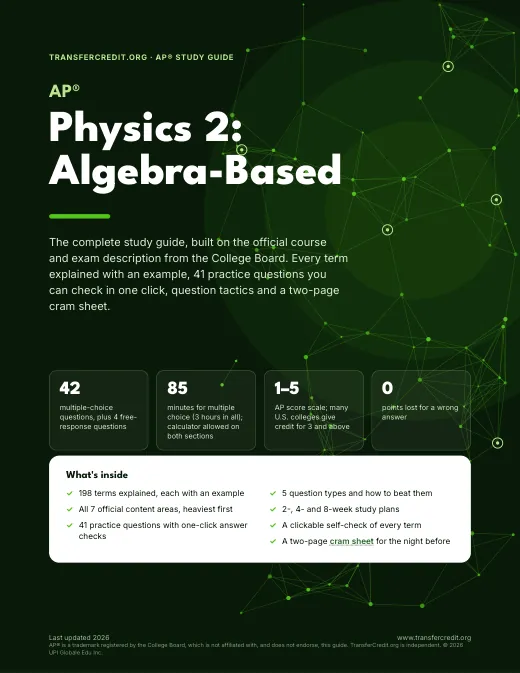
AP® Physics 2: Algebra-Based study guide: a printable PDF built from the College Board's official course and exam description, heaviest topics first.

  • 198 key terms, each with an example
  • 41 practice questions with every answer explained
  • A 2-page cram sheet for the night before
  • 2-, 4- and 8-week study plans built from the exam weights
Not sure yet? Try 10 free questions

Last updated 2026 · exam details checked against the College Board's published exam information in 2026

Look inside the guide

Real pages from the 44-page PDF.

Page 1 of the TransferCredit.org Guide to AP® Physics 2: Algebra-Based: the cover
Page 1 The cover
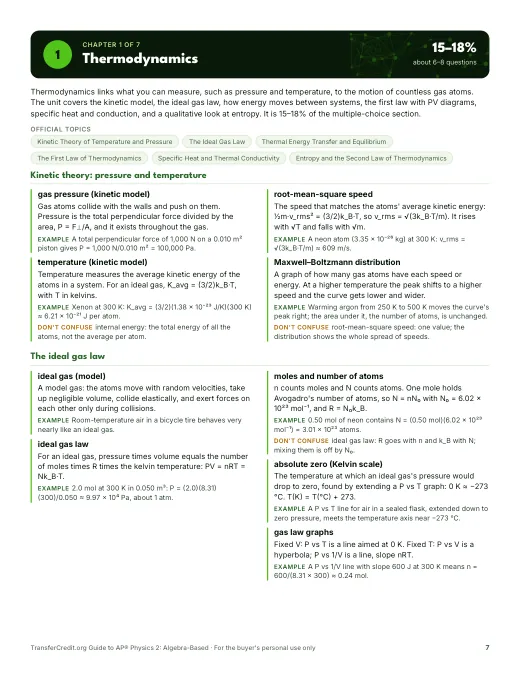
Page 7 of the TransferCredit.org Guide to AP® Physics 2: Algebra-Based: the Chapter 1 opener
Page 7 The Chapter 1 opener
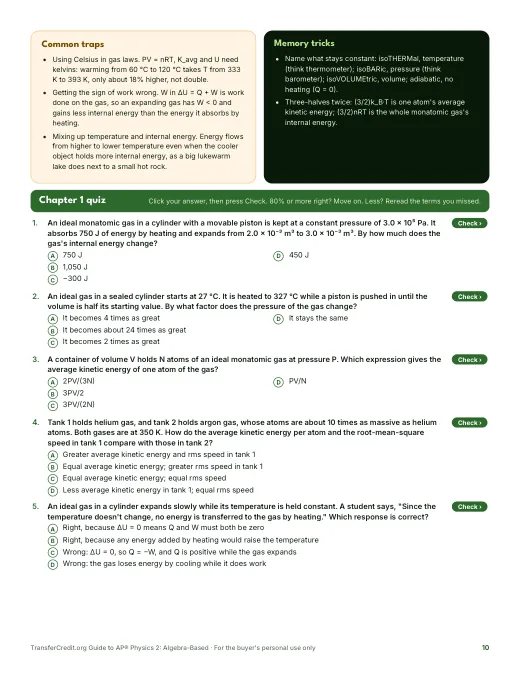
Page 10 of the TransferCredit.org Guide to AP® Physics 2: Algebra-Based: a chapter quiz
Page 10 A chapter quiz
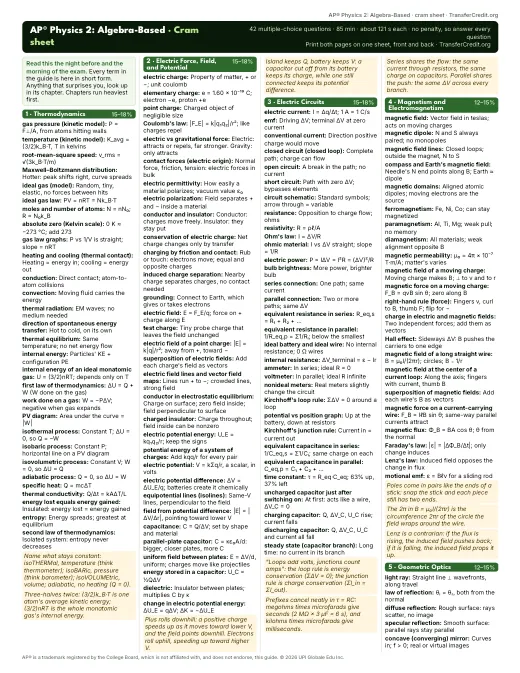
Page 43 of the TransferCredit.org Guide to AP® Physics 2: Algebra-Based: the 2-page cram sheet
Page 43 The 2-page cram sheet

What you get for $5

One chapter for each area of the official course and exam description, heaviest topics first.

  • 📘44pages, printable
  • 🧭7chapters
  • 🔑198terms with examples
  • ✍️41practice questions, answers explained
  • ⚠️21exam traps to avoid
  • 📄2page cram sheet

Try 10 free AP® Physics 2: Algebra-Based questions

Multiple-choice questions taken from the guide's chapter quizzes: 7 areas, heaviest first. About 20 minutes, with every answer explained and a score by area. The exam's free-response questions aren't in this quiz: see how the exam works.

10 questions  
  1. Question 1 · Thermodynamics
    An ideal monatomic gas in a cylinder with a movable piston is kept at a constant pressure of 3.0 × 10⁵ Pa. It absorbs 750 J of energy by heating and expands from 2.0 × 10⁻³ m³ to 3.0 × 10⁻³ m³. By how much does the gas's internal energy change?
    Show the answer

    Answer: B. 450 J. The work done on the gas is W = −PΔV = −(3.0 × 10⁵ Pa)(1.0 × 10⁻³ m³) = −300 J, negative because the gas expands. Then ΔU = Q + W = 750 J − 300 J = 450 J, which matches (3/2)PΔV for a monatomic gas.

    The trap: 1,050 J adds the 300 J instead of subtracting it. W is the work done on the gas, and an expanding gas has negative work done on it.

  2. Question 2 · Electric Force, Field, and Potential
    Two small charged spheres, A and B, sit r apart and exert electric forces of magnitude F on each other. The charge on A is halved, and the spheres are moved closer until their separation is r/3. How strong is the force each sphere now exerts on the other?
    Show the answer

    Answer: C. 9F/2. Coulomb's law gives F proportional to q₁q₂/r². Halving one charge multiplies F by 1/2, and cutting r to r/3 multiplies it by 3² = 9, so the new force is (1/2)(9)F = 9F/2.

    The trap: 3F/2 treats the force as falling off like 1/r instead of 1/r². The separation factor must be squared: one-third the distance gives nine times the force.

  3. Question 3 · Electric Circuits
    An ideal 18 V battery drives a 3.0 Ω resistor followed by a parallel pair of resistors, 10 Ω and 15 Ω. How much current is in the 15 Ω resistor?
    Show the answer

    Answer: D. 0.80 A. The parallel pair has 1/R = 1/10 + 1/15 = 1/6, so R = 6.0 Ω, and the whole circuit has R_eq = 3.0 + 6.0 = 9.0 Ω. The battery's current is 18 V/9.0 Ω = 2.0 A, the pair has (2.0 A)(6.0 Ω) = 12 V across it, and the 15 Ω resistor carries 12 V/15 Ω = 0.80 A.

    The trap: 2.0 A is the battery's current. At the junction it splits between the branches, and the larger resistor gets the smaller share.

  4. Question 4 · Magnetism and Electromagnetism
    A long straight wire carries a steady current of 5.0 A. An electron moves at 2.0 × 10⁶ m/s parallel to the wire, 0.010 m from it. How strong is the magnetic force on the electron?
    Show the answer

    Answer: A. 3.2 × 10⁻¹⁷ N. The wire's field at the electron is B = μ₀I/(2πr) = (4π × 10⁻⁷ T·m/A)(5.0 A)/(2π × 0.010 m) = 1.0 × 10⁻⁴ T. That field circles the wire, so it is perpendicular to the electron's velocity, and F_B = evB = (1.60 × 10⁻¹⁹ C)(2.0 × 10⁶ m/s)(1.0 × 10⁻⁴ T) = 3.2 × 10⁻¹⁷ N.

    The trap: "0 N" treats moving along the wire as moving along the field. The wire's field circles it, so the electron's velocity is at 90° to the field. (2.0 × 10⁻¹⁶ N comes from dropping the 2π.)

  5. Question 5 · Geometric Optics
    A candle flame 3.0 cm tall stands 12 cm in front of a concave mirror whose radius of curvature is 16 cm. How tall is the image of the flame?
    Show the answer

    Answer: B. 6.0 cm. The focal length is f = R/2 = 8.0 cm. Then 1/sᵢ = 1/8.0 cm − 1/12 cm = 1/24 cm, so sᵢ = +24 cm (a real, inverted image). |M| = sᵢ/s₀ = 24/12 = 2.0, so the image is 2.0 × 3.0 cm = 6.0 cm tall.

    The trap: "12 cm" uses the 16 cm radius of curvature as the focal length, which gives sᵢ = −48 cm and |M| = 4. The focal length is half the radius. (1.5 cm comes from inverting the ratio, s₀/sᵢ.)

  6. Question 6 · Waves, Sound, and Physical Optics
    A soap film with index of refraction 1.33 has air on both sides. Green light of wavelength 532 nm in air shines on it at normal incidence. Which film thickness gives the strongest reflection of this light?
    Show the answer

    Answer: D. 100 nm. Reflection at the front surface (air to film) has a 180° phase change; reflection at the back (film to air) has none. With one flip, the reflections reinforce when 2t is half a wavelength in the film: 2t = λ/(2n), so t = 532 nm/(4 × 1.33) = 100 nm.

    The trap: 200 nm makes 2t equal one whole film wavelength (400 nm). With one phase flip, that gives destructive interference, so the film looks dark in green light.

  7. Question 7 · Modern Physics
    A helium ion with a single electron (He⁺) has these energy levels:
    Level | n = 1 | n = 2 | n = 3
    Energy (eV) | −54.4 | −13.6 | −6.04
    Its electron drops from the n = 3 level to the n = 2 level. What is the wavelength of the emitted photon, most nearly?
    Show the answer

    Answer: C. 164 nm. The photon carries the energy difference between the two levels: −6.04 eV − (−13.6 eV) = 7.56 eV. Then λ = hc/E = 1240 eV·nm/7.56 eV ≈ 164 nm.

    The trap: 205 nm uses only the n = 3 level's 6.04 eV. A photon's energy is the gap between the two levels, not the energy of either one.

  8. Question 8 · Thermodynamics
    An ideal gas in a sealed cylinder starts at 27 °C. It is heated to 327 °C while a piston is pushed in until the volume is half its starting value. By what factor does the pressure of the gas change?
    Show the answer

    Answer: A. It becomes 4 times as great. With the amount of gas fixed, P = nRT/V. The temperature goes from 300 K to 600 K, a factor of 2, and halving the volume doubles the pressure again, so the pressure becomes 2 × 2 = 4 times as great.

    The trap: About 24 times divides 327 by 27 in degrees Celsius and then doubles. Gas laws need kelvins, and 600 K is only twice 300 K.

  9. Question 9 · Electric Force, Field, and Potential
    A +4.0 nC point charge is fixed at x = 0, and a −4.0 nC point charge is fixed at x = 0.60 m. With V = 0 at infinity, what is the electric potential at x = 0.20 m?
    Show the answer

    Answer: C. 90 V. Potential is a scalar sum that keeps each sign: V = k(4.0 × 10⁻⁹ C)/(0.20 m) + k(−4.0 × 10⁻⁹ C)/(0.40 m) = 180 V − 90 V = 90 V.

    The trap: 270 V adds the two contributions as if both charges were positive. The −4.0 nC charge lowers the potential, so its 90 V is subtracted, not added.

  10. Question 10 · Electric Circuits
    Bulbs 1 and 2, with resistances R and 2R, are wired one after the other across an ideal battery. How do the bulbs' currents and brightness compare?
    Show the answer

    Answer: D. Equal currents; bulb 2 is brighter. In series, both bulbs carry the same current I. Power is P = I²R, so bulb 2, with twice the resistance, dissipates twice the power and glows brighter.

    The trap: "Equal currents; bulb 1 is brighter" uses P = (ΔV)²/R as if both bulbs had the same potential difference. In series they don't: bulb 2 has twice the potential difference of bulb 1.

The AP® Physics 2: Algebra-Based exam at a glance

The AP® Physics 2: Algebra-Based exam is from the College Board. It has 42 multiple-choice questions, plus 4 free-response questions. You get 85 minutes for multiple choice (3 hours in all); calculator allowed on both sections. The score scale is 1–5 (AP® score scale; many U.S. colleges give credit for 3 and above). The guide has 7 chapters, one for each area of the official course and exam description; the heaviest is Thermodynamics at 15–18%.

Questions
42multiple-choice questions, plus 4 free-response questions
Time
85 minfor the 42 multiple-choice questions, about 121 seconds a question
Score
1–5AP® score scale; many U.S. colleges give credit for 3 and above
Fee
$99per exam in the U.S. and Canada in 2026-27; your school may charge more
Calculator
Yescalculator allowed on both sections
Wrong answers
No penaltya wrong answer costs nothing
  • Section I has 42 multiple-choice questions in 85 minutes (50% of your score). Some stand alone; others come in sets that share one stimulus or data set. Section II has 4 free-response questions in 95 minutes (50%).
  • The free-response section has one question of each type: Mathematical Routines (10 points, suggested 20–25 minutes), Translation Between Representations (12 points, 25–30 minutes), Experimental Design and Analysis (10 points, 25–30 minutes) and Qualitative/Quantitative Translation (8 points, 15–20 minutes).
  • This is a hybrid digital exam: you answer the multiple-choice questions and read the free-response questions in the Bluebook app, and you handwrite your free-response answers in a paper booklet. A four-function, scientific or graphing calculator is allowed on both sections (an approved handheld one or Bluebook's built-in Desmos calculator), and an equation sheet with constants is provided.
  • Your multiple-choice score is the number of questions you answer correctly, so a wrong answer costs nothing.
  • Units 9, 10 and 11 are 15–18% of the multiple-choice section each; Units 12 to 15 are 12–15% each. From May 2027 the exam has 42 multiple-choice questions in 85 minutes and a 95-minute free-response section; older practice material may show 40 questions, 80 minutes and 100 minutes.

Source: official AP® Physics 2: Algebra-Based page and the official course and exam description. Last updated 2026.

What the exam covers

7 chapters, heaviest first, with each area's official weight. The guide's chapters follow this order.

  1. Thermodynamics15–18% · ~6–8 Q
  2. Electric Force, Field, and Potential15–18% · ~6–8 Q
  3. Electric Circuits15–18% · ~6–8 Q
  4. Magnetism and Electromagnetism12–15% · ~5–6 Q
  5. Geometric Optics12–15% · ~5–6 Q
  6. Waves, Sound, and Physical Optics12–15% · ~5–6 Q
  7. Modern Physics12–15% · ~5–6 Q

Where to start: the 4 heaviest areas (marked in the map) carry about 26 of the 42 questions. The guide puts them first, so working front to back covers the most points earliest.

AP® Physics 2: Algebra-Based study guide by area

The 2 heaviest areas are open to read now. The full guide has a chapter for every area, each with all its terms, a quiz and an answer key.

2 of 7 chapters open  ·  in the guide's order
15–18% · about 6–8 questions · free preview Thermodynamics Chapter 1 of the guide

Thermodynamics links what you can measure, such as pressure and temperature, to the motion of countless gas atoms. The unit covers the kinetic model, the ideal gas law, how energy moves between systems, the first law with PV diagrams, specific heat and conduction, and a qualitative look at entropy. It is 15–18% of the multiple-choice section.

Key terms, with examples

gas pressure (kinetic model)
Gas atoms collide with the walls and push on them. Pressure is the total perpendicular force divided by the area, P = F⊥/A, and it exists throughout the gas.
Example: A total perpendicular force of 1,000 N on a 0.010 m² piston gives P = 1,000 N/0.010 m² = 100,000 Pa.
ideal gas (model)
A model gas: the atoms move with random velocities, take up negligible volume, collide elastically, and exert forces on each other only during collisions.
Example: Room-temperature air in a bicycle tire behaves very nearly like an ideal gas.
heating and cooling (thermal contact)
Systems are in thermal contact when energy can pass between them by thermal processes. Heating is energy transferred into a system this way; cooling is energy transferred out.
Example: A cold juice box set on a warm counter: the juice is heated while the counter beneath it is cooled.
internal energy
Kinetic energy of a system's particles plus potential energy of their configuration (an ideal gas has none). It can change without moving the system's center of mass.
Example: Ice melting at 0 °C gains internal energy as configuration potential energy, though its temperature stays the same.
isothermal process
A process at constant temperature, following an isotherm on a PV diagram. For an ideal gas, U doesn't change (ΔU = 0), so Q = −W.
Example: Slowly compressing a gas in a cylinder kept in an ice bath: 300 J of work done on it, 300 J leaves by cooling.
specific heat
The energy needed to raise 1 kg of a material by 1 K, from Q = mcΔT. It is an intrinsic property of the material, modeled as independent of temperature.
Example: Warming 0.20 kg of aluminum (c = 900 J/(kg·K)) by 10 K takes Q = (0.20)(900)(10) = 1,800 J.
entropy
A qualitative measure of how spread out a system's energy is, or how much of it can't do work. A state function, it is greatest at thermodynamic equilibrium.
Example: A bouncing ball's energy ends up spread through the floor and air as thermal energy, which can't relaunch the ball.
temperature (kinetic model)
Temperature measures the average kinetic energy of the atoms in a system. For an ideal gas, K_avg = (3/2)k_B·T, with T in kelvins.
Example: Xenon at 300 K: K_avg = (3/2)(1.38 × 10⁻²³ J/K)(300 K) ≈ 6.21 × 10⁻²¹ J per atom.
ideal gas law
For an ideal gas, pressure times volume equals the number of moles times R times the kelvin temperature: PV = nRT = Nk_B·T.
Example: 2.0 mol at 300 K in 0.050 m³: P = (2.0)(8.31)(300)/0.050 ≈ 9.97 × 10⁴ Pa, about 1 atm.
conduction
Energy transfer through collisions between atoms of systems in direct contact. Energy passes atom to atom while the material itself stays in place.
Example: The handle of a metal spoon left in hot soup grows warm as energy passes along the spoon.
internal energy of an ideal monatomic gas
For an ideal monatomic gas, internal energy is just the atoms' total kinetic energy: U = (3/2)nRT = (3/2)Nk_B·T, so it depends only on T.
Example: 2.0 mol of argon at 400 K: U = (3/2)(2.0 mol)(8.31 J/(mol·K))(400 K) ≈ 9,970 J.
isobaric process
A process at constant pressure, shown as a horizontal line on a PV diagram. The work done on the gas is W = −PΔV.
Example: At a steady 1.0 × 10⁵ Pa, a gas shrinks by 0.015 m³ (ΔV = −0.015 m³): W = −PΔV = +1,500 J.

What this area covers

Kinetic theory: pressure and temperatureThe ideal gas lawThermal energy transfer and equilibriumInternal energy and the first lawThermodynamic processesSpecific heat and thermal conductivityEntropy and the second law

How the exam asks it

Most questions describe a gas, a container or two objects in contact and ask you to calculate a value, predict how a quantity changes, or pick the claim and reason that fit. Convert to kelvins first, write the law that links the quantities (PV = nRT, K_avg = (3/2)k_B·T, ΔU = Q + W, Q = mcΔT or Q/Δt = kAΔT/L), then track signs: W is work done on the gas. Process questions turn on what stays constant: temperature, pressure, volume, or no heating (Q = 0). Entropy is tested only in words.

Common traps

Trap 1. Using Celsius in gas laws. PV = nRT, K_avg and U need kelvins: warming from 60 °C to 120 °C takes T from 333 K to 393 K, only about 18% higher, not double.

Trap 2. Getting the sign of work wrong. W in ΔU = Q + W is work done on the gas, so an expanding gas has W < 0 and gains less internal energy than the energy it absorbs by heating.

Trap 3. Mixing up temperature and internal energy. Energy flows from higher to lower temperature even when the cooler object holds more internal energy, as a big lukewarm lake does next to a small hot rock.

Memory trick

Name what stays constant: isoTHERMal, temperature (think thermometer); isoBARic, pressure (think barometer); isoVOLUMEtric, volume; adiabatic, no heating (Q = 0).

Three-halves twice: (3/2)k_B·T is one atom's average kinetic energy; (3/2)nRT is the whole monatomic gas's internal energy.

15–18% · about 6–8 questions · free preview Electric Force, Field, and Potential Chapter 2 of the guide

This chapter is about charges at rest: how they push and pull on each other, the electric fields and potentials they create, and how capacitors store charge and energy. Expect point-charge work with Coulomb's law, field and isoline maps, parallel-plate capacitors, and energy conservation for charges moving through a potential difference.

Key terms, with examples

electric charge
A fundamental property of all matter that causes electric forces. Charge is either positive or negative, and its SI unit is the coulomb (C).
Example: A dust grain carrying −3.0 nC has more electrons than protons; a grain carrying +3.0 nC has fewer.
conservation of electric charge
A system's net charge stays constant unless charge is transferred to or from it. Charge is moved from place to place, never created or destroyed.
Example: A +9 nC metal ball touches an identical neutral ball: each ends with +4.5 nC, and the total is still +9 nC.
electric field
Force per unit charge on a test charge: E = F_E/q, a vector measured in N/C. Positive charges are pushed along E, negative charges opposite.
Example: A +2.0 nC test charge pushed east by 60 μN shows E = 60 μN/2.0 nC = 3.0 × 10⁴ N/C, east.
electric potential energy
The energy of two point charges, U_E = kq₁q₂/r, equal to the work needed to bring them in from infinitely far apart. Positive for like charges, negative for unlike.
Example: For charges 0.50 m apart, U_E = k(+2.0 μC)(−3.0 μC)/(0.50 m) ≈ −0.11 J, negative because they attract.
electric potential
Electric potential energy per unit charge at a point. For point charges V = kΣqᵢ/rᵢ, a scalar sum keeping each charge's sign, with V = 0 at infinity. Unit: volt.
Example: 0.30 m from both +6.0 nC and −2.0 nC, V = k(6.0 − 2.0) nC/(0.30 m) = 120 V.
capacitance
The charge on each plate per volt: C = Q/ΔV, in farads (F). It depends only on the capacitor's shape and the material between its two oppositely charged plates.
Example: A capacitor holding 12 μC on each plate at 4.0 V has C = 12 μC/4.0 V = 3.0 μF.
change in electric potential energy
A charge q moving through a potential difference ΔV changes the electric potential energy by ΔU_E = qΔV. With only electric forces acting, its kinetic energy changes by ΔK = −ΔU_E.
Example: A proton moving from 500 V to 200 V has ΔU_E = e(−300 V) = −300 eV, so it gains 300 eV of kinetic energy.
elementary charge
The magnitude of one electron's or proton's charge, e = 1.60 × 10⁻¹⁹ C, the smallest indivisible amount. An electron has −e, a proton +e, a neutron 0.
Example: A glass rod that loses 3.0 × 10¹⁰ electrons has q = +Ne = (3.0 × 10¹⁰)(1.60 × 10⁻¹⁹ C) = +4.8 × 10⁻⁹ C.
charging by friction and contact
Rubbing or touching two objects can transfer charge between them, changing each one's net charge. In solids the charges that move are electrons; protons stay in their nuclei.
Example: Rubbing a rubber rod with fur moves electrons onto the rod: the rod becomes negative and the fur equally positive.
test charge
A point charge small enough that its presence doesn't noticeably change the electric field it is used to measure.
Example: To map the field near a charged dome, use a tiny probe charge; a large one would push the dome's own charge around.
potential energy of a system of charges
The total electric potential energy of several point charges is the sum of kq₁q₂/r over every pair of charges. The exam uses at most four point charges.
Example: Four charges at a square's corners form six pairs, four along the sides and two along the diagonals, so the sum has six terms.
electric potential difference
The change in electric potential energy per unit charge when a test charge moves between two points: ΔV = ΔU_E/q. A battery's chemical processes also create one.
Example: Each 2.0 C pushed through a battery gains 24 J of electric potential energy: ΔV = 24 J/2.0 C = 12 V.

What this area covers

Charge and the electric forceCharging and conservation of chargeElectric fieldsElectric potential energyElectric potentialCapacitorsEnergy of a moving charge

How the exam asks it

Questions describe a few point charges, a pair of charged plates or a map of isolines in words, then ask for a force, field, potential or energy, a comparison of two points, or the factor by which something changes. First decide whether the quantity is a vector (force and field: add as arrows and get the direction from a sketch) or a scalar (potential and potential energy: add signed numbers). Claim questions often turn on the steps of a charging process or on what stays fixed when a capacitor is changed.

Common traps

Trap 1. Force and field fall off as 1/r²; potential and potential energy fall off as 1/r. Doubling the distance cuts F_E and E to a quarter but cuts V and U_E only to half.

Trap 2. Attraction doesn't prove an object is charged: a charged rod also attracts neutral objects, by induced charge separation. Only repulsion proves the object carries charge, of the same sign as the rod.

Trap 3. Keep signs in V = kΣq/r and U_E = kq₁q₂/r, because they are scalars and a negative charge lowers V. Coulomb's law and |E| = k|q|/r² use magnitudes, with the direction taken from a sketch.

Memory trick

Plus rolls downhill: a positive charge speeds up as it moves toward lower V, and the field points downhill. Electrons roll uphill, speeding up toward higher V.

Island keeps Q, battery keeps V: a capacitor cut off from its battery keeps its charge, while one still connected keeps its potential difference.

How AP® Physics 2: Algebra-Based questions are written

The exam has 42 multiple-choice questions, plus 4 free-response questions. The guide sorts the questions into 5 types; spot the type and you'll know what the question wants before you read the choices.

Type 1

Derive a symbolic expression (skill 2.A)

A setup given only in letters (Q, d, A, ΔV, λ, ε₀ and other constants), ending "Which expression gives ...?" The wrong expressions drop a factor of ½ or 2, flip a ratio or forget a square.

  • Name the law or definition that links the quantities, in the equation sheet's form.
  • Substitute and simplify in letters until only the given symbols remain.
  • Check the units, and test a limit: what should happen if d doubles or ΔV is zero?
Type 2

Calculate a value with units (skill 2.B)

Numbers with units and one unknown, often "closest to" or "most nearly". Constants come from the equation sheet, and some questions in a set share one table or described setup.

  • List the knowns with units and convert first (°C to K, cm to m, eV to J where needed).
  • Pick the equation that links them, solve in symbols, then substitute.
  • A near miss among the choices usually points to a skipped conversion or the wrong constant.
Type 3

Compare scenarios or rank (skill 2.C)

Two or more setups, places or moments, then "How does ... compare?" or "Which ranks ...?" The choices say greater, less or equal, often for two quantities at once, or give a ranking such as A > B = C.

  • Write one equation that holds in every case, and mark which quantities differ and which stay fixed.
  • Settle each comparison from the equation, one quantity at a time.
  • Choose the only option that matches every comparison you made.
Type 4

Predict a factor of change (skill 2.D)

Something is doubled, halved, swapped or rewired, and the question asks by what factor another quantity changes, or for its new value in terms of the old one ("in terms of P").

  • Write the relationship and note what stays fixed, such as a battery's potential difference.
  • Find the power of each changing quantity and multiply the factors.
  • Check the direction: should the quantity grow or shrink?
Type 5

Make or justify a claim (skills 3.B and 3.C)

A scenario, often with a student's statement, then options that pair a claim with a reason: "Yes, because ..." or "No: ...". Some pair the right claim with a false or irrelevant reason.

  • Decide the claim yourself from a law or model before reading the options.
  • Cross out every option whose claim disagrees with yours.
  • Of the rest, keep the one whose reason is true and actually explains the claim.

Test-day habits that add points

  1. Answer every question. There's no penalty for a wrong answer. A blank is always worth zero, so never leave one.
  2. Predict, then look. Name the answer before reading the choices. It protects you from distractors written to sound right.
  3. Eliminate. Cross out choices you know are wrong. Every choice you rule out raises your odds on a guess.
  4. Mark and move on. If a question takes more than a minute, pick your best guess, mark it and come back if time allows.
  5. Watch absolute words. Choices with "always", "never" or "only" are often wrong, because most rules and findings have exceptions. Treat this as a tiebreaker, not a rule.
  6. Change answers for a reason. Switch an answer only when you can say why the new one is better, such as a detail you missed.
  7. The four free-response questions. The free-response section gives you 95 minutes for 4 questions worth 50% of your score, one of each type, numbered in this order. Mathematical Routines (10 points; suggested time 20–25 minutes): derive relationships in symbols, calculate values, create and use a representation, then make and justify a claim or prediction. Translation Between Representations (12 points; 25–30 minutes): create a visual representation, derive equations and draw graphs, then justify whether two answers agree or make and justify a prediction. Experimental Design and Analysis (10 points; 25–30 minutes): design a procedure that varies one parameter and measures its effect on one characteristic, using equipment found in a typical high school lab; describe a graphical or comparative analysis; then plot the data you're given and use its slope or intercepts. Qualitative/Quantitative Translation (8 points; 15–20 minutes): make and justify a claim and derive an equation, then justify agreement or make and justify a prediction. You read the questions in Bluebook and handwrite your answers in a paper exam booklet.

Pacing: 42 questions in 85 minutes, about 121 seconds a question.

AP® Physics 2: Algebra-Based flashcards

Try the first 8 cards free. Read the term, say the definition out loud, then select the card to check yourself. Arrow keys move between cards.

Free card 1 of 8 (deck total: 198)

How to study for AP® Physics 2: Algebra-Based: a 5-step plan

Follow the steps, then enter your test date. The planner gives you a dated plan that starts with the heaviest areas and saves the last days for review.

  1. Take the 10 free questionsSee which AP® Physics 2: Algebra-Based areas you already know.
  2. Study the heaviest areas firstStart with Thermodynamics, Electric Force, Field, and Potential and Electric Circuits, then work down the exam map.
  3. Learn each term with an exampleSay the definition out loud, then check it with the flashcards. A term you can't use in an example isn't learned yet.
  4. Quiz yourself and study the trapsAfter each area, answer its quiz and read why the tempting wrong answer is wrong.
  5. Plan backwards from your exam dateBuild a dated plan, keep the last days for a full review, and read the cram sheet the night before.

How it works

  1. 1Check outSelect Get the guide · $5 and pay on TransferCredit.org's secure checkout.
  2. 2Download the PDFFrom your TransferCredit.org account.
  3. 3Study the heaviest areas firstFollow the 2-, 4- or 8-week plan, then read the cram sheet the night before.

This page or the full guide

Everything on this page is free with no account. The full guide is a PDF you keep.

What's on this page and in the full study guide
Study toolThis pageFull study guide ($5)
ChaptersA preview of 2 of 7All 7
Terms explainedA sample from the open chaptersAll 198, each with an example
Practice questions10 free questions41, with an answer key
Flashcards8 cardsAll 198 terms on the self-check list
Study planDated planner2-, 4- and 8-week plans
Cram sheet—2 pages, for the night before
FormatWeb page44-page PDF, printable

Questions students ask

What's in the full AP® Physics 2: Algebra-Based study guide?
44 pages: 7 chapters, one for each area of the College Board's official course and exam description, heaviest topics first. 198 terms, each with a plain-English definition and an example, common traps and memory tricks, 41 practice questions with an answer key that explains every answer, question tactics, 2-, 4- and 8-week study plans and a 2-page cram sheet.
How much is the full AP® Physics 2: Algebra-Based study guide?
The full 44-page PDF is $5. The 10 practice questions on this page are free.
How do I get the full guide?
Select Get the guide · $5 and check out on TransferCredit.org. Then sign in to your TransferCredit.org account to download the PDF.
Can I print the guide or use it on my phone?
Yes. It's a PDF, so it opens on phones, tablets and computers, and printing is allowed. Its tick boxes and answer bubbles work in PDF readers that support forms. Copying and editing are turned off.
Can I try the AP® Physics 2: Algebra-Based guide before I buy it?
Yes. This page has 10 questions from the guide's own chapter quizzes, a preview of the 2 heaviest areas, 8 flashcards and a study planner. No account needed.
Is this an official AP® study guide?
No. AP® is a trademark registered by the College Board, which is not affiliated with, and does not endorse, this guide. TransferCredit.org is independent. We built the guide from the College Board's official course and exam description, and the exam details were checked against the College Board's published exam information in 2026.
How was this study guide made?
One chapter for each area of the official course and exam description, using its published weights. Each chapter was written, then fact-checked against the official exam information in a separate review. The practice questions are original: none are copied from the College Board's released questions.
How up to date is this AP® Physics 2: Algebra-Based guide?
Last updated 2026. The exam details were checked against the College Board's published exam information in 2026. Exams change, so confirm the details on the official AP® Physics 2: Algebra-Based page before you test.
More questions about the AP® Physics 2: Algebra-Based exam (16)
What is the AP® Physics 2: Algebra-Based exam?
The AP® Physics 2: Algebra-Based exam is from the College Board. It has 42 multiple-choice questions, plus 4 free-response questions. You get 85 minutes for multiple choice (3 hours in all); calculator allowed on both sections. The score scale is 1–5 (AP® score scale; many U.S. colleges give credit for 3 and above). The guide has 7 chapters, one for each area of the official course and exam description; the heaviest is Thermodynamics at 15–18%.
How many questions are on the AP® Physics 2: Algebra-Based exam, and how long is it?
Section I has 42 multiple-choice questions in 85 minutes (50% of your score). Some stand alone; others come in sets that share one stimulus or data set. Section II has 4 free-response questions in 95 minutes (50%). The free-response section has one question of each type: Mathematical Routines (10 points, suggested 20–25 minutes), Translation Between Representations (12 points, 25–30 minutes), Experimental Design and Analysis (10 points, 25–30 minutes) and Qualitative/Quantitative Translation (8 points, 15–20 minutes).
How is the AP® Physics 2: Algebra-Based exam scored?
The score scale is 1–5: AP® score scale; many U.S. colleges give credit for 3 and above. Your multiple-choice score is the number of questions you answer correctly, so a wrong answer costs nothing.
What AP® Physics 2: Algebra-Based score do I need for college credit?
Many U.S. colleges give credit for 3 and above. Each college sets its own credit policy, so check the one at your college before you count on the credit.
How much does the AP® Physics 2: Algebra-Based exam cost?
The fee is $99: per exam in the U.S. and Canada in 2026-27; your school may charge more. Fees can change, so check the official page when you register.
Can I use a calculator on the AP® Physics 2: Algebra-Based exam?
A four-function, scientific or graphing calculator is allowed on both sections (an approved handheld one or Bluebook's built-in Desmos calculator), and an equation sheet with constants is provided.
Is there a penalty for guessing on AP® Physics 2: Algebra-Based?
No. There's no penalty for a wrong answer. A blank is always worth zero, so never leave one.
What topics are on the AP® Physics 2: Algebra-Based exam?
7 areas, from the official course and exam description: Thermodynamics (15–18%); Electric Force, Field, and Potential (15–18%); Electric Circuits (15–18%); Magnetism and Electromagnetism (12–15%); Geometric Optics (12–15%); Waves, Sound, and Physical Optics (12–15%); Modern Physics (12–15%).
Which AP® Physics 2: Algebra-Based topics should I study first?
The 4 heaviest areas (marked in the map) carry about 26 of the 42 questions. The guide puts them first, so working front to back covers the most points earliest.
Is the AP® Physics 2: Algebra-Based exam hard?
It depends on what you already know. The largest area, Thermodynamics, is 15–18%, and the smallest, Modern Physics, is 12–15%. Try the 10 free questions above to see where you stand in about 20 minutes.
What kinds of questions are on the AP® Physics 2: Algebra-Based exam?
The exam has 42 multiple-choice questions, plus 4 free-response questions. The guide sorts the questions into 5 types: “Derive a symbolic expression (skill 2.A)”, “Calculate a value with units (skill 2.B)”, “Compare scenarios or rank (skill 2.C)”, “Predict a factor of change (skill 2.D)” and “Make or justify a claim (skills 3.B and 3.C)”. Multiple-choice questions have 4 answer choices. See how each type is written.
What are the free-response questions on the AP® Physics 2: Algebra-Based exam?
The free-response section gives you 95 minutes for 4 questions worth 50% of your score, one of each type, numbered in this order. Mathematical Routines (10 points; suggested time 20–25 minutes): derive relationships in symbols, calculate values, create and use a representation, then make and justify a claim or prediction. Translation Between Representations (12 points; 25–30 minutes): create a visual representation, derive equations and draw graphs, then justify whether two answers agree or make and justify a prediction. Experimental Design and Analysis (10 points; 25–30 minutes): design a procedure that varies one parameter and measures its effect on one characteristic, using equipment found in a typical high school lab; describe a graphical or comparative analysis; then plot the data you're given and use its slope or intercepts. Qualitative/Quantitative Translation (8 points; 15–20 minutes): make and justify a claim and derive an equation, then justify agreement or make and justify a prediction. You read the questions in Bluebook and handwrite your answers in a paper exam booklet.
How should I pace myself on the AP® Physics 2: Algebra-Based exam?
42 questions in 85 minutes, about 121 seconds a question. If a question takes more than a minute, pick your best guess, mark it and come back if time allows.
How long should I study for AP® Physics 2: Algebra-Based?
Take the 10 free questions to see where you stand. The full guide has 2-, 4- and 8-week plans built from the exam weights, and the planner on this page builds a dated plan from your exam date.
How do I know I'm ready for the AP® Physics 2: Algebra-Based exam?
The guide's readiness checklist: You can explain every term on the checklist without notes. You score 80% or better on every chapter quiz. You can read the cram sheet and nothing on it surprises you. You know the AP® score your college gives credit for, and your exam date.
What should I do the night before?
Read the 2-page cram sheet once, slowly. Check your exam time and room with your AP® coordinator. Multiple choice is in the Bluebook app; free-response answers are handwritten in a paper booklet. Bring up to 2 approved calculators if you want your own; Bluebook also has a built-in Desmos scientific and graphing calculator, and the equation sheet is provided. In the morning, skim the traps, then stop studying.

How we built this guide

We built one chapter for each area of the College Board's official course and exam description for AP® Physics 2: Algebra-Based, using its published weights to order the chapters and size the quizzes. Each chapter was written, then fact-checked against the official exam information in a separate review. The exam details were checked against the College Board's published exam information in 2026.

Sources: official AP® Physics 2: Algebra-Based page, official course and exam description. Last updated 2026.

AP® is a trademark registered by the College Board, which is not affiliated with, and does not endorse, this guide. TransferCredit.org is independent and not affiliated with the College Board. © 2026 UPI Globale Edu Inc.

Ready for the full AP® Physics 2: Algebra-Based guide? 44 pages, 198 terms, 41 practice questions and a 2-page cram sheet, $5.

Get the guide · $5

In the full guide

TransferCredit.org Guide to AP® Physics 2: Algebra-Based

  • All 7 chapters
  • 198 terms with examples
  • 41 practice questions with an answer key
  • A 2-page cram sheet and 2-, 4- and 8-week plans
Get the guide · $5