← All AP® study guides
AP® Study Guide Printable PDF · 43 pages

TransferCredit.org Guide to AP® Physics C: Mechanics

AP® Physics C: Mechanics study guide: a printable PDF built from the College Board's official course and exam description, heaviest topics first.

  • 195 key terms, each with an example
  • 43 practice questions with every answer explained
  • A 2-page cram sheet for the night before
  • 2-, 4- and 8-week study plans built from the exam weights
Not sure yet? Try 10 free questions

Last updated 2026 · exam details checked against the College Board's published exam information in 2026

Look inside the guide

Real pages from the 43-page PDF.

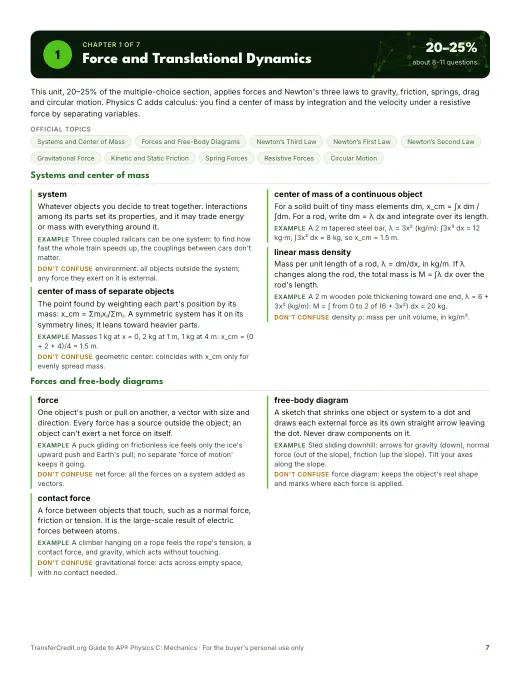
Page 1 of the TransferCredit.org Guide to AP® Physics C: Mechanics: the cover
Page 1 The cover
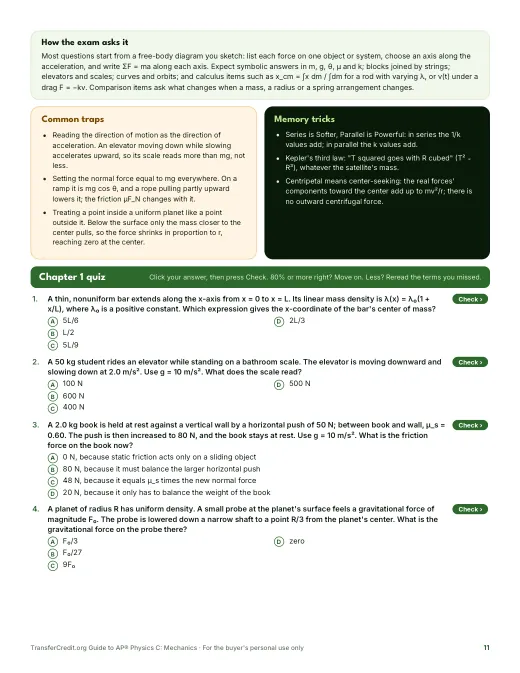
Page 7 of the TransferCredit.org Guide to AP® Physics C: Mechanics: the Chapter 1 opener
Page 7 The Chapter 1 opener
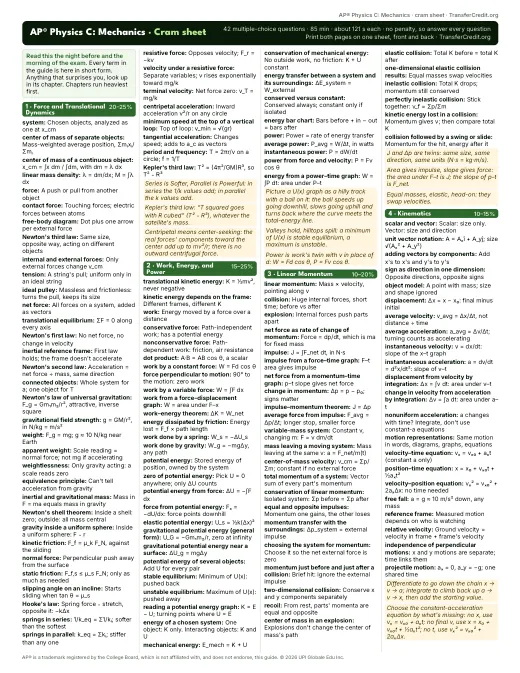
Page 11 of the TransferCredit.org Guide to AP® Physics C: Mechanics: a chapter quiz
Page 11 A chapter quiz
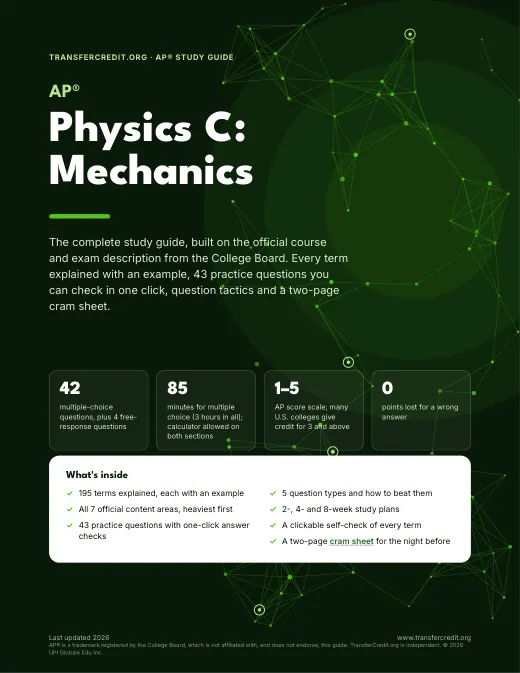
Page 42 of the TransferCredit.org Guide to AP® Physics C: Mechanics: the 2-page cram sheet
Page 42 The 2-page cram sheet

What you get for $5

One chapter for each area of the official course and exam description, heaviest topics first.

  • 📘43pages, printable
  • 🧭7chapters
  • 🔑195terms with examples
  • ✍️43practice questions, answers explained
  • ⚠️21exam traps to avoid
  • 📄2page cram sheet

Try 10 free AP® Physics C: Mechanics questions

Multiple-choice questions taken from the guide's chapter quizzes: 7 areas, heaviest first. About 20 minutes, with every answer explained and a score by area. The exam's free-response questions aren't in this quiz: see how the exam works.

10 questions  
  1. Question 1 · Force and Translational Dynamics
    A thin, nonuniform bar extends along the x-axis from x = 0 to x = L. Its linear mass density is λ(x) = λ₀(1 + x/L), where λ₀ is a positive constant. Which expression gives the x-coordinate of the bar's center of mass?
    Show the answer

    Answer: D. 5L/9. The total mass is M = ∫ from 0 to L of λ₀(1 + x/L) dx = 3λ₀L/2, and ∫ from 0 to L of xλ dx = λ₀(L²/2 + L²/3) = 5λ₀L²/6. So x_cm = (5λ₀L²/6)/(3λ₀L/2) = 5L/9, a little past the middle, toward the denser end.

    The trap: 5L/6 divides by λ₀L, the mass the bar would have if its density were λ₀ everywhere. The density rises to 2λ₀ at x = L, so its real mass is 3λ₀L/2.

  2. Question 2 · Work, Energy, and Power
    A 2.0 kg cart starts from rest at x = 0 on a frictionless horizontal track. The only horizontal force on it acts along +x with magnitude F(x) = 12 − 3x², in newtons with x in meters. What is the cart's speed at x = 2.0 m?
    Show the answer

    Answer: C. 4.0 m/s. The work is W = ∫ from 0 to 2.0 m of (12 − 3x²) dx = [12x − x³] = 24 − 8 = 16 J. By the work–energy theorem, 16 J = ½(2.0 kg)v², so v = 4.0 m/s.

    The trap: 4.9 m/s uses W = F(0) × d = 12 N × 2.0 m = 24 J. The force shrinks as the cart moves, so the work must come from the integral.

  3. Question 3 · Linear Momentum
    A 0.50 kg puck starts at rest on frictionless ice. From t = 0 to t = 2.0 s, the only horizontal force on it points east with magnitude F(t) = 6t(2 − t), in newtons with t in seconds. What is the puck's speed at t = 2.0 s?
    Show the answer

    Answer: B. 16 m/s. The impulse is J = ∫ from 0 to 2.0 s of (12t − 6t²) dt = [6t² − 2t³] from 0 to 2.0 = 24 − 16 = 8.0 N·s. The puck starts from rest, so its momentum becomes 8.0 kg·m/s and v = 8.0/0.50 = 16 m/s, east.

    The trap: 24 m/s multiplies the peak force, 6 N at t = 1 s, by the full 2.0 s. The force is smaller at every other moment, so integrate F(t) instead.

  4. Question 4 · Kinematics
    A particle moves along the x-axis with position x(t) = 2t³ − 9t² + 12t, with x in meters and t in seconds. What is the particle's acceleration at the first instant after t = 0 when it is momentarily at rest?
    Show the answer

    Answer: A. −6 m/s². v = dx/dt = 6t² − 18t + 12 = 6(t − 1)(t − 2), so the particle is first at rest at t = 1 s. Then a = dv/dt = 12t − 18 = 12(1) − 18 = −6 m/s².

    The trap: 0 m/s² assumes an object at rest isn't accelerating. Its velocity is zero for only an instant; the −6 m/s² acceleration is what turns it around.

  5. Question 5 · Torque and Rotational Dynamics
    A thin rod of mass M and length L gets denser toward one end: its linear mass density is λ = bx, where x is the distance from the light end and b is a positive constant. Which expression gives the rod's rotational inertia about an axis through the light end, perpendicular to the rod?
    Show the answer

    Answer: A. ML²/2. The mass is M = ∫ from 0 to L of bx dx = bL²/2, so b = 2M/L². Then I = ∫x² dm = ∫ from 0 to L of bx³ dx = bL⁴/4 = (2M/L²)(L⁴/4) = ML²/2.

    The trap: ML²/3 is the uniform rod's result. Here more of the mass sits near the far end, away from the axis, so the rotational inertia is larger.

  6. Question 6 · Rotational Energy and Momentum
    A merry-go-round with rotational inertia 100 kg·m² about its axle is at rest and turns with negligible friction. A 25 kg child runs at 4.0 m/s along a straight line that passes 1.0 m from the axle and jumps on where that line crosses the edge, 2.0 m from the axle. Treat the child as a point mass. What is the angular speed of the merry-go-round and child just after she lands?
    Show the answer

    Answer: D. 0.50 rad/s. No outside torque acts about the axle during the brief landing, so angular momentum about it is conserved. Before: L = mvr⊥ = 25 × 4.0 × 1.0 = 100 kg·m²/s, where 1.0 m is the perpendicular distance from the axle to her path. After: I = 100 + 25 × 2.0² = 200 kg·m², so ω = 100/200 = 0.50 rad/s.

    The trap: 1.0 rad/s uses the 2.0 m edge radius as the lever arm. Her angular momentum about the axle is mv times the perpendicular distance from the axle to her line of motion, 1.0 m.

  7. Question 7 · Oscillations
    A thin uniform hoop with mass M and radius R hangs on a horizontal nail through a point on its rim and swings in its own plane through small angles. Its rotational inertia about its center is MR². Which expression gives the period of its oscillation?
    Show the answer

    Answer: B. 2π√(2R/g). This is a physical pendulum with d = R from the nail to the center of mass. The parallel axis theorem gives I = MR² + MR² = 2MR² about the nail, so T = 2π√(I/(Mgd)) = 2π√(2MR²/(MgR)) = 2π√(2R/g).

    The trap: 2π√(R/g) uses the rotational inertia about the hoop's center. The hoop turns about the nail on its rim, so the parallel axis theorem adds MR².

  8. Question 8 · Force and Translational Dynamics
    A 50 kg student rides an elevator while standing on a bathroom scale. The elevator is moving downward and slowing down at 2.0 m/s². Use g = 10 m/s². What does the scale read?
    Show the answer

    Answer: C. 600 N. Moving down while slowing means the acceleration points up. With up as positive, F_N − mg = ma, so F_N = 50(10 + 2.0) = 600 N. The scale reads the normal force, the student's apparent weight.

    The trap: 400 N assumes that moving down means accelerating down. The elevator is slowing on its way down, so its acceleration is upward and the scale must read more than mg.

  9. Question 9 · Work, Energy, and Power
    Two objects interact through a conservative force. The system's potential energy is U(x) = A/x² − B/x, where x is the distance between them and A and B are positive constants. Which expression gives the separation at which the system is in stable equilibrium?
    Show the answer

    Answer: B. 2A/B. Equilibrium needs Fₓ = −dU/dx = 0: dU/dx = −2A/x³ + B/x² = 0 gives x = 2A/B. U is a minimum there (it climbs toward +∞ at small x and back up toward zero at large x), so the equilibrium is stable.

    The trap: A/B is where U(x) = 0. Equilibrium needs the slope of U to be zero, not U itself.

  10. Question 10 · Linear Momentum
    An open railcar rolls along a straight, level track with negligible friction. Grain pours straight down into it from a stationary chute at a constant rate of β kilograms per second. A locomotive pushes the railcar so that it keeps a constant speed v. Which expression gives the horizontal force the locomotive must exert?
    Show the answer

    Answer: D. βv. The grain lands with no horizontal velocity and must be brought up to speed v. By the impulse–momentum theorem, F = dp/dt = v(dm/dt) + m(dv/dt). The speed is constant, so dv/dt = 0 and F = βv.

    The trap: ½βv sets the force's power, Fv, equal to the rate at which the grain gains kinetic energy, ½βv². Half the energy supplied is dissipated as the grain is dragged up to speed, so the energy shortcut fails; momentum gives βv.

The AP® Physics C: Mechanics exam at a glance

The AP® Physics C: Mechanics exam is from the College Board. It has 42 multiple-choice questions, plus 4 free-response questions. You get 85 minutes for multiple choice (3 hours in all); calculator allowed on both sections. The score scale is 1–5 (AP® score scale; many U.S. colleges give credit for 3 and above). The guide has 7 chapters, one for each area of the official course and exam description; the heaviest is Force and Translational Dynamics at 20–25%.

Questions
42multiple-choice questions, plus 4 free-response questions
Time
85 minfor the 42 multiple-choice questions, about 121 seconds a question
Score
1–5AP® score scale; many U.S. colleges give credit for 3 and above
Fee
$99per exam in the U.S. and Canada in 2026-27; your school may charge more
Calculator
Yescalculator allowed on both sections
Wrong answers
No penaltya wrong answer costs nothing
  • Section I has 42 multiple-choice questions in 85 minutes (50% of your score). Some stand alone; others come in sets that share one stimulus or data set. Section II has 4 free-response questions in 95 minutes (50%).
  • The free-response questions come in this order: Mathematical Routines (10 points, suggested 20–25 minutes), Translation Between Representations (12 points, 25–30 minutes), Experimental Design and Analysis (10 points, 25–30 minutes) and Qualitative/Quantitative Translation (8 points, 15–20 minutes).
  • This is a hybrid digital exam: you answer the multiple-choice questions and read the free-response questions in the Bluebook app, and you handwrite your free-response answers in a paper booklet. A four-function, scientific or graphing calculator is allowed on both sections (an approved handheld one or Bluebook's built-in Desmos calculator), and an equation sheet with calculus and vector formulas is provided.
  • Your multiple-choice score is the number of questions you answer correctly, so a wrong answer costs nothing.
  • The course is calculus-based: expect derivatives and integrals throughout. Where a number for g is needed, the exam uses g ≈ 10 m/s² (9.8 or 9.81 m/s² is also accepted).
  • Unit 2 is 20–25% of the multiple-choice section, Unit 3 is 15–25%, Unit 4 is 10–20%, and Units 1, 5, 6 and 7 are 10–15% each. From May 2027 the exam has 42 multiple-choice questions in 85 minutes and a 95-minute free-response section; older practice material may show 40 questions, 80 minutes and 100 minutes.

Source: official AP® Physics C: Mechanics page and the official course and exam description. Last updated 2026.

What the exam covers

7 chapters, heaviest first, with each area's official weight. The guide's chapters follow this order.

  1. Force and Translational Dynamics20–25% · ~8–11 Q
  2. Work, Energy, and Power15–25% · ~6–11 Q
  3. Linear Momentum10–20% · ~4–8 Q
  4. Kinematics10–15% · ~4–6 Q
  5. Torque and Rotational Dynamics10–15% · ~4–6 Q
  6. Energy and Momentum of Rotating Systems10–15% · ~4–6 Q
  7. Oscillations10–15% · ~4–6 Q

Where to start: the 4 heaviest areas (marked in the map) carry about 29 of the 42 questions. The guide puts them first, so working front to back covers the most points earliest.

AP® Physics C: Mechanics study guide by area

The heaviest area is open to read now. The full guide has a chapter for every area, each with all its terms, a quiz and an answer key.

1 of 7 chapters open  ·  in the guide's order
20–25% · about 8–11 questions · free preview Force and Translational Dynamics Chapter 1 of the guide

This unit, 20–25% of the multiple-choice section, applies forces and Newton's three laws to gravity, friction, springs, drag and circular motion. Physics C adds calculus: you find a center of mass by integration and the velocity under a resistive force by separating variables.

Key terms, with examples

system
Whatever objects you decide to treat together. Interactions among its parts set its properties, and it may trade energy or mass with everything around it.
Example: Three coupled railcars can be one system: to find how fast the whole train speeds up, the couplings between cars don't matter.
force
One object's push or pull on another, a vector with size and direction. Every force has a source outside the object; an object can't exert a net force on itself.
Example: A puck gliding on frictionless ice feels only the ice's upward push and Earth's pull; no separate 'force of motion' keeps it going.
Newton's third law
Forces come in pairs: if A exerts a force on B, B exerts one on A of the same size, pointing the opposite way: F_A on B = −F_B on A.
Example: A rocket's engine pushes exhaust gas backward with 5000 N, so the gas pushes the rocket forward with 5000 N.
net force
The vector sum of all the forces exerted on a system. Add the forces along each axis separately, with signs for direction, then combine the components.
Example: On level ice, ropes pull a sled with 6 N east and 8 N north: the net horizontal force is √(36 + 64) = 10 N.
Newton's second law
The net external force on a system, divided by its mass, gives the acceleration of its center of mass: a = ΣF/m. The acceleration points the same way as ΣF.
Example: A net force of 4500 N forward on a 1500 kg car gives a = 4500/1500 = 3 m/s² forward.
Newton's law of universal gravitation
Two masses attract along the line between their centers of mass: F_g = Gm₁m₂/r², G = 6.67 × 10⁻¹¹ N·m²/kg². Twice the distance, one-fourth the force.
Example: Two asteroids, 500 kg and 600 kg, 2 m apart: F_g = (6.67 × 10⁻¹¹)(3 × 10⁵)/2² ≈ 5.0 × 10⁻⁶ N.
kinetic friction
Friction on a surface sliding over another: F_f = μ_k F_N, opposite the sliding. The contact area doesn't affect it; μ_k depends on the two materials.
Example: A 50 kg sled pulled horizontally on level snow with μ_k = 0.10 feels 0.10 × 500 = 50 N of friction, opposite its sliding.
Hooke's law
An ideal (massless) spring pulls or pushes in proportion to how far it is stretched or squeezed from its relaxed length, back toward equilibrium: F_s = −kΔx.
Example: A spring with k = 400 N/m compressed 0.03 m pushes outward with 400 × 0.03 = 12 N.
resistive force
A velocity-dependent force that points opposite the object's velocity, such as air or water drag. A simple model is F_r = −kv, where k is a positive constant.
Example: A ball moving through syrup at 4 m/s with k = 0.5 kg/s feels 0.5 × 4 = 2 N of drag, backward.
centripetal acceleration
The acceleration component toward the center of a circular path, a_c = v²/r. One force, several forces or force components (as on a banked curve) can cause it.
Example: A car takes a 40 m radius curve at 20 m/s: a_c = 20²/40 = 10 m/s², toward the curve's center.
center of mass of separate objects
The point found by weighting each part's position by its mass: x_cm = Σmᵢxᵢ/Σmᵢ. A symmetric system has it on its symmetry lines; it leans toward heavier parts.
Example: Masses 1 kg at x = 0, 2 kg at 1 m, 1 kg at 4 m: x_cm = (0 + 2 + 4)/4 = 1.5 m.
contact force
A force between objects that touch, such as a normal force, friction or tension. It is the large-scale result of electric forces between atoms.
Example: A climber hanging on a rope feels the rope's tension, a contact force, and gravity, which acts without touching.

What this area covers

Systems and center of massForces and free-body diagramsNewton's third law, tension and pulleysNewton's first law and equilibriumNewton's second lawGravitational forceFrictionSpring forcesResistive forcesCircular motion and orbits

How the exam asks it

Most questions start from a free-body diagram you sketch: list each force on one object or system, choose an axis along the acceleration, and write ΣF = ma along each axis. Expect symbolic answers in m, g, θ, μ and k; blocks joined by strings; elevators and scales; curves and orbits; and calculus items such as x_cm = ∫x dm / ∫dm for a rod with varying λ, or v(t) under a drag F = −kv. Comparison items ask what changes when a mass, a radius or a spring arrangement changes.

Common traps

Trap 1. Reading the direction of motion as the direction of acceleration. An elevator moving down while slowing accelerates upward, so its scale reads more than mg, not less.

Trap 2. Setting the normal force equal to mg everywhere. On a ramp it is mg cos θ, and a rope pulling partly upward lowers it; the friction μF_N changes with it.

Trap 3. Treating a point inside a uniform planet like a point outside it. Below the surface only the mass closer to the center pulls, so the force shrinks in proportion to r, reaching zero at the center.

Memory trick

Series is Softer, Parallel is Powerful: in series the 1/k values add; in parallel the k values add.

Kepler's third law: "T squared goes with R cubed" (T² ∝ R³), whatever the satellite's mass.

How AP® Physics C: Mechanics questions are written

The exam has 42 multiple-choice questions, plus 4 free-response questions. The guide sorts the questions into 5 types; spot the type and you'll know what the question wants before you read the choices.

Type 1

Derive a symbolic expression (skill 2.A)

Only letters are given (masses, lengths, k, θ and g), and the question asks "Which expression gives ...?" The four choices are formulas built from those letters; the wrong ones come from a lost factor of 2, an inverted ratio or the wrong principle.

  • Name the principle the situation calls for (forces, energy, momentum, torque or an oscillation period) and write it in symbols.
  • Do the algebra in letters all the way to the unknown.
  • Compare with the choices, then break any tie with a units check or an extreme case.
Type 2

Calculate a value with units (skill 2.B)

Given values with units (the stem says "Use g = 10 m/s²" when gravity matters) and a request for one number, often "closest to". Some questions come in sets built on one shared table, graph or description.

  • Write down each given value with its unit, and mark the quantity you're asked for.
  • Choose the principle that links them and solve in letters before you substitute.
  • If your value misses every choice, look for a dropped ½, a missing square or square root, or a unit slip such as cm for m.
Type 3

Use calculus: a rate or an area (skills 2.A and 2.B)

A quantity given as a function, such as x(t), F(x), U(x) or P(t), or a graph described by its key points. The question asks for a rate (a derivative or slope) or a total built up over an interval (an integral or area).

  • Decide whether the question wants a rate at one instant or a total over an interval.
  • Differentiate, or integrate between the limits the question gives, using the power rule.
  • Don't put one instant's value into an equation meant for constant forces, accelerations or powers.
Type 4

Compare scenarios or predict a factor of change (skills 2.C and 2.D)

Two setups or two moments to compare (is one quantity greater, less or the same?), or several cases to rank, or one variable changed by a factor (doubled, four times, halved) with a question about how another quantity changes.

  • Write the formula for the asked quantity in letters and mark every variable that changes.
  • Replace each changed variable by its new value, such as ℓ → 4ℓ, and simplify; whatever doesn't change cancels.
  • For a comparison or ranking, work out the same expression for each case, then compare.
Type 5

Make or justify a claim (skills 3.B and 3.C)

A scenario, a data table or a student's statement, followed by choices of the form "claim, because reason". Often two choices share the right claim and only one gives the right reason.

  • Settle the claim first (greater, less, equal, right or wrong) using one law or definition.
  • Strike every choice whose claim disagrees with yours.
  • Of the survivors, pick the reason that is both true and the actual cause; a true fact that doesn't explain the claim is a trap.

Test-day habits that add points

  1. Answer every question. There's no penalty for a wrong answer. A blank is always worth zero, so never leave one.
  2. Predict, then look. Name the answer before reading the choices. It protects you from distractors written to sound right.
  3. Eliminate. Cross out choices you know are wrong. Every choice you rule out raises your odds on a guess.
  4. Mark and move on. You have about 2 minutes a question (42 in 85 minutes). If one takes much longer, pick your best guess, mark it and come back if time allows.
  5. Check units and extreme cases. Before you choose a formula answer, check that its units match the quantity asked for. Then try an extreme case, such as a mass going to zero or an angle going to 90°: the right expression still makes physical sense. Wrong choices often fail one of these two checks.
  6. Change answers for a reason. Switch an answer only when you can say why the new one is better, such as a detail you missed.
  7. The four free-response questions. Section II has 4 free-response questions in 95 minutes (50% of your score), in this order. Mathematical Routines (10 points, suggested 20–25 minutes): derive expressions, calculate values, and create and use a representation such as a free-body diagram or a velocity–time sketch. Translation Between Representations (12 points, 25–30 minutes): create a visual representation such as a diagram, derive equations and draw graphs, then justify whether they agree or predict and justify. Experimental Design and Analysis (10 points, 25–30 minutes): design a procedure, doable with typical high school lab equipment, that varies one quantity and measures its effect on another, describe how you would analyze the data, then plot given data and use a slope or intercept. Qualitative/Quantitative Translation (8 points, 15–20 minutes): make and justify a claim, derive an equation, then justify agreement or predict and justify. You read the questions in Bluebook and handwrite your answers in a paper booklet.

Pacing: 42 questions in 85 minutes, about 121 seconds a question.

AP® Physics C: Mechanics flashcards

Try the first 8 cards free. Read the term, say the definition out loud, then select the card to check yourself. Arrow keys move between cards.

Free card 1 of 8 (deck total: 195)

How to study for AP® Physics C: Mechanics: a 5-step plan

Follow the steps, then enter your test date. The planner gives you a dated plan that starts with the heaviest areas and saves the last days for review.

  1. Take the 10 free questionsSee which AP® Physics C: Mechanics areas you already know.
  2. Study the heaviest areas firstStart with Force and Translational Dynamics, Work, Energy, and Power and Linear Momentum, then work down the exam map.
  3. Learn each term with an exampleSay the definition out loud, then check it with the flashcards. A term you can't use in an example isn't learned yet.
  4. Quiz yourself and study the trapsAfter each area, answer its quiz and read why the tempting wrong answer is wrong.
  5. Plan backwards from your exam dateBuild a dated plan, keep the last days for a full review, and read the cram sheet the night before.

How it works

  1. 1Check outSelect Get the guide · $5 and pay on TransferCredit.org's secure checkout.
  2. 2Download the PDFFrom your TransferCredit.org account.
  3. 3Study the heaviest areas firstFollow the 2-, 4- or 8-week plan, then read the cram sheet the night before.

This page or the full guide

Everything on this page is free with no account. The full guide is a PDF you keep.

What's on this page and in the full study guide
Study toolThis pageFull study guide ($5)
ChaptersA preview of 1 of 7All 7
Terms explainedA sample from the open chaptersAll 195, each with an example
Practice questions10 free questions43, with an answer key
Flashcards8 cardsAll 195 terms on the self-check list
Study planDated planner2-, 4- and 8-week plans
Cram sheet—2 pages, for the night before
FormatWeb page43-page PDF, printable

Questions students ask

What's in the full AP® Physics C: Mechanics study guide?
43 pages: 7 chapters, one for each area of the College Board's official course and exam description, heaviest topics first. 195 terms, each with a plain-English definition and an example, common traps and memory tricks, 43 practice questions with an answer key that explains every answer, question tactics, 2-, 4- and 8-week study plans and a 2-page cram sheet.
How much is the full AP® Physics C: Mechanics study guide?
The full 43-page PDF is $5. The 10 practice questions on this page are free.
How do I get the full guide?
Select Get the guide · $5 and check out on TransferCredit.org. Then sign in to your TransferCredit.org account to download the PDF.
Can I print the guide or use it on my phone?
Yes. It's a PDF, so it opens on phones, tablets and computers, and printing is allowed. Its tick boxes and answer bubbles work in PDF readers that support forms. Copying and editing are turned off.
Can I try the AP® Physics C: Mechanics guide before I buy it?
Yes. This page has 10 questions from the guide's own chapter quizzes, a preview of the heaviest area, 8 flashcards and a study planner. No account needed.
Is this an official AP® study guide?
No. AP® is a trademark registered by the College Board, which is not affiliated with, and does not endorse, this guide. TransferCredit.org is independent. We built the guide from the College Board's official course and exam description, and the exam details were checked against the College Board's published exam information in 2026.
How was this study guide made?
One chapter for each area of the official course and exam description, using its published weights. Each chapter was written, then fact-checked against the official exam information in a separate review. The practice questions are original: none are copied from the College Board's released questions.
How up to date is this AP® Physics C: Mechanics guide?
Last updated 2026. The exam details were checked against the College Board's published exam information in 2026. Exams change, so confirm the details on the official AP® Physics C: Mechanics page before you test.
More questions about the AP® Physics C: Mechanics exam (16)
What is the AP® Physics C: Mechanics exam?
The AP® Physics C: Mechanics exam is from the College Board. It has 42 multiple-choice questions, plus 4 free-response questions. You get 85 minutes for multiple choice (3 hours in all); calculator allowed on both sections. The score scale is 1–5 (AP® score scale; many U.S. colleges give credit for 3 and above). The guide has 7 chapters, one for each area of the official course and exam description; the heaviest is Force and Translational Dynamics at 20–25%.
How many questions are on the AP® Physics C: Mechanics exam, and how long is it?
Section I has 42 multiple-choice questions in 85 minutes (50% of your score). Some stand alone; others come in sets that share one stimulus or data set. Section II has 4 free-response questions in 95 minutes (50%). The free-response questions come in this order: Mathematical Routines (10 points, suggested 20–25 minutes), Translation Between Representations (12 points, 25–30 minutes), Experimental Design and Analysis (10 points, 25–30 minutes) and Qualitative/Quantitative Translation (8 points, 15–20 minutes).
How is the AP® Physics C: Mechanics exam scored?
The score scale is 1–5: AP® score scale; many U.S. colleges give credit for 3 and above. Your multiple-choice score is the number of questions you answer correctly, so a wrong answer costs nothing.
What AP® Physics C: Mechanics score do I need for college credit?
Many U.S. colleges give credit for 3 and above. Each college sets its own credit policy, so check the one at your college before you count on the credit.
How much does the AP® Physics C: Mechanics exam cost?
The fee is $99: per exam in the U.S. and Canada in 2026-27; your school may charge more. Fees can change, so check the official page when you register.
Can I use a calculator on the AP® Physics C: Mechanics exam?
A four-function, scientific or graphing calculator is allowed on both sections (an approved handheld one or Bluebook's built-in Desmos calculator), and an equation sheet with calculus and vector formulas is provided.
Is there a penalty for guessing on AP® Physics C: Mechanics?
No. There's no penalty for a wrong answer. A blank is always worth zero, so never leave one.
What topics are on the AP® Physics C: Mechanics exam?
7 areas, from the official course and exam description: Force and Translational Dynamics (20–25%); Work, Energy, and Power (15–25%); Linear Momentum (10–20%); Kinematics (10–15%); Torque and Rotational Dynamics (10–15%); Energy and Momentum of Rotating Systems (10–15%); Oscillations (10–15%).
Which AP® Physics C: Mechanics topics should I study first?
The 4 heaviest areas (marked in the map) carry about 29 of the 42 questions. The guide puts them first, so working front to back covers the most points earliest.
Is the AP® Physics C: Mechanics exam hard?
It depends on what you already know. The largest area, Force and Translational Dynamics, is 20–25%, and the smallest, Oscillations, is 10–15%. Try the 10 free questions above to see where you stand in about 20 minutes.
What kinds of questions are on the AP® Physics C: Mechanics exam?
The exam has 42 multiple-choice questions, plus 4 free-response questions. The guide sorts the questions into 5 types: “Derive a symbolic expression (skill 2.A)”, “Calculate a value with units (skill 2.B)”, “Use calculus: a rate or an area (skills 2.A and 2.B)”, “Compare scenarios or predict a factor of change (skills 2.C and 2.D)” and “Make or justify a claim (skills 3.B and 3.C)”. Multiple-choice questions have 4 answer choices. See how each type is written.
What are the free-response questions on the AP® Physics C: Mechanics exam?
Section II has 4 free-response questions in 95 minutes (50% of your score), in this order. Mathematical Routines (10 points, suggested 20–25 minutes): derive expressions, calculate values, and create and use a representation such as a free-body diagram or a velocity–time sketch. Translation Between Representations (12 points, 25–30 minutes): create a visual representation such as a diagram, derive equations and draw graphs, then justify whether they agree or predict and justify. Experimental Design and Analysis (10 points, 25–30 minutes): design a procedure, doable with typical high school lab equipment, that varies one quantity and measures its effect on another, describe how you would analyze the data, then plot given data and use a slope or intercept. Qualitative/Quantitative Translation (8 points, 15–20 minutes): make and justify a claim, derive an equation, then justify agreement or predict and justify. You read the questions in Bluebook and handwrite your answers in a paper booklet.
How should I pace myself on the AP® Physics C: Mechanics exam?
42 questions in 85 minutes, about 121 seconds a question. You have about 2 minutes a question (42 in 85 minutes). If one takes much longer, pick your best guess, mark it and come back if time allows.
How long should I study for AP® Physics C: Mechanics?
Take the 10 free questions to see where you stand. The full guide has 2-, 4- and 8-week plans built from the exam weights, and the planner on this page builds a dated plan from your exam date.
How do I know I'm ready for the AP® Physics C: Mechanics exam?
The guide's readiness checklist: You can explain every term on the checklist without notes. You score 80% or better on every chapter quiz. You can read the cram sheet and nothing on it surprises you. You know the AP® score your college gives credit for, and your exam date.
What should I do the night before?
Read the 2-page cram sheet once, slowly. Check your exam time and room with your AP® coordinator. Multiple choice is in the Bluebook app; free-response answers are handwritten in a paper booklet. Bring up to 2 approved calculators if you want your own; Bluebook also has a built-in Desmos scientific and graphing calculator, and the equation sheet is provided. In the morning, skim the traps, then stop studying.

How we built this guide

We built one chapter for each area of the College Board's official course and exam description for AP® Physics C: Mechanics, using its published weights to order the chapters and size the quizzes. Each chapter was written, then fact-checked against the official exam information in a separate review. The exam details were checked against the College Board's published exam information in 2026.

Sources: official AP® Physics C: Mechanics page, official course and exam description. Last updated 2026.

AP® is a trademark registered by the College Board, which is not affiliated with, and does not endorse, this guide. TransferCredit.org is independent and not affiliated with the College Board. © 2026 UPI Globale Edu Inc.

Ready for the full AP® Physics C: Mechanics guide? 43 pages, 195 terms, 43 practice questions and a 2-page cram sheet, $5.

Get the guide · $5

In the full guide

TransferCredit.org Guide to AP® Physics C: Mechanics

  • All 7 chapters
  • 195 terms with examples
  • 43 practice questions with an answer key
  • A 2-page cram sheet and 2-, 4- and 8-week plans
Get the guide · $5